
Safety Comes First
Dave Gee | [email protected]
Don't be a fool when it comes to safety
PEOPLE SAY, "You're only fooling yourself," like it's a bad thing, but it doesn't have to be. Have you ever placed your car keys on top of some item you didn't want to forget to bring? That way, you won't leave it behind.
Since I can be forgetful and lazy when it comes to proper safety precautions, sometimes I resort to fooling myself into doing the right thing. For instance, my trusty Dremel tool gets plenty of use, but once upon a time, I would sometimes run it "just for a moment" to grind or cut something without wearing eye protection. Dumb!
When age caught up to me and made prescription glasses necessary for close-up work, I decided to solve two problems at once by getting safety-grade lenses in my reading glasses. That way I can't see to do the work unless I am properly protected.
A reader told me that when he developed sensitivity to Super Glue, he rewired the light switch in his workshop so that it automatically turned the exhaust fan on. Unless he tries to work in the dark, the glue fumes will always be carried out of the room. But he's only fooling himself.
Clem Wehner wasn't fooling when he told me about a long shot that paid off in a bad way.
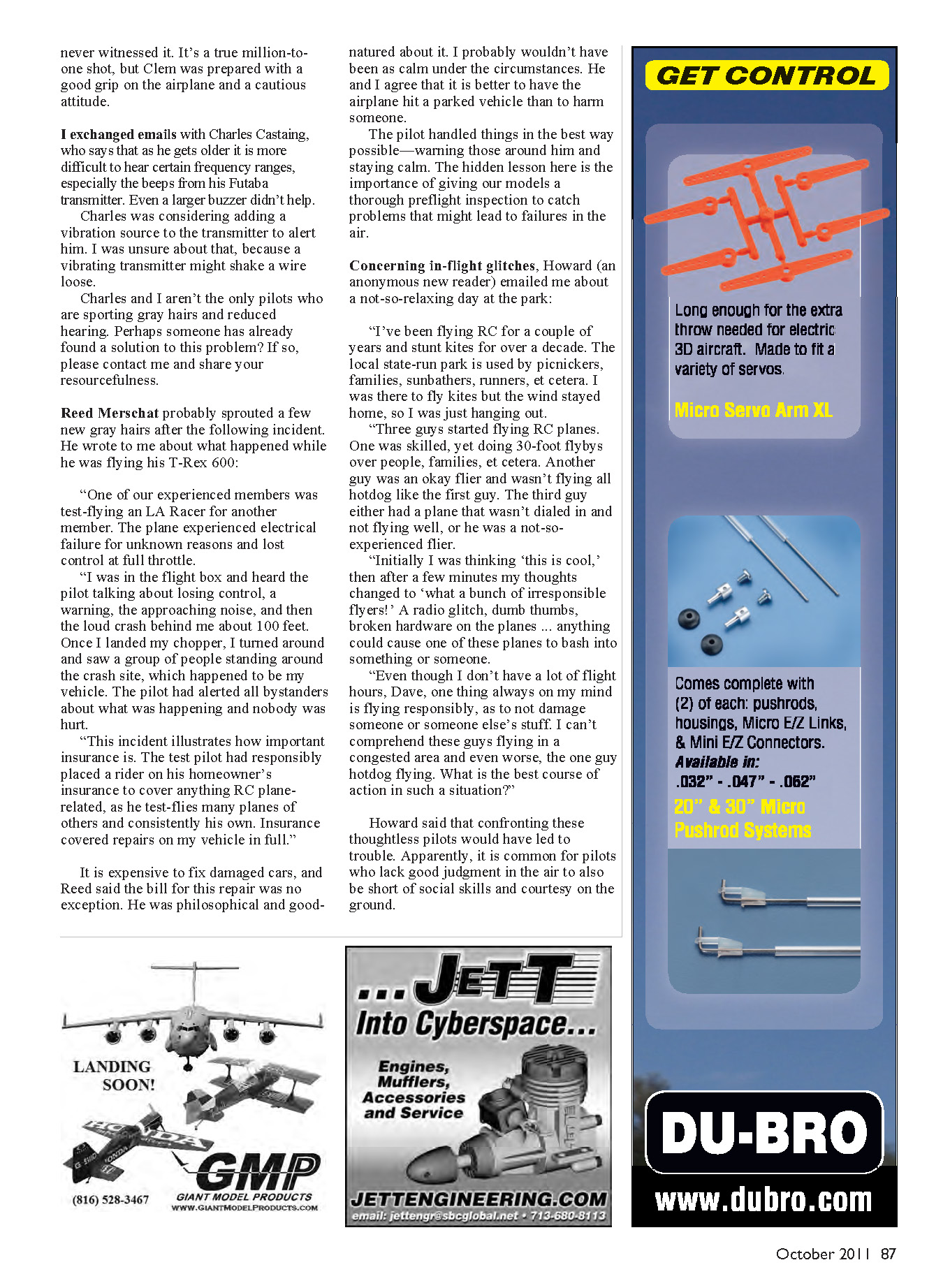
"My airplane had been soaking in the hot summer sun when I flipped the prop on the four-stroke Saito 65 to draw fuel into the carb after fueling. When I attached the glow plug clip, the engine started. I didn't flip the prop, it just started and continued running.
"Fortunately, the throttle was at idle and I had one hand on the glow plug clip and the other on the cowling, though only 2 inches from the prop. After recovering from the surprise, I realized the glow plug driver knob had gotten turned too high, which burned out the glow plug and caused the super-hot element to ignite the fuel.
"The prop had probably been left in a compression-stroke position. I've never seen this in 45 years of RC, but this chain of events could easily happen to anyone. Consider a fueled engine just like a loaded gun. I was lucky."
I've heard stories of this situation but never witnessed it. It's a true million-to-one shot, but Clem was prepared with a good grip on the airplane and a cautious attitude.
I exchanged emails with Charles Castaing, who says that as he gets older it is more difficult to hear certain frequency ranges, especially the beeps from his Futaba transmitter. Even a larger buzzer didn't help.
Charles was considering adding a vibration source to the transmitter to alert him. I was unsure about that, because a vibrating transmitter might shake a wire loose.
Charles and I aren't the only pilots who are sporting gray hairs and reduced hearing. Perhaps someone has already found a solution to this problem? If so, please contact me and share your resourcefulness.
Reed Merschat probably sprouted a few new gray hairs after the following incident. He wrote to me about what happened while he was flying his T-Rex 600:
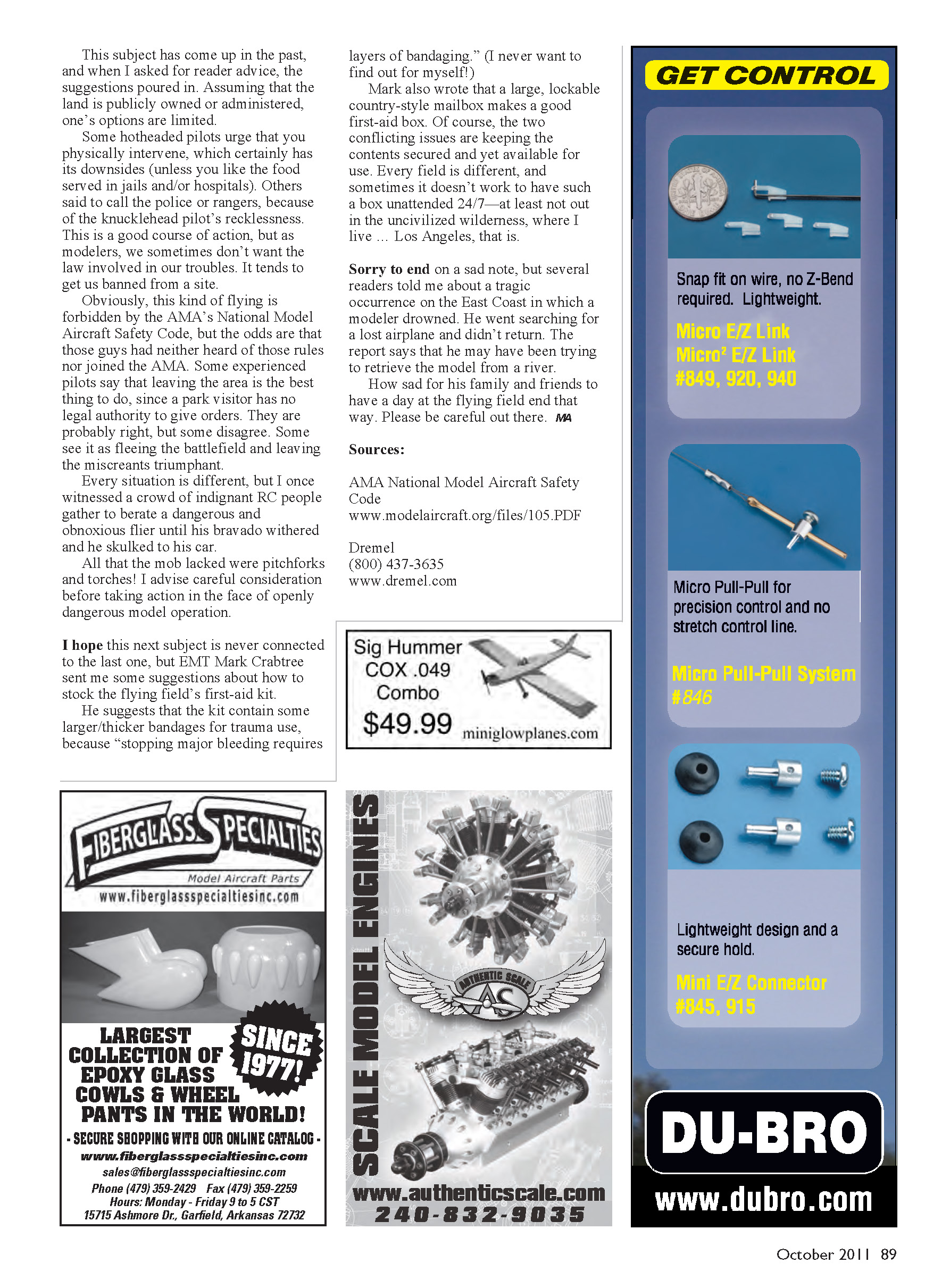
"One of our experienced members was test-flying an LA Racer for another member. The plane experienced electrical failure for unknown reasons and lost control at full throttle.
"I was in the flight box and heard the pilot talking about losing control, a warning, the approaching noise, and then the loud crash behind me about 100 feet. Once I landed my chopper, I turned around and saw a group of people standing around the crash site, which happened to be my vehicle. The pilot had alerted all bystanders about what was happening and nobody was hurt.
"This incident illustrates how important insurance is. The test pilot had responsibly placed a rider on his homeowner's insurance to cover anything RC plane-related, as he test-flies many planes of others and consistently his own. Insurance covered repairs on my vehicle in full."
It is expensive to fix damaged cars, and Reed said the bill for this repair was no exception. He was philosophical and good-natured about it. I probably wouldn't have been as calm under the circumstances. He and I agree that it is better to have the airplane hit a parked vehicle than to harm someone.
The pilot handled things in the best way possible—warning those around him and staying calm. The hidden lesson here is the importance of giving our models a thorough preflight inspection to catch problems that might lead to failures in the air.
Concerning in-flight glitches, Howard (an anonymous new reader) emailed me about a not-so-relaxing day at the park:
"I've been flying RC for a couple of years and stunt kites for over a decade. The local state-run park is used by picnickers, families, sunbathers, runners, et cetera. I was there to fly kites but the wind stayed home, so I was just hanging out.
"Three guys started flying RC planes. One was skilled, yet doing 30-foot flybys over people, families, et cetera. Another guy was an okay flier and wasn't flying all hotdog like the first guy. The third guy either had a plane that wasn't dialed in and not flying well, or he was a not-so-experienced flier.
"Initially I was thinking 'this is cool,' then after a few minutes my thoughts changed to 'what a bunch of irresponsible flyers!' A radio glitch, dumb thumbs, broken hardware on the planes ... anything could cause one of these planes to bash into something or someone.
"Even though I don't have a lot of flight hours, Dave, one thing always on my mind is flying responsibly, as to not damage someone or someone else's stuff. I can't comprehend these guys flying in a congested area and even worse, the one guy hotdog flying. What is the best course of action in such a situation?"
Howard said that confronting these thoughtless pilots would have led to trouble. Apparently, it is common for pilots who lack good judgment in the air to also be short of social skills and courtesy on the ground.
I hope this next subject is never connected to the last one, but EMT Mark Crabtree sent me some suggestions about how to stock the flying field’s first-aid kit.
He suggests that the kit contain some larger/thicker bandages for trauma use, because “stopping major bleeding requires layers of bandaging.” (I never want to find out for myself!)
Mark also wrote that a large, lockable country-style mailbox makes a good first-aid box. Of course, the two conflicting issues are keeping the contents secured and yet available for use. Every field is different, and sometimes it doesn’t work to have such a box unattended 24/7—at least not out in the uncivilized wilderness, where I live ... Los Angeles, that is.
Sorry to end on a sad note, but several readers told me about a tragic occurrence on the East Coast in which a modeler drowned. He went searching for a lost airplane and didn’t return. The report says that he may have been trying to retrieve the model from a river.
How sad for his family and friends to have a day at the flying field end that way. Please be careful out there. MA
Sources:
AMA National Model Aircraft Safety Code www.modelaircraft.org/files/105.PDF
Dremel (800) 437-3635 www.dremel.com
Transcribed from original scans by AI. Minor OCR errors may remain.

