
Pit viper visits the pits
Dave Gee
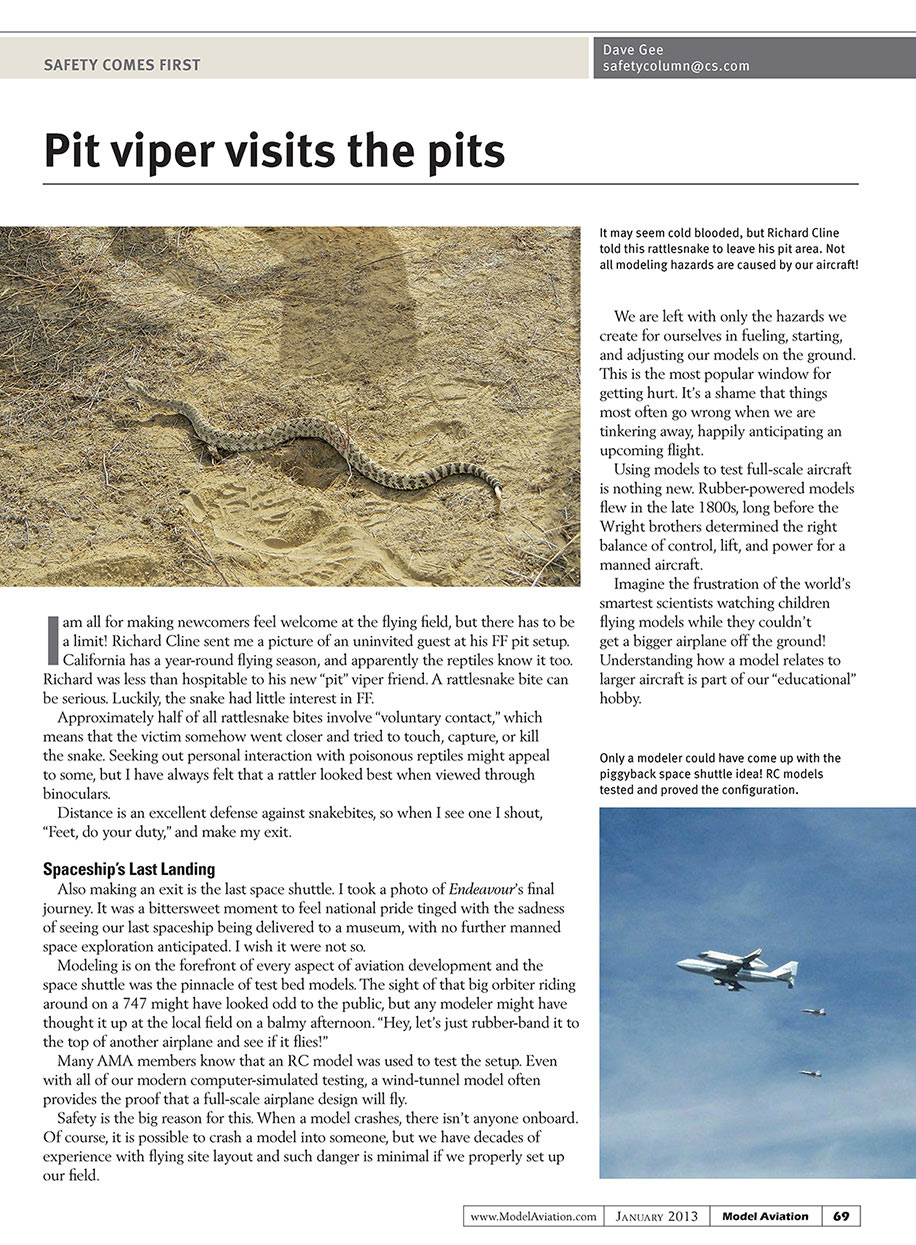
I am all for making newcomers feel welcome at the flying field, but there has to be a limit: Richard Cline sent me a picture of an uninvited guest at his FF pit setup. California has a year-round flying season, and apparently the reptiles know it too. Richard was less than hospitable to his new "pit" viper friend. A rattlesnake bite can be serious. Luckily, the snake had little interest in FF.
Approximately half of all rattlesnake bites involve "voluntary contact," which means that the victim somehow went closer and tried to touch, capture, or kill the snake. Seeking out personal interaction with poisonous reptiles might appeal to some, but I have always felt that a rattler looked best when viewed through binoculars.
Distance is an excellent defense against snakebites, so when I see one I shout, "Feet, do your duty," and make my exit.
Spaceship's Last Landing
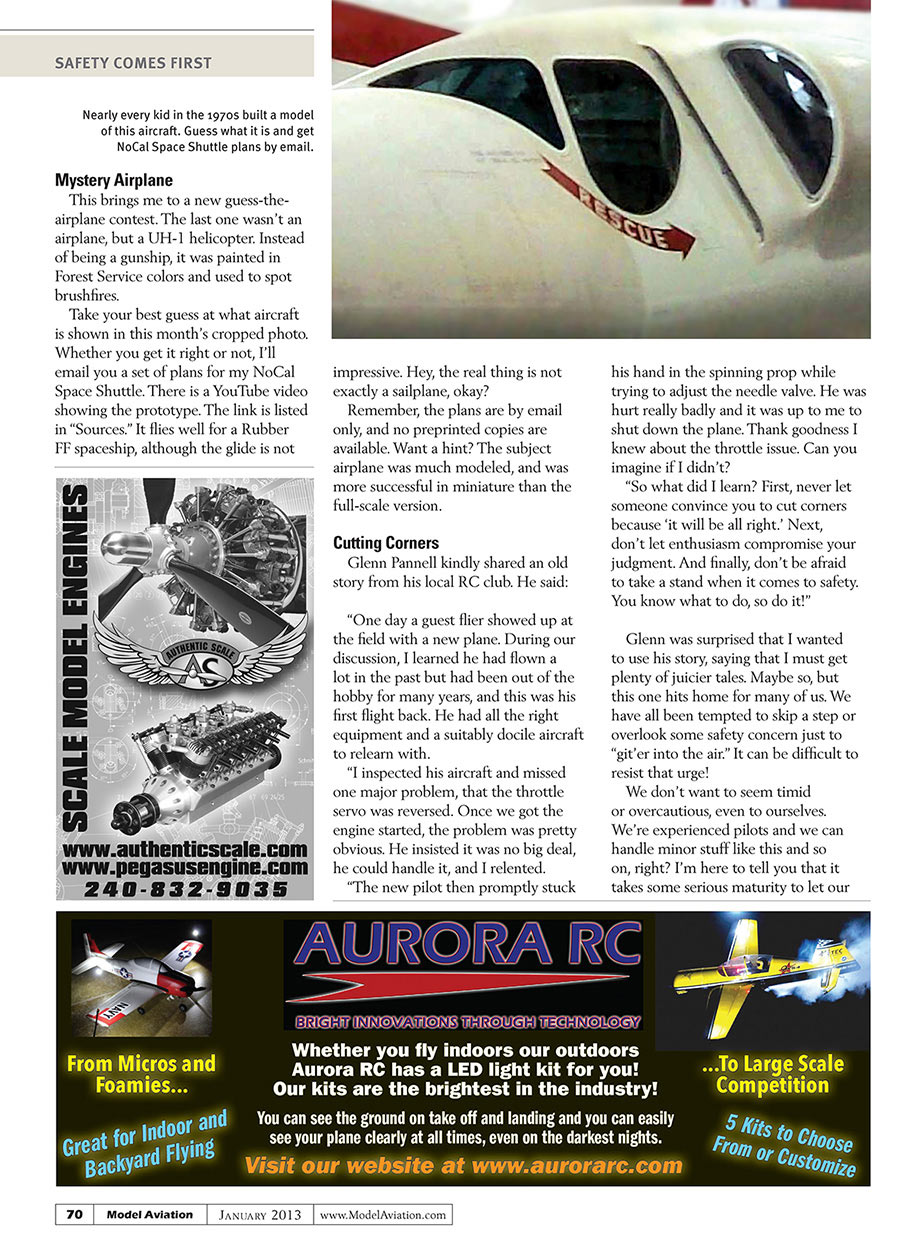
Also making an exit is the last space shuttle. I took a photo of Endeavour's final journey. It was a bittersweet moment to feel national pride tinged with the sadness of seeing our last spaceship being delivered to a museum, with no further manned space exploration anticipated. I wish it were not so.
Modeling is on the forefront of every aspect of aviation development and the space shuttle was the pinnacle of test bed models. The sight of that big orbiter riding around on a 747 might have looked odd to the public, but any modeler might have thought it up at the local field on a balmy afternoon. "Hey, let's just rubber-band it to the top of another airplane and see if it flies!"
Many AMA members know that an RC model was used to test the setup. Even with all of our modern computer-simulated testing, a wind-tunnel model often provides the proof that a full-scale airplane design will fly.
Safety is the big reason for this. When a model crashes, there isn't anyone onboard. Of course, it is possible to crash a model into someone, but we have decades of experience with flying site layout and such danger is minimal if we properly set up our field.
We are left with only the hazards we create for ourselves in fueling, starting, and adjusting our models on the ground. This is the most popular window for getting hurt. It's a shame that things most often go wrong when we are tinkering away, happily anticipating an upcoming flight.
Using models to test full-scale aircraft is nothing new. Rubber-powered models flew in the late 1800s, long before the Wright brothers determined the right balance of control, lift, and power for a manned aircraft.
Imagine the frustration of the world's smartest scientists watching children flying models while they couldn't get a bigger airplane off the ground!
Understanding how a model relates to larger aircraft is part of our "educational" hobby.
Safety Comes First
Dave Gee
Mystery Airplane
This brings me to a new guess-the-airplane contest. The last one wasn't an airplane, but a UH-1 helicopter. Instead of being a gunship, it was painted in Forest Service colors and used to spot brushfires.
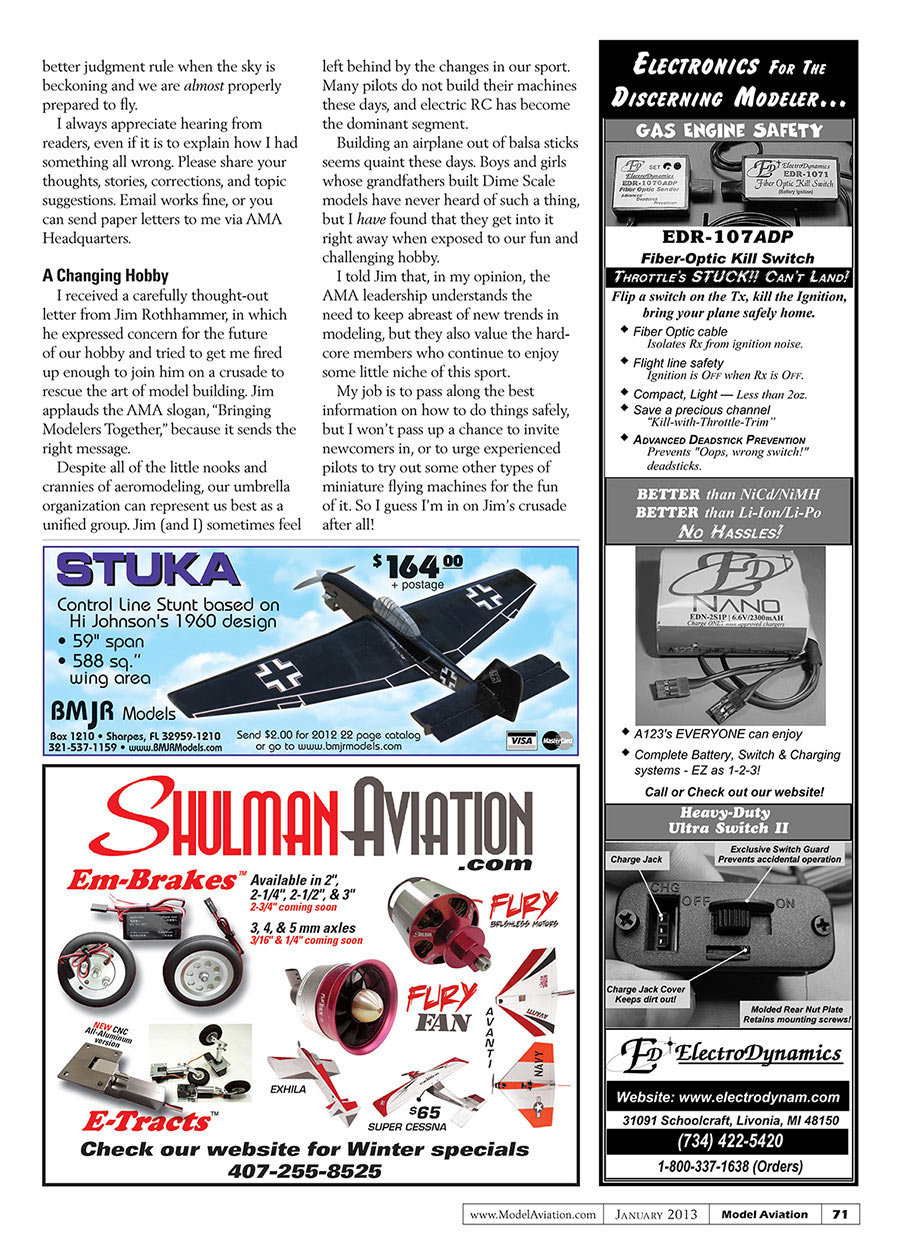
Take your best guess at what aircraft is shown in this month's cropped photo. Whether you get it right or not, I'll email you a set of plans for my NoCal Space Shuttle. There is a YouTube video showing the prototype. The link is listed in "Sources." It flies well for a Rubber FF spaceship, although the glide is not impressive. Hey, the real thing is not exactly a sailplane, okay?
Remember, the plans are by email only, and no preprinted copies are available. Want a hint? The subject airplane was much modeled, and was more successful in miniature than the full-scale version.
Cutting Corners
Glenn Pannell kindly shared an old story from his local RC club. He said:
"One day a guest flier showed up at the field with a new plane. During our discussion, I learned he had flown a lot in the past but had been out of the hobby for many years, and this was his first flight back. He had all the right equipment and a suitably docile aircraft to relearn with.
"I inspected his aircraft and missed one major problem, that the throttle servo was reversed. Once we got the engine started, the problem was pretty obvious. He insisted it was no big deal, he could handle it, and I relented.
"The new pilot then promptly stuck his hand in the spinning prop while trying to adjust the needle valve. He was hurt really badly and it was up to me to shut down the plane. Thank goodness I knew about the throttle issue. Can you imagine if I didn't?
"So what did I learn? First, never let someone convince you to cut corners because 'it will be all right.' Next, don't let enthusiasm compromise your judgment. And finally, don't be afraid to take a stand when it comes to safety. You know what to do, so do it!"
Glenn was surprised that I wanted to use his story, saying that I must get plenty of juicier tales. Maybe so, but this one hits home for many of us. We have all been tempted to skip a step or overlook some safety concern just to "git 'er into the air." It can be difficult to resist that urge!
We don't want to seem timid or overcautious, even to ourselves. We're experienced pilots and we can handle minor stuff like this and so on, right? I'm here to tell you that it takes some serious maturity to let our better judgment rule when the sky is beckoning and we are almost properly prepared to fly.
I always appreciate hearing from readers, even if it is to explain how I had something all wrong. Please share your thoughts, stories, corrections, and topic suggestions. Email works fine, or you can send paper letters to me via AMA Headquarters.
A Changing Hobby
I received a carefully thought-out letter from Jim Rothhammer, in which he expressed concern for the future of our hobby and tried to get me fired up enough to join him on a crusade to rescue the art of model building. Jim applauds the AMA slogan, “Bringing Modelers Together,” because it sends the right message.
Despite all of the little nooks and crannies of aeromodeling, our umbrella organization can represent us best as a unified group. Jim (and I) sometimes feel left behind by the changes in our sport. Many pilots do not build their machines these days, and electric RC has become the dominant segment.
Building an airplane out of balsa sticks seems quaint these days. Boys and girls whose grandfathers built Dime Scale models have never heard of such a thing, but I have found that they get into it right away when exposed to our fun and challenging hobby.
I told Jim that, in my opinion, the AMA leadership understands the need to keep abreast of new trends in modeling, but they also value the hardcore members who continue to enjoy some little niche of this sport.
My job is to pass along the best information on how to do things safely, but I won’t pass up a chance to invite newcomers in, or to urge experienced pilots to try out some other types of miniature flying machines for the fun of it. So I guess I’m in on Jim’s crusade after all!
Dave Gee
Supply and Demand
The idea of niche markets within our hobby was discussed on an Internet chat board recently. Most fliers realize that we all benefit from mass-produced hobby products, even if we aren't interested in that particular type of airplane or helicopter. Selling popular and profitable items can allow suppliers to carry other things that we may like.
I don't mind walking down an aisle past stuff I don't want, if the airplane I do want is waiting at the end of the row. Mass-market products help our hobby grow, so I encourage it, although I am more likely to find something of interest at cottage suppliers.
One person posted, "I don't buy stuff just to support suppliers. Business is not a charity. If we don't want it enough to buy it, we don't need it enough for them to supply it."
Although I philosophically agree with this pure capitalistic view, our entire hobby is a small niche that would disappear from commerce if not for the emotionally motivated actions of suppliers and purchasers.
People go into business as cottage suppliers for us not because they expect to make more profits in this line than they could in others, but because they have the fever and want to become more involved with aeromodeling.
"How do you end up with a small fortune in the aviation business? Start with a large fortune," someone wrote on the chat board.
Therefore, I often support specialized suppliers by purchasing more than I need, and promoting their products to my friends. It is not so much "charity" as advancing the interest of my hobby.
Products that do not directly serve my interests are valuable because they promote modeling, so I sometimes purchase things I do not need. I want to encourage the maker/seller, and there is always a kid who is thrilled to receive the items from me.
Just because someone has not yet advanced to FF and remains mired in RC, doesn't mean he or she isn't a real modeler.
SOURCES:
Space Shuttle NoCal in flight www.youtube.com/watch?v=tDvBXIiEloU
Transcribed from original scans by AI. Minor OCR errors may remain.

