
Look before you cut
It's the digital age, and my friend, Howard Littman, had a modeling injury involving one of his digits. He kindly wrote about his account, despite knowing that I would share it with the world. Howard wrote:
"It's hard to type with my finger in a splint, but here goes anyway. I'm pushing 70 and about five years ago, my left index finger went numb. The doctors could find no cause or cure. Since the effect did not really get in the way of doing things, I simply got used to it.
"Recently, I was cutting a paper pattern for my laser cutter. I held down a steel ruler with my left hand, with a hobby knife in my right hand. I was paying attention to holding the ruler straight and did not see, and more importantly could not feel, that my index finger was over the edge of the ruler. The knife neatly sliced off the tip of my index finger as it passed! My first reaction was to wonder, 'What was that thing that just fell onto the paper?' Then the bleeding started ...
"I am on an aspirin regimen, and one downside is that you tend to bleed more. In this case, alarmingly! The wound was obviously too large for the little bandages I keep handy, but was not a candidate for sewing back on, so I decided to perform first aid on myself. I wrapped the finger in paper towels and headed into the house. During my efforts to bandage the wound, I noticed something in that finger that I had not felt in years ... it hurt!
"The next day, it still hurt pretty bad, so I visited the doctor after all. He put a wraparound bandage on it with a removable aluminum splint to protect it from impact, and then told me that it was going to hurt for the better part of the next two weeks.
"I learned some painful lessons. If you have some part of your body that you cannot feel, be sure that you actually look at where that body part is before moving or starting a tool. Also, keep a full-on first-aid kit in your work area."
Howard is an expert model designer, and I was glad to hear that his wound was healing nicely and wouldn't interfere with his drawing.
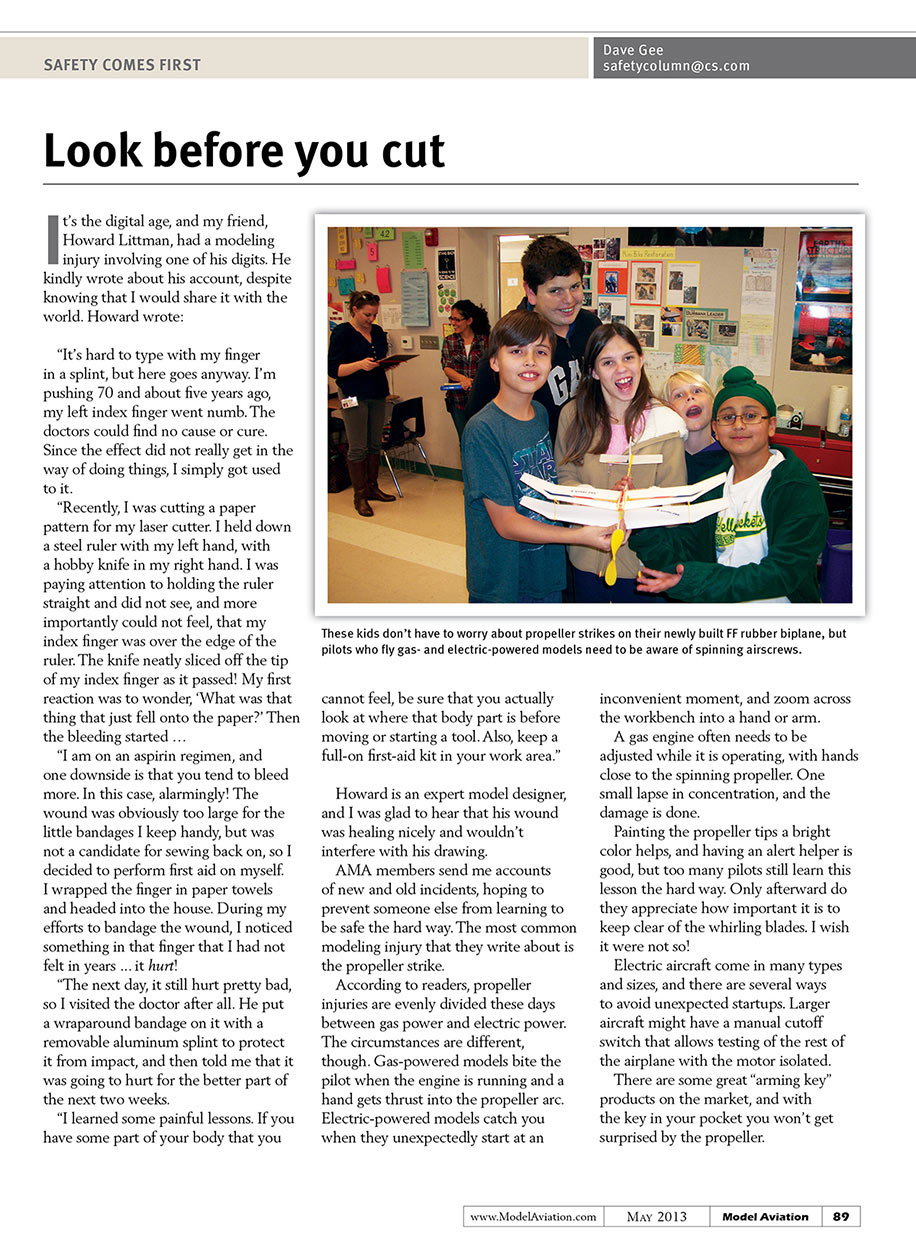
AMA members send me accounts of new and old incidents, hoping to prevent someone else from learning to be safe the hard way. The most common modeling injury that they write about is the propeller strike.
According to readers, propeller injuries are evenly divided these days between gas power and electric power. The circumstances are different, though. Gas-powered models bite the pilot when the engine is running and a hand gets thrust into the propeller arc. Electric-powered models catch you when they unexpectedly start at an inconvenient moment, and zoom across the workbench into a hand or arm.
A gas engine often needs to be adjusted while it is operating, with hands close to the spinning propeller. One small lapse in concentration, and the damage is done.
Painting the propeller tips a bright color helps, and having an alert helper is good, but too many pilots still learn this lesson the hard way. Only afterward do they appreciate how important it is to keep clear of the whirling blades. I wish it were not so!
Electric aircraft come in many types and sizes, and there are several ways to avoid unexpected startups. Larger aircraft might have a manual cutoff switch that allows testing of the rest of the airplane with the motor isolated.
There are some great "arming key" products on the market, and with the key in your pocket you won't get surprised by the propeller's unexpected startup.
Some smaller electrics have no on/off switch and they use the battery disconnect as a master switch. Most of these systems will not permit the propeller to start when powering up, even if the throttle stick happens to be full on.
Small motors are becoming very powerful, and although this is great for the hobby, they require more caution.
Old-timers such as me, who are accustomed to small electrics being low powered and harmless, need to keep up with technology or get bitten!
Another Mystery Airplane Contest?
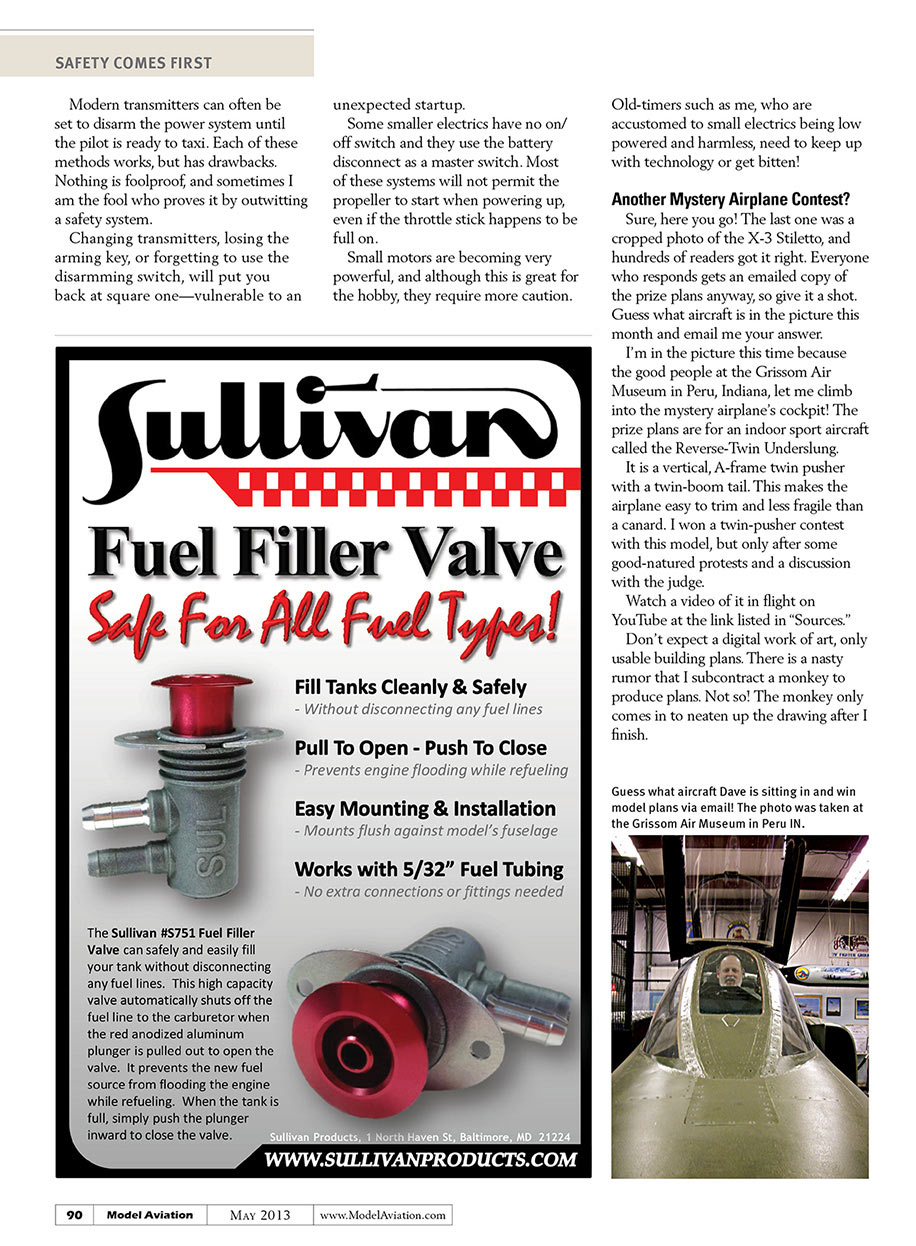
Sure, here you go! The last one was a cropped photo of the X-3 Stiletto, and hundreds of readers got it right. Everyone who responds gets an emailed copy of the prize plans anyway, so give it a shot. Guess what aircraft is in the picture this month and email me your answer.
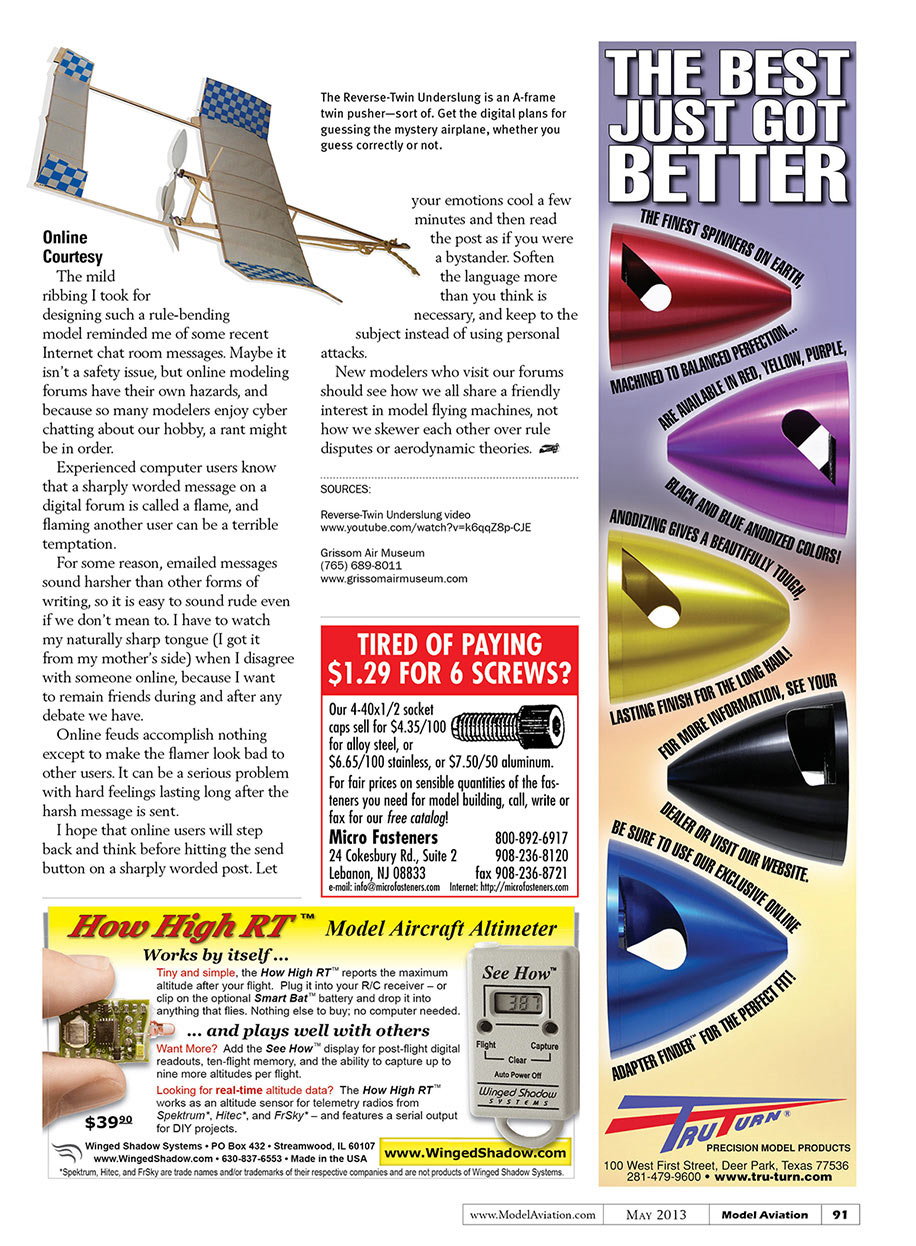
I'm in the picture this time because the good people at the Grissom Air Museum in Peru, Indiana, let me climb into the mystery airplane's cockpit! The prize plans are for an indoor sport aircraft called the Reverse-Twin Underslung.
It is a vertical, A-frame twin pusher with a twin-boom tail. This makes the airplane easy to trim and less fragile than a canard. I won a twin-pusher contest with this model, but only after some good-natured protests and a discussion with the judge.
Watch a video of it in flight on YouTube at the link listed in "Sources."
Don't expect a digital work of art, only usable building plans. There is a nasty rumor that I subcontract a monkey to produce plans. Not so! The monkey only comes in to neaten up the drawing after I finish.
Online Courtesy
The mild ribbing I took for designing such a rule-bending model reminded me of some recent Internet chat room messages. Maybe it isn't a safety issue, but online modeling forums have their own hazards, and because so many modelers enjoy cyber chatting about our hobby, a rant might be in order.
Experienced computer users know that a sharply worded message on a digital forum is called a flame, and flaming another user can be a terrible temptation.
For some reason, emailed messages sound harsher than other forms of writing, so it is easy to sound rude even if we don't mean to. I have to watch my naturally sharp tongue (I got it from my mother's side) when I disagree with someone online, because I want to remain friends during and after any debate we have.
Online feuds accomplish nothing except to make the flamer look bad to other users. It can be a serious problem with hard feelings lasting long after the harsh message is sent.
I hope that online users will step back and think before hitting the send button on a sharply worded post. Let your emotions cool a few minutes and then read the post as if you were a bystander. Soften the language more than you think is necessary, and keep to the subject instead of using personal attacks.
New modelers who visit our forums should see how we all share a friendly interest in model flying machines, not how we skewer each other over rule disputes or aerodynamic theories.
SOURCES:
Reverse-Twin Underslung video www.youtube.com/watch?v=k6gqZ8p-CJE
Grissom Air Museum (765) 689-8011 www.grissomairmuseum.com
Transcribed from original scans by AI. Minor OCR errors may remain.

