
Pilot carelessness puts us all in danger
Dave Gee
Promises, promises! When I was a kid, science magazines predicted that there would soon be a personal aircraft in every driveway and we would all fly to work each day. Well, I’m still waiting for my own suburban helicopter, but the advances in our model aircraft far exceed any predictions from the good old days.
Our electric systems have outrageous power-to-weight ratios and modern RC systems are ultrareliable, interference-proof, and amazingly affordable. Laser-cut kits and superglue make model building faster and easier than ever. What an age of miracles—better and more practical than the magazine predictions!
My father said it’s a good thing they didn’t keep that promise about personal aircraft, because too many people in his neighborhood can’t properly drive a car, never mind a flying machine. Sometimes it seems as though the same is true for models. Some people don’t seem ready for the responsibility.
Readers have sent me video links that show RC pilots doing some scary stuff. Not satisfied with simply doing some wildly unsafe thing, they make sure it is taped and posted online!
I’ve seen videos showing models flying too close to spectators and pit procedures that would make my hair stand on end (if I had any left). Some videos show people flying while heavily intoxicated, or deliberately trying to hit each other with RC models. There are also videos of pilots flying in inappropriate places with traffic and obstacles that leave no margin for error or an in-flight emergency.
Isn’t there enough fun in our hobby already without endangering each other and risking a storm of bad publicity for us all? Why must some pilots make a point of breaking time-tested safety rules? The risk they take is not only to their own health, but to the safety of others nearby, and to the public image of all modelers.
Fun Is Fun, But . . .
Hey, I’m all for the lighthearted enjoyment of our sport, but there is a line between playfulness and negligence.
My local club has a reputation for irreverence (they don’t call us the Black Sheep Squadron for nothing), but you’ll never see a more serious bunch when it’s time for setting safety lines or clearing a C/L circle. Nothing spoils good times like physical injuries, and even worse than hurting yourself would be causing harm to a friend or an innocent bystander.
We prevent accidents by being cautious and following proper safety procedures when operating our aircraft. There’s no reason why we can’t have fun at the same time, but first things first.
Sorry to get graphic and stern, but this fad of doing foolish things and then publicizing them has upset me. We need to discourage such things whenever possible. I don’t expect any of the perpetrators to read this, but maybe some of their friends will. A true friend would step up and talk some sense when RC abuse is planned.
A flying model has potential to bring great harm as well as great delight. Servicing or flying your machine is the time for concentration and good judgment—not fooling around!
Safety Overkill
Sometimes a pilot (often one who is doing something dangerous) will complain about safety overkill, and how ridiculous it is to have so many “petty” rules. I’ve heard complaints about “safety nuts,” which is an attempt to insult those who care about the well-being of their modeling friends and our sport.
Experienced fliers typically don’t have problems with the rules. They’ve been around long enough to know what happens when people take shortcuts. I'm the first to fight against dumb or pointless regulations, but throughout many decades of model activity, modelers found out the hard way what works and what doesn't. I'm happy to put that experience to use.
Safety overkill exists in our hobby and in the world. We need to use our judgment and experience to ensure that flying field regulations are logical and practical. It's not hard.
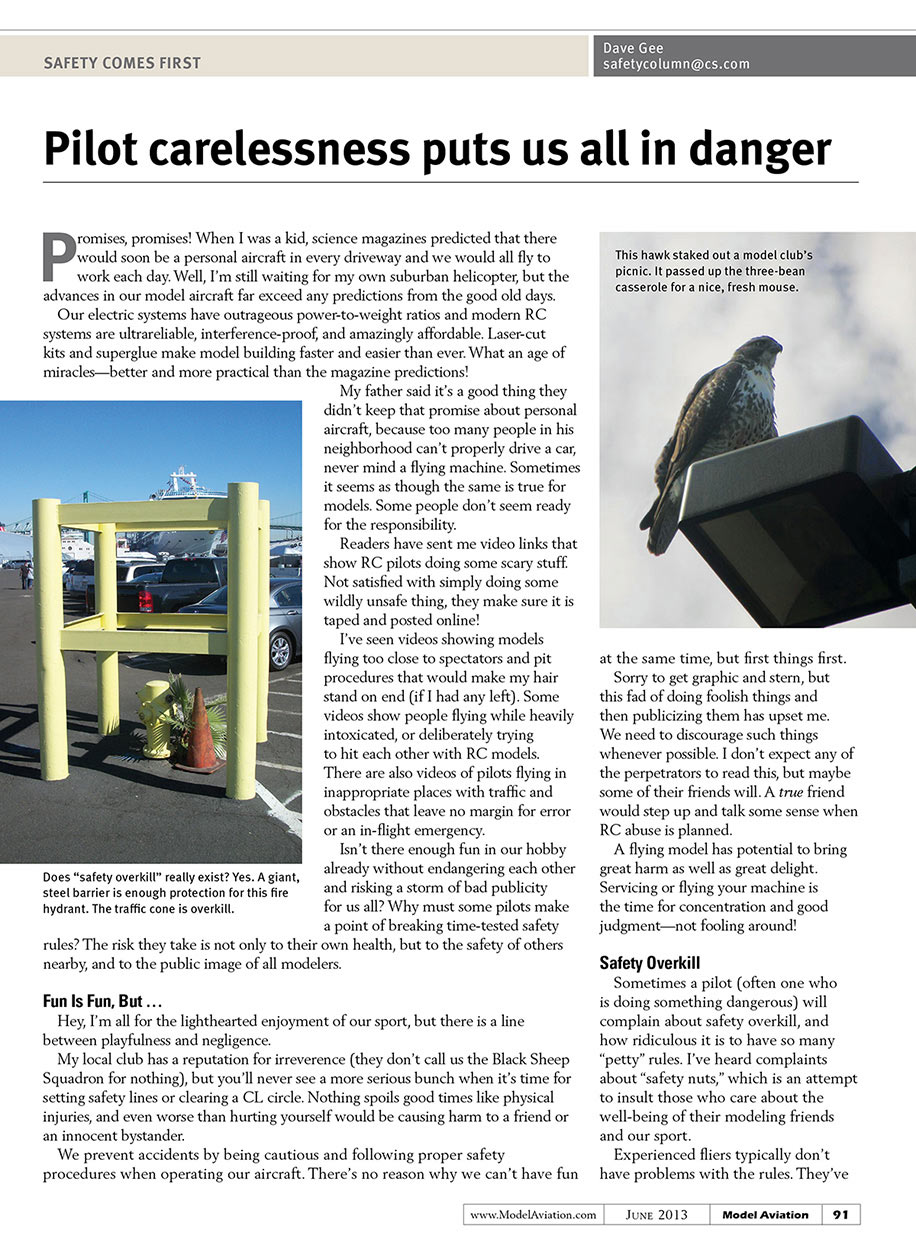
Here's an example of apparent safety overkill: I recently snapped a photo of a fire hydrant in the parking lot at the USS Iowa floating museum.
Someone decided that there should be a big barrier around the hydrant. I wonder what they thought might drive through the parking lot?
What made me grin was that the huge posts and crossbeams were apparently not enough. An orange traffic cone was added to make sure that nothing happened to that fireplug. There! That should do it!
If you ever get the chance to visit San Pedro, California, don't miss the battleship Iowa tour. You will be delighted and astounded at this marvelous ship.
Although some of the email I get is upsetting (such as the reckless flying videos), I am always happy to hear from readers. Sometimes they have new topics or good information, and occasionally I get set straight on some matter. The best emails have close-call stories or tales about hard lessons that we can learn the easy way.
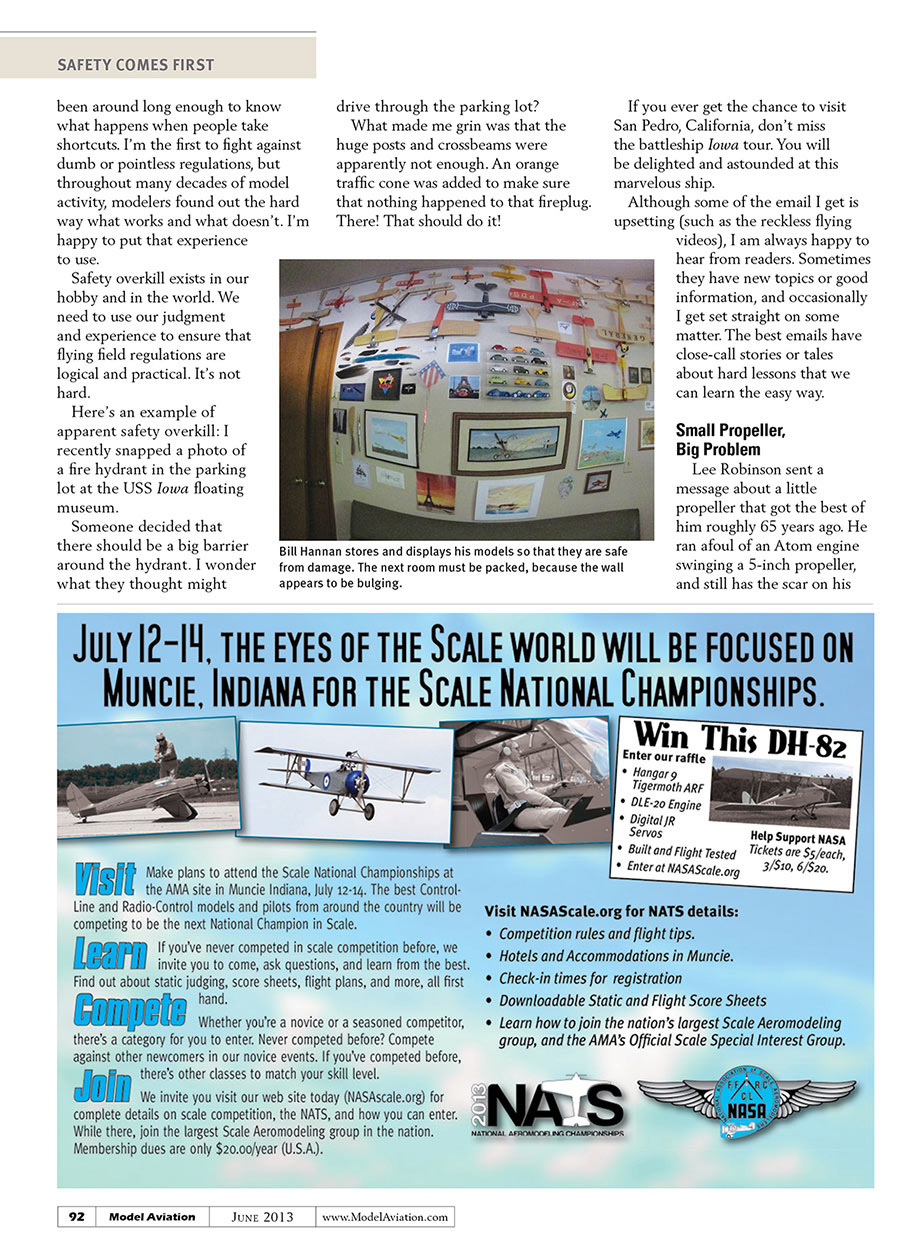
Bill Hannan stores and displays his models so that they are safe from damage. The next room must be packed, because the wall appears to be bulging.
Small Propeller, Big Problem
Lee Robinson sent a message about a little propeller that got the best of him roughly 65 years ago. He ran afoul of an Atom engine swinging a 5-inch propeller, and still has the scar on his right thumb. Lee wrote that it doesn't take a big propeller to do serious damage, so we should watch them all.
Follow-Ups
Readers sent follow-up information on past topics. In my March 2013 column I discussed ways to store your hobby equipment so that it is less vulnerable to natural disasters. Bill Hannan sent a photograph showing how he displays his models, protecting them from California earthquakes and cats. Hanging them by the tail (the models, not the cats) greatly reduces dust accumulation.
Take a close look at the photo and you might recognize some of the models. Bill has published plenty of great aeromodelling material, and some of the airplanes pictured are somewhat famous.
Shake It Up
Ricky Gode wrote to me about adding a vibration feature to transmitters. Pilots who have difficulty hearing sometimes cannot detect the beeps of a low-battery warning. Ricky tracked down and installed a device that slightly shakes his radio instead of simply beeping.
He noted that there are many products available, because partial hearing loss varies from individual to individual. I won't go into details, but if you need them, they are available.
Wild Animals at Flying Sites
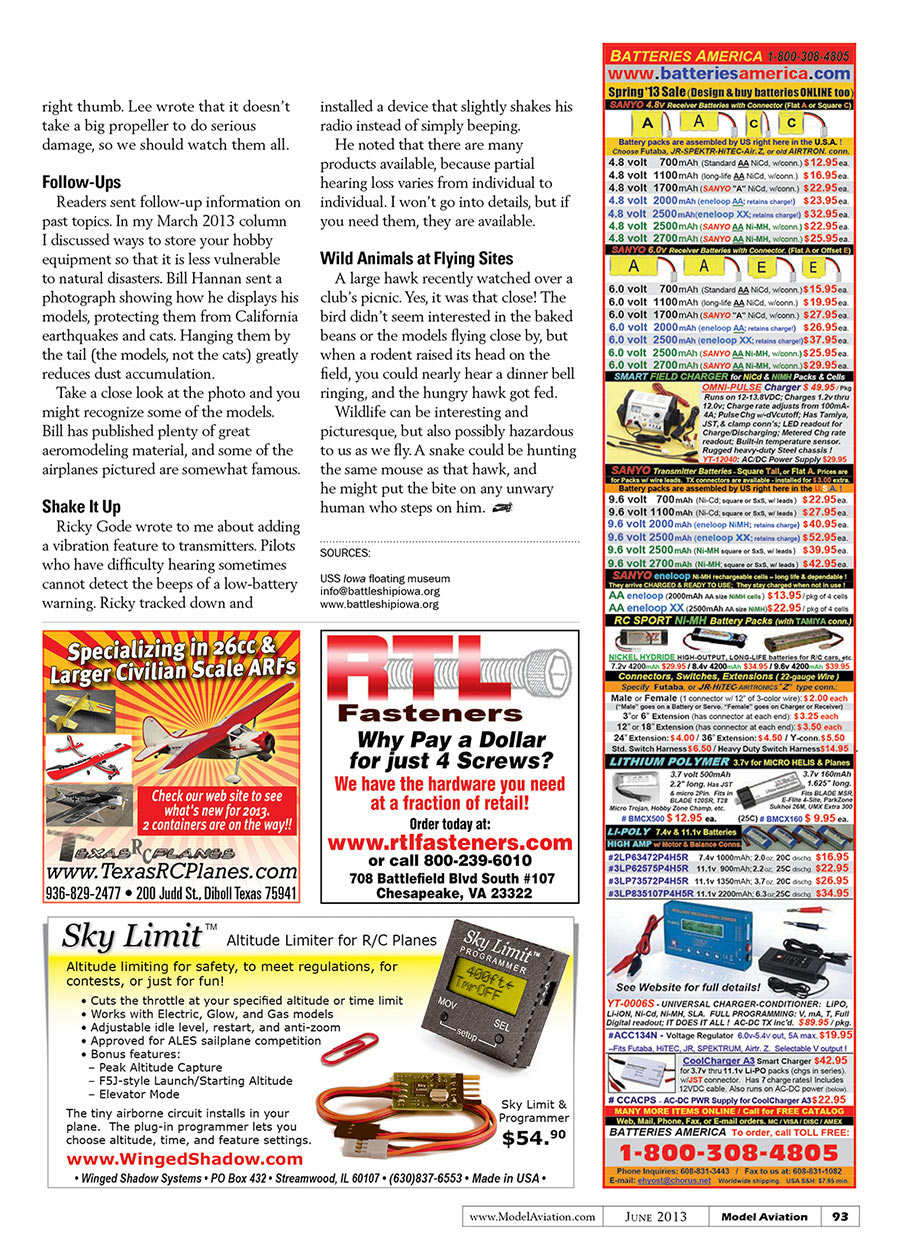
A large hawk recently watched over a club's picnic. Yes, it was that close! The bird didn't seem interested in the baked beans or the models flying close by, but when a rodent raised its head on the field, you could nearly hear a dinner bell ringing, and the hungry hawk got fed.
Wildlife can be interesting and picturesque, but also possibly hazardous to us as we fly. A snake could be hunting the same mouse as that hawk, and he might put the bite on any unwary human who steps on him.
SOURCES
- USS Iowa floating museum
- [email protected]
- www.battleshipiowa.org
Transcribed from original scans by AI. Minor OCR errors may remain.

