
Teaching an old dog new tricks
Dave Gee [email protected]
How do you learn things about modeling? Where do you go to find information when a new challenge arises? And, especially, where do you get answers to safety questions? Your flying buddies? A club officer? The Internet? The AMA website? This magazine?
There are probably some who, like me, blunder through every mistake until finding a method that works. I'm the poster child of trial and error, but I don't recommend that technique. Asking and learning is better.
I am fortunate to have a mentor (my father) who is wise and experienced and willing to share his knowledge. Not many modelers are as lucky! A technical question about some newfangled electronic device might stump us both, and then it's time to ask Google.
There are loads of homemade videos available for every possible facet of aeromodeling. When someone learns a skill or solves a problem, he or she typically wants to share the knowledge with other pilots.
This is great, and the resulting body of knowledge is terrific for new fliers and old dogs learning new tricks. Sometimes you can find several videos with opposing viewpoints, but that's our sport. There can be more than one right way to do something.
Regarding Mentors
Most people get into modeling to enjoy their own aircraft, not to become instructors. Someone who is willing and able to teach newcomers is a treasure.
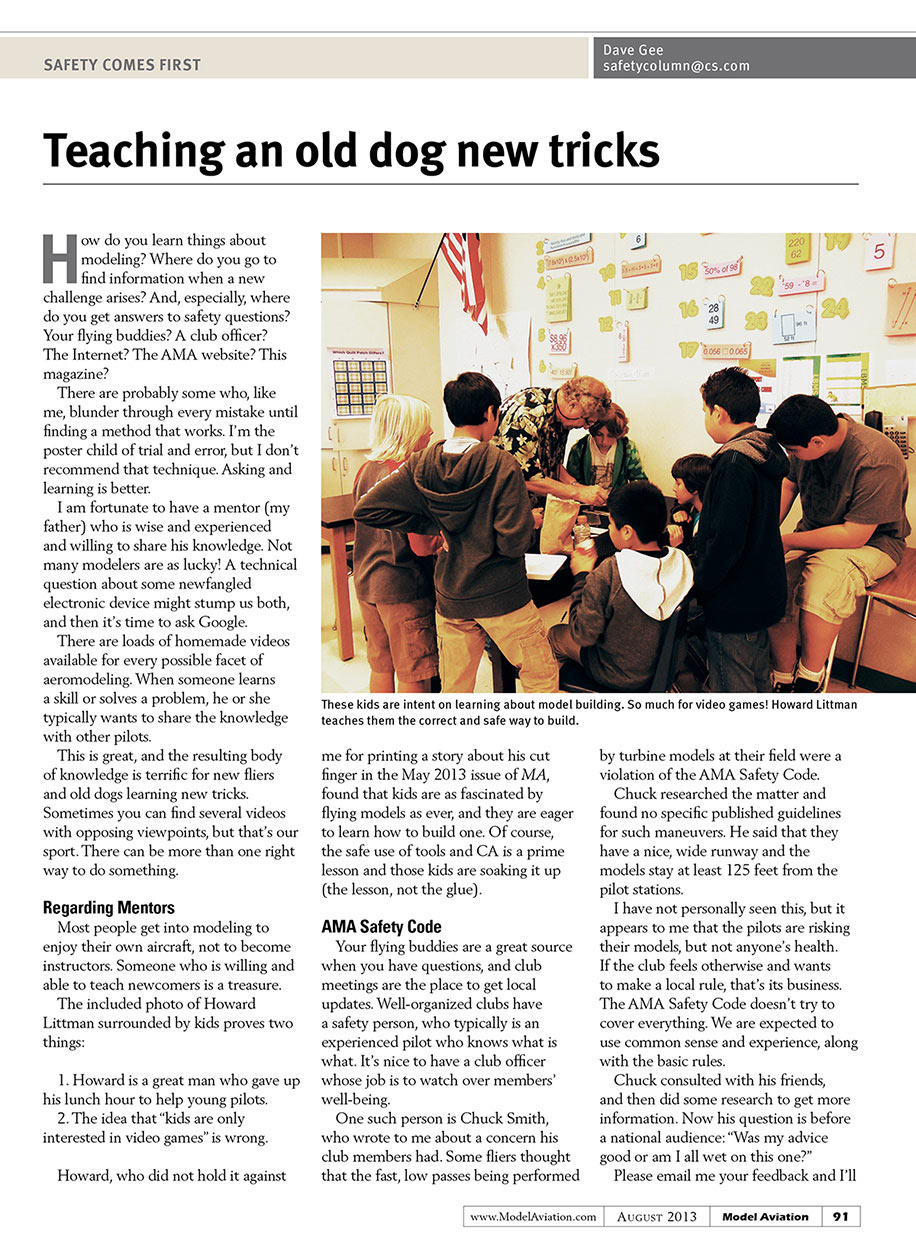
The included photo of Howard Littman surrounded by kids proves two things:
- Howard is a great man who gave up his lunch hour to help young pilots.
- The idea that "kids are only interested in video games" is wrong.
Howard, who did not hold it against me for printing a story about his cut finger in the May 2013 issue of MA, found that kids are as fascinated by flying models as ever, and they are eager to learn how to build one. Of course, the safe use of tools and CA is a prime lesson and those kids are soaking it up (the lesson, not the glue).
AMA Safety Code
Your flying buddies are a great source when you have questions, and club meetings are the place to get local updates. Well-organized clubs have a safety person, who typically is an experienced pilot who knows what is what. It's nice to have a club officer whose job is to watch over members' well-being.
One such person is Chuck Smith, who wrote to me about a concern his club members had. Some fliers thought that the fast, low passes being performed by turbine models at their field were a violation of the AMA Safety Code.
Chuck researched the matter and found no specific published guidelines for such maneuvers. He said that they have a nice, wide runway and the models stay at least 125 feet from the pilot stations.
I have not personally seen this, but it appears to me that the pilots are risking their models, but not anyone's health. If the club feels otherwise and wants to make a local rule, that's its business. The AMA Safety Code doesn't try to cover everything. We are expected to use common sense and experience, along with the basic rules.
Chuck consulted with his friends, and then did some research to get more information. Now his question is before a national audience: "Was my advice good or am I all wet on this one?"
Please email me your feedback and I'll report the results. You are also welcome to include any other issues, complaints, topics, or knock‑knock jokes you have. I'll leave your name out if you prefer.
Flying in the Tustin Blimp Hangar
Some of our hobby's rules and lessons are not written down, but this magazine is a rich source of knowledge and history. Scans of back issues are available online and you can search them electronically through MA's Digital Library to find articles or mentions of a topic. This is faster than—but not as much fun as—digging through old magazines on your shelf!
Somewhere in those old magazines is coverage of a long‑ago indoor session in the giant blimp hangar at Tustin, California. Once upon a time, modelers had regular flying sessions in this incredible building. Things later changed, and for decades our models were forbidden.
The military base closed, the local government took over the hangar, and it looked as though that was the end of model aircraft flying there—forever.
A few intrepid and diplomatic modelers arranged test sessions of record‑attempting indoor flying. These sessions were gradually expanded to a few fun‑fly days, in between commercial rentals of the space. Some experienced nostalgic joy being in the room again, while others (like me) who had never set foot inside, were awed by the 150‑foot ceiling.
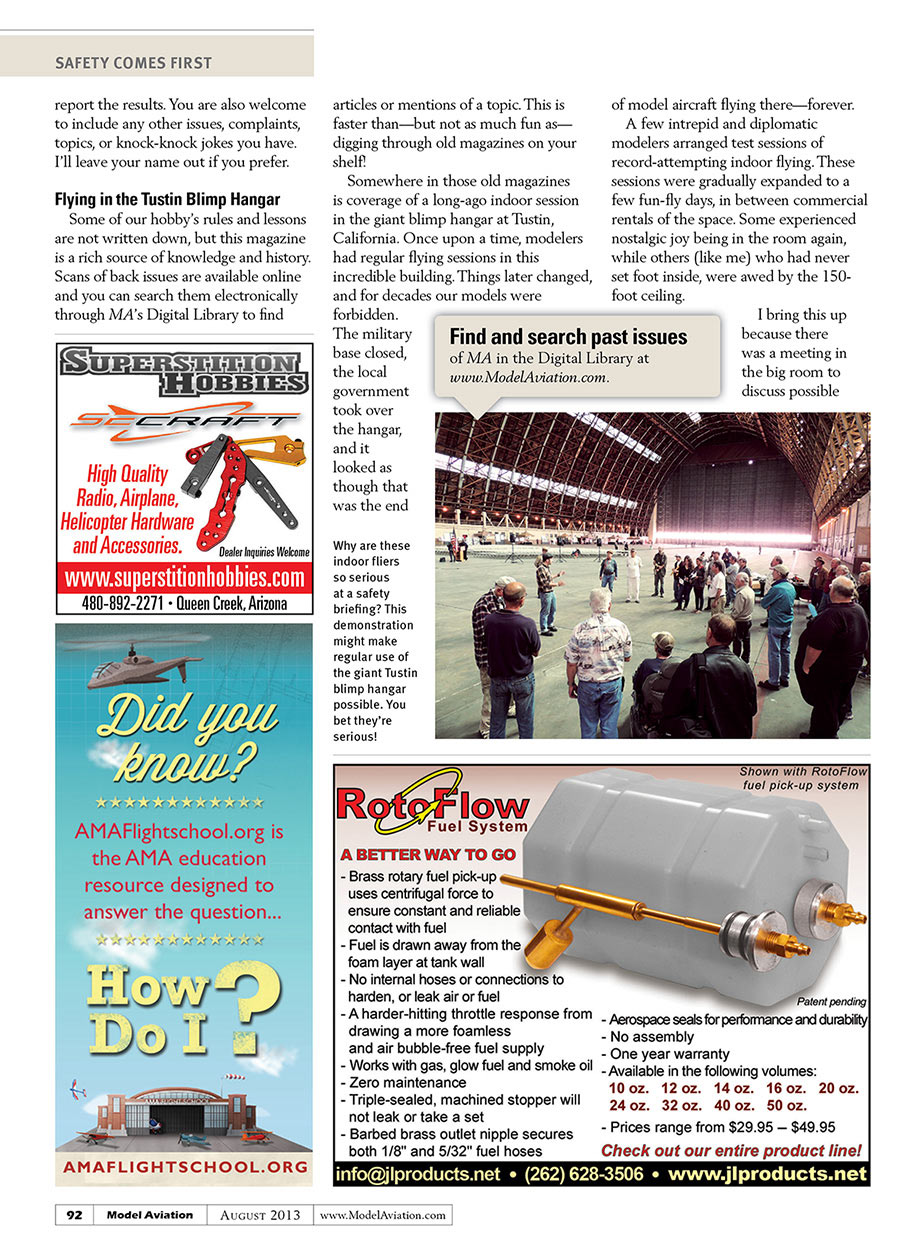
Why are these indoor fliers so serious at a safety briefing? This demonstration might make regular use of the giant Tustin blimp hangar possible. But they're serious!
I bring this up because there was a meeting in the big room to discuss possible
Find and search past issues of MA in the Digital Library at www.ModelAviation.com.
Safety Comes First
Dave Gee
Pilot briefings before a flying event are all similar. The safety rules for the field are discussed, and the officers brief the fliers on their plans for a safe and enjoyable day of flight. I've never seen such a serious and attentive group as the indoor modelers at the Tustin hangar before the public demonstration session for the parks department!
These people knew what was at stake, and they were motivated to have a successful, persuasive, and incident‑free flying session. One goof could have ruined everything, so we did our best to stay inbounds and show the harmless fun that indoor models can provide. It was slightly amusing to think that an errant microfilm aircraft could cause such concern!
They made one mistake, however: they let me fly. I somehow got my little Fokker triplane down in one piece after some slow Figure Eights and mild aerobatics.
In addition to light RC and high‑performance FF models, there were electric CL aircraft and sport airplanes in the air, and large and small helicopters. The crowd loved it, and apparently the parks officials were impressed. Hopes are high for modelers to be on the blimp hangar’s schedule someday soon!
LiPo Fires
Leonard Good sent me a real, handwritten, paper letter, and his cool stationary (outlined with aviation logos) nearly distracted me from his story!
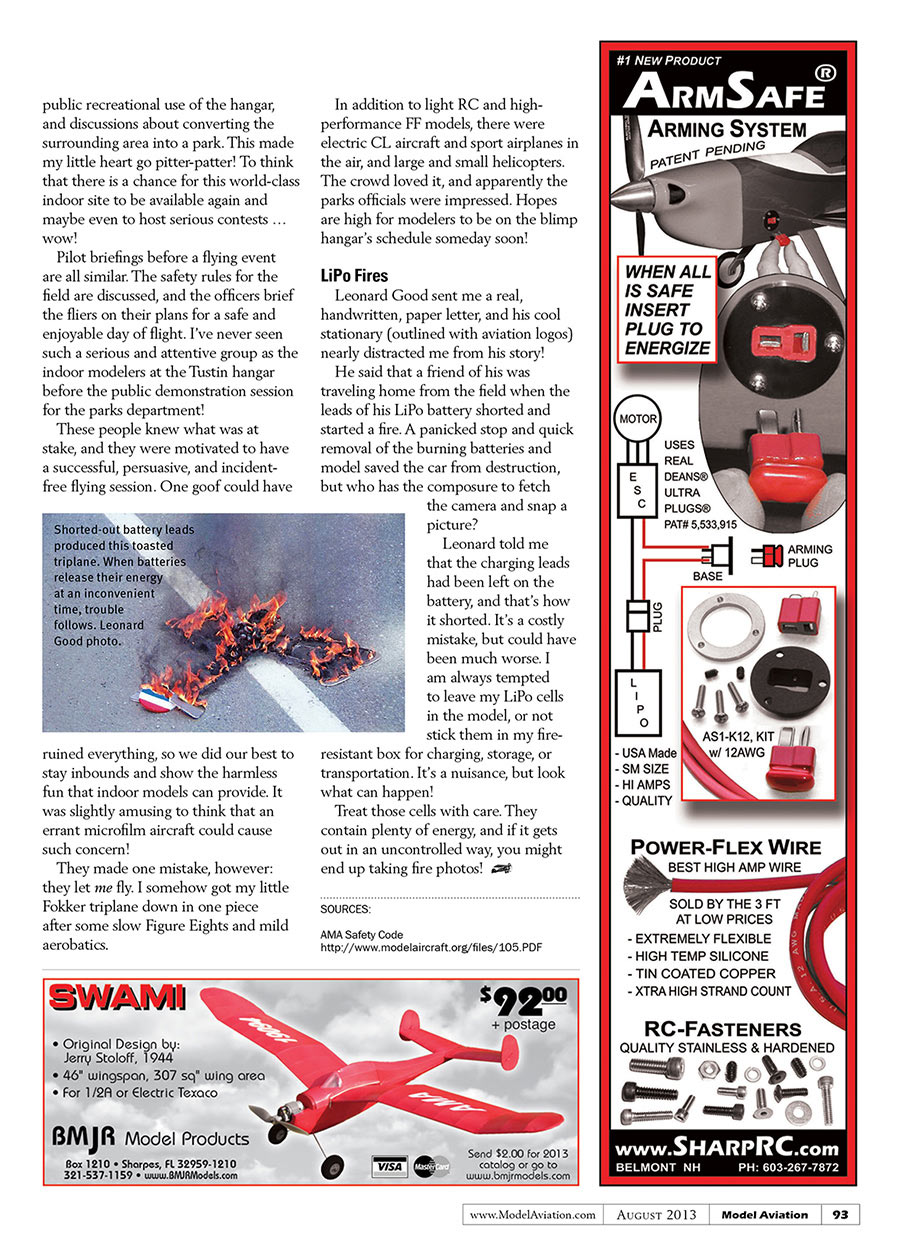
He said that a friend of his was traveling home from the field when the leads of his LiPo battery shorted and started a fire. A panicked stop and quick removal of the burning batteries and model saved the car from destruction, but who has the composure to fetch the camera and snap a picture?
Leonard told me that the charging leads had been left on the battery, and that's how it shorted. It's a costly mistake, but could have been much worse. I am always tempted to leave my LiPo cells in the model, or not stick them in my fire‑resistant box for charging, storage, or transportation. It's a nuisance, but look what can happen!
Treat those cells with care. They contain plenty of energy, and if it gets out in an uncontrolled way, you might end up taking fire photos!
SOURCES: AMA Safety Code http://www.modelaircraft.org/files/105.PDF
Transcribed from original scans by AI. Minor OCR errors may remain.

