
Don't let your ego become a safety obstacle
Dave Gee
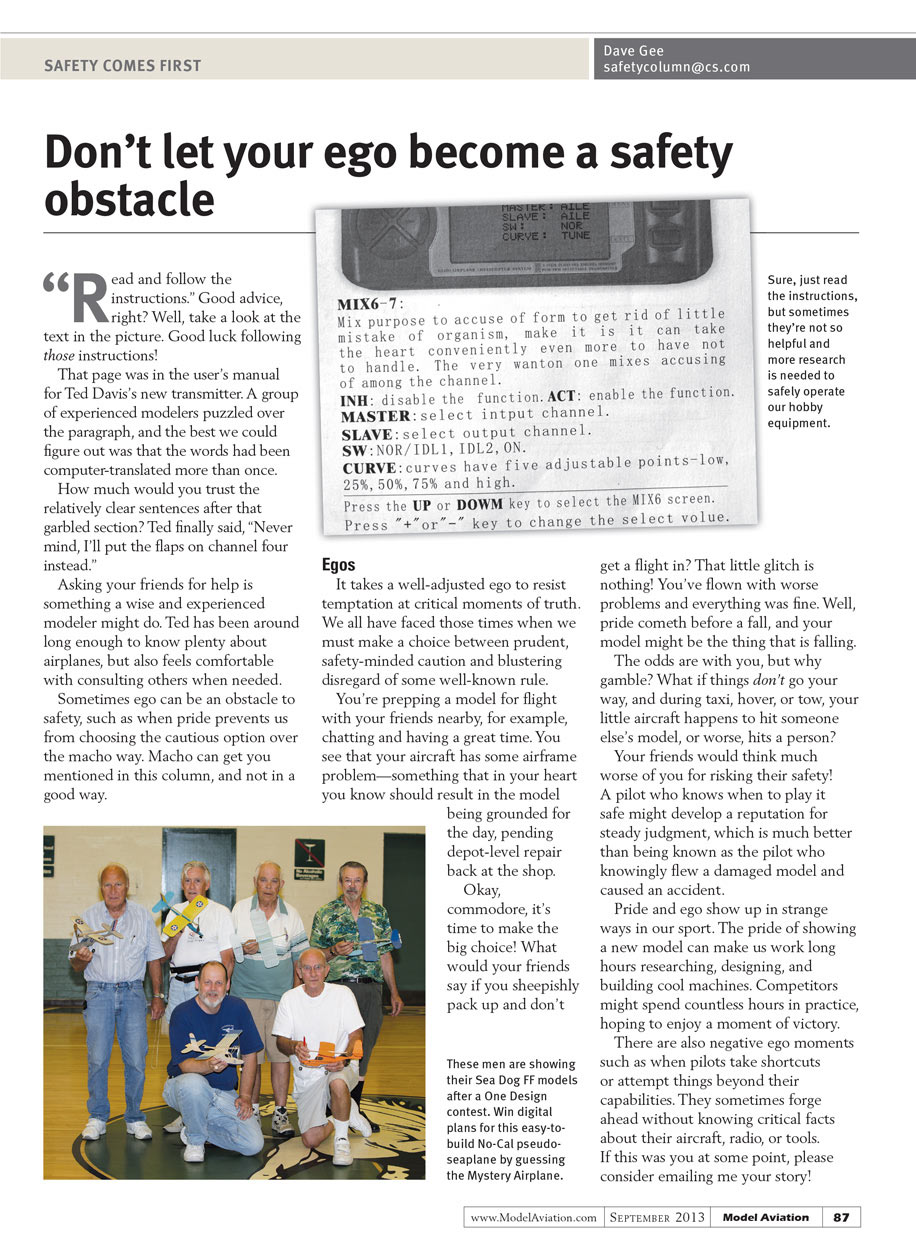
"Read and follow the instructions." Good advice, right? Well, take a look at the text in the picture. Good luck following those instructions!
That page was in the user's manual for Ted Davis's new transmitter. A group of experienced modelers puzzled over the paragraph, and the best we could figure out was that the words had been computer-translated more than once.
How much would you trust the relatively clear sentences after that garbled section? Ted finally said, "Never mind, I'll put the flaps on channel four instead."
Asking your friends for help is something a wise and experienced modeler might do. Ted has been around long enough to know plenty about airplanes, but also feels comfortable with consulting others when needed.
Sometimes ego can be an obstacle to safety, such as when pride prevents us from choosing the cautious option over the macho way. Macho can get you mentioned in this column, and not in a good way.
Egos
It takes a well-adjusted ego to resist temptation at critical moments of truth. We all have faced those times when we must make a choice between prudent, safety-minded caution and blustering disregard of some well-known rule.
You're prepping a model for flight with your friends nearby, for example, chatting and having a great time. You see that your aircraft has some airframe problem—something that in your heart you know should result in the model being grounded for the day, pending depot-level repair back at the shop.
Okay, commodore, it's time to make the big choice! What would your friends say if you sheepishly pack up and don't get a flight in? That little glitch is nothing! You've flown with worse problems and everything was fine. Well, pride cometh before a fall, and your model might be the thing that is failing.
The odds are with you, but why gamble? What if things don't go your way, and during taxi, hover, or tow, your little aircraft happens to hit someone else's model, or worse, hits a person? Your friends would think much worse of you for risking their safety! A pilot who knows when to play it safe might develop a reputation for steady judgment, which is much better than being known as the pilot who knowingly flew a damaged model and caused an accident.
Pride and ego show up in strange ways in our sport. The pride of showing a new model can make us work long hours researching, designing, and building cool machines. Competitors might spend countless hours in practice, hoping to enjoy a moment of victory.
There are also negative ego moments such as when pilots take shortcuts or attempt things beyond their capabilities. They sometimes forge ahead without knowing critical facts about their aircraft, radio, or tools. If this was you at some point, please consider emailing me your story!
Safety Comes First
Dave Gee
I admit that some types of models are as dull as watching paint dry, and I'm sure that others may feel the same about my own favorites, but we must all stick together and support the entire hobby if we want to continue to enjoy our favorite genres of model aviation. Egos, although sometimes helpful, must be controlled when they endanger our safety or the future of our sport.
Complacency Can Motivate
Jack Martin felt humbled by his model and was kind enough to share the story. He is his club's safety coordinator and he wanted to help everyone avoid an incident that happened to him.
Jack has an H9 Cessna Skylane ARF with an O.S. 160 two-stroke engine that he purchased already built. He has made many successful flights with it. He wrote:
"I decided I wanted a four-stroke and put in a used Saito 180. I took the time to set up [the] throttle on the bench, put in end points, use thread-locking compound, etc. [I] fastened the plane to the work table, [and] put the radio behind the engine.
"I started the motor with my paint-roller chicken stick and the idle was unexpectedly high, so I stepped back to lower the trim on the radio. Before I reached the radio, but after I had moved (thankfully) past the motor, the entire firewall came loose. If I had been in my previous location, the prop would have caught me in the belly and would have been a very ugly mess."
If you fly a model that you did not build, maybe Jack’s story is motivation to check your firewall and engine mount. A running engine without a model attached can be bothersome.
Mystery Airplane
Some readers kid me about using photos here that don’t directly relate to safety. Hey, it’s tough to find pictures of safety every month!
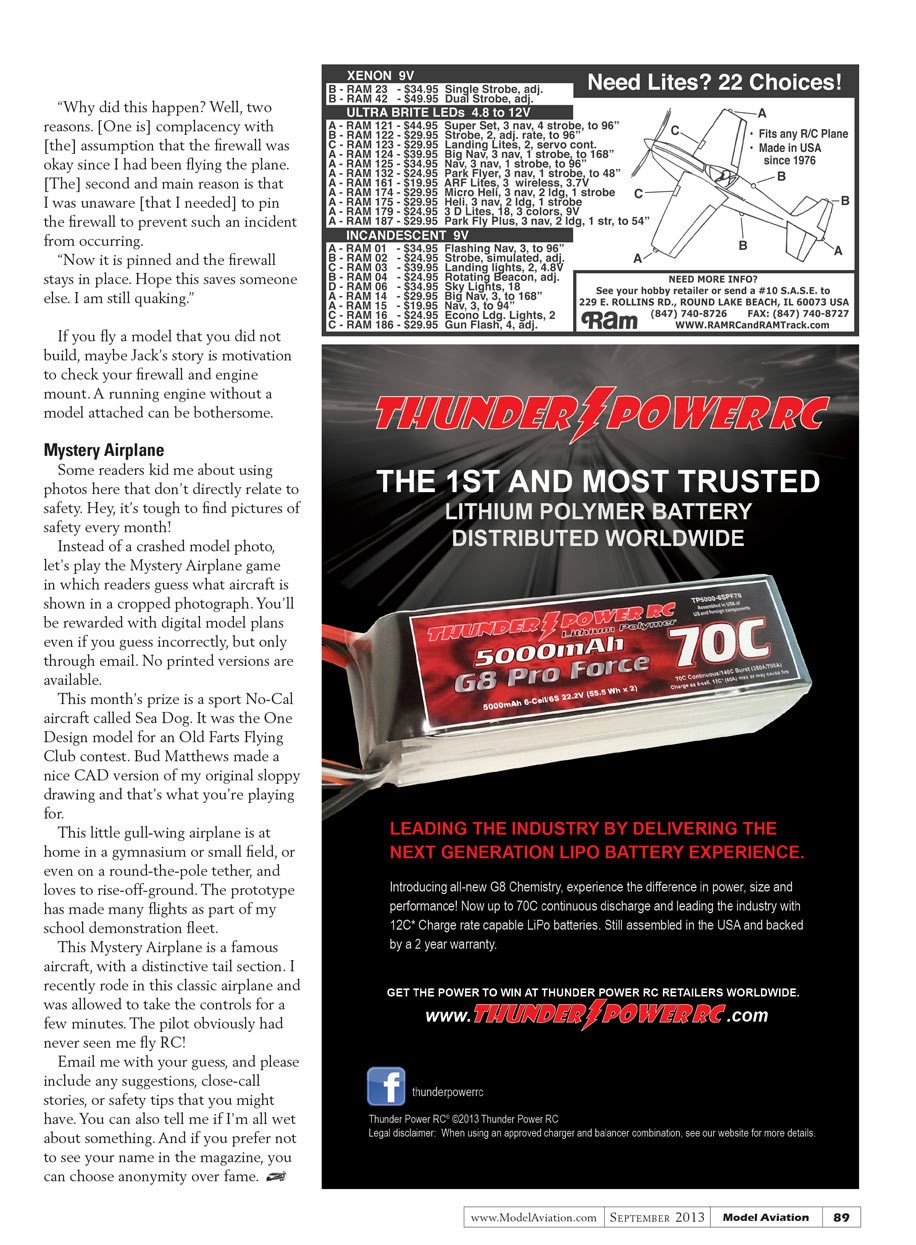
Instead of a crashed model photo, let’s play the Mystery Airplane game in which readers guess what aircraft is shown in a cropped photograph. You’ll be rewarded with digital model plans even if you guess incorrectly, but only through email. No printed versions are available.
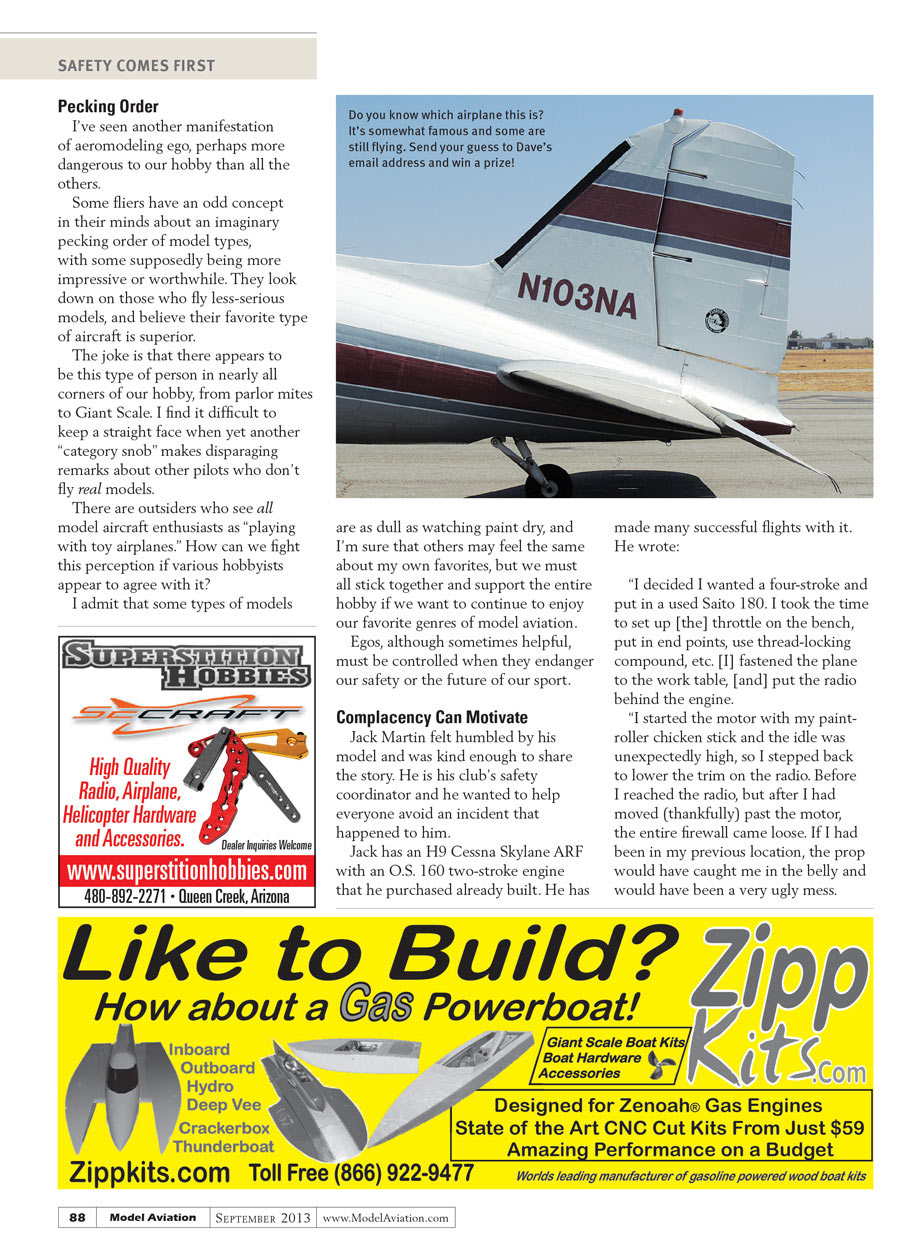
This month’s prize is a sport No-Cal aircraft called Sea Dog. It was the One Design model for an Old Farts Flying Club contest. Bud Matthews made a nice CAD version of my original sloppy drawing and that’s what you’re playing for.
This little gull-wing airplane is at home in a gymnasium or small field, or even on a round-the-pole tether, and loves to rise-off-ground. The prototype has made many flights as part of my school demonstration fleet.
This Mystery Airplane is a famous aircraft, with a distinctive tail section. I recently rode in this classic airplane and was allowed to take the controls for a few minutes. The pilot obviously had never seen me fly RC!
Email me with your guess, and please include any suggestions, close-call stories, or safety tips that you might have. You can also tell me if I’m all wet about something. And if you prefer not to see your name in the magazine, you can choose anonymity over fame.
Transcribed from original scans by AI. Minor OCR errors may remain.

