
Do you build model airplanes or simply fly RC?
Dave Gee
There was once a time when you had to make your aircraft if you wanted to fly. Turning balsa sticks, foam, wire, and covering material into something that can take to the sky (or in my case, trundle along the ground) was the heart of our sport.
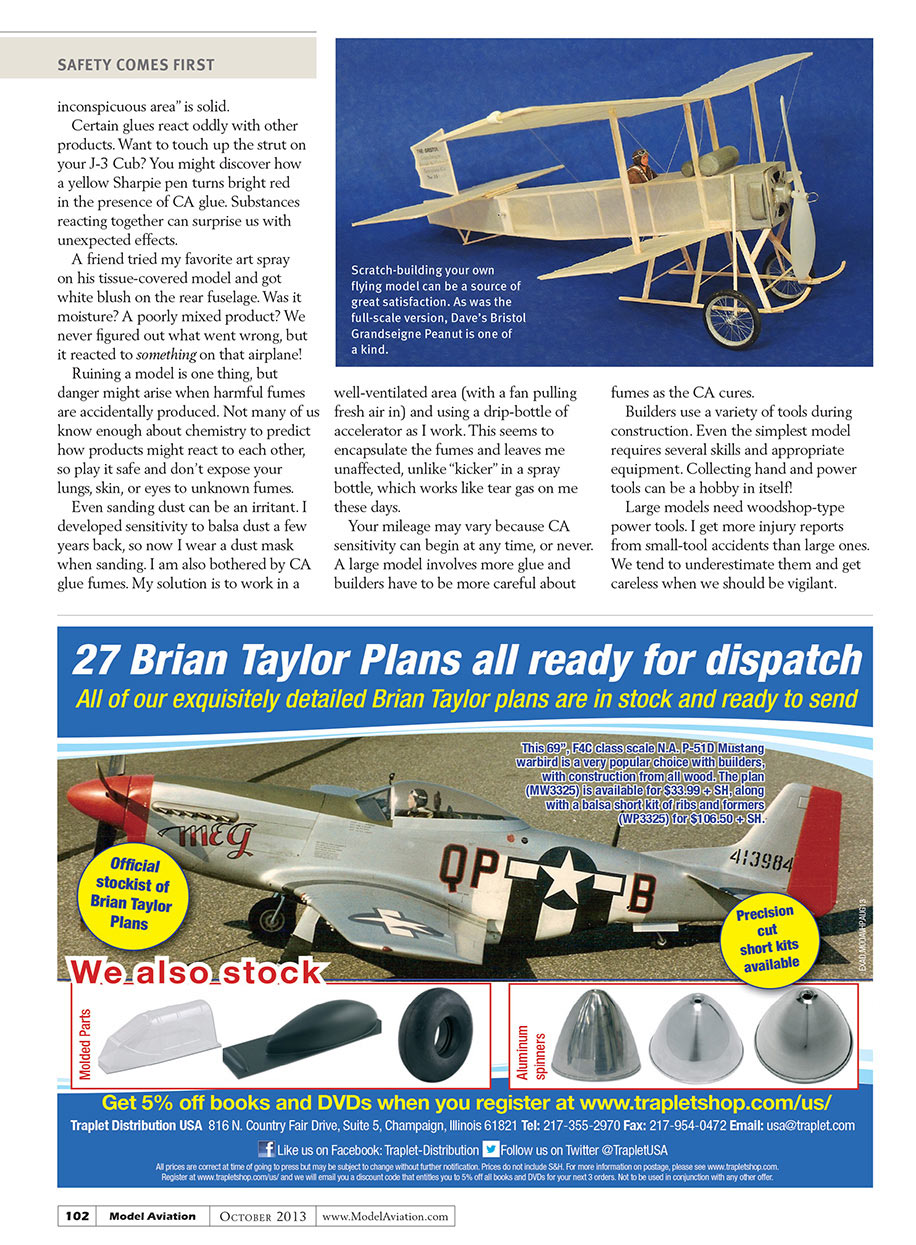
These days, with so many terrific RTF models available, a pilot can choose to fly without ever building a model. Although a growing number of us do it that way, I can’t help but feel sorry for them because I think they’re missing out on fun. For me, nothing beats the satisfaction of choosing and building my own miniature flying machine from scratch.
I recently helped the Santa Fe Dam RC Modelers present an aeromodeling demonstration at a school. The club members did the outdoor RC flying and my son, Jeff, and I flew indoor models. There were choppers, quadcopters, fixed-wing models, and an ornithopter.
We had an attentive audience of happy, interested, and nice kids, but their education lacks in the knowledge that modeling can provide. They were baffled by the complex technology of a simple slip-together balsa glider. These youngsters had never before faced anything so manually challenging.
What a shame for this generation of children! The fine motor skills that they could develop while building an airplane or helicopter would come in handy throughout their lives.
What is to become of our civilization if the kids don’t know how to build and fly model airplanes? The children of ancient Egypt, Greece, and Rome suffered a similar deficit, and look what happened to those civilizations! Okay, bad example.
Making models brings its own set of dangers and cautions. But make no mistake, the hazards are mostly minor and are nothing compared to the joys of constructing one’s own flying machine.
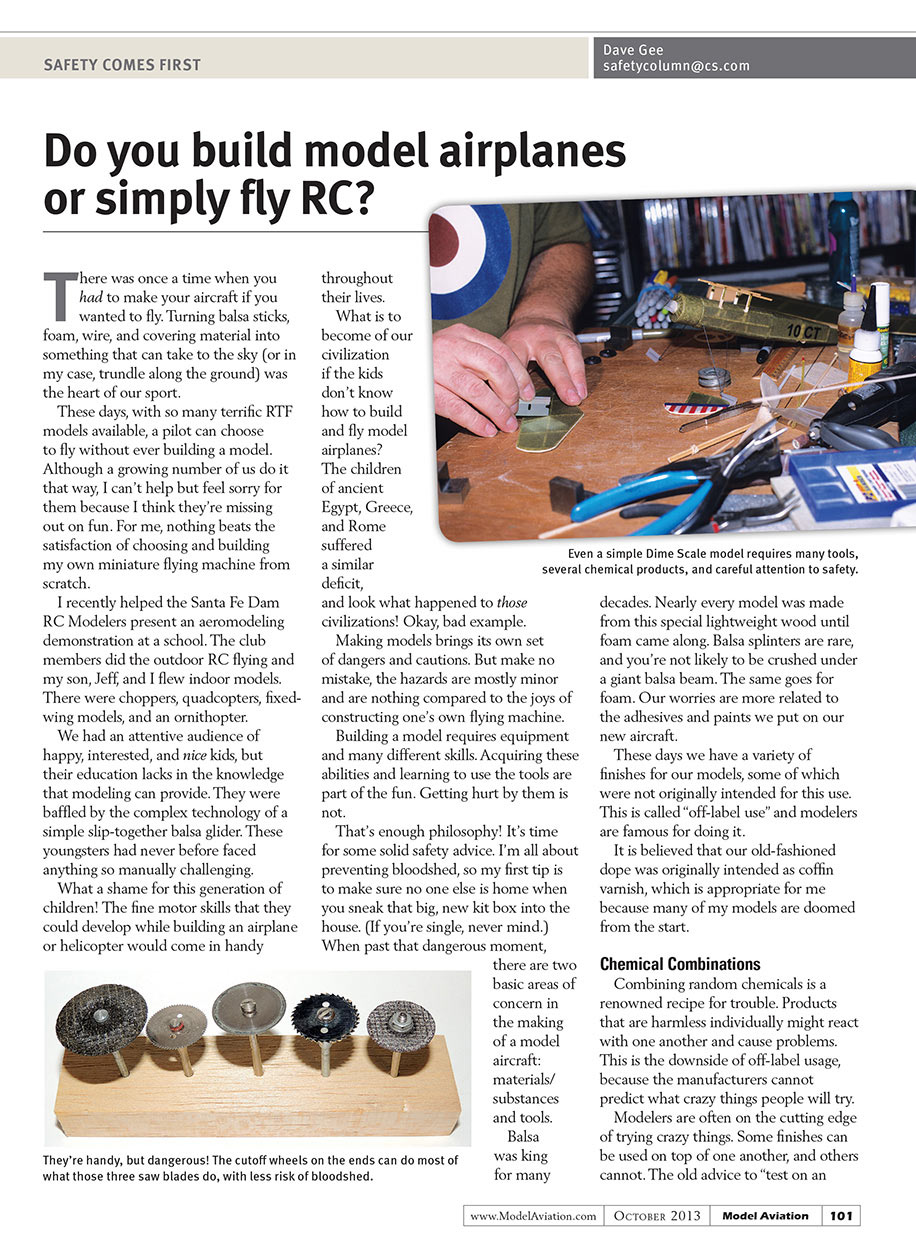
Building a model requires equipment and many different skills. Acquiring these abilities and learning to use the tools are part of the fun. Getting hurt by them is not.
That’s enough philosophy! It’s time for some solid safety advice. I’m all about preventing bloodshed, so my first tip is to make sure no one else is home when you sneak that big, new kit box into the house. (If you’re single, never mind.) When past that dangerous moment, there are two basic areas of concern in the making of a model aircraft: materials/substances and tools.
Balsa was king for many decades. Nearly every model was made from this special lightweight wood until foam came along. Balsa splinters are rare, and you’re not likely to be crushed under a giant balsa beam. The same goes for foam. Our worries are more related to the adhesives and paints we put on our new aircraft.
These days we have a variety of finishes for our models, some of which were not originally intended for this use. This is called “off-label use” and modelers are famous for doing it.
It is believed that our old-fashioned dope was originally intended as coffin varnish, which is appropriate for me because many of my models are doomed from the start.
Chemical Combinations
Combining random chemicals is a renowned recipe for trouble. Products that are harmless individually might react with one another and cause problems. This is the downside of off-label usage, because the manufacturers cannot predict what crazy things people will try.
Modelers are often on the cutting edge of trying crazy things. Some finishes can be used on top of one another, and others cannot. The old advice to “test on an inconspicuous area” is solid.
Certain glues react oddly with other products. Want to touch up the strut on your J-3 Cub? You might discover how a yellow Sharpie pen turns bright red in the presence of CA glue. Substances reacting together can surprise us with unexpected effects.
A friend tried my favorite art spray on his tissue-covered model and got white blush on the rear fuselage. Was it moisture? A poorly mixed product? We never figured out what went wrong, but it reacted to something on that airplane!
Ruining a model is one thing, but danger might arise when harmful fumes are accidentally produced. Not many of us know enough about chemistry to predict how products might react to each other, so play it safe and don’t expose your lungs, skin, or eyes to unknown fumes.
Even sanding dust can be an irritant. I developed sensitivity to balsa dust a few years back, so now I wear a dust mask when sanding. I am also bothered by CA glue fumes. My solution is to work in a well-ventilated area (with a fan pulling fresh air in) and using a drip-bottle of accelerator as I work. This seems to encapsulate the fumes and leaves me unaffected, unlike “kicker” in a spray bottle, which works like tear gas on me these days.
Your mileage may vary because CA sensitivity can begin at any time, or never. A large model involves more glue and builders have to be more careful about fumes as the CA cures.
Builders use a variety of tools during construction. Even the simplest model requires several skills and appropriate equipment. Collecting hand and power tools can be a hobby in itself!
Large models need woodshop-type power tools. I get more injury reports from small-tool accidents than large ones. We tend to underestimate them and get careless when we should be vigilant.
SAFETY COMES FIRST
Dave Gee
inconspicuous area” is solid.
Safety Comes First
Dave Gee
Saw What?
Electric rotary tools are popular. I read an online discussion about the little circular saw blades that many of us use. It appears that some major manufacturers no longer produce those attachments. Hmm, why would that be? As it turns out, nearly everyone in the discussion had hurt himself or herself on unprotected rotary saw blades at some point. Yup, even I have, and more than once.
They're really useful, but an unprotected spinning blade is as dangerous as it gets! I often substitute an abrasive cutoff wheel for the little saw blade. It'll cut balsa fine in a slow and controllable way and is less prone to kick out and bite your hand.
Building, Not Bleeding
I've always used single-edge razor blades for my model work, but most builders prefer a standard hobby knife. Either way, I endorse the old Boy Scout advice that a sharp blade is safer than a dull one. I toss my little blade and grab a fresh one when it begins to load up or become dull. The minor expense is worth possibly avoiding an injury!
Hobby-knife blades are meant to be disposable, but it is easy to resharpen them. With practice you can improve the edge beyond factory new. I had to buy a second honing set because Sweet Diedra claimed to have found a loophole in our marriage vows that lets her swipe my hobby tools for her craft room. She likes her #11 blades nice and sharp.
Transcribed from original scans by AI. Minor OCR errors may remain.

