
Making new arrivals feel welcome
Dave Gee
When I visit a new field, it often takes me a few minutes to get the lay of the land. It's swell to have someone come up and say hello and chat with me to see whether I'm an interested spectator or an experienced pilot. (I can fool 'em pretty well until they see me fly.)
Many sites have special unwritten rules of conduct or courtesy, based on the field's physical layout or some past incident. Sometimes that information is posted, sometimes not.
Imagine a new arrival at your field. He or she could be an experienced flier or a novice with an unopened model aircraft box. How would he or she find out the rules and customs for safely operating a model at your club's site?
Would the pilot be welcomed, informed, and guided, or would he or she only be spoken to after bending some unwritten law? Sometimes there is a club officer designated to work with newcomers. If that person wasn't around, would you fill in and make a stranger feel welcome?
I sometimes hear about aspiring pilots who felt ignored or unwelcome during their first visit. That's a shame for our hobby, and it is unusual when compared with the number of fresh faces that are welcomed and even pounced on by a club's membership coordinator.
I love hearing an aspiring modeler tell about being shown around by a club member and then taken to the flightline for a buddy-box session. We modelers may tend to be slightly eccentric, but we are also known for being friendly!
The field layout is an issue at some sites. We have to work with the property we have and sometimes the best setup is a compromise. Even indoor sites can face this problem.
With powerful indoor RC models becoming so common, clubs with smart leadership attempt to allow as many types of aircraft as possible. It means no more simply setting up our work stations around the rim of the room and watching the Pennyplanes. Contact with a midsize helicopter or a fast-spinning 3-D propeller is not on the menu!
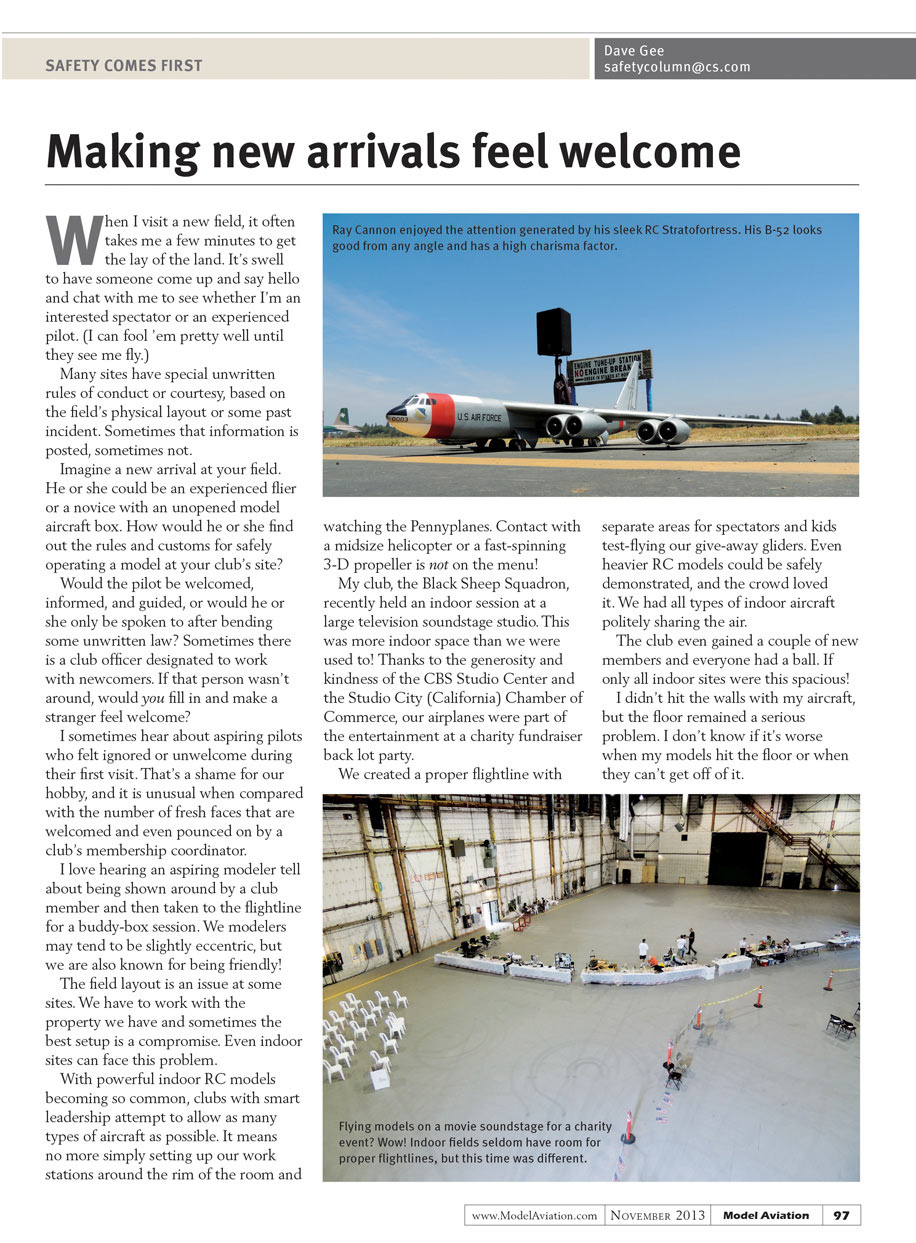
My club, the Black Sheep Squadron, recently held an indoor session at a large television soundstage studio. This was more indoor space than we were used to! Thanks to the generosity and kindness of the CBS Studio Center and the Studio City (California) Chamber of Commerce, our airplanes were part of the entertainment at a charity fundraiser back lot party.
We created a proper flightline with separate areas for spectators and kids test-flying our give-away gliders. Even heavier RC models could be safely demonstrated, and the crowd loved it. We had all types of indoor aircraft politely sharing the air.
The club even gained a couple of new members and everyone had a ball. If only all indoor sites were this spacious!
I didn't hit the walls with my aircraft, but the floor remained a serious problem. I don't know if it's worse when my models hit the floor or when they can't get off of it.
Arming Keys
I received several emails from readers who are interested in arming keys. Recent columns have discussed these items, which are available commercially or can be homemade, and how they can disconnect the motor of an electric model from the control system. This allows you to adjust things without worrying about the propeller suddenly coming to life.
To answer a common question—no, there isn’t a universal schematic for arming plugs. Every model has its own circuitry, and you must tailor the wiring to your aircraft. You must be sure you are interrupting the correct power line to the motor, and I can’t tell you how to safely do that via email. If in doubt, purchase a plug and follow the instructions.
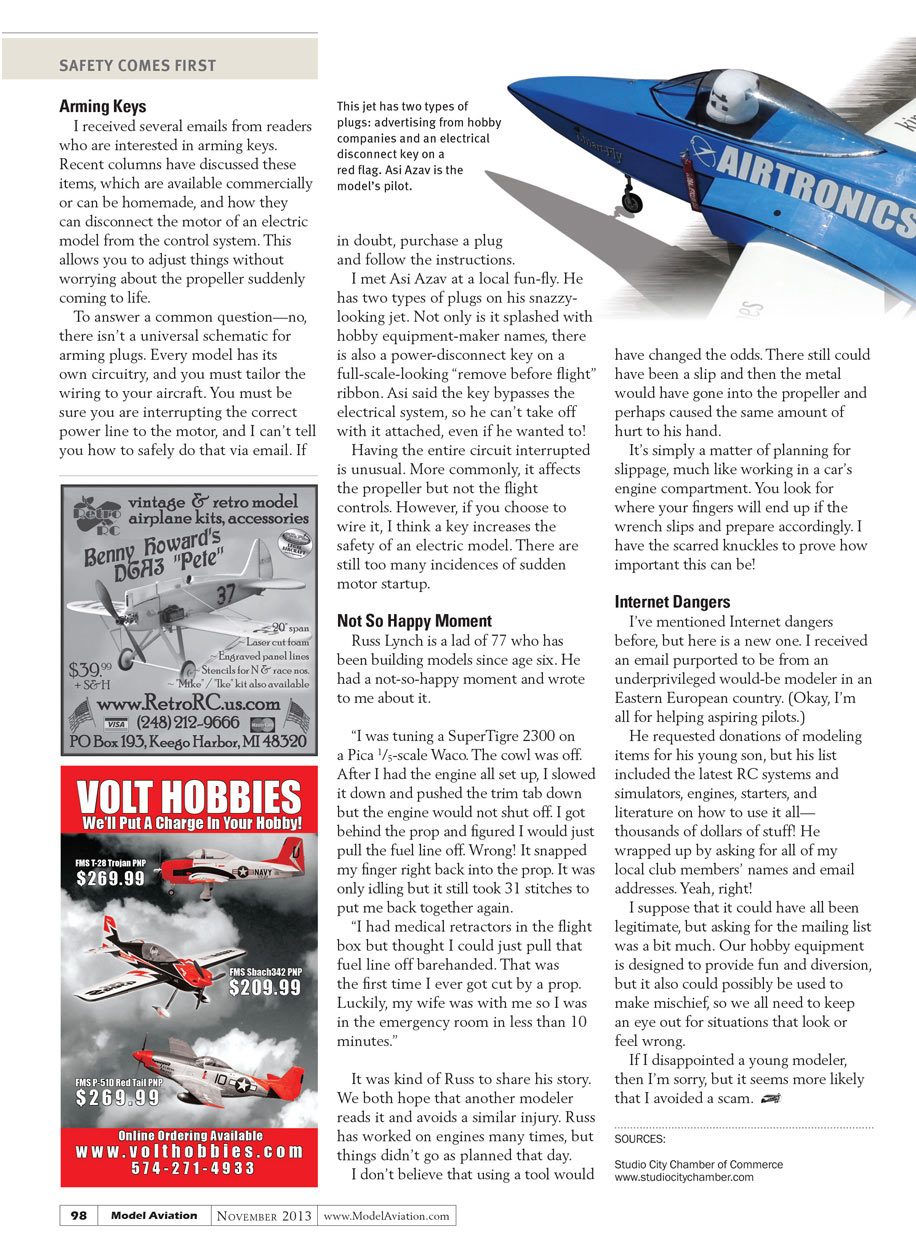
I met Asi Azav at a local fun-fly. He has two types of plugs on his snazzy-looking jet. Not only is it splashed with hobby equipment-maker names, there is also a power-disconnect key on a full-scale-looking “remove before flight” ribbon. Asi said the key bypasses the electrical system, so he can’t take off with it attached, even if he wanted to!
Having the entire circuit interrupted is unusual. More commonly, it affects the propeller but not the flight controls. However, if you choose to wire it, I think a key increases the safety of an electric model. There are still too many incidences of sudden motor startup.
Not So Happy Moment
Russ Lynch is a lad of 77 who has been building models since age six. He had a not-so-happy moment and wrote to me about it.
“I was tuning a SuperTigre 2300 on a Pica 1/5-scale Waco. The cowl was off. After I had the engine all set up, I slowed it down and pushed the trim tab down but the engine would not shut off. I got behind the prop and figured I would just pull the fuel line off. Wrong! It snapped my finger right back into the prop. It was only idling but it still took 31 stitches to put me back together again.
“I had medical retractors in the flight box but thought I could just pull that fuel line off barehanded. That was the first time I ever got cut by a prop. Luckily, my wife was with me so I was in the emergency room in less than 10 minutes.”
It was kind of Russ to share his story. We both hope that another modeller reads it and avoids a similar injury. Russ has worked on engines many times, but things didn’t go as planned that day.
I don’t believe that using a tool would have changed the odds. There still could have been a slip and then the metal would have gone into the propeller and perhaps caused the same amount of hurt to his hand.
It’s simply a matter of planning for slippage, much like working in a car’s engine compartment. You look for where your fingers will end up if the wrench slips and prepare accordingly. I have the scarred knuckles to prove how important this can be!
Internet Dangers
I’ve mentioned Internet dangers before, but here is a new one. I received an email purported to be from an underprivileged would-be modeler in an Eastern European country. (Okay, I’m all for helping aspiring pilots.)
He requested donations of modeling items for his young son, but his list included the latest RC systems and simulators, engines, starters, and literature on how to use it all—thousands of dollars of stuff! He wrapped up by asking for all of my local club members’ names and email addresses. Yeah, right!
I suppose that it could have all been legitimate, but asking for the mailing list was a bit much. Our hobby equipment is designed to provide fun and diversion, but it also could possibly be used to make mischief, so we all need to keep an eye out for situations that look or feel wrong.
If I disappointed a young modeler, then I’m sorry, but it seems more likely that I avoided a scam.
SOURCES: Studio City Chamber of Commerce www.studiocitychamber.com
Transcribed from original scans by AI. Minor OCR errors may remain.

