

Careful inspections could prevent close calls
Dave Gee
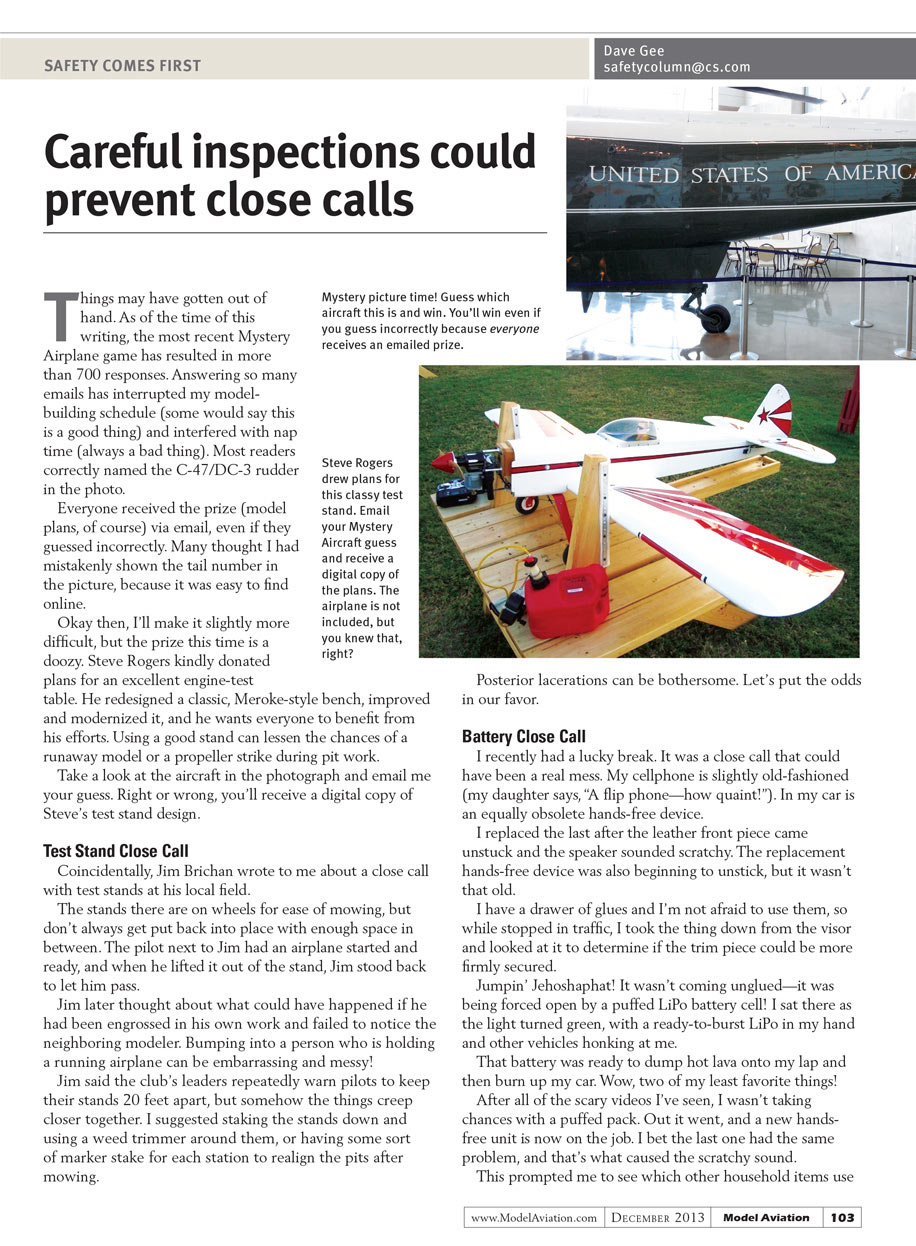
Things may have gotten out of hand. As of the time of this writing, the most recent Mystery Airplane game has resulted in more than 700 responses. Answering so many emails has interrupted my model-building schedule (some would say this is a good thing) and interfered with nap time (always a bad thing). Most readers correctly named the C-47/DC-3 rudder in the photo.
Everyone received the prize (model plans, of course) via email, even if they guessed incorrectly. Many thought I had mistakenly shown the tail number in the picture, because it was easy to find online.
Okay then, I’ll make it slightly more difficult, but the prize this time is a doozy. Steve Rogers kindly donated plans for an excellent engine-test table. He redesigned a classic, Meroke-style bench, improved and modernized it, and he wants everyone to benefit from his efforts. Using a good stand can lessen the chances of a runaway model or a propeller strike during pit work.
Take a look at the aircraft in the photograph and email me your guess. Right or wrong, you’ll receive a digital copy of Steve’s test stand design.
Test Stand Close Call
Coincidentally, Jim Brichan wrote to me about a close call with test stands at his local field.
The stands there are on wheels for ease of moving, but don’t always get put back into place with enough space in between. The pilot next to Jim had an airplane started and ready, and when he lifted it out of the stand, Jim stood back to let him pass.
Jim later thought about what could have happened if he had been engrossed in his own work and failed to notice the neighboring modeler. Bumping into a person who is holding a running airplane can be embarrassing and messy!
Jim said the club’s leaders repeatedly warn pilots to keep their stands 20 feet apart, but somehow the things creep closer together. I suggested staking the stands down and using a weed trimmer around them, or having some sort of marker stake for each station to realign the pits after mowing.
Posterior lacerations can be bothersome. Let’s put the odds in our favor.
Battery Close Call
I recently had a lucky break. It was a close call that could have been a real mess. My cellphone is slightly old-fashioned (my daughter says, “A flip phone—how quaint!”). In my car is an equally obsolete hands-free device.
I replaced the last after the leather front piece came unstuck and the speaker sounded scratchy. The replacement hands-free device was also beginning to unstick, but it wasn’t that old.
I have a drawer of glues and I’m not afraid to use them, so while stopped in traffic, I took the thing down from the visor and looked at it to determine if the trim piece could be more firmly secured.
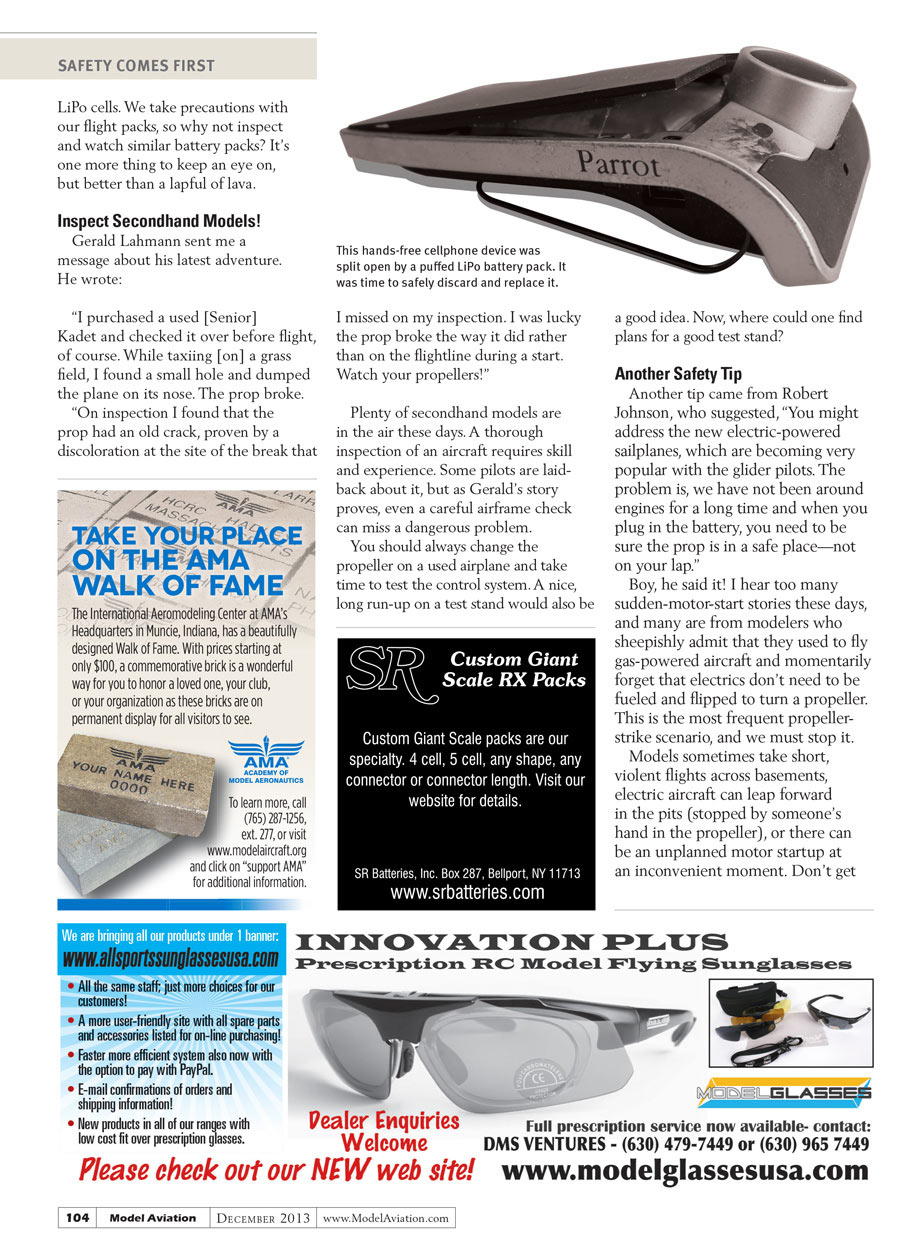
Jumpin’ Jehoshaphat! It wasn’t coming unglued—it was being forced open by a puffed LiPo battery cell! I sat there as the light turned green, with a ready-to-burst LiPo in my hand and other vehicles honking at me.
That battery was ready to dump hot lava onto my lap and then burn up my car. Wow, two of my least favorite things!
After all the scary videos I’ve seen, I wasn’t taking chances with a puffed pack. Out it went, and a new hands-free unit is now on the job. I bet the last one had the same problem, and that’s what caused the scratchy sound.
This prompted me to see which other household items use LiPo cells. We take precautions with our flight packs, so why not inspect and watch similar battery packs? It's one more thing to keep an eye on, but better than a lapful of lava.
Inspect Secondhand Models!
Gerald Lahmann sent me a message about his latest adventure. He wrote:
"I purchased a used [Senior] Kadet and checked it over before flight, of course. While taxiing [on] a grass field, I found a small hole and dumped the plane on its nose. The prop broke.
"On inspection I found that the prop had an old crack, proven by a discoloration at the site of the break that I missed on my inspection. I was lucky the prop broke the way it did rather than on the flightline during a start. Watch your propellers!"
Plenty of secondhand models are in the air these days. A thorough inspection of an aircraft requires skill and experience. Some pilots are laid-back about it, but as Gerald's story proves, even a careful airframe check can miss a dangerous problem.
You should always change the propeller on a used airplane and take time to test the control system. A nice, long run-up on a test stand would also be a good idea. Now, where could one find plans for a good test stand?
Another Safety Tip
Another tip came from Robert Johnson, who suggested, "You might address the new electric-powered sailplanes, which are becoming very popular with the glider pilots. The problem is, we have not been around engines for a long time, and when you plug in the battery, you need to be sure the prop is in a safe place—not on your lap."
Boy, he said it! I hear too many sudden-motor-start stories these days, and many are from modelers who sheepishly admit that they used to fly gas-powered aircraft and momentarily forget that electrics don't need to be fueled and flipped to turn a propeller. This is the most frequent propeller-strike scenario, and we must stop it.
Models sometimes take short, violent flights across basements, electric aircraft can leap forward in the pits (stopped by someone's hand in the propeller), or there can be an unplanned motor startup at an inconvenient moment. Don't get attacked by your own aircraft! Use an arming key, a rubber band on the throttle stick, a lockout in the transmitter programming, or whatever works best for you.
Safety Comes First
Dave Gee
Hot Battery
Charles E. Castaing gets the final word this month. He's been modeling since the days of escapements, but learned a thing or two from this close call:
"I purchased a new, 12-volt motorcycle battery, the type with clear plastic sides so the sulfuric acid solution is visible. Because my eyes are now 82 years old, I had a difficult time seeing the level of the liquid.
"I have a portable floor lamp (with a 100-watt bulb) that I brought close to the battery to aid me in locating the level of the liquid so as to align it with the mark I had painted on it. I still had difficulty, and brought the lamp directly over the top of the battery, about 6 inches from the battery. This was right over the black, plastic top.
"Then the telephone rang. I got distracted, left the shop, and went inside the house for about 20 to 30 minutes. When I returned to my workshop, to my amazement, the black, plastic top of the battery had partially melted and caved in about 1 or 2 inches.
"The battery and the contents were very, very hot! I am sure if I had left it longer, much worse things could have happened!"
Transcribed from original scans by AI. Minor OCR errors may remain.

