
Safety in Model Flight Operations Part 1
by Donald Brooks
At the end of last month's "From the Ground Up" installment we had the model at the taxiway with its engine at idle. Leave it there for the time being; I'm going to discuss model flight operations in terms of where we fly and what we fly to reduce the level of risk.
In the next article I'll write about flight-operations safety from the perspective of how we fly, including methods, techniques, and good flight-safety practices.
Level of Risk
Everything we do in our lives carries some risk. If you are a newcomer to flying models or an experienced old-timer, you should fully appreciate the safety concerns involved with piloting an RC aircraft. That knowledge can assist you in preventing injury to others and yourself during model flight operations.
As the old saying goes, "Forewarned is forearmed." If you know about the dangers, you have a better chance of avoiding an accident and the potential consequences.
The primary concern in model flight operations is an out-of-control aircraft striking someone. A secondary concern is property damage caused by an errant airplane. A third is that if you lose control of the model, you destroy your beautiful creation.
Loss of control and the subsequent crash may occur for a variety of reasons. The pilot could make a mistake and cause the crash. A radio receiver battery could fail. A control surface could detach. The model may be flown out of radio range. A servo could jam or fail to operate properly.
In the first two articles of this series I described the levels of safety action we apply to aeromodeling to minimize risks and prevent injuries. As a basis for further discussion, review the accompanying Table 1: "Aeromodeling Safety Risks and Defense."
Reading from left to right takes us from a low to high level of consequence—a first-aid injury to major injury or death.
Reading from bottom to top we see that the safety action levels increase as the probability of an occurrence increases. Where risk level is low and the likelihood of an event happening is low, we may only need to ensure that we have the right attitude. Let's consider sawing a piece of thick balsa with a razor saw. If we slipped, the resulting injury would be a cut and would be addressed by first aid. If we considered an out-of-control, 6-pound aircraft moving 60 mph with a propeller spinning at 12,000 rpm on the front, we are looking at a safety risk of major injury or death.
In the latter case we would apply all the levels of safety we could muster. We would ensure the right attitude, prechecks in the preflight inspection, and backups such as dual and independent servos for ailerons or elevator to prevent the out-of-control situation. We would also, by flying-field design, use isolation by physical separation of the overflight area and spectator and pit areas to protect us from injury. In extreme situations such as air combat, we would increase the separation between the flight operations and spectators and use barriers—i.e., hard hats—to protect the pilots.
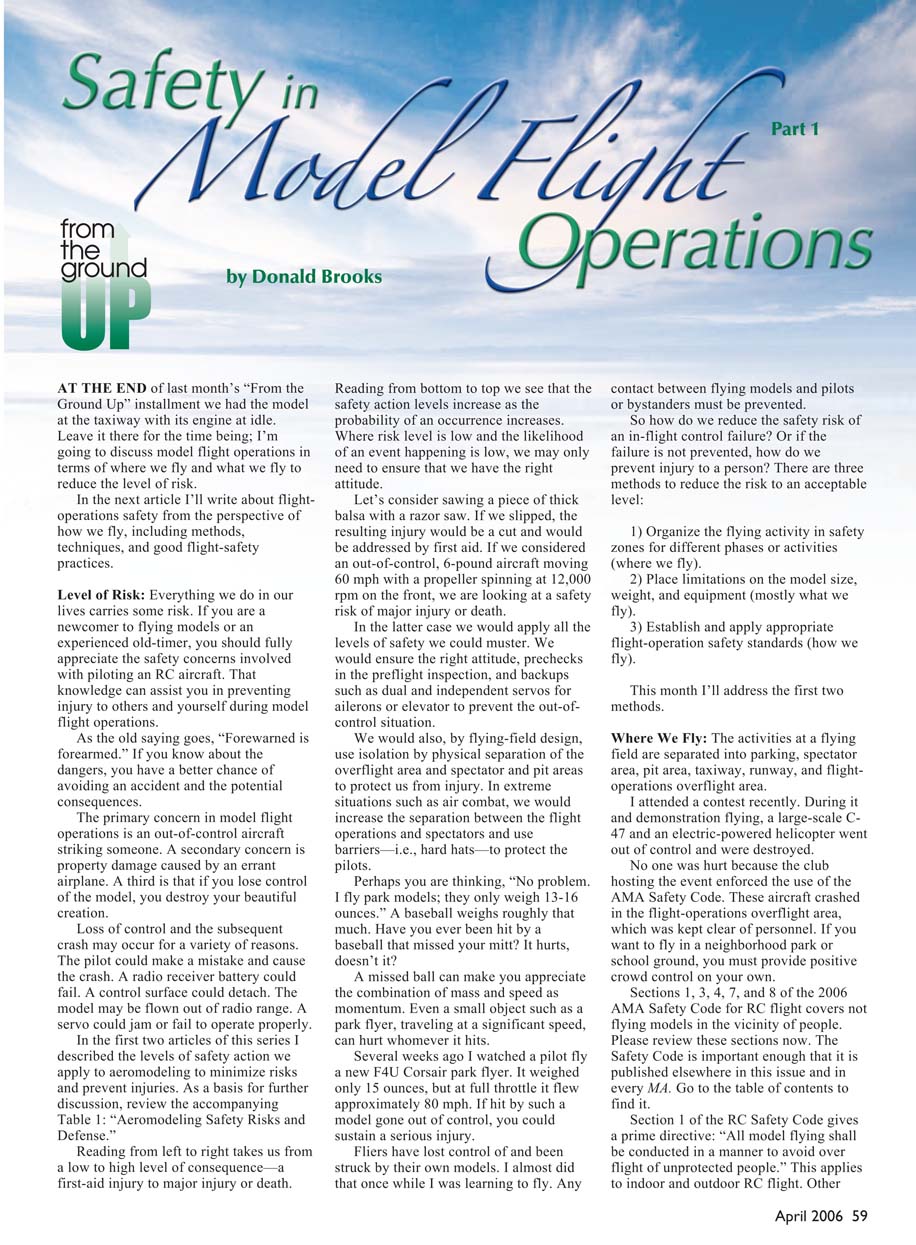
Perhaps you are thinking, "No problem. I fly park models; they only weigh 13–16 ounces." A baseball weighs roughly that much. Have you ever been hit by a baseball that missed your mitt? It hurts, doesn't it? A missed ball can make you appreciate the combination of mass and speed as momentum. Even a small object such as a park flyer, traveling at a significant speed, can hurt whomever it hits.
Several weeks ago I watched a pilot fly a new F4U Corsair park flyer. It weighed only 15 ounces, but at full throttle it flew approximately 80 mph. If hit by such a model gone out of control, you could sustain a serious injury.
Fliers have lost control of and been struck by their own models. I almost did that once while I was learning to fly. Any contact between flying models and pilots or bystanders must be prevented. So how do we reduce the safety risk of an in-flight control failure? Or if the failure is not prevented, how do we prevent injury to a person? There are three methods to reduce the risk to an acceptable level:
- Organize the flying activity in safety zones for different phases or activities (where we fly).
- Place limitations on the model size, weight, and equipment (mostly what we fly).
- Establish and apply appropriate flight-operation safety standards (how we fly).
This month I'll address the first two methods.
Where We Fly
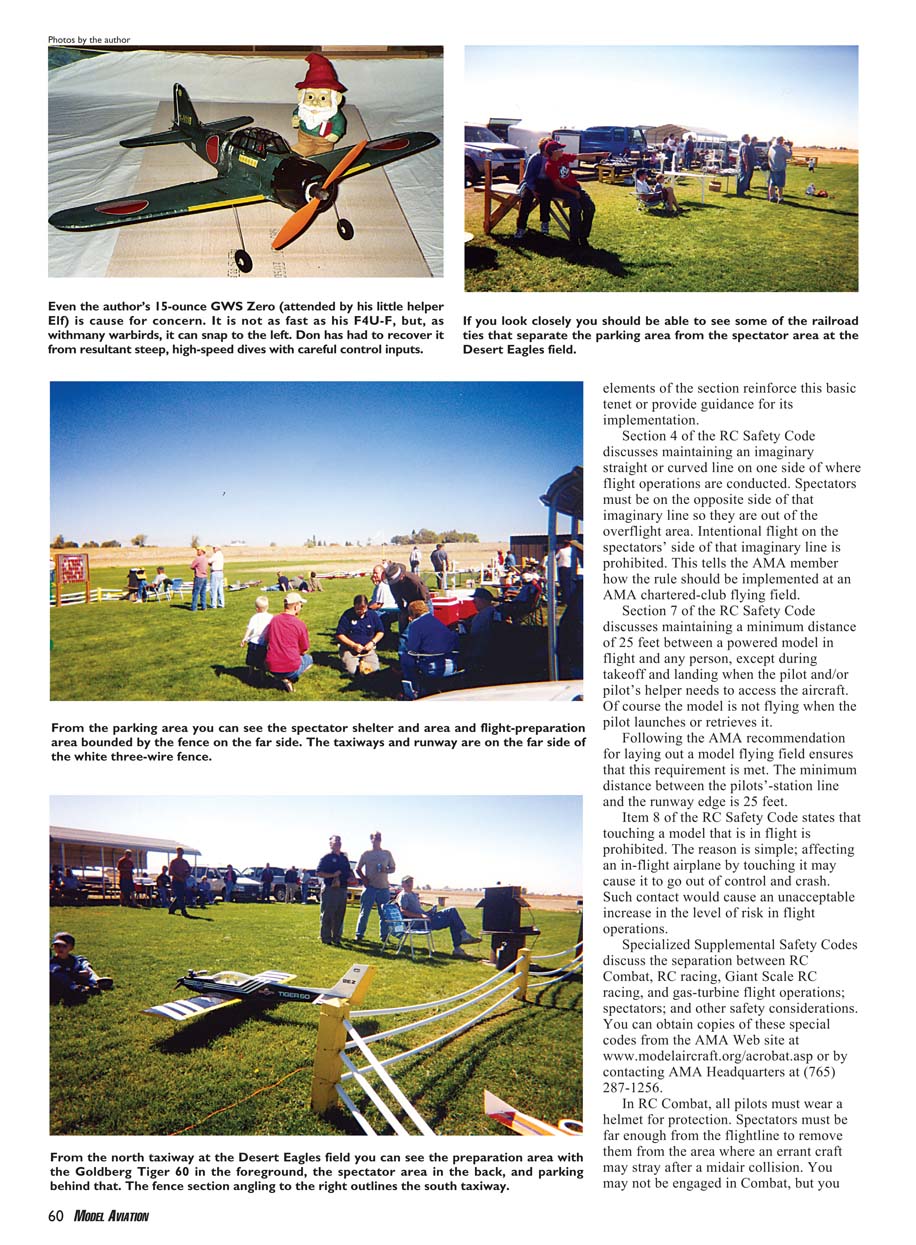
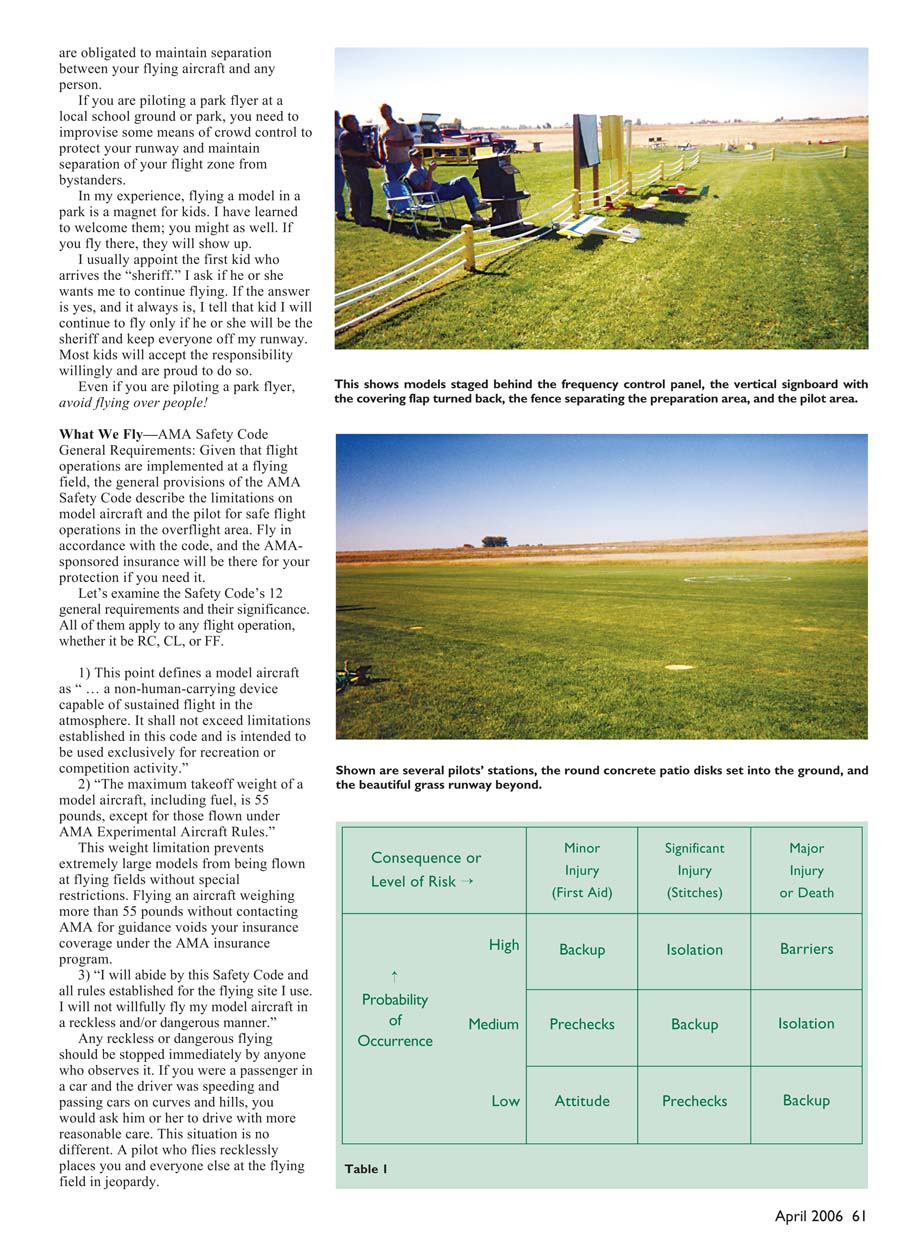
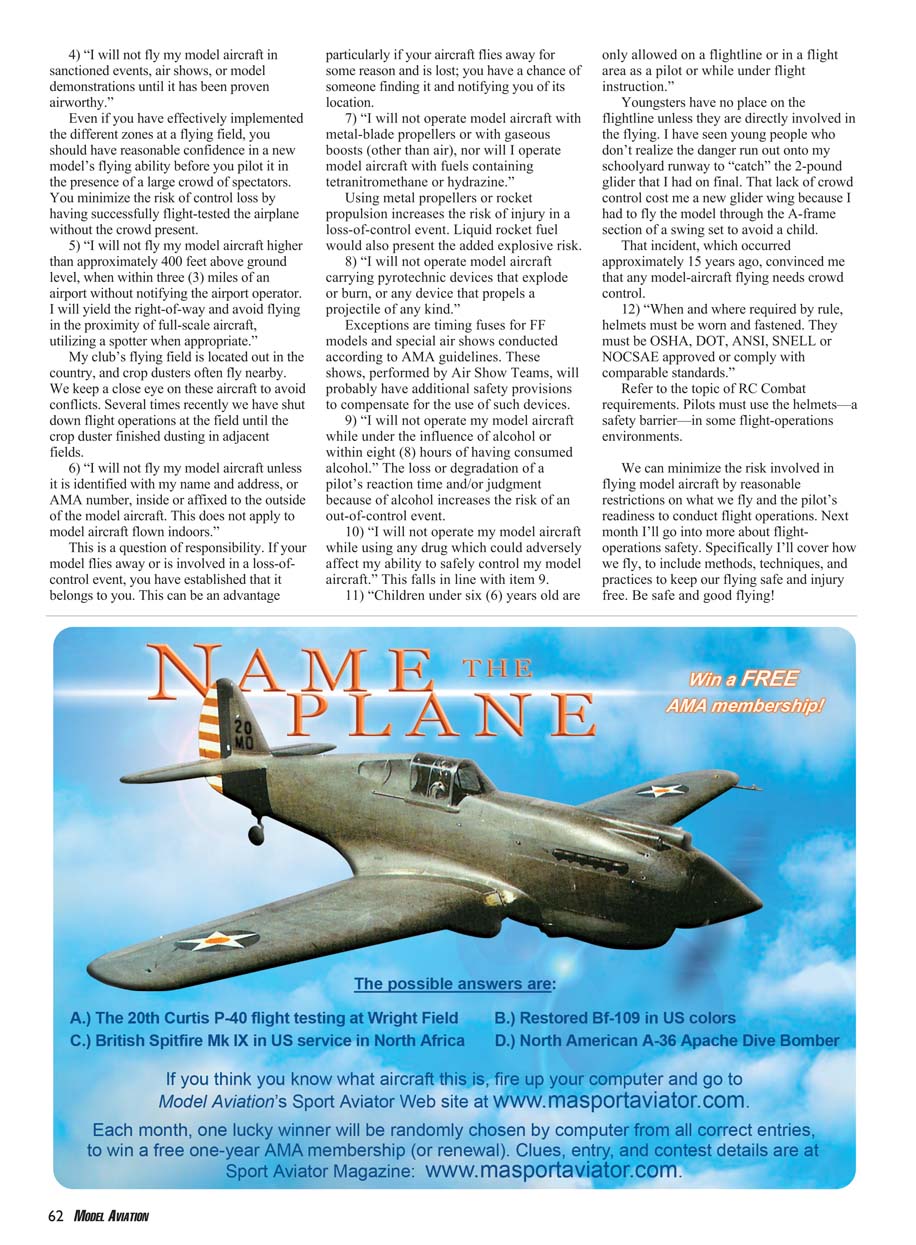
The activities at a flying field are separated into parking, spectator area, pit area, taxiway, runway, and flight-operations overflight area.
I attended a contest recently. During it and during demonstration flying, a large-scale C-47 and an electric-powered helicopter went out of control and were destroyed.
No one was hurt because the club hosting the event enforced the use of the AMA Safety Code. These aircraft crashed in the flight-operations overflight area, which was kept clear of personnel. If you want to fly in a neighborhood park or school ground, you must provide positive crowd control on your own.
Sections 1, 3, 4, 7, and 8 of the 2006 AMA Safety Code for RC flight cover not flying models in the vicinity of people. Please review these sections now. The Safety Code is important enough that it is published elsewhere in this issue and in every MA. Go to the table of contents to find it.
Section 1 of the RC Safety Code gives a prime directive: "All model flying shall be conducted in a manner to avoid overflight of unprotected people." This applies to indoor and outdoor RC flight. Other elements of the section reinforce this basic tenet or provide guidance for its implementation.
Section 4 of the RC Safety Code discusses maintaining an imaginary straight or curved line on one side of where flight operations are conducted. Spectators must be on the opposite side of that imaginary line so they are out of the overflight area. Intentional flight on the spectators' side of that imaginary line is prohibited. This tells the AMA member how the rule should be implemented at an AMA-chartered club flying field.
Section 7 of the RC Safety Code discusses maintaining a minimum distance of 25 feet between a powered model in flight and any person, except during takeoff and landing when the pilot and/or pilot's helper needs to access the aircraft. Of course the model is not flying when the pilot launches or retrieves it.
Following the AMA recommendation for laying out a model flying field ensures that this requirement is met. The minimum distance between the pilots' station line and the runway edge is 25 feet.
Item 8 of the RC Safety Code states that touching a model that is in flight is prohibited. The reason is simple: affecting an in-flight airplane by touching it may cause it to go out of control and crash. Such contact would cause an unacceptable increase in the level of risk in flight operations.
Specialized supplemental safety codes discuss the separation between RC combat, RC racing, giant-scale RC racing, and gas-turbine flight operations; spectators; and other safety considerations. You can obtain copies of these special codes from the AMA website at www.modelaircraft.org/acrobat.asp or by contacting AMA Headquarters at (765) 287-1256.
In RC Combat, all pilots must wear a helmet for protection. Spectators must be far enough from the flightline to remove them from the area where an errant craft may stray after a midair collision. You may not be engaged in Combat, but you are obligated to maintain separation between your flying aircraft and any person.
If you are piloting a park flyer at a local school ground or park, you need to improvise some means of crowd control to protect your runway and maintain separation of your flight zone from bystanders.
In my experience, flying a model in a park is a magnet for kids. I have learned to welcome them; you might as well. If you fly there, they will show up.
I usually appoint the first kid who arrives the "sheriff." I ask if he or she wants me to continue flying. If the answer is yes, and it always is, I tell that kid I will continue to fly only if he or she will be the sheriff and keep everyone off my runway. Most kids will accept the responsibility willingly and are proud to do so.
Even if you are piloting a park flyer, avoid flying over people!
What We Fly — AMA Safety Code General Requirements
Given that flight operations are implemented at a flying field, the general provisions of the AMA Safety Code describe the limitations on model aircraft and the pilot for safe flight operations in the overflight area. Fly in accordance with the code, and the AMA-sponsored insurance will be there for your protection if you need it.
Let's examine the Safety Code's 12 general requirements and their significance. All of them apply to any flight operation, whether it be RC, CL, or FF.
- "A model aircraft is a non-human-carrying device capable of sustained flight in the atmosphere. It shall not exceed limitations established in this code and is intended to be used exclusively for recreation or competition activity."
- "The maximum takeoff weight of a model aircraft, including fuel, is 55 pounds, except for those flown under AMA Experimental Aircraft Rules."
- This weight limitation prevents extremely large models from being flown at flying fields without special restrictions. Flying an aircraft weighing more than 55 pounds without contacting AMA for guidance voids your insurance coverage under the AMA insurance program.
- "I will abide by this Safety Code and all rules established for the flying site I use. I will not willfully fly my model aircraft in a reckless and/or dangerous manner."
- Any reckless or dangerous flying should be stopped immediately by anyone who observes it. A pilot who flies recklessly places everyone at the flying field in jeopardy.
- "I will not fly my model aircraft in sanctioned events, air shows, or model demonstrations until it has been proven airworthy."
- Even if you have effectively implemented the different zones at a flying field, you should have reasonable confidence in a new model's flying ability before you pilot it in the presence of a large crowd.
- "I will not fly my model aircraft higher than approximately 400 feet above ground level when within three (3) miles of an airport without notifying the airport operator. I will yield the right-of-way and avoid flying in the proximity of full-scale aircraft, utilizing a spotter when appropriate."
- Be aware of full-scale traffic (crop dusters, etc.) and coordinate or suspend operations when necessary.
- "I will not fly my model aircraft unless it is identified with my name and address, or AMA number, inside or affixed to the outside of the model aircraft. This does not apply to model aircraft flown indoors."
- Identification establishes responsibility and increases the chance of recovery if the model is lost.
- "I will not operate model aircraft with metal-blade propellers or with gaseous boosts (other than air), nor will I operate model aircraft with fuels containing tetranitromethane or hydrazine."
- Metal propellers and rocket propulsion increase injury and explosive risk in a loss-of-control event.
- "I will not operate model aircraft carrying pyrotechnic devices that explode or burn, or any device that propels a projectile of any kind."
- Exceptions include timing fuses for FF models and special air shows conducted according to AMA guidelines and additional safety provisions.
- "I will not operate my model aircraft while under the influence of alcohol or within eight (8) hours of having consumed alcohol."
- Alcohol impairs reaction time and judgment and increases the risk of an out-of-control event.
- "I will not operate my model aircraft while using any drug which could adversely affect my ability to safely control my model aircraft."
- This follows the same logic as item 9.
- "Children under six (6) years old are only allowed on the flightline or in a flight area as a pilot or while under flight instruction."
- Young children should not be on the flightline unless directly involved in flying. Lack of crowd control can lead to accidents and equipment damage.
- "When and where required by rule, helmets must be worn and fastened. They must be OSHA, DOT, ANSI, SNELL or NOCSAE approved or comply with comparable standards."
- See RC Combat requirements; helmets are required in some flight-operations environments.
We can minimize the risk involved in flying model aircraft by reasonable restrictions on what we fly and the pilot's readiness to conduct flight operations. Next month I'll go into more about flight-operations safety. Specifically I'll cover how we fly, to include methods, techniques, and practices to keep our flying safe and injury free. Be safe and good flying!
Table 1: Aeromodeling Safety Risks and Defense
Refer to Table 1. Going from the lower left to the upper right we transition from a situation in which we have reasonably good accident prevention to one in which we do not. In the lower left part of the table we prevent an incident with a pre-emptive level of control. For the conditions in the upper right portion of the table we focus on protection where we cannot always prevent an accident.
Five levels of safety defense:
- Prevent inappropriate attitudes for safe work or play
- Hurried
- Stressed
- Tired
- Distracted
- Afflicted by Commodore Syndrome (unjustified overconfidence)
- Use prechecks
- Inspect equipment for satisfactory condition
- Check equipment for proper operation
- Employ backups or redundancy
- Cyanoacrylate debonder
- Model holder while starting aircraft
- Spotter for flying (co-pilot, if you will)
- Redundant controls (dual elevators with independent servos)
- Isolate the people from the hazard
- Area control by function
- Distance separation
- Use barriers (protective equipment)
- Goggles
- Dust masks
- Fences
Donald Brooks [email protected]
Transcribed from original scans by AI. Minor OCR errors may remain.

