
Scale Aerobatics Goes Hollywood
By Mike Hurley
HOW WOULD YOU like to turn on the TV and see RC Scale Aerobatics (SA) on your favorite cable or broadcast channel?
Last year I was asked to help work on a made-for-broadcast, documentary-style film to highlight SA and, in particular, the Freestyle portion of SA. There was a 15-person crew with truckloads of equipment and a budget that is unheard of in this hobby. We shot from before sunup to well past sundown for eight straight days surrounding the 2004 Tucson Aerobatic Shootout in Arizona, held October 21-24.
Meet the Producer: I fly with a father-and-son team in the Denver area that has become deeply involved in the competition aspect of SA and has moved quickly through the ranks, taking home a huge stack of some serious wood along the way. Adam Bry, along with his dad Doug Bry, have been flying since Adam was roughly 10 and competing in many different disciplines of RC.
Adam and Doug started flying IMAC (International Miniature Aerobatic Club) a few years ago. In the last couple years, Adam, now 19, has won almost every contest he has entered, including two AMA Nats and two Tucson Aerobatic Shootouts, one each in the last two seasons. Doug says they have had a lot of help along the way, and they feel a great deal of appreciation for that help.
The pair went to the last three Tournament of Champions (TOC) contests to watch the best in the world duke it out. During the contests Doug shot some home videos of several Freestyle routines. He edited the movies into a DVD and sent more than 100 out to his family and friends for Christmas cards.
The response was overwhelming. People who had never even heard of RC sports were blown away, and Doug knew right then that there could be a broad appeal for this type of competition. At that point he began to think about bringing our sport to the masses.
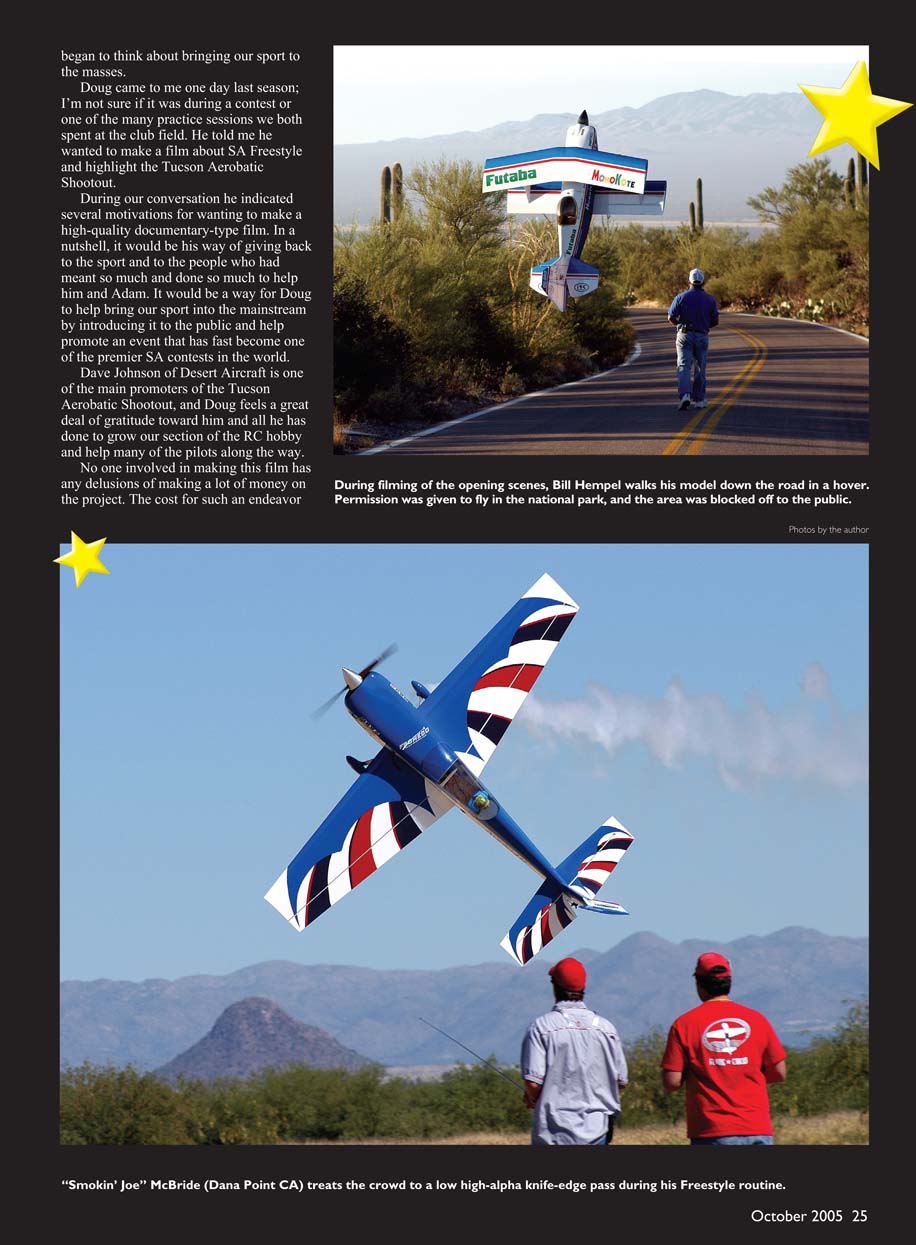
Bill puts his 52% Pitts Challenger biplane into a flat spin. Freestyle routines can include smoke, streamers, and music.
During the opening scenes of the film, Bill Hempel (Tucson AZ) knife-edges his Pitts at sunrise.
Bill flew his Pitts Challenger in Saturday's Freestyle competition. Sunday he chose to fly his 38% Yak-54 in the Freestyle.
Doug came to me one day last season; I'm not sure if it was during a contest or one of the many practice sessions we both spent at the club field. He told me he wanted to make a film about SA Freestyle and highlight the Tucson Aerobatic Shootout.
During our conversation he indicated several motivations for wanting to make a high-quality documentary-type film. In a nutshell, it would be his way of giving back to the sport and to the people who had meant so much and done so much to help him and Adam. It would be a way for Doug to help bring our sport into the mainstream by introducing it to the public and help promote an event that has fast become one of the premier SA contests in the world.
Dave Johnson of Desert Aircraft is one of the main promoters of the Tucson Aerobatic Shootout, and Doug feels a great deal of gratitude toward him and all he has done to grow our section of the RC hobby and help many of the pilots along the way.
No one involved in making this film has any delusions of making a lot of money on the project. The cost for such an endeavor is huge, and after contacting many potential sponsors, Doug has shouldered most of that risk on his own. It will be a monumental task just to break even.
Fourteen-time French National Champion Christophe Paysant-LeRoux with his caller/father Jacques bring it in show center, low and slow, during his Freestyle routine.
Jason Noll (Champaign IL) flew a 40% Carden Extra 330 through one of the most demanding and heart-stopping Freestyles of the event.
Yuri Higuchi (Phoenix AZ) and caller Eddie Meyer teamed up to thrill the crowd. Yuri's flight with his flag-painted Extra was a moving tribute set to the music of God Bless the USA.
Doug's vision for the film was to make it as high quality as possible, shot with the latest equipment and with a professional film crew. That meant not only was it to be shot in all digital, but in High Definition (HD). Some of the professional filmmakers Doug contacted initially argued against shooting in HD. The cost for the equipment was approximately three times that of movie-quality standard film. But Doug persisted, the budget was increased, and HD got the nod.
The idea behind the film was to introduce the layman to our little section of RC aircraft. By no means did we intend for it to be solely event coverage, but there would be an explanation of what the Tucson Aerobatic Shootout is all about. The focus was to be on the Freestyle event, but the real thrust was to capture the personalities and the passion of the competitors, as well as the uniqueness of what we do out there at hidden flying fields across the country.
All of this needed to be put together in an intellectually and visually compelling way. The film was made in the cinema verite documentary style, with only a loose script and shooting schedule. As the event progressed, a “cast of characters” and a storyline were developed.
“Take One!” Two months before we left Denver for Tucson, I was invited to fly for the film crews on one of the test days. A select few of the area's top commercial and documentary film producer/directors were invited to take a look at the project and try using the heavy new HD cameras to film a moving airplane.
My first thought was that this would produce some amazing footage with guys of this caliber filming our airplanes. But to my surprise, the professionals did not want to hold the heavy cameras, and following the airplanes with a tripod-mounted camera was next to impossible. One of the directors flat out said the whole thing was impossible! (He didn't get the job.) Shouldering the camera was the only way to capture the models in flight, and not too many camera operators in the profession wanted that job. I would soon learn why.
Doug came to me a few weeks later and asked if I wanted to be one of the camera operators on the crew. Not knowing what I was getting into, I agreed and we set up a time for me to practice. I asked one of my friends to meet us at the field and fly for me while I tried to get the hang of the big 25-pound, $80,000 camera. I shot roughly 15 seconds of one of his flights and thought I was going to die!
We spent the next few hours trying to figure out a way to support the camera and still allow the freedom of movement that would be needed to capture a flying aircraft—but to no avail. The camera had to be shoulder-mounted, and we'd just have to suck it up and make it work. I figured I could take almost any abuse for a couple of days just to get it done. My back, shoulders, and neck ached for a week after that short test. What had I gotten myself into?
The Cast: The crew headed out a week before the contest to shoot the main Freestyle competitors as they practiced and prepared for the contest. Pilots tend to spread out and find secluded spots in which to practice. It gives them more flight time, the ability to concentrate with few interruptions, and secrecy from prying eyes wanting to see the next big Freestyle maneuvers.
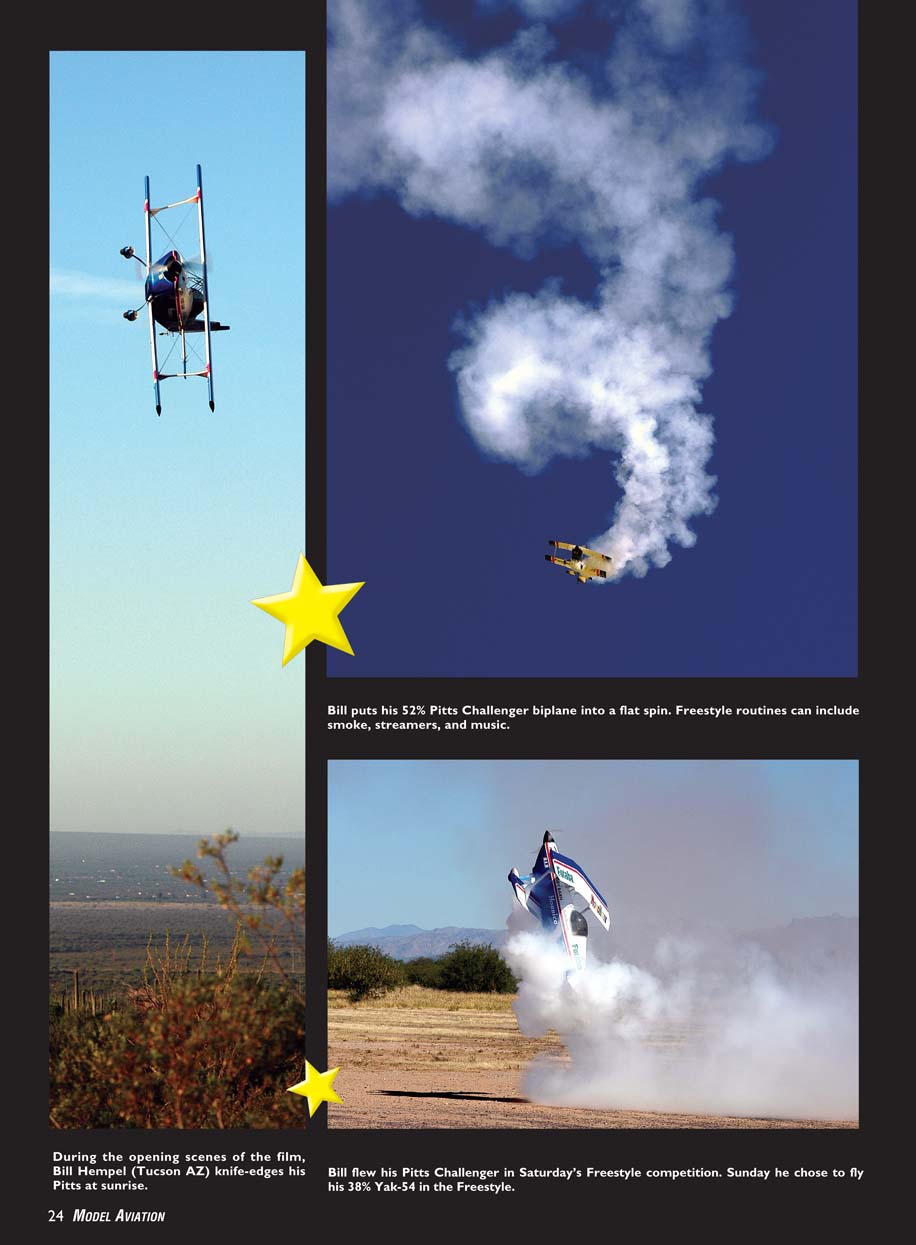
The camera crews broke up into three groups and headed out to find the competitors. Getting a feel for the pilot's state of mind going into the contest was paramount to the film, and finding out how individuals approach getting psyched into the big event was riveting.
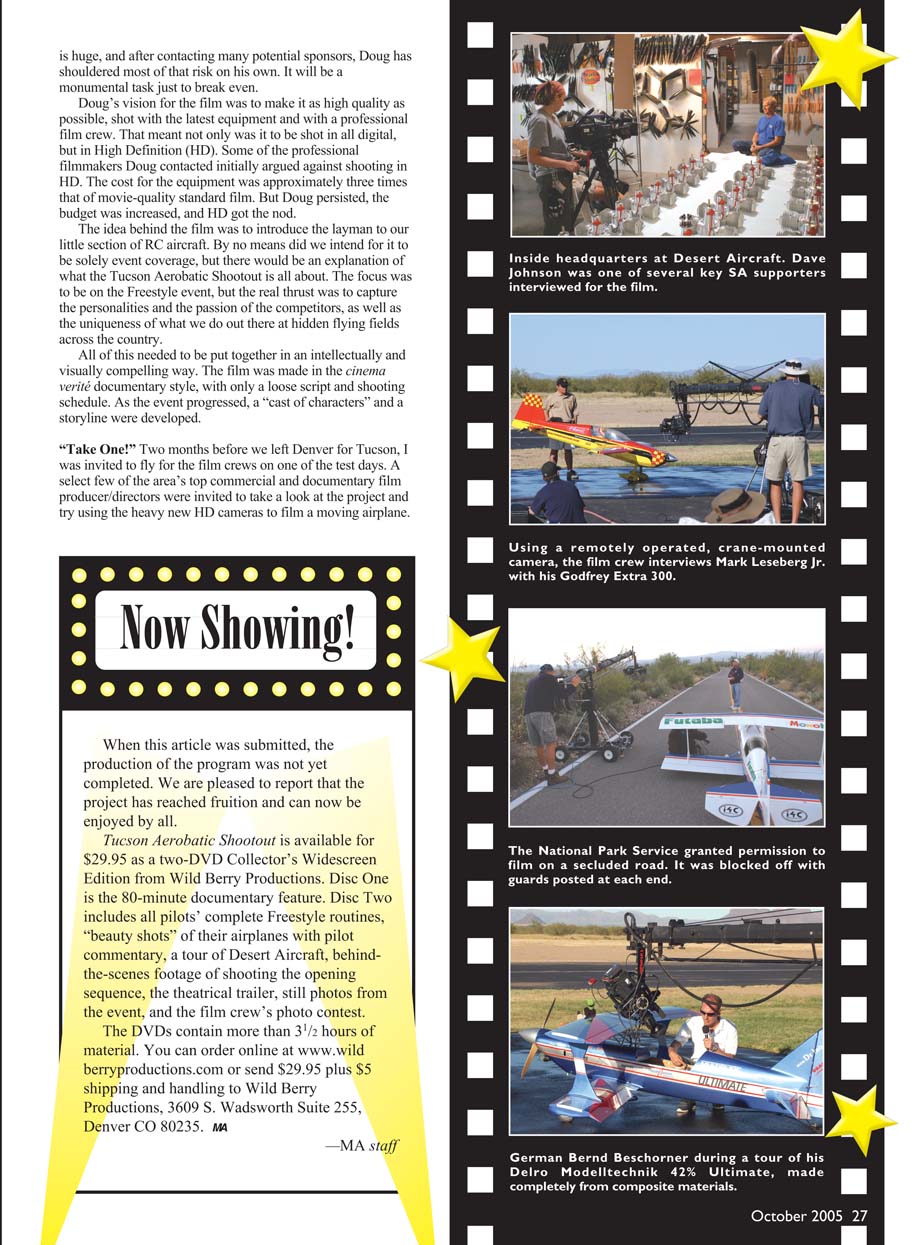
To get a good sampling of how the fliers prepare, we interviewed them in differing situations: some from their home shops, others at the practice field, and even a few as they mingled at Desert Aircraft—the primary sponsor of the event and a leading manufacturer of the gas engines used in the Giant Scale airplanes.
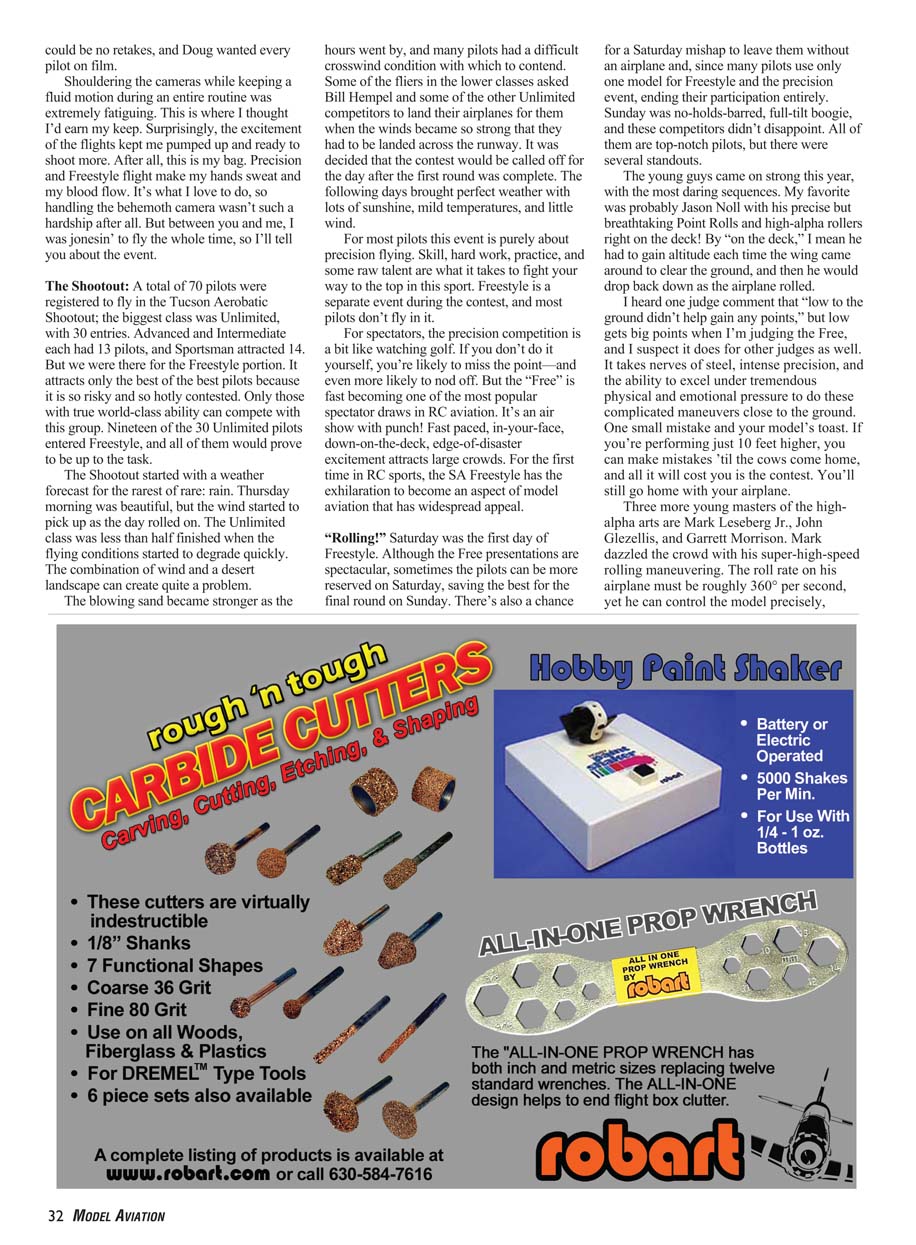
This was a contest with international competitors. Christophe Paysant-Le Roux of France, Bernd Beschorner of Germany, and others from within and outside the US had shipped their airplanes to the Desert Aircraft facility in Tucson, and we captured them on film unpacking the huge crates and assembling their models to prepare for the competition.
Another aspect of the film was to capture the peripheral players: manufacturers, mechanics for the high-profile pilots, and builders. Brian Hueffmeier flies SA, but he is also one of the most respected builders in the hobby. pilot for the movie The Aviator, about the life of Howard Hughes starring Leonardo DiCaprio, so working with our little crew was no sweat.
(Editor’s note: The three-part story about the airplanes made for The Aviator was published in the July, August, and September 2005 issues of MA.)
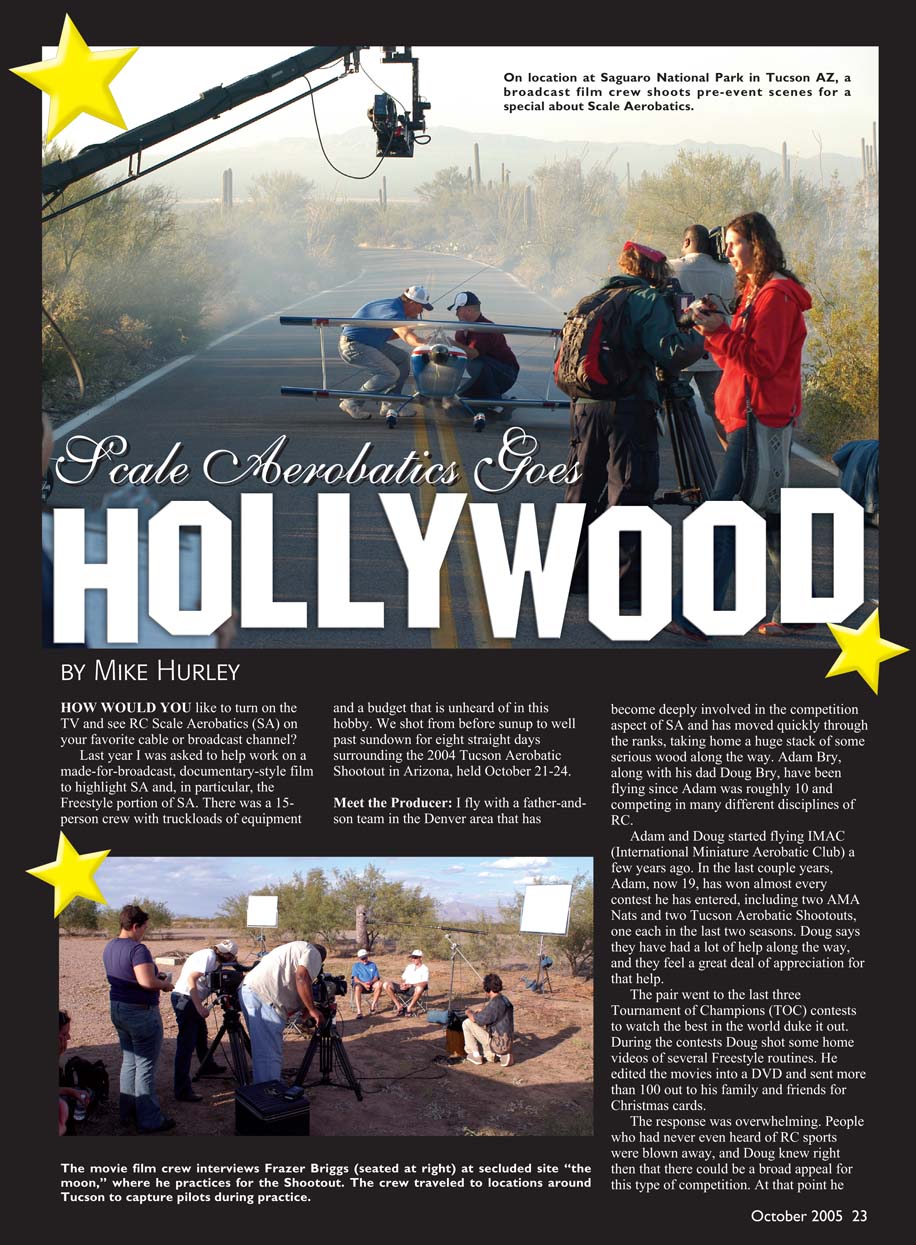
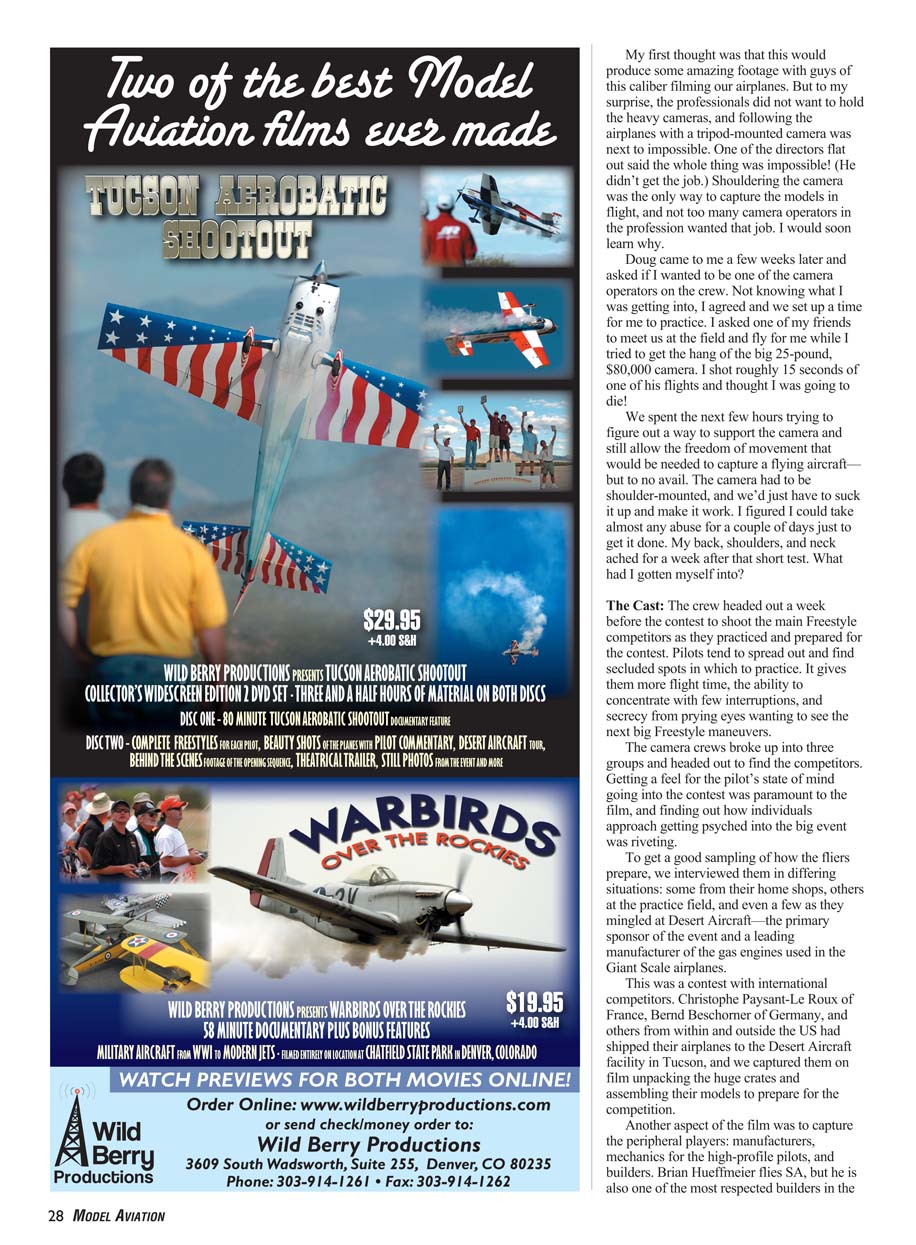
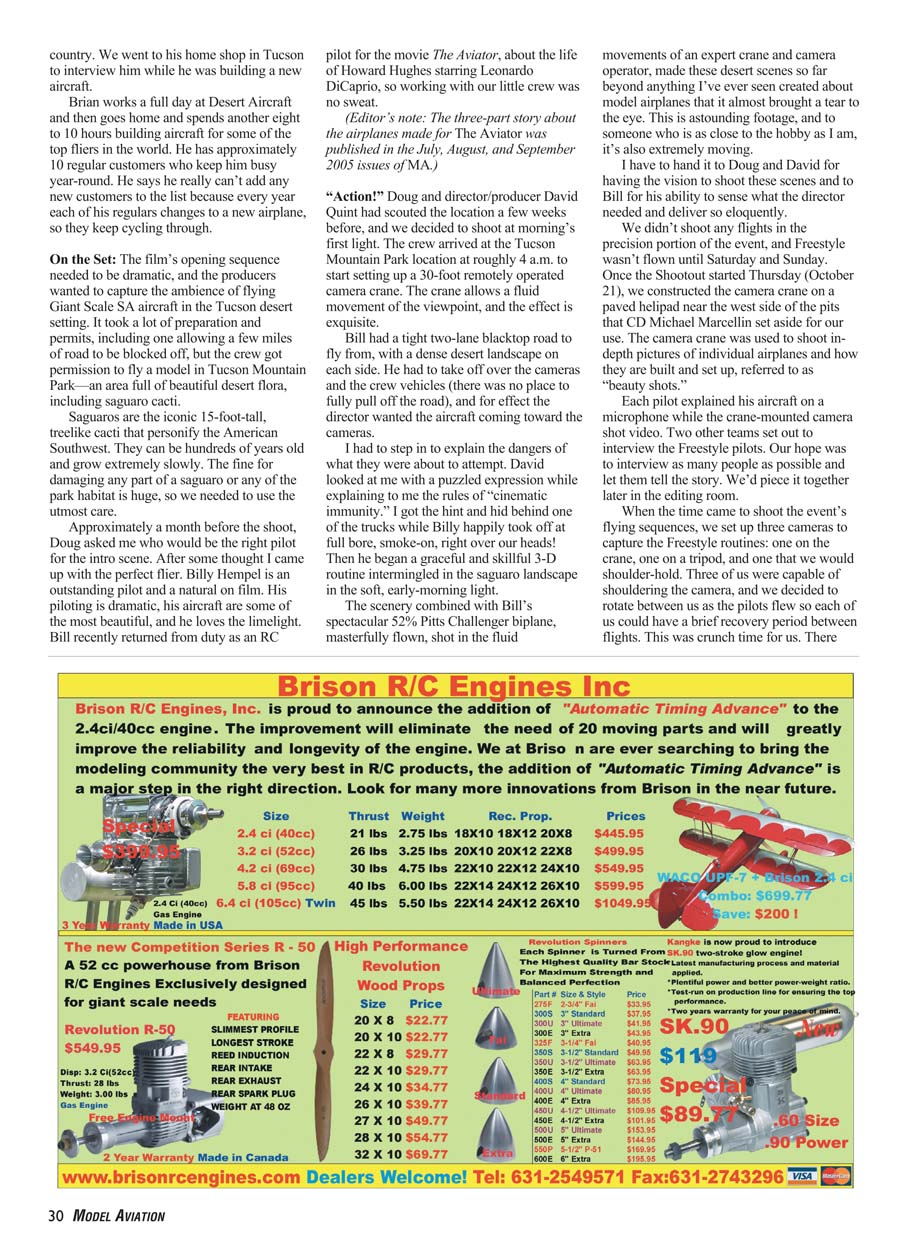
“Action!” Doug and director/producer David Quint had scouted the location a few weeks before, and we decided to shoot at morning’s first light. The crew arrived at the Tucson Mountain Park location at roughly 4 a.m. to start setting up a 30-foot remotely operated camera crane. The crane allows a fluid movement of the viewpoint, and the effect is exquisite.
Bill had a tight two-lane blacktop road to fly from, with a dense desert landscape on each side. He had to take off over the cameras and the crew vehicles (there was no place to fully pull off the road), and for effect the director wanted the aircraft coming toward the cameras.
I had to step in to explain the dangers of what they were about to attempt. David looked at me with a puzzled expression while explaining to me the rules of “cinematic immunity.” I got the hint and hid behind one of the trucks while Billy happily took off at full bore, smoke-on, right over our heads! Then he began a graceful and skillful 3-D routine intermixed in the saguaro landscape in the soft, early-morning light.
The scenery combined with Bill’s spectacular 52% Pitts Challenger biplane, masterfully flown, shot in the fluid movements of an expert crane and camera operator, made these desert scenes so far beyond anything I’ve ever seen created about model airplanes that it almost brought a tear to the eye. The footage is astounding, and to someone who is as close to the hobby as I am, it’s also extremely moving.
I have to hand it to Doug and David for having the vision to shoot these scenes and to Bill for his ability to sense what the director needed and deliver so eloquently.
We didn’t shoot any flights in the precision portion of the event, and Freestyle wasn’t flown until Saturday and Sunday. Once the Shootout started Thursday (October 21), we constructed the camera crane on a paved helipad near the west side of the pits that CD Michael Marcellin set aside for our use. The camera crane was used to shoot in-depth pictures of individual airplanes and how they are built and set up, referred to as “beauty shots.”
Each pilot explained his aircraft on a microphone while the crane-mounted camera shot video. Two other teams set out to interview the Freestyle pilots. Our hope was to interview as many people as possible and let them tell the story. We’d piece it together later in the editing room.
When the time came to shoot the event’s flying sequences, we set up three cameras to capture the Freestyle routines: one on the crane, one on a tripod, and one that we would shoulder-hold. Three of us were capable of shouldering the camera, and we decided to rotate between us as the pilots flew so each of us could have a brief recovery period between flights. This was crunch time for us. There could be no retakes, and Doug wanted every pilot on film.
Shouldering the cameras while keeping a fluid motion during an entire routine was extremely fatiguing. This is where I thought I’d earn my keep. Surprisingly, the excitement of the flights kept me pumped up and ready to shoot more. After all, this is my bag. Precision and Freestyle flight make my hands sweat and my blood flow. It’s what I love to do, so handling the behemoth camera wasn’t such a hardship after all. But between you and me, I was jonesin’ to fly the whole time, so I’ll tell you about the event.
The Shootout: A total of 70 pilots were registered to fly in the Tucson Aerobatic Shootout; the biggest class was Unlimited, with 30 entries. Advanced and Intermediate each had 13 pilots, and Sportsman attracted 14. But we were there for the Freestyle portion. It attracts only the best of the best pilots because it is so risky and so hotly contested. Only those with true world-class ability can compete with this group. Nineteen of the 30 Unlimited pilots entered Freestyle, and all of them would prove to be up to the task.
The Shootout started with a weather forecast for the rarest of rare: rain. Thursday morning was beautiful, but the wind started to pick up as the day rolled on. The Unlimited class was less than half finished when the flying conditions started to degrade quickly. The combination of wind and a desert landscape can create quite a problem.
The blowing sand became stronger as the hours went by, and many pilots had a difficult crosswind condition with which to contend. Some of the fliers in the lower classes asked Bill Hempel and some of the other Unlimited competitors to land their airplanes for them when the winds became so strong that they had to be landed across the runway. It was decided that the contest would be called off for the day after the first round was complete. The following days brought perfect weather with lots of sunshine, mild temperatures, and little wind.
For most pilots this event is purely about precision flying. Skill, hard work, practice, and some raw talent are what it takes to fight your way to the top in this sport. Freestyle is a separate event during the contest, and most pilots don’t fly in it.
For spectators, the precision competition is a bit like watching golf. If you don’t do it yourself, you’re likely to miss the point—and even more likely to nod off. But the “Free” is fast becoming one of the most popular spectator draws in RC aviation. It’s an air show with punch! Fast paced, in-your-face, down-on-the-deck, edge-of-disaster excitement attracts large crowds. For the first time in RC sports, the SA Freestyle has the exhilaration to become an aspect of model aviation that has widespread appeal.
“Rolling!” Saturday was the first day of Freestyle. Although the Free presentations are spectacular, sometimes the pilots can be more reserved on Saturday, saving the best for the final round on Sunday. There’s also a chance for a Saturday mishap to leave them without an airplane and, since many pilots use only one model for Freestyle and the precision event, ending their participation entirely. Sunday was no-holds-barred, full-tilt boogie, and these competitors didn’t disappoint. All of them are top-notch pilots, but there were several standouts.
The young guys came on strong this year, with the most daring sequences. My favorite was probably Jason Noll with his precise but breathtaking Point Rolls and high-alpha rollers right on the deck! By “on the deck,” I mean he had to gain altitude each time the wing came around to clear the ground, and then he would drop back down as the airplane rolled.
I heard one judge comment that “low to the ground don’t help gain any points,” but low gets big points when I’m judging the Free, and I suspect it does for other judges as well. It takes nerves of steel, intense precision, and the ability to excel under tremendous physical and emotional pressure to do these complicated maneuvers close to the ground. One small mistake and your model’s toast. If you’re performing just 10 feet higher, you can make mistakes ’til the cows come home, and all it will cost you is the contest. You’ll still go home with your airplane.
Three more young masters of the high-alpha arts are Mark Leseberg Jr., John Glezellis, and Garrett Morrison. Mark dazzled the crowd with his super-high-speed rolling maneuvering. The roll rate on his airplane must be roughly 360° per second, yet he can control the model precisely, putting it where he wants, when he wants, in any position or attitude. The airplane is a blur, yet he is in full control. I'm sure he's whipping those radio sticks around like the drummer for Metallica!
John Glezellis has the knack of doing things with an airplane that no one else even thinks of. With his Latin beat music and the way he dances the model through the air, it's almost as if you can feel his passion come through in his performance. Talking with John in person, he's a reserved, quiet, even calculating kind of guy. But his Freestyle routine reveals a lot of internal fire. The performer inside is trying to get out, and you can see that fire rust in his model.
Garrett Morrison is not a reserved guy, and his piloting speaks volume. Garrett takes you away from the dance floor and into the funhouse. His happy-go-lucky music, changing tempos, and daring flying skill keep the heart pumping and the face smiling during the whole performance.
I think Andrew Jesky was the youngest Unlimited pilot and Free performer. In his last Freestyle on Sunday, he got his airplane a little too low on a Parachute maneuver and it smacked the ground. It hit wheels-down, slamming the rudder, splaying the gear slightly, and ever so slightly kissing the dirt with the propeller. The model popped back into the air, and Andrew flew it back around and landed it without incident. He can be credited with quick thinking and exceptional piloting skill in his recovery.
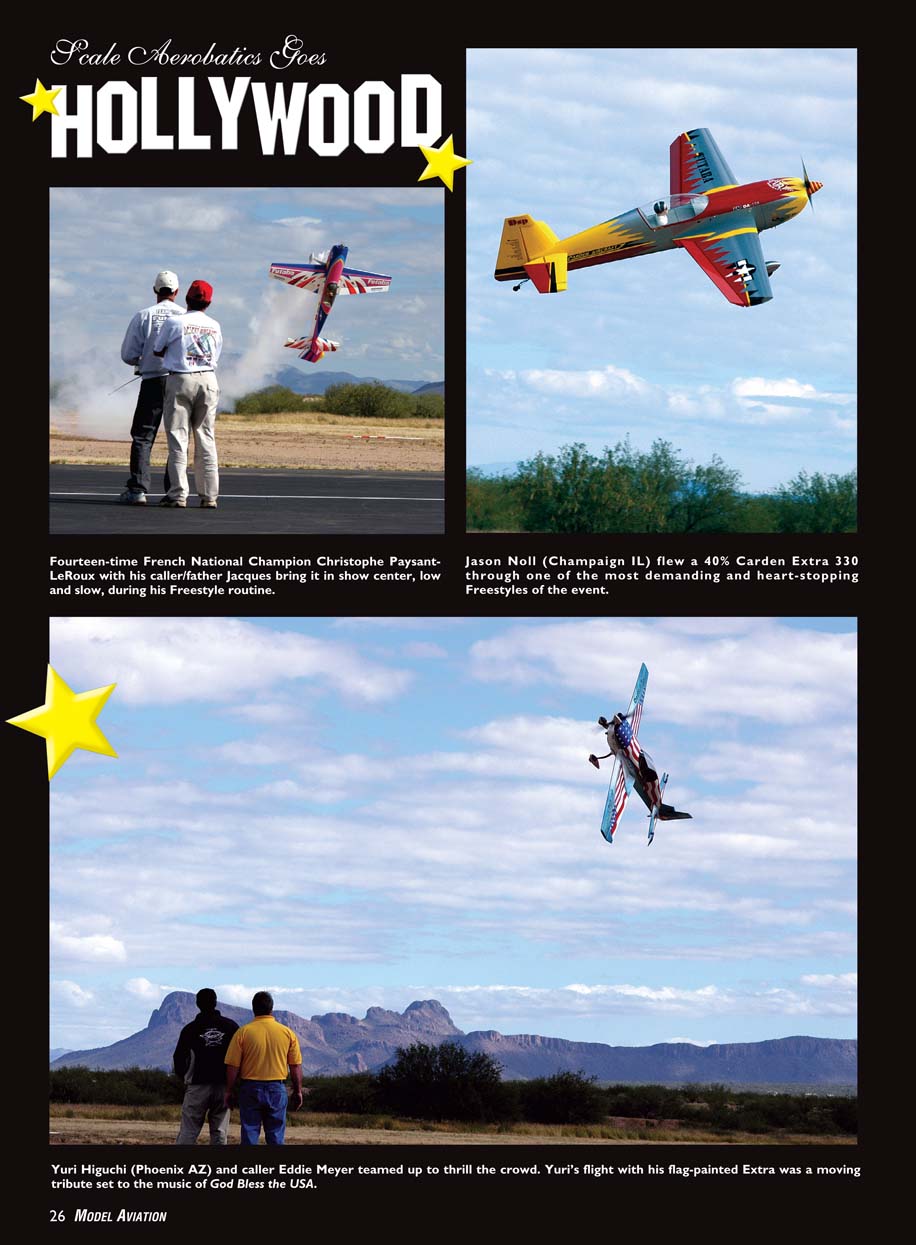
The best performers weren't all 20-somethings. This was my first meeting with Joe McBride, and he made quite an impression on the pilots and the spectators. Smokin' Joe got in there and mixed it up with the best of them, and I think he went home as one of the crowd favorites.
The usual big names were at the Shootout too. French competitor Christophe Paysant-LeRoux was spectacular, but he used the same Freestyle he's had for nearly four years. That just isn't going to give you win with the sophistication of today's judges.
Quique Somenzi won Freestyle in spite of Mark Leseberg's early lead. As was evident in his last TOC Freestyle, Quique's flying has evolved beyond what most of us are doing and into a more demanding, more precise, and more elegant performance. However, he didn't make the mistake he made at the last TOC of being overly artistic. This time he gave us that punch in the face we all want, with some daring and spectacular flying, including a new maneuver that will suck the air right out of your chest.
During a horizontal line, Quique executes a violent inverted snap, plummeting the airplane vertically in a brutal spin, and then it instantaneously explodes into a slow and graceful flat spin ending at roughly his chest level. It's sort of like a horizontal to vertical Blender with a pinch of fear factor mixed in.
Frazer Briggs, a longtime competitor from New Zealand, was the overall winner of the precision portion of the Shootout, and he took second place in Freestyle. He had a different sequence for each of his three Freestyle rounds. In the end, I think this is one thing that set him apart from the other fliers. Although there are different judges for all three rounds, all of the judges watched all three rounds. The element of surprise and newness keeps everybody guessing, and that's exciting. And exciting is what scores high in the Free.
The Tucson Aerobatic Shootout continues to grow in popularity and incredible sponsorship. The manufacturers, individuals, and organizations that support this event make up the world's Who's Who of SA devotees. This year the value of cash and in-kind prizes for the contestants exceeded $80,000! Not too shabby for a bunch of guys flying "toy airplanes"!
The contest's main sponsor/promoter is Dave Johnson of Desert Aircraft, and it's held at the TIMPA (Tucson International Modelplane Park Association) field just outside of Tucson. People come from across the country and the world to compete in the contest, help run it, and help judge the flights. Fred Johnson of Florida and Peter Wessels of Germany are among those who traveled a great distance to judge.
"Cut!" With the exception of Doug and myself, the rest of the film crew, being complete outsiders, had no idea what they were getting into. They had never even seen airplanes like the ones we were shooting, and to find such an organized and technically sophisticated sport, taking place completely
Transcribed from original scans by AI. Minor OCR errors may remain.

