
Scale World Championships
by Stan Alexander
RC and CL masters compete for international honors
Sweden was the host country of the 19th Scale World Championships, held July 13–23, 2006. As do many countries that host the World Championships, the Swedish aeroclub used a military base in the town of Norrköping to complete static and flight competition. The weather was great all week for a championships, with little rain and light winds. And as some of the locals noted, there was no snow; evidently that can happen even in July.
To represent their country at the World Championships, scale modelers usually qualify at a Team Selection held by their aeroclub—in our case AMA—the FAI Scale Team Selection Committee, and the National Association of Scale Aeromodelers (NASA). In 2005 our team was selected from an open competition in which any AMA member could participate. The winners were awarded Gold, Silver, and Bronze medals, just as they would be at the World Championships. Two classes were flown: F4B (CL Scale) and F4C (RC Scale).
In roughly the past 10 years the rules have changed for the better. Although they still require roughly 80 pages to print off, that includes the most comprehensive list of flight diagrams available for Scale competition. Most of the flight maneuvers for F4B and F4C are similar, if not identical, to AMA rule-book maneuvers.
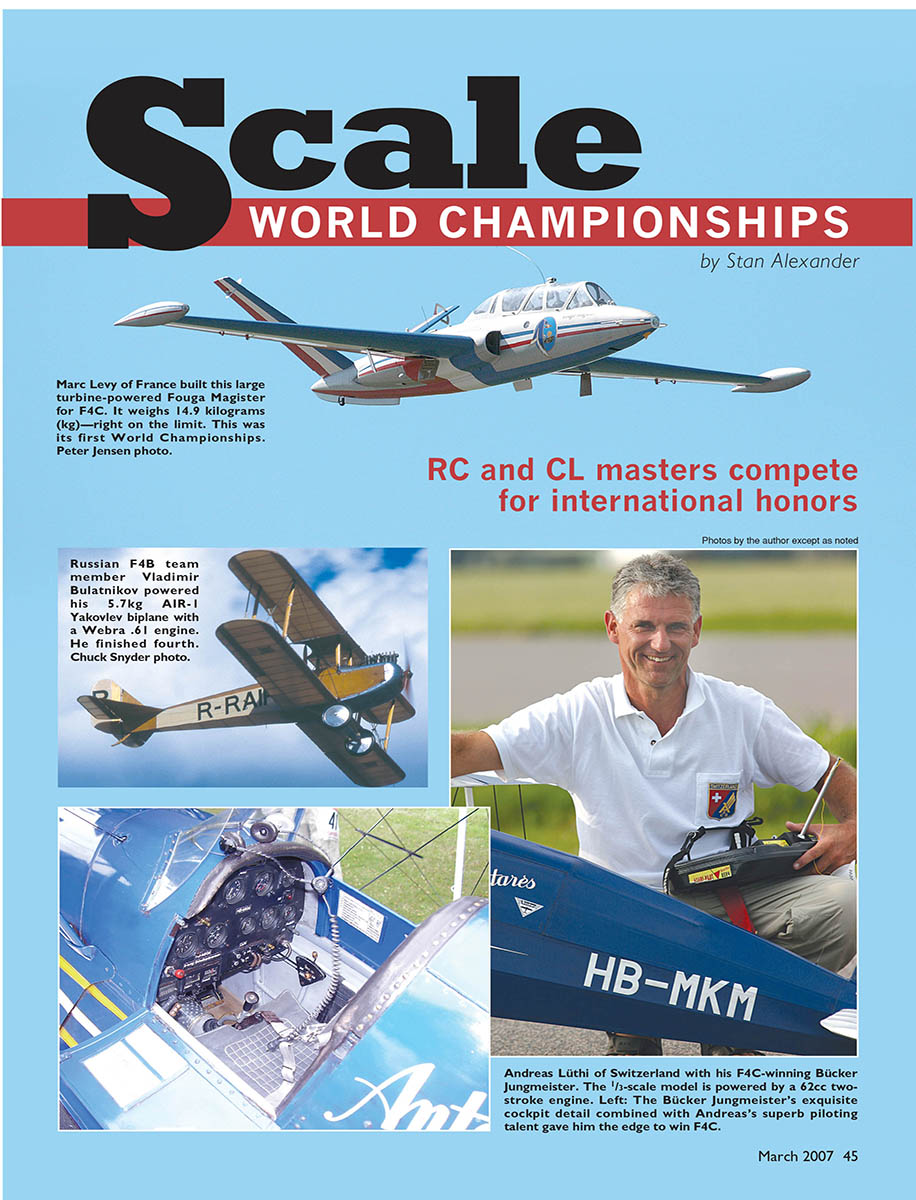
Keep the new weight rules in mind. The F4C (RC Scale) limit is 15 kilograms (33.03 pounds) and the F4B (CL Scale) limit is 6 kilograms (13.22 pounds). Several airplanes at the World Championships almost reached the F4C weight limit, including the Bücker Jungmeister, the F-15 Eagle, and the Fw 190 from South Africa.
A larger assortment of aircraft has been competitive at the World Championships recently, including jets, World War II types, civil airplanes, and the European favorite World War I subjects. Ten years ago almost all the top 10 finishers were World War I models of some type, but that is no longer the case. A rebuilt 1930s biplane did finish first this year, but other kinds were right on its heels in static and flight competition.
At a World Championships a formal dinner and opening ceremony are usually followed by an air show and a parade through the town in the host country. We don't do anything like that here in the US.
A World Championships can last eight or nine days. Proposals are being circulated to reduce this to a week; organizers and many competitors hope this happens soon.
The pit area for all the countries is usually in a large tent or, as it was this year, in a large gym or hangar. Once you put your model together, it can stay together for the entire contest. Teams eat together, participate in the competition, and closely watch the other teams in static and especially flight competition.
Team USA, led by Manager Lloyd Roberts, brought our national flag for display and pins and giveaways for kids and other competitors from around the world. This is a great opportunity to meet people of different nationalities, make friends, and learn about interesting documentation sources. There were 19 countries present for this year's Championships.
After the teams marched into the national flag area and F4 Scale Chairman Narve Jensen opened the ceremony, local officials, the mayor, and others spoke briefly to the gathered crowd.
A manager usually accompanies the team, or he or she can be one of the three team members.
Results — F4B (CL Scale)
- This year the team from Poland won the F4B team competition, with its members placing second, third, and eighth.
- Silver medals went to the team from Russia, whose members finished first, fourth, and 10th; less than 100 points separated the two places.
- Team USA finished third overall. Bronze medals were awarded to the U.S. F4B team (team members Dale Campbell — 5th, Chuck Snyder — 6th, Ralph Burnstine — 11th, and F4B Team Manager Richard Schneider).
There was some controversy about the winning Yak-52 performing nonaerobatic maneuvers and a "leaflet drop" during the flight performance. The Russian Yak, with the overall white color scheme, is definitely an acrobatic aircraft, and many expected the flight routine to reflect that.
Notable F4B individual performances:
- Second place (individual): Piotr Zawada (Poland) with the twin-engine Airspeed AS.10 Oxford. His Oxford had a wingspan of 79 inches, was powered by two O.S. .52 FS engines, and had all other parts, including the landing gear, scratch-built.
- Third place: Marian Kazirod (Poland), former World Champion, with his Fairey Battle Mk II. It had a wingspan of 85.75 inches, was powered by an O.S. 1.20 FS engine, and weighed 6.2 kilograms (just over 12 pounds).
- Twins and multiengine models remain competitive: Chuck Snyder flew a Henschel Hs 129B-2/R-2 (two Thunder Tiger .46 two-stroke engines), model weight 6.87 kilograms, wingspan 76 inches.
- Dale Campbell flew a highly detailed Spacewalker II built to 1/4 scale, powered by an O.S. 1.20 FS engine, covered with fabric and painted with dope.
- Mechanical problems kept Ralph Burnstine out of contention with his de Havilland Chipmunk trainer (powered by an O.S. four-stroke engine).
Results — F4C (RC Scale) and static judging
F4C static judging actually started before the opening ceremony. Judging teams were divided into two groups: three judges evaluated outline, and three other judges scored color, scale details, surface texture, and craftsmanship.
Unlike in many Scale competitions, expect to lose points if you can't prove that your model looks the way it should at the World Championships. Some scale modelers think this restricts the subjects they can model, but it primarily allows the contestant to show how well his or her model matches the documentation.
Having photos of the airplane showing both sides of the fuselage and many detail shots is a huge advantage. You also need at least one complete photo of the entire full-scale aircraft you have modeled; that is the minimum criterion to compete. Static judges watch for any nonscale items such as wing bolts, mufflers sticking out, switches, clevises, nonscale control horns, servo hatches, and the entire cockpit. A few modelers actually move control surfaces while judges examine the cockpit to show that the joystick and rudder pedals are connected.
In past years competitors have asked for notes after static judging to understand point deductions. This year the F4C team managers received a total of 104 pages of notes on 52 airplanes. The F4B static and flight judges will be giving notes back at the next World Championships.
High static and winners:
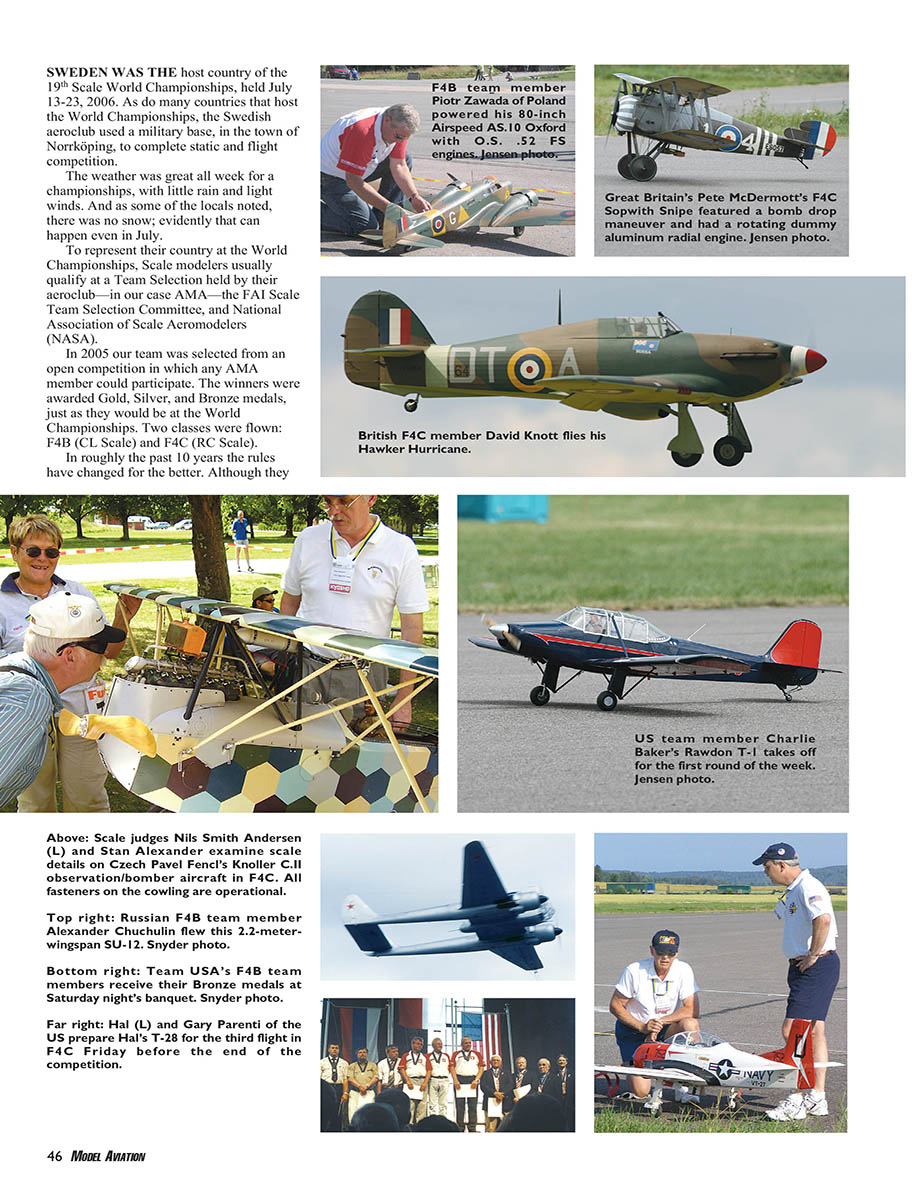
- The high static score in F4C went to Great Britain's Pete McDermott with his Sopwith Snipe, just edging out eventual winner Andreas Lüthi of Switzerland with his Bücker Jungmeister. Pete finished second overall with a scratch-built model that featured a bomb drop in the flight routine. The Snipe's dummy aluminum radial engine actually spun in flight and was powered by a Laser-360V twin experimental engine.
- Humphrey LeGrice (South Africa) had a high-static Focke-Wulf Fw 190 A-6 with extensive cockpit detail; he finished seventh overall.
- Germany's Max Merckenschlager earned second place with his Grumman F7F Tigercat. The big model (86.86-inch wingspan) had folding wings, was powered by two O.S. .91 FS engines, weighed 22.44 pounds, and featured scratch-built retracts and brakes.
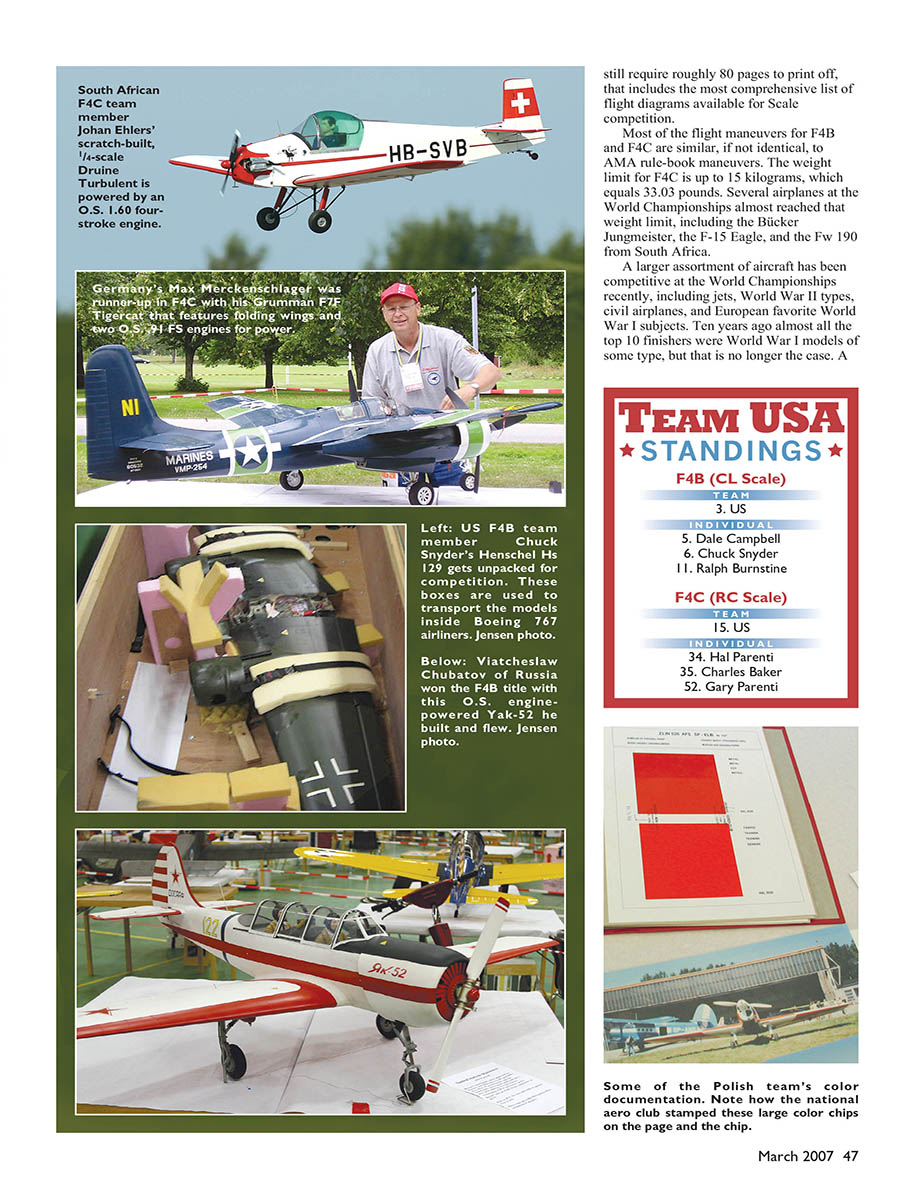
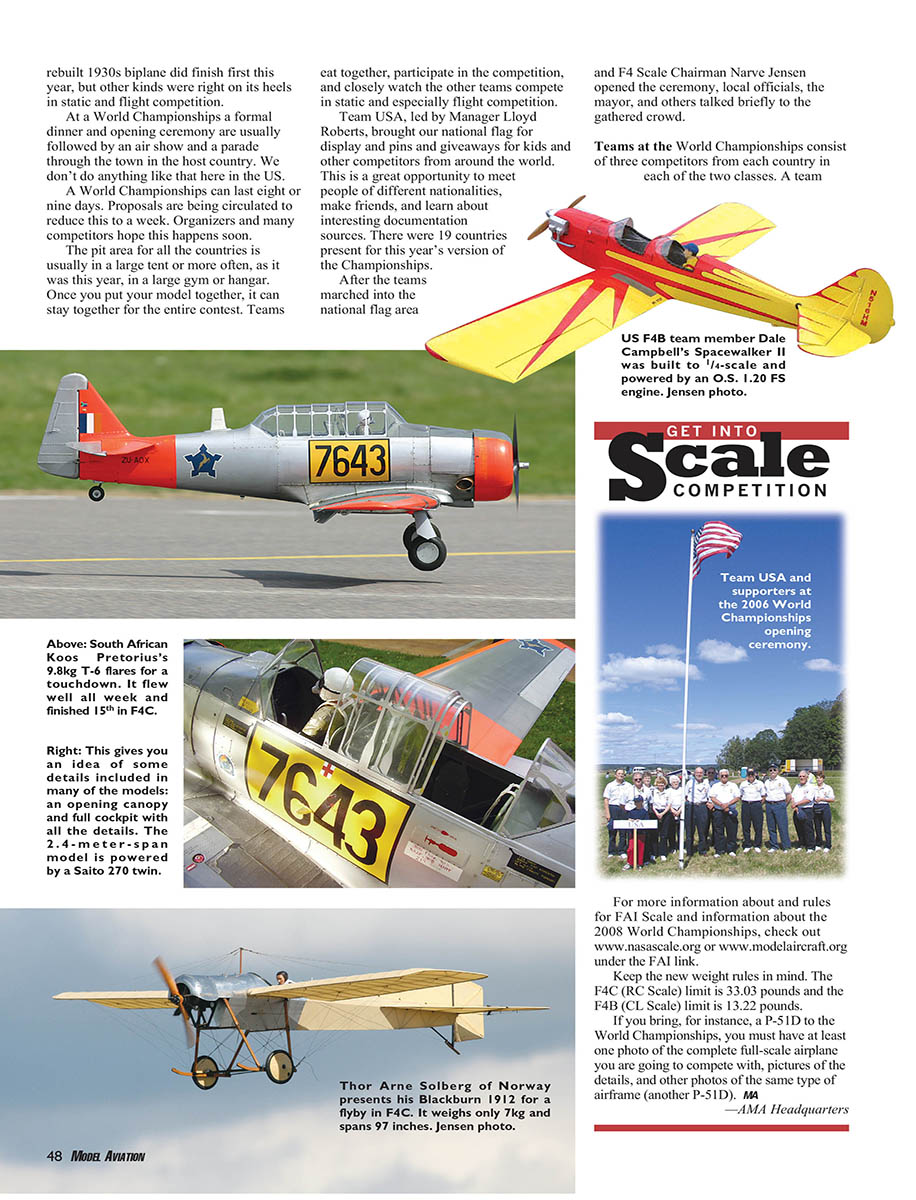
- Andreas Lüthi (Switzerland) brought his Bücker Jungmeister; the documentation was excellent and the outline judges said the model's outline was almost flawless. Combined with daily practice and strong flying skills, he was hard to beat and won the F4C title. Andreas has won the last four World Championships with two airplane models; many think it's time for him to retire the Jungmeister.
Team competition — F4C:
- Andreas Lüthi's individual win, along with team members Max Schilt and Gody Fischer, put Switzerland in third place in the team competition.
- The Czech Republic team fought to a first-place team finish. Team Manager Pavel Fencl flew his Knoller C.II to a fifth-place finish in F4C and was in second place at the end of the second round.
- Petr Tax (Czech Republic) brought a huge French Caudron G.IV with a 162-inch wingspan, finished fourth overall. The G.IV weighed 12 kilograms (26.4 pounds) and was powered by two Laser-200 four-stroke engines. Petr experienced problems in the second round and elected not to fly further.
- Teammate Karel Vodsiel flew a Bristol F.2B Fighter to an eighth-place finish. All three Czech models were large, well detailed, and scratch-built.
Team USA — F4C problems: Mechanical problems kept Team USA's F4C contingent out of the running. Gary Parenti crash-landed his T-28 during practice before his first official flight; the wing and landing gear damage were not reparable. Hal Parenti, flying an identical T-28, completed most of his three flights but suffered engine problems and was out of contention. Charlie Baker completed all three of his flights with his Rawdon T-1 and finished 35th overall.
Team selection and future events
The Team Selection competition for the 2008 FAI World Championships is mostly set, with most members of the FAI Scale Team Selection Committee in agreement. Committee Chairman Mike Gretz is voting to hold the event at the USA FAI Scale Championships in Muncie, Indiana, September 20–23. This first-year event is limited to U.S. residents and AMA members.
Thanks to a scale benefactor, NASA is offering $10,000 in prize money for this event. The top three finishers will create the U.S. team, and the fourth-place finisher will be the alternate. Hope to see everyone there!
The World Championships are already set for 2008 in Poland. Those who went to Sweden seemed to have had a great experience and were shown the best of times and excellent administrative efforts. I look forward to the next Team USA participating in F4B and F4C classes.
Thanks and acknowledgments
Thanks for the hard work of the Swedish staff and:
- Peter Kalhoff
- Bengt Lindgren
- Lennart Andersson
- Johan Bagg
- Lars-Erik Bengt
- Ulf Hammar
- Bertil Carlsson
- Rolf Pålsson
- Ulf Malmqvist
- Riikka Viikuna
- Lillian Sahlin
For more information about FAI Scale rules and the 2008 World Championships, check:
- www.nasascale.org
- www.modelaircraft.org (under the FAI link)
For more information about the 2006 World Championships, photos, and videos, go to:
MA Stan Alexander [email protected]
Transcribed from original scans by AI. Minor OCR errors may remain.

