
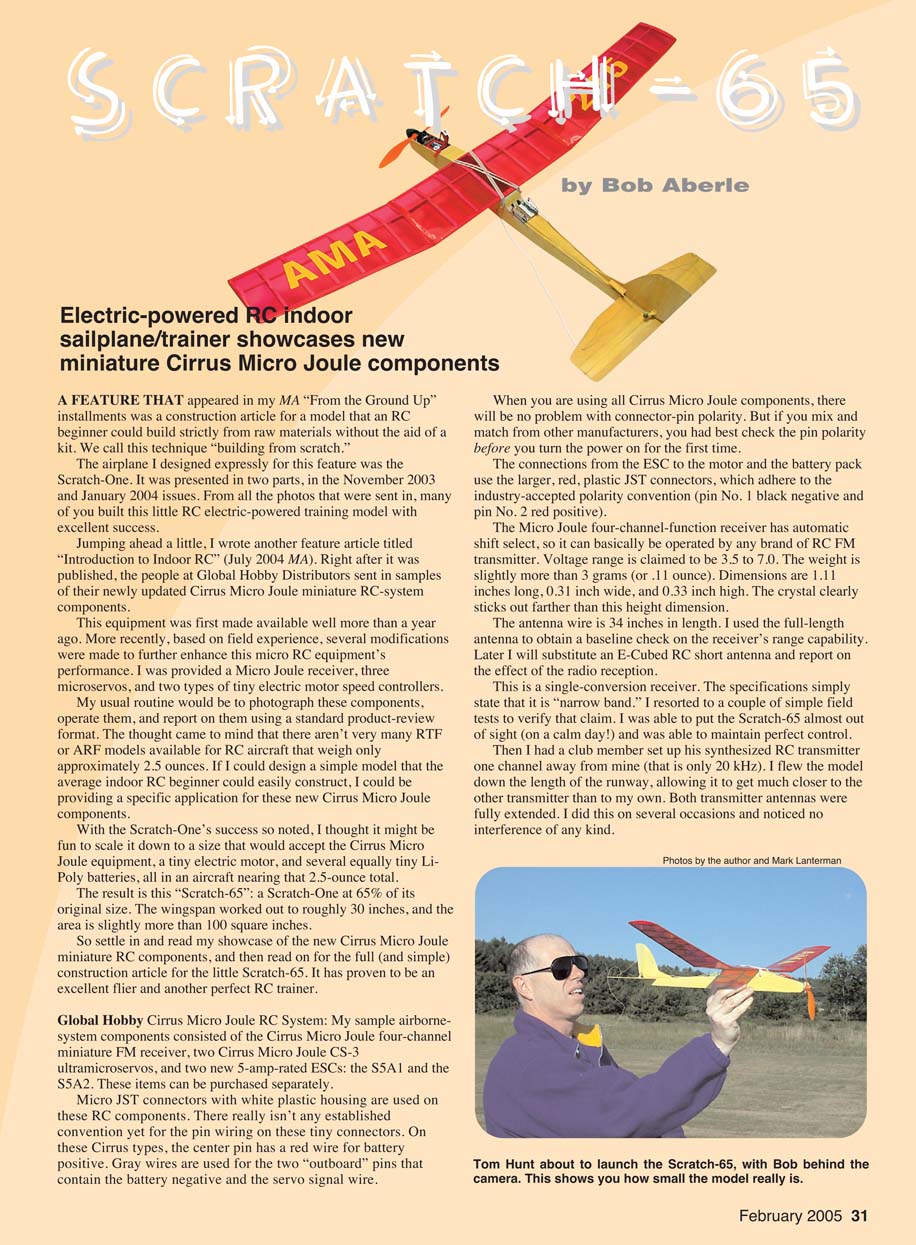
SCRATCH-65
by Bob Aberle
Electric-powered RC indoor sailplane/trainer showcases new miniature Cirrus Micro Joule components
A feature that appeared in my MA “From the Ground Up” installments was a construction article for a model that an RC beginner could build strictly from raw materials without the aid of a kit. We call this technique “building from scratch.”
The airplane I designed expressly for this feature was the Scratch-One. It was presented in two parts, in the November 2003 and January 2004 issues. From all the photos that were sent in, many of you built this little RC electric-powered training model with excellent success.
Jumping ahead a little, I wrote another feature article titled “Introduction to Indoor RC” (July 2004 MA). Right after it was published, the people at Global Hobby Distributors sent in samples of their newly updated Cirrus Micro Joule miniature RC-system components.
This equipment was first made available well more than a year ago. More recently, based on field experience, several modifications were made to further enhance this micro RC equipment’s performance. I was provided a Micro Joule receiver, three microservos, and two types of tiny electric motor speed controllers.
My usual routine would be to photograph these components, operate them, and report on them using a standard product-review format. The thought came to mind that there aren’t very many RTF or ARF models available for RC aircraft that weigh only approximately 2.5 ounces. If I could design a simple model that the average indoor RC beginner could easily construct, I could be providing a specific application for these new Cirrus Micro Joule components.
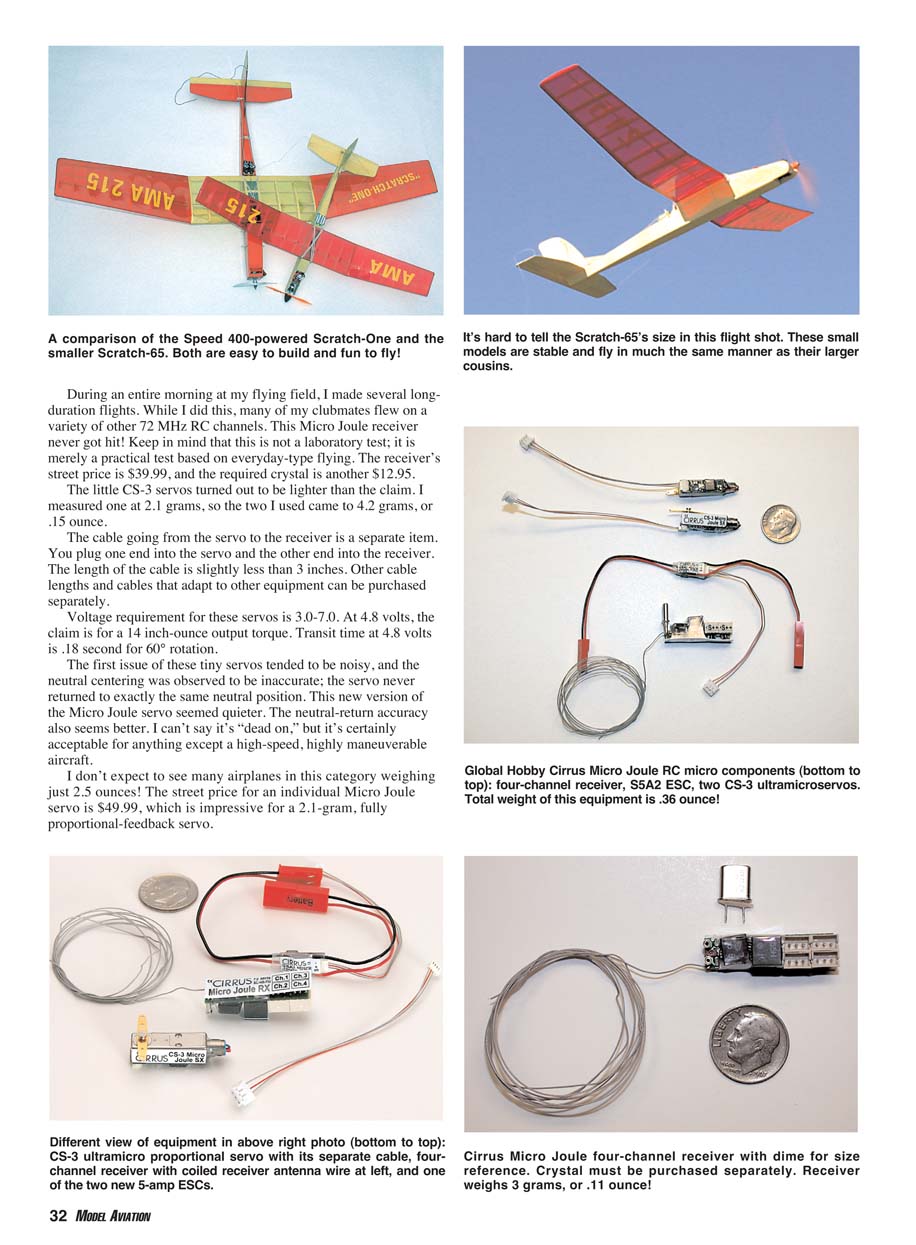
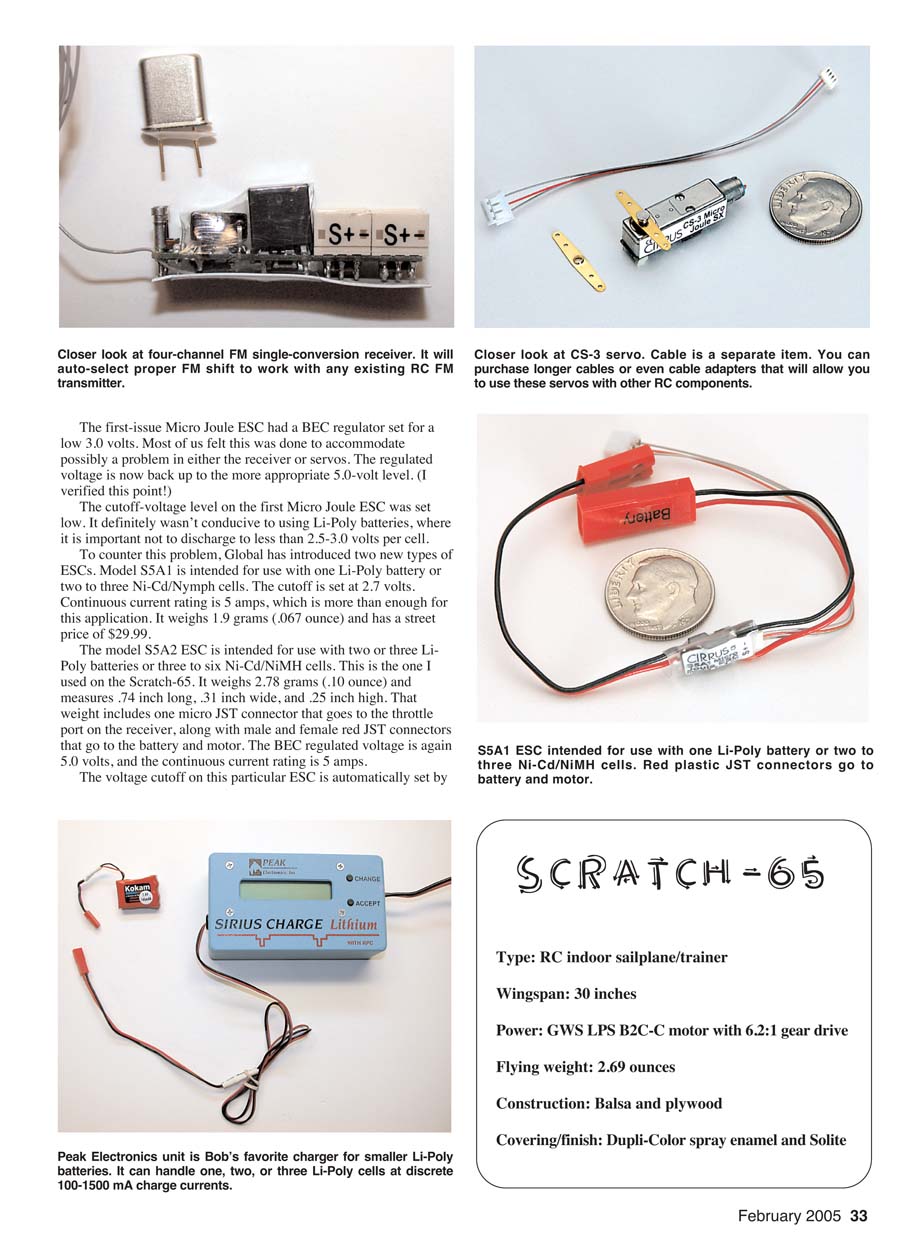
With the Scratch-One’s success so noted, I thought it might be fun to scale it down to a size that would accept the Cirrus Micro Joule equipment, a tiny electric motor, and several equally tiny Li-Poly batteries, all in an aircraft nearing that 2.5-ounce total. The result is this “Scratch-65”: a Scratch-One at 65% of its original size. The wingspan worked out to roughly 30 inches, and the area is slightly more than 100 square inches. So settle in and read my showcase of the new Cirrus Micro Joule miniature RC components, and then read on for the full (and simple) construction article for the little Scratch-65. It has proven to be an excellent flier and another perfect RC trainer.
Global Hobby Cirrus Micro Joule RC System
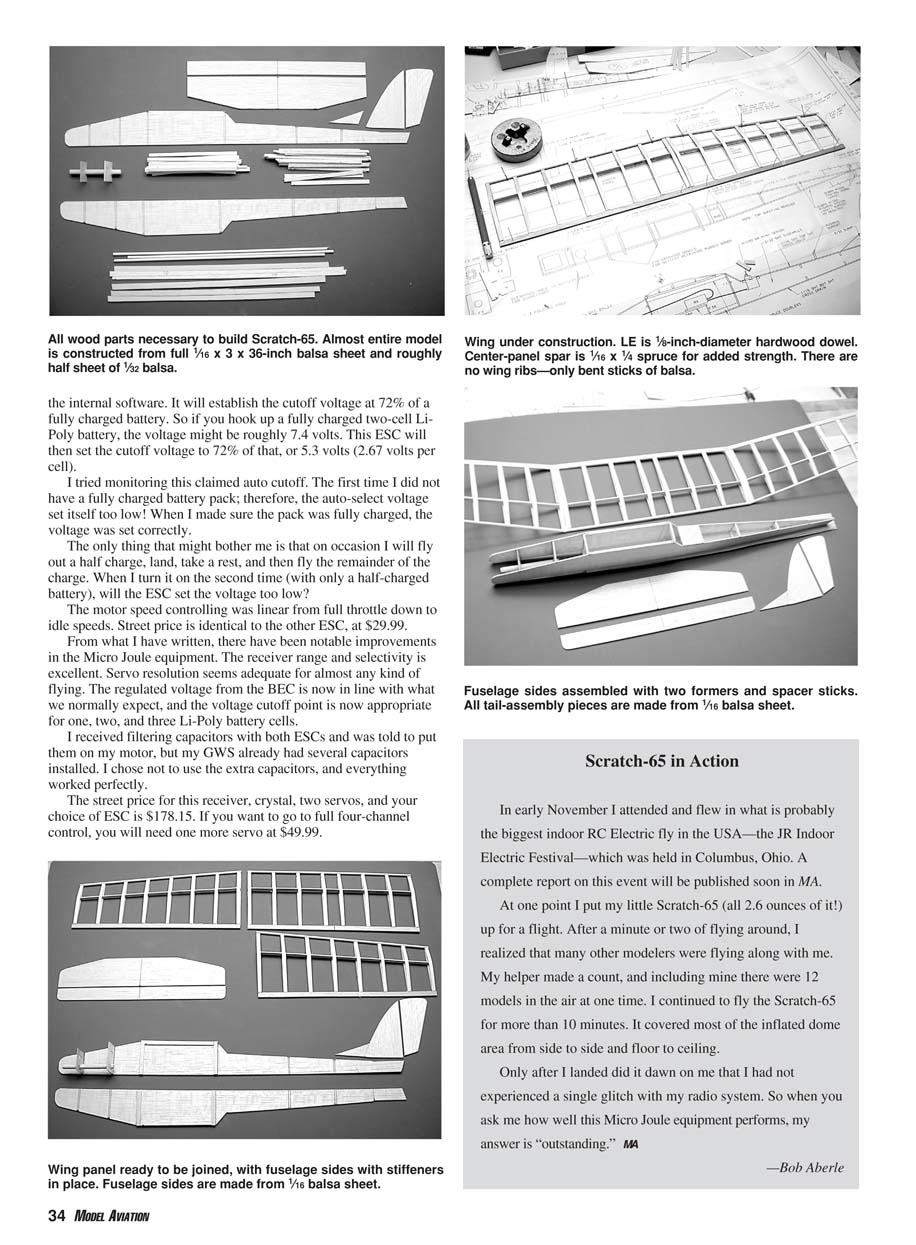
My sample airborne-system components consisted of the Cirrus Micro Joule four-channel miniature FM receiver, two Cirrus Micro Joule CS-3 ultramicroservos, and two new 5-amp-rated ESCs: the S5A1 and the S5A2. These items can be purchased separately.
Micro JST connectors with white plastic housing are used on these RC components. There really isn’t any established convention yet for the pin wiring on these tiny connectors. On these Cirrus types, the center pin has a red wire for battery positive. Gray wires are used for the two “outboard” pins that contain the battery negative and the servo signal wire.
When you are using all Cirrus Micro Joule components, there will be no problem with connector-pin polarity. But if you mix and match from other manufacturers, you had best check the pin polarity before you turn the power on for the first time.
The connections from the ESC to the motor and the battery pack use the larger, red, plastic JST connectors, which adhere to the industry-accepted polarity convention (pin No. 1 black negative and pin No. 2 red positive).
The Micro Joule four-channel-function receiver has automatic shift select, so it can basically be operated by any brand of RC FM transmitter. Voltage range is claimed to be 3.5 to 7.0 volts. The weight is slightly more than 3 grams (0.11 ounce). Dimensions are 1.11 inches long, 0.31 inch wide, and 0.33 inch high. The crystal clearly sticks out farther than this height dimension. The antenna wire is 34 inches in length. I used the full-length antenna to obtain a baseline check on the receiver’s range capability. Later I substituted an E-Cubed RC short antenna and reported on the effect of the radio reception.
This is a single-conversion receiver. The specifications simply state that it is “narrow band.” I resorted to a couple of simple field tests to verify that claim; I was able to put the Scratch-65 almost out of sight (on a calm day) and was able to maintain perfect control.
Then I had a club member set up his synthesized RC transmitter one channel away from mine (that is only 20 kHz). I flew the model down the length of the runway, allowing it to get much closer to the other transmitter than to my own. Both transmitter antennas were fully extended. I did this on several occasions and noticed no interference of any kind.
During an entire morning at my flying field, I made several long-duration flights. While I did this, many of my clubmates flew on a variety of other 72 MHz RC channels. This Micro Joule receiver never got hit! Keep in mind that this is not a laboratory test; it is merely a practical test based on everyday-type flying. The receiver's street price is $39.99, and the required crystal is another $12.95.
The little CS-3 servos turned out to be lighter than the claim. I measured one at 2.1 grams, so the two I used came to 4.2 grams (0.15 ounce).
The cable going from the servo to the receiver is a separate item. You plug one end into the servo and the other end into the receiver. The length of the cable is slightly less than 3 inches. Other cable lengths and cables that adapt to other equipment can be purchased separately.
Voltage requirement for these servos is 3.0–7.0 volts. At 4.8 volts, the claim is for a 14 inch-ounce output torque. Transit time at 4.8 volts is 0.18 second for 60° rotation.
The first issue of these tiny servos tended to be noisy, and the neutral centering was observed to be inaccurate; the servo never returned to exactly the same neutral position. This new version of the Micro Joule servo seemed quieter. The neutral-return accuracy also seems better. I can't say it's "dead on," but it's certainly acceptable for anything except a high-speed, highly maneuverable aircraft.
I don't expect to see many airplanes in this category weighing just 2.5 ounces! The street price for an individual Micro Joule servo is $49.99, which is impressive for a 2.1-gram, fully proportional-feedback servo.
The first-issue Micro Joule ESC had a BEC regulator set for a low 3.0 volts. Most of us felt this was done to accommodate possibly a problem in either the receiver or servos. The regulated voltage is now back up to the more appropriate 5.0-volt level (I verified this point).
The cutoff-voltage level on the first Micro Joule ESC was set low. It definitely wasn't conducive to using Li-Poly batteries, where it is important not to discharge to less than 2.5–3.0 volts per cell.
To counter this problem, Global has introduced two new types of ESCs:
- Model S5A1: intended for use with one Li-Poly battery or two to three Ni-Cd/NiMH cells. The cutoff is set at 2.7 volts. Continuous current rating is 5 amps. It weighs 1.9 grams (0.067 ounce) and has a street price of $29.99.
- Model S5A2: intended for use with two or three Li-Poly batteries or three to six Ni-Cd/NiMH cells. This is the one I used on the Scratch-65. It weighs 2.78 grams (0.10 ounce) and measures 0.74 inch long, 0.31 inch wide, and 0.25 inch high. That weight includes one micro JST connector that goes to the throttle port on the receiver, along with male and female red JST connectors that go to the battery and motor. The BEC regulated voltage is 5.0 volts, and the continuous current rating is 5 amps.
The internal software will establish the cutoff voltage at 72% of a fully charged battery. So if you hook up a fully charged two-cell Li-Poly battery, the voltage might be roughly 7.4 volts. This ESC will then set the cutoff voltage to 72% of that, or 5.3 volts (2.67 volts per cell).
I tried monitoring this claimed auto cutoff. The first time I did not have a fully charged battery pack; therefore, the auto-select voltage set itself too low. When I made sure the pack was fully charged, the voltage was set correctly.
One thing that might bother me is that on occasion I will fly out a half charge, land, take a rest, and then fly the remainder of the charge. When I turn it on the second time (with only a half-charged battery), will the ESC set the voltage too low?
The motor speed controlling was linear from full throttle down to idle speeds. Street price is identical to the other ESC, at $29.99.
From what I have written, there have been notable improvements in the Micro Joule equipment. The receiver range and selectivity is excellent. Servo resolution seems adequate for almost any kind of flying. The regulated voltage from the BEC is now in line with what we normally expect, and the voltage cutoff point is now appropriate for one, two, and three Li-Poly battery cells.
I received filtering capacitors with both ESCs and was told to put them on my motor, but my GWS already had several capacitors installed. I chose not to use the extra capacitors, and everything worked perfectly.
The street price for this receiver, crystal, two servos, and your choice of ESC is $178.15. If you want to go to full four-channel control, you will need one more servo at $49.99.
Specifications
- Type: RC indoor sailplane/trainer
- Wingspan: 30 inches
- Power: GWS LPS B2C-C motor with 6.2:1 gear drive
- Flying weight: 2.69 ounces
- Construction: Balsa and plywood
- Covering/finish: Dupli-Color spray enamel and Solite
Scratch-65 in Action
In early November I attended and flew in what is probably the biggest indoor RC electric fly-in in the USA—the JR Indoor Electric Festival—which was held in Columbus, Ohio. A complete report on this event will be published soon in MA.
At one point I put my little Scratch-65 (all 2.6 ounces of it!) up for a flight. After a minute or two of flying around, I realized that many other modelers were flying along with me. My helper made a count, and including mine there were 12 models in the air at one time. I continued to fly the Scratch-65 for more than 10 minutes. It covered most of the inflated dome area from side to side and floor to ceiling.
Only after I landed did it dawn on me that I had not experienced a single glitch with my radio system. So when you ask me how well this Micro Joule equipment performs, my answer is "outstanding." MA
—Bob Aberle
CONSTRUCTION
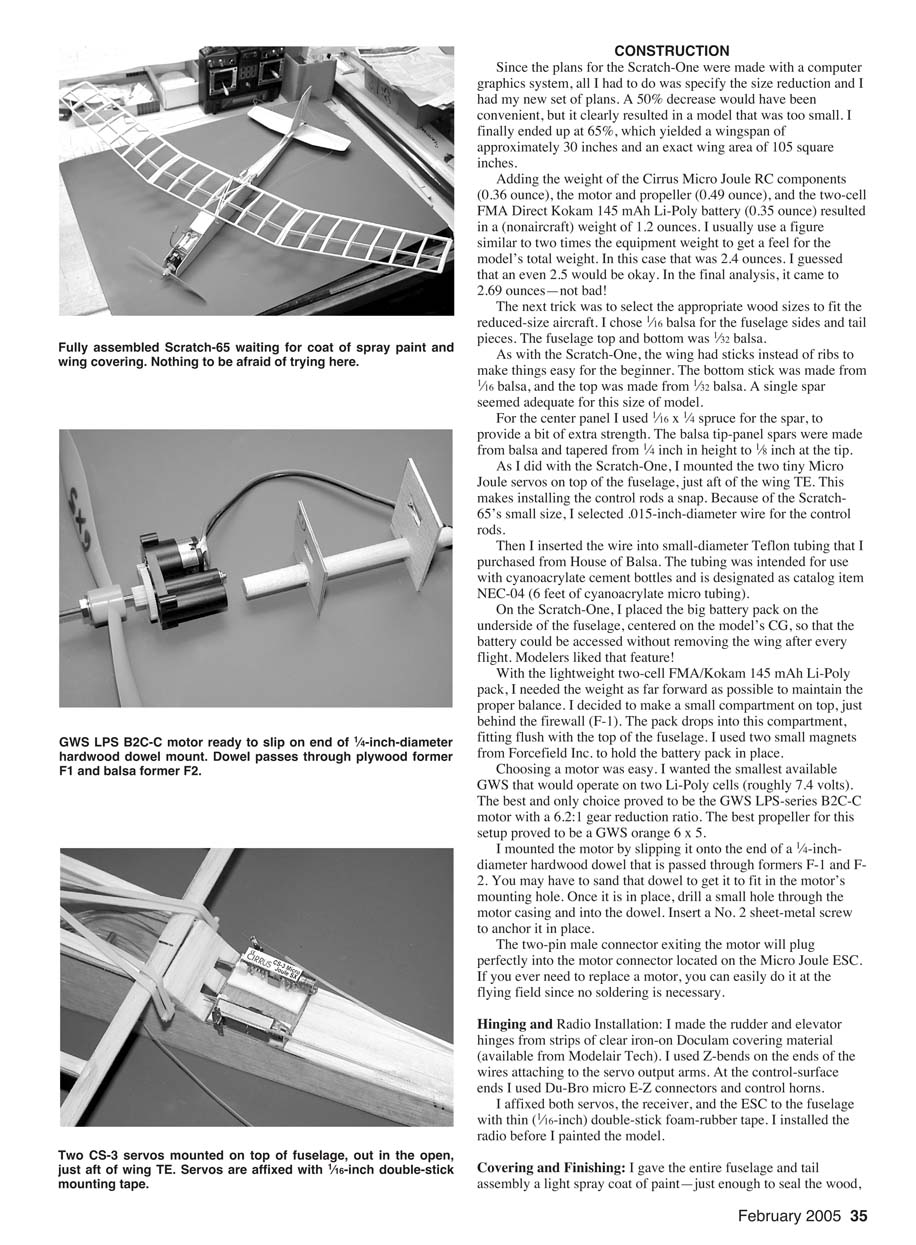
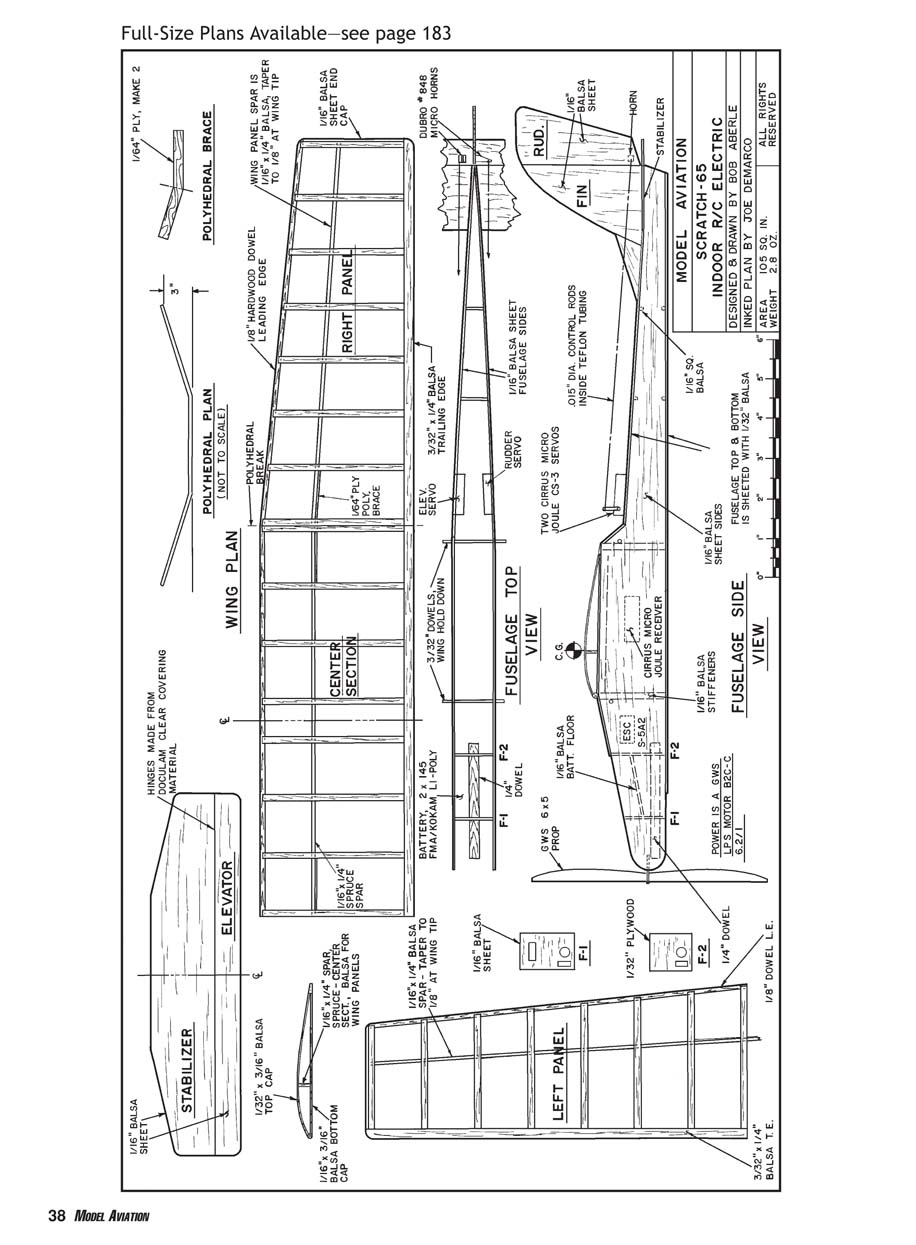
Since the plans for the Scratch-One were made with a computer graphics system, all I had to do was specify the size reduction and I had my new set of plans. A 50% decrease would have been convenient, but it clearly resulted in a model that was too small. I finally ended up at 65%, which yielded a wingspan of approximately 30 inches and an exact wing area of 105 square inches.
Adding the weight of the Cirrus Micro Joule RC components (0.36 ounce), the motor and propeller (0.49 ounce), and the two-cell FMA Direct Kokam 145 mAh Li-Poly battery (0.35 ounce) resulted in a (non-aircraft) weight of 1.2 ounces. I usually use a figure similar to two times the equipment weight to get a feel for the model's total weight. In this case that was 2.4 ounces. I guessed that an even 2.5 would be okay. In the final analysis, it came to 2.69 ounces—not bad!
The next trick was to select the appropriate wood sizes to fit the reduced-size aircraft. I chose 1/16-inch balsa for the fuselage sides and tail pieces. The fuselage top and bottom was 3/32-inch balsa.
As with the Scratch-One, the wing had sticks instead of ribs to make things easy for the beginner. The bottom stick was made from 1/16-inch balsa, and the top was made from 3/32-inch balsa. A single spar seemed adequate for this size of model.
For the center panel I used 1/16 x 1/4-inch spruce for the spar, to provide a bit of extra strength. The balsa tip-panel spars were made from balsa and tapered from 1/4 inch in height to 1/8 inch at the tip.
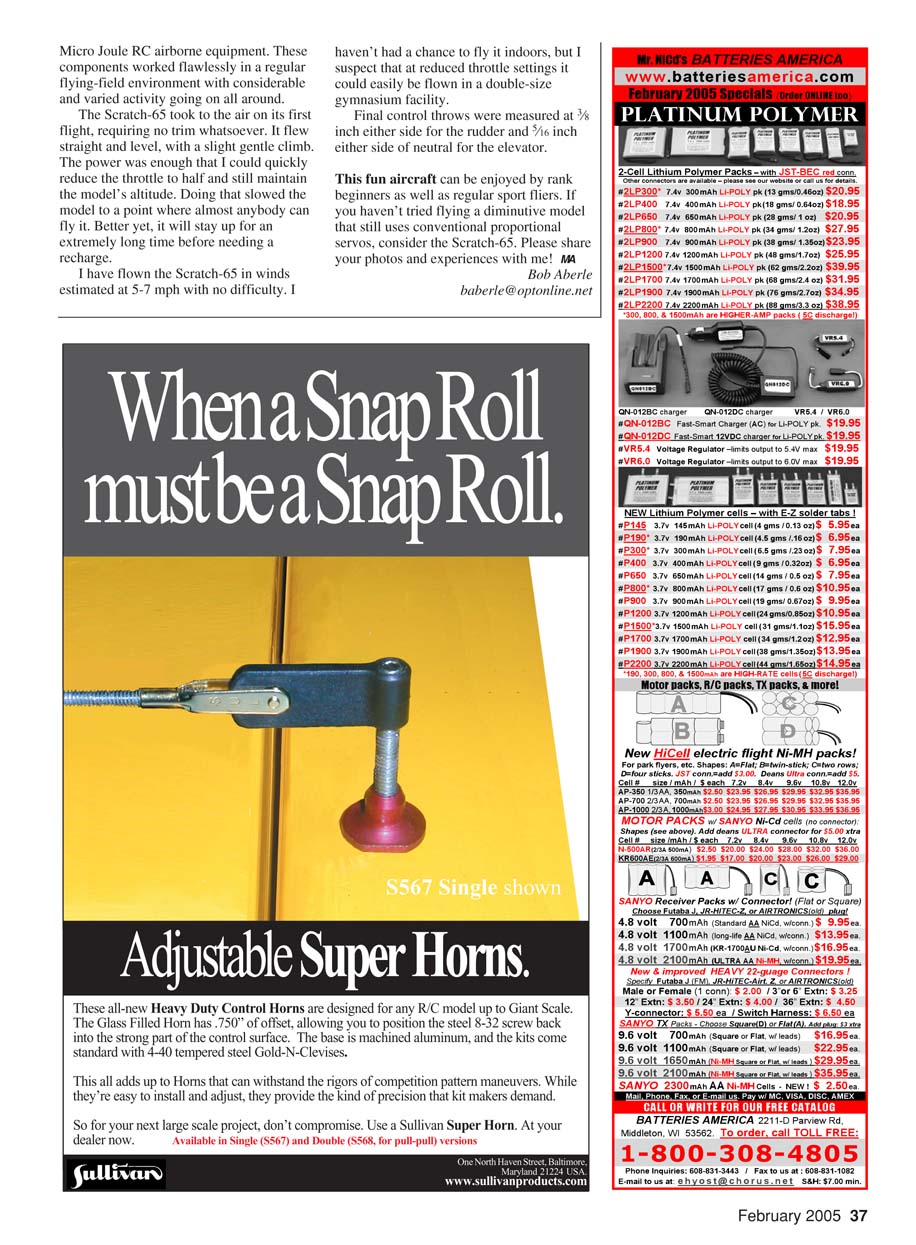
As I did with the Scratch-One, I mounted the two tiny Micro Joule servos on top of the fuselage, just aft of the wing trailing edge. This makes installing the control rods a snap. Because of the Scratch-65's small size, I selected 0.015-inch-diameter wire for the control rods.
Then I inserted the wire into small-diameter Teflon tubing that I purchased from House of Balsa. The tubing was intended for use with cyanoacrylate cement bottles and is designated as catalog item NEC-04 (6 feet of cyanoacrylate micro tubing).
On the Scratch-One, I placed the big battery pack on the underside of the fuselage, centered on the model's CG, so that the battery could be accessed without removing the wing after every flight. Modelers liked that feature!
With the lightweight two-cell FMA/Kokam 145 mAh Li-Poly pack, I needed the weight as far forward as possible to maintain the proper balance. I decided to make a small compartment on top, just behind the firewall (F-1). The pack drops into this compartment, fitting flush with the top of the fuselage. I used two small magnets from Forcefield Inc. to hold the battery pack in place.
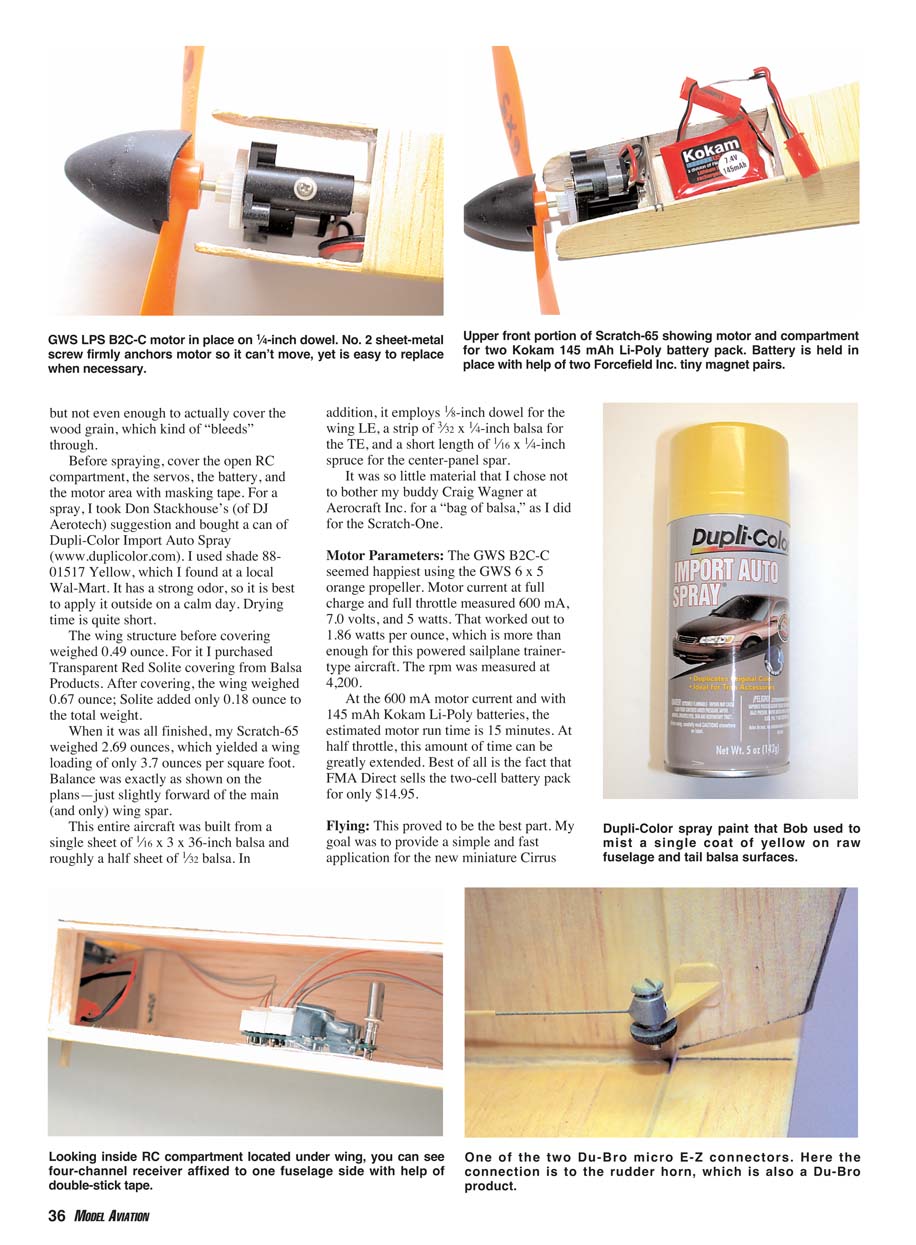
Choosing a motor was easy. I wanted the smallest available GWS that would operate on two Li-Poly cells (roughly 7.4 volts). The best and only choice proved to be the GWS LPS-series B2C-C motor with a 6.2:1 gear reduction ratio. The best propeller for this setup proved to be a GWS orange 6 x 5.
I mounted the motor by slipping it onto the end of a 1/4-inch-diameter hardwood dowel that is passed through formers F-1 and F-2. You may have to sand that dowel to get it to fit in the motor's mounting hole. Once it is in place, drill a small hole through the motor casing and into the dowel. Insert a No. 2 sheet-metal screw to anchor it in place.
The two-pin male connector exiting the motor will plug perfectly into the motor connector located on the Micro Joule ESC. If you ever need to replace a motor, you can easily do it at the flying field since no soldering is necessary.
Hinging and Radio Installation
I made the rudder and elevator hinges from strips of clear iron-on Doculam covering material (available from Modelair Tech). I used Z-bends on the ends of the wires attaching to the servo output arms. At the control-surface ends I used Du-Bro micro E-Z connectors and control horns.
I affixed both servos, the receiver, and the ESC to the fuselage with thin (1/16-inch) double-stick foam-rubber tape. I installed the radio before I painted the model.
Covering and Finishing
I gave the entire fuselage and tail assembly a light spray coat of paint—just enough to seal the wood, but not even enough to actually cover the wood grain, which kind of “bleeds” through.
Before spraying, cover the open RC compartment, the servos, the battery, and the motor area with masking tape. For a spray, I took Don Stackhouse’s (of DJ Aerotech) suggestion and bought a can of Dupli-Color Import Auto Spray (www.duplicolor.com). I used shade 88-01517 Yellow, which I found at a local Wal‑Mart. It has a strong odor, so it is best to apply it outside on a calm day. Drying time is quite short.
The wing structure before covering weighed 0.49 ounce. For it I purchased Transparent Red Solite covering from Balsa Products. After covering, the wing weighed 0.67 ounce; Solite added only 0.18 ounce to the total weight.
When it was all finished, my Scratch-65 weighed 2.69 ounces, which yielded a wing loading of only 3.7 ounces per square foot. Balance was exactly as shown on the plans—just slightly forward of the main (and only) wing spar.
This entire aircraft was built from a single sheet of 1/16 x 3 x 36-inch balsa and roughly a half sheet of 1/32 balsa. In addition, it employs 1/8-inch dowel for the wing leading edge, a strip of 3/32 x 1/4-inch balsa for the trailing edge, and a short length of 1/16 x 1/4-inch spruce for the center-panel spar.
It was so little material that I chose not to bother my buddy Craig Wagner at Aerocraft Inc. for a “bag of balsa,” as I did for the Scratch-One.
Motor Parameters
The GWS B2C-C seemed happiest using the GWS 6 x 5 orange propeller. Motor current at full charge and full throttle measured 600 mA, 7.0 volts, and 5 watts. That worked out to 1.86 watts per ounce, which is more than enough for this powered sailplane trainer-type aircraft. The rpm was measured at 4,200.
At the 600 mA motor current and with 145 mAh Kokam Li‑Poly batteries, the estimated motor run time is 15 minutes. At half throttle, this amount of time can be greatly extended. Best of all is the fact that FMA Direct sells the two-cell battery pack for only $14.95.
Flying
This proved to be the best part. My goal was to provide a simple and fast application for the new miniature Cirrus Micro Joule RC airborne equipment. These components worked flawlessly in a regular flying-field environment with considerable and varied activity going on all around.
The Scratch-65 took to the air on its first flight, requiring no trim whatsoever. It flew straight and level, with a slight gentle climb. The power was enough that I could quickly reduce the throttle to half and still maintain the model's altitude. Doing that slowed the model to a point where almost anybody can fly it. Better yet, it will stay up for an extremely long time before needing a recharge.
I have flown the Scratch-65 in winds estimated at 5–7 mph with no difficulty. I haven't had a chance to fly it indoors, but I suspect that at reduced throttle settings it could easily be flown in a double-size gymnasium facility.
Final control throws were measured at 3/8 inch either side for the rudder and 5/16 inch either side of neutral for the elevator.
This fun aircraft can be enjoyed by rank beginners as well as regular sport fliers. If you haven't tried flying a diminutive model that still uses conventional proportional servos, consider the Scratch-65. Please share your photos and experiences with me!
Bob Aberle [email protected]
Full-Size Plans Available — see page 183
Transcribed from original scans by AI. Minor OCR errors may remain.

