


Selecting Electric Power Systems: Part 2
by Bob Aberle
(Editor’s note: In the March issue, Bob explained the background of how power sources for modeling are rated and specifically how electric motors have been related in power output to glow engines. He covered how to go about sizing, or matching, a specific-size motor to a given model’s size, weight, and wing-loading parameters.
Bob provided a list of the various aircraft categories and explained how to measure motor input power, aircraft weight and power-loading considerations, wing loading and how it relates to flying experience and skill, and thrust factors. He included details of the motor-selection process, a comprehensive listing of Web sites containing helpful data, and a listing of computer programs that can help the selection process.
This month Bob gets into the details of the motor/airplane-selection process.)
It’s time to put all you’ve learned together with several examples of motor selections. Let’s make a glow kit or glow ARF electric-powered.
Many popular glow-engine-powered full kits and ARF “kits” on the market can easily be constructed and/or assembled from scratch with electric power in mind. One such model is Tower Hobbies’ “Perfect Trainer-20,” or “PT-20” as it is generally called. It is intended for .15–.25 cu. in. glow engines. The PT-20 has 515 square inches of wing area, can weigh 3.5–4.5 pounds, and has a wing-loading range of 16–20 ounces/square foot (sq. ft.).
As a start, take into account that the wing area is 515 square inches (3.6 sq. ft.). Pick a wing loading for the intended skill level. Using Table 3, I picked “Larger trainer,” with a range of 15–20 ounces/sq. ft. That is close to the wing loading cited for glow power.
Using an average, I selected 17.5 ounces/sq. ft. as my target wing loading. If I multiply that 17.5 by the 3.6 sq. ft. of wing area, I end up with a target weight of 63 ounces (just under 4 pounds), or 3.93 pounds.
From Table 2 I selected 40–50 watts/pound for the power loading. Wanting a bit more in performance (with some reserve), I specifically selected 50 watts/pound. Multiplying 3.93 pounds by 50 gives 197 watts.
Since power is amps multiplied by volts, you can work backward using the power (watts) and the estimated motor current. That motor-current figure will always prove to be the tricky part: it’s an estimate that balances desired run time and the motor’s maximum continuous current. This is where the ElectriCalc and MotoCalc motor-selection programs can really help.
For this application I decided on a motor-current range of 20.0–25.0 amps and 22.5 as an average. Divide 197 watts by 22.5 amps and you obtain 8.75 volts. You can reach a voltage close to that with an eight-cell NiMH or Ni-Cd battery pack. It would fall between two and three Li-Poly cells (3.7 volts per cell) but gives a useful ballpark.
From this point you can look up motor data on one of the motor-test Web sites. I generally go for AXI brushless outrunner motors because they are available in many sizes and are very reliable. Using “The Great Electric Motor Test” at www.flyingmodels.org, I searched motor current, power, and propeller sizes.
I selected an AXI 2820/10 brushless outrunner motor. On 8.0 volts with an APC 10 x 7E propeller it shows about 23.0 amps and 176 watts of power. The 10-inch propeller can easily clear the PT-20’s landing gear.
A battery pack consisting of eight Ni-Cd or NiMH cells should work. Ni-Cd cells will likely produce slightly higher voltage, current, and wattage. I recommend an eight-cell Sanyo 1950 mAh NiMH pack, which will get slightly over my target but allows throttling back during flight to stretch run time to longer than eight minutes.
You can fly that PT-20 with this motor, propeller, and battery. As you progress, feel free to “what-if” your parameters in either of the motor-selection programs. You can even move to Li-Poly batteries by carefully selecting a propeller size that will allow use of a three-cell pack without excessive motor current.
Converting/Updating
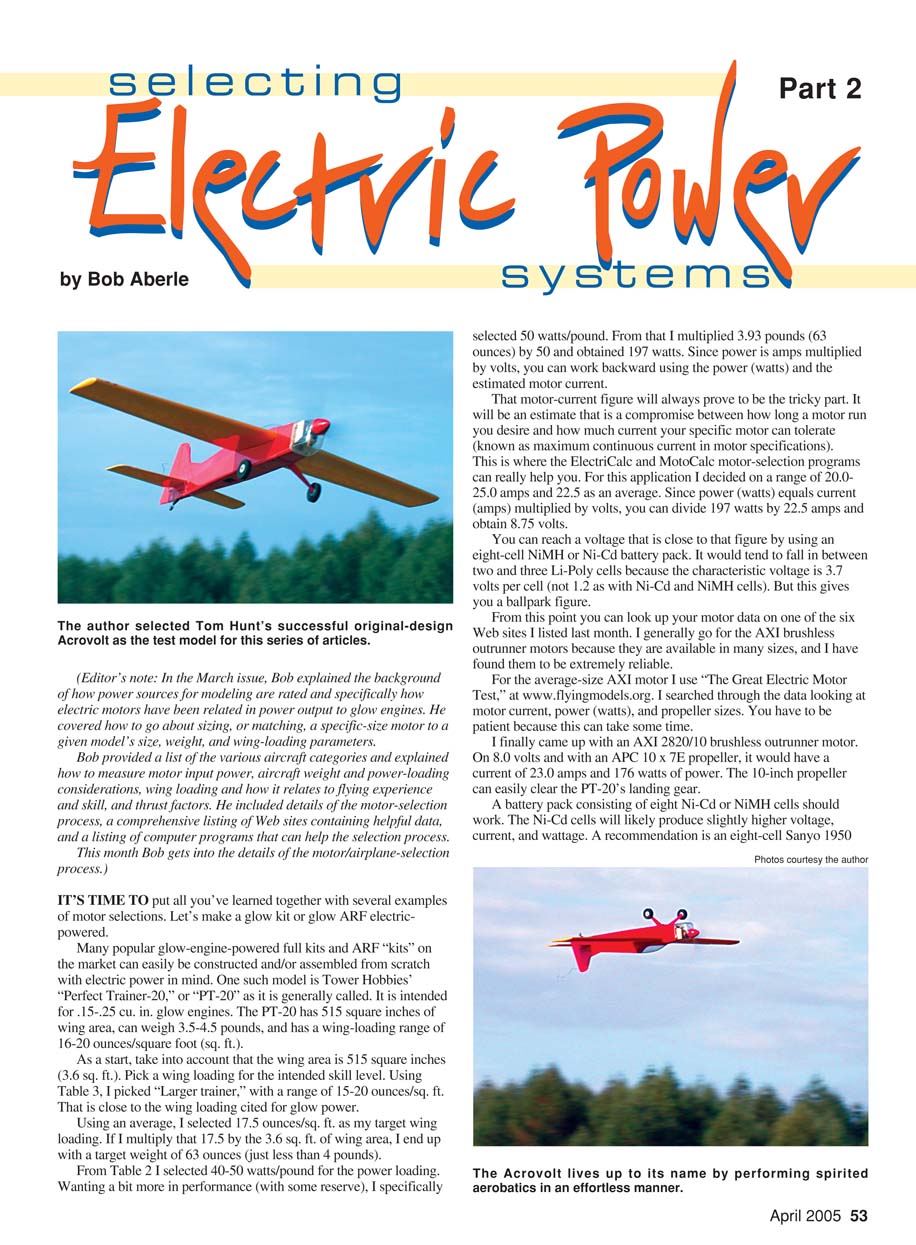
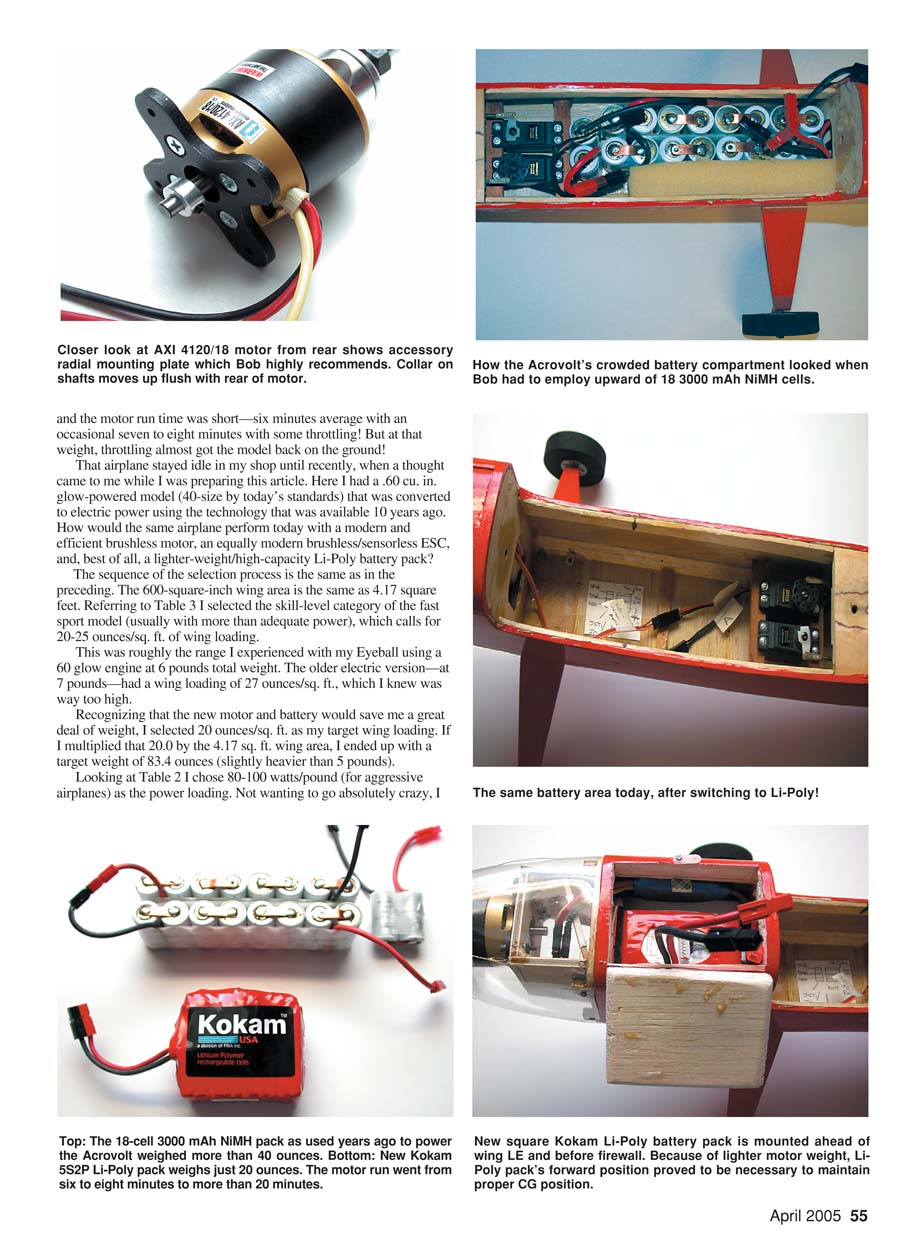
Almost 10 years ago, Tom Hunt designed a large aerobatic/pattern electric model called the Acrovolt. It was inspired by Art Schroeder's Eyeball design from the 1960s. I flew Art's Eyeball back then; it weighed about 6 pounds with an Enya 60 glow engine. Tom designed his Acrovolt around his then-new Modelair-Tech H-1000 belt drive and either a Speed 700 ferrite motor or a DeWALT 18-volt cordless-drill motor.
In 1995 the Acrovolt was powered by a 16-cell Ni-Cd battery pack, later increased to an 18-cell 3000 mAh NiMH pack. Weight at the time was roughly 7 pounds. The wing loading was high and motor run time was short—about six minutes average, sometimes seven to eight with throttling.
The airplane stayed idle in my shop until recently, when I wondered how it would perform today with a modern brushless motor, a modern brushless/sensorless ESC, and a lighter-weight/high-capacity Li-Poly battery pack.
The sequence of the selection process is the same as before. The Acrovolt’s wing area is 600 square inches (4.17 sq. ft.). Referring to Table 3 I selected the fast sport model category (20–25 ounces/sq. ft.) for wing loading. This matched my experience flying the Eyeball at about 6 pounds. The older electric version (7 pounds) had a wing loading of 27 ounces/sq. ft., which was too high.
Recognizing that the new motor and battery would save a great deal of weight, I selected 20 ounces/sq. ft. as my target wing loading. Multiplying 20.0 by 4.17 sq. ft. gives a target weight of 83.4 ounces (5.2 pounds).
From Table 2 I chose 80–100 watts/pound for aggressive airplanes and selected the midrange number of 90 watts/pound. Multiplying 5.2 pounds by 90 gives 468 watts.
Again, you can work backward using the power (watts) and an estimated motor current. For this application I settled on approximately 27.0 amps (I ran 30–32 amps with the older motor 10 years ago but wanted to use less current now because the airplane would weigh much less). Divide 468 watts by 27.0 amps and you obtain about 17.3 volts.
For this application I wanted to use a large Li-Poly pack. With nominal cell voltage at 3.7 volts, five Li-Poly cells give 18.5 volts (3.7 × 5), the closest practical match to 17.3 volts.
I then selected a brushless motor. I favor AXI motors, so I looked at their larger 41-series data. Dave Radford of Air Craft Inc. provided those data at www.aircraft-world.com/default.asp?id=18. I settled on the AXI 4120-18 brushless outrunner.
The published data called for an APC 12 x 8E propeller and 16 Ni-Cd or NiMH cells (1.2 × 16 = 19.2 volts). The published motor current was 24.5 amps and power 434 watts—close enough as a starting point.
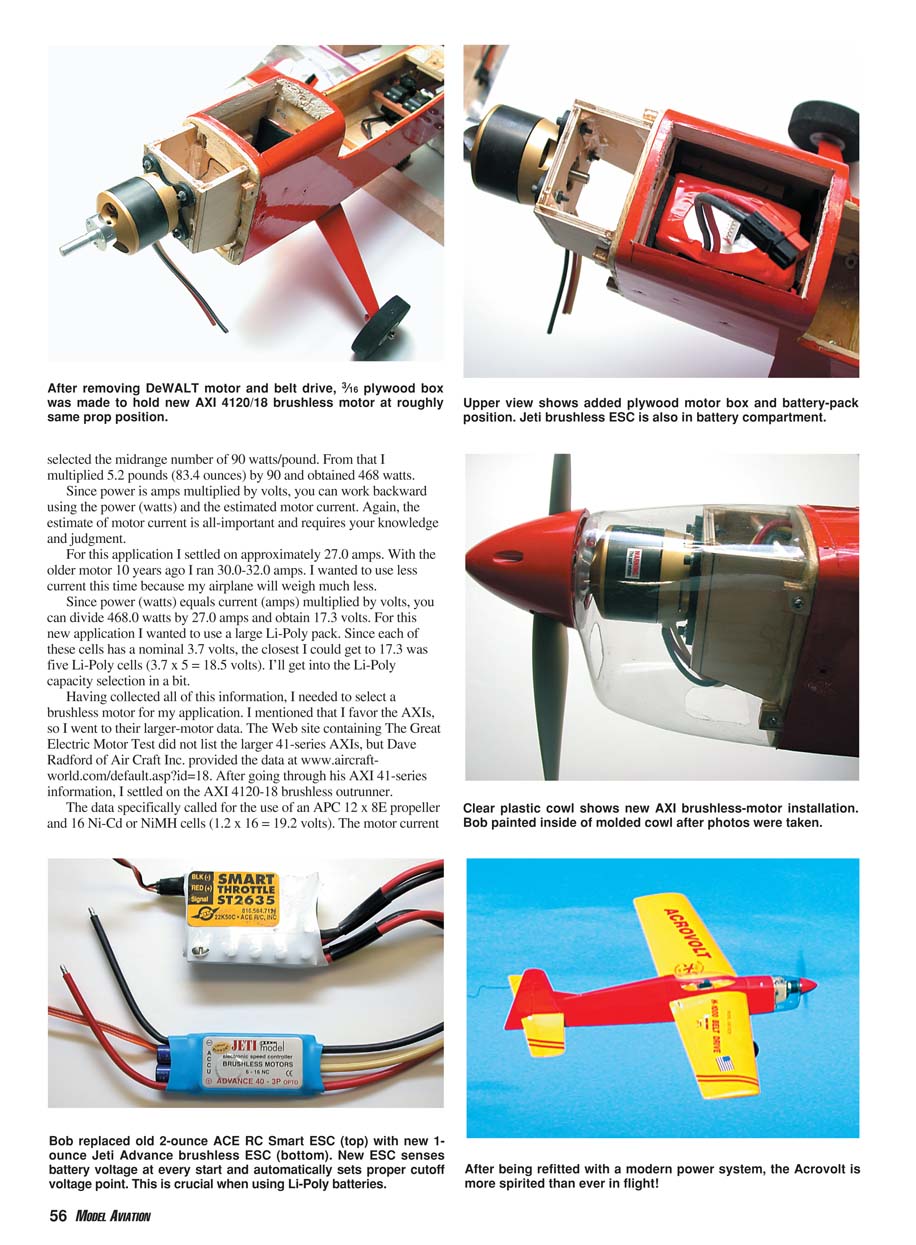
The photos accompanying this article show how easy it was to swap the larger ferrite motor for the brushless motor. Since the Li-Poly battery was much lighter, I moved it farther forward (just behind the firewall) to maintain the proper CG.
Flying the revised Acrovolt was wonderful. The final model weight was 85.3 ounces (5 pounds, 5.3 ounces), yielding a wing loading of 20.5 ounces/sq. ft. Actual motor parameters were higher than my initial predictions but acceptable for test flights: motor current 28.5 amps, voltage under load 18.0 volts, wattage 511 watts, watts/pound 95.8, and rpm 8,600.
The Kokam S5ZP battery pack I used consisted of 2.0 Ah-rated cells (15C-load capable). With two sets in parallel (2P), the actual capacity was 4.0 Ah. Total flying time obtained with this pack was approximately 20 minutes with some throttle management. The model was capable of loops from level flight at half throttle, and after flights the motor, ESC, and battery pack were hardly warm. This proved to be a very successful power-system choice.
Estimating Motor Run Time
When you near the end of your motor-selection process, decide what battery capacity you want to use (Ni-Cd, NiMH, Li, or Li-Poly). Battery capacity is rated in mAh or Ah, and battery weight is directly related to capacity.
For a quick estimate of motor run time, use this formula:
- Multiply 60 by the battery capacity in Ah, then divide by motor current in amps.
- The result is an estimated run time in minutes.
Example: A 1950 mAh (1.95 Ah) battery with a motor current of 23.0 amps gives:
- 60 × 1.95 / 23.0 = 5.09 minutes (static estimate). Actual in-flight time will be longer because the prop unloads and you rarely fly at full throttle. In the PT-20 example the actual flight time was about eight minutes.
Keeping Records
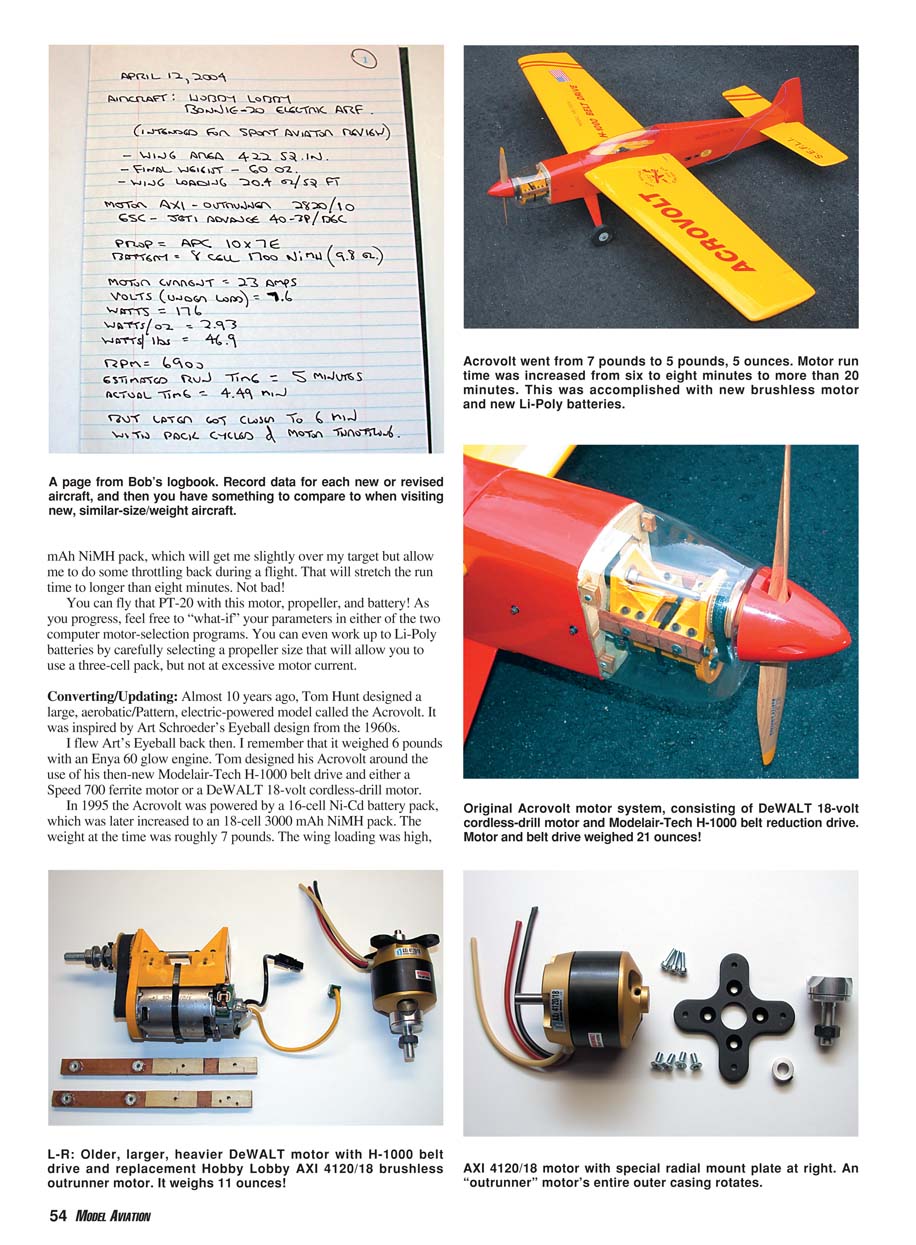
Keep accurate, dated records of each aircraft. In a bound logbook note:
- Aircraft description
- Electric parameters (motor current, voltage, watts, watts/ounce or watts/pound, rpm, run time)
- Flight performance and observations
These records provide practical comparisons when choosing power systems for new aircraft.
Where to Get Help
If you need help, try:
- Model forums specializing in electric power (RC Groups, E-Digest, RC Universe, SFRC)
- Local modeling clubs that specialize in electric power
- Hobby distributors and experts, such as:
- Kirk Massey, New Creations RC: (936) 856-4630
- Dave Thacker, Radical RC: www.radicalrc.com
- Dave and Bob Peru, Balsa Products: www.balsapr.com
- Sal DeFrancesco, Northeast Sailplane Products: www.nesail.com
- Helmut Goestl, Dymond Modelsport: www.rc-dymond.com
- Tom Hunt, Modelair-Tech: www.modelairtech.com
References
In the past two years I have authored a series of articles about electric-powered flight published in MA. You can find the “From the Ground Up” articles on the MA Web site at www.modelaircraft.org/mag/index.htm:
- “State of the Sport: Electric-Powered Flight”: April 2002, pages 18–40.
- “From the Ground Up: Introduction to Electric Power”: July 2003, pages 56–64.
- “From the Ground Up: Battery Basics”: October 2003, pages 54–62.
- “Introduction to Lithium-Polymer Batteries”: May 2004, pages 44–58.
I have also written articles posted on MA’s Sport Aviator online magazine:
- “The SuperStar-EP Electric ARF” (review) at www.masportaviator.com/ah.asp?CatID=1&ID=16
- “Bonnie 20 ARF Electric Trainer” (review) at www.masportaviator.com/ah.asp?CatID=1&ID=39
- “Bonnie 20—Adapting to Li-Poly Batteries” (conversion) at www.masportaviator.com/ah.asp?CatID=2&ID=43
I also wrote the book Getting Started in Backyard Flying, available from AMA. Pages 58–59 explain measuring motor current using an AstroFlight Super Whattmeter (part 101).
The process of selecting a motor system may seem overwhelming at first, but follow the logical steps presented here and they work. Buy a meter and take your own measurements. Buy a scale and weigh your aircraft. Buy a tachometer and verify RPM. Buy one of the recommended motor-selection programs—you’ll be amazed how helpful they are.
If you hit a snag, please write or e-mail me. I will try to answer detailed questions and include useful Q&A in MA’s “Frequently Asked Questions” column if it benefits other readers. Don’t give up on electric power; get more involved!
MA
Bob Aberle [email protected]
Manufacturers/Distributors
- Li-Poly batteries, chargers: FMA Direct — www.fmadirect.com
- Optics 6 RC system: Hitec RCD — www.hitecrcd.com
- Bonnie 20 ARF, AXI motors, radial motor mounts, Jeti controllers: Hobby Lobby International — www.hobby-lobby.com
- Acrovolt plans: Modelair-Tech — www.modelairtech.com
- Li-Poly charger: Peak Electronics — www.siriuselectronics.com
- TNC tachometer: Skyborn Electronics — www.bktsi.com
- SuperStar EP, PT-20: Tower Hobbies — www.towerhobbies.com
Transcribed from original scans by AI. Minor OCR errors may remain.

