
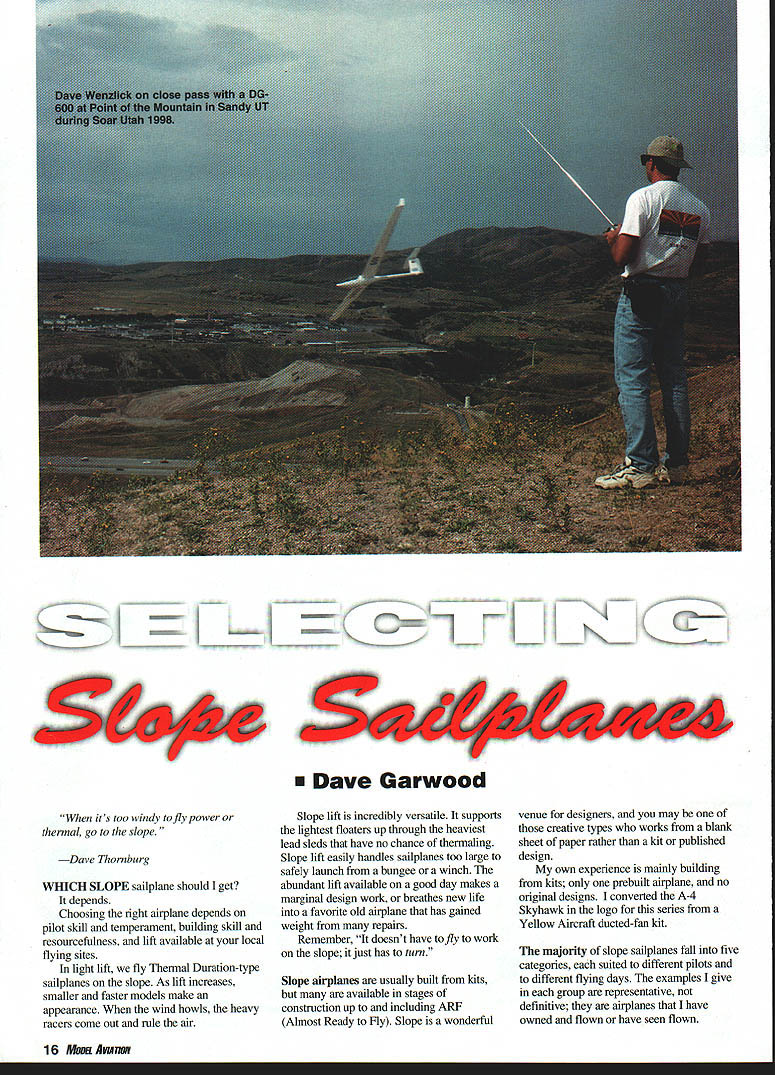
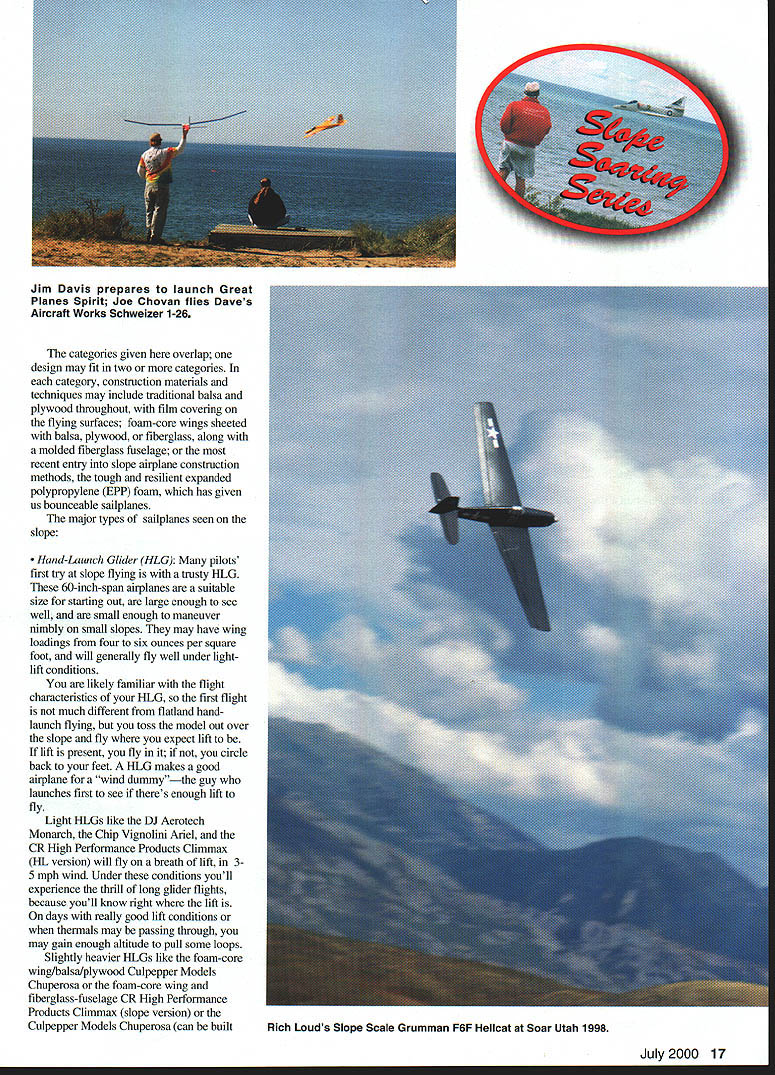
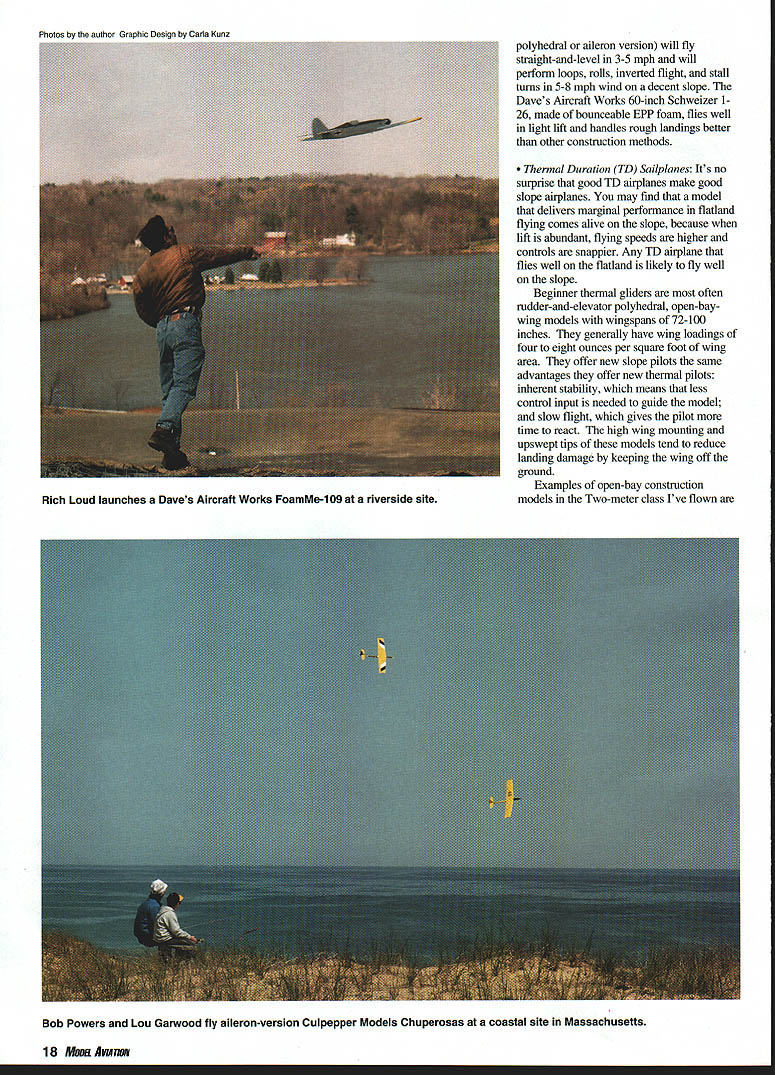
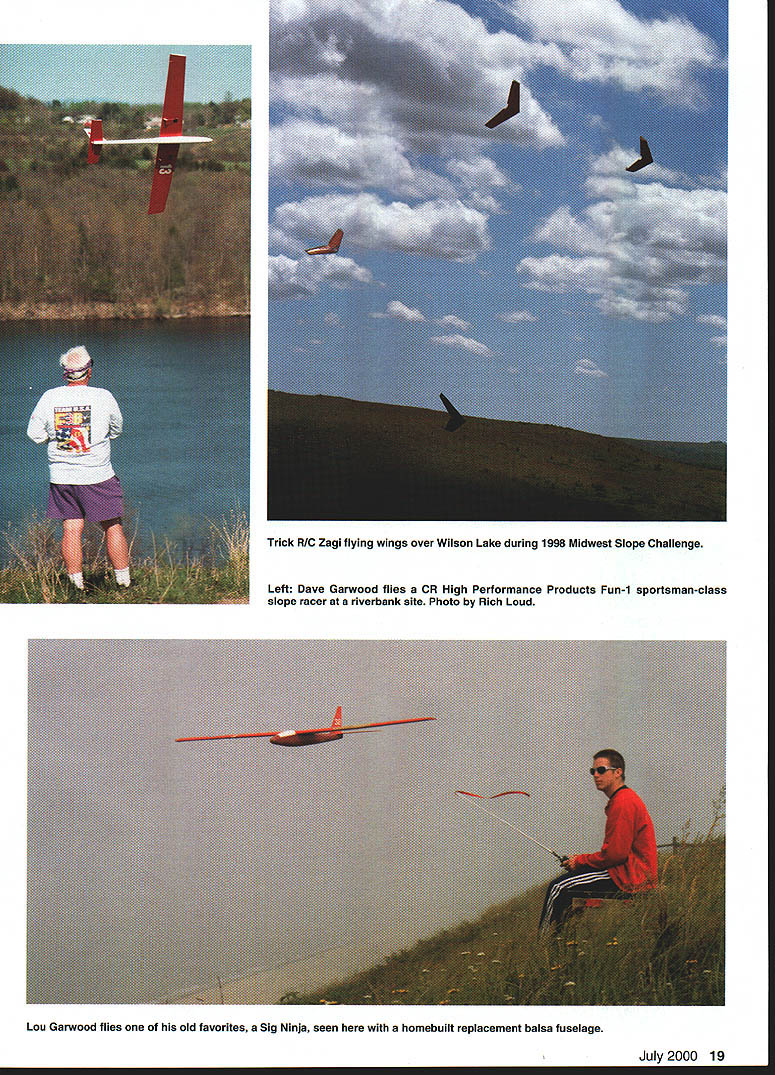
Selecting Slope Sailplanes
■ Dave Garwood
"When it's too windy to fly power or thermal, go to the slope." —Dave Thornburg
Which slope sailplane should I get?
Choosing the right airplane depends on pilot skill and temperament, building skill and resources/finance, and lift available at your local flying sites.
In light lift, we fly Thermal Duration–type sailplanes on the slope. As lift increases, smaller and faster models make an appearance. When the wind howls, the heavy racers come out and rule the air.
Slope lift is incredibly versatile. It supports the lightest floaters up through the heaviest lead sleds that have no chance of thermaling. Slope lift easily handles sailplanes too large to safely launch from a bungee or a winch. The abundant lift available on a good day makes a marginal design work, or breathes new life into a favorite old airplane that has gained weight from many repairs.
Remember, "It doesn't have to fly to work on the slope; it just has to turn."
Slope airplanes are usually built from kits, but many are available in stages of construction up to and including ARF (Almost Ready to Fly). Slope is a wonderful venue for designers, and you may be one of those creative types who works from a blank sheet of paper rather than a kit or published design.
My own experience is mainly building from kits; only one prebuilt airplane, and no original designs. I converted the A-4 Skyhawk in the logo for this series from a Yellow Aircraft ducted-fan kit.
The majority of slope sailplanes fall into five categories, each suited to different pilots and to different flying days. The examples I give in each group are representative, not definitive; they are airplanes that I have owned and flown or have seen flown.
The categories given here overlap; one design may fit in two or more categories. In each category, construction materials and techniques may include traditional balsa and plywood throughout, with film covering on the flying surfaces; foam-core wings sheeted with balsa, plywood, or fiberglass, along with a molded fiberglass fuselage; or the most recent entry into slope airplane construction methods, the tough and resilient expanded polypropylene (EPP) foam, which has given us bounceable sailplanes.
The major types of sailplanes seen on the slope are:
Hand-Launch Glider (HLG)
Many pilots’ first try at slope flying is with a trusty HLG. These 60-inch-span airplanes are a suitable size for starting out, are large enough to see well, and are small enough to maneuver nimbly on small slopes. They may have wing loadings from four to six ounces per square foot, and will generally fly well under light-lift conditions.
You are likely familiar with the flight characteristics of your HLG, so the first flight is not much different from flatland hand-launch flying, but you toss the model out over the slope and fly where you expect lift to be. If lift is present, you fly in it; if not, you circle back to your feet. A HLG makes a good airplane for a “wind dummy”—the guy who launches first to see if there’s enough lift to fly.
Light HLGs like the DJ Aerotech Monarch, the Chip Vignolini Ariel, and the CR High Performance Products Climax (HL version) will fly on a breath of lift, in 3–5 mph wind. Under these conditions you’ll experience the thrill of long glider flights, because you’ll know where the lift is. On days with really good lift conditions or when thermals may be passing through, you may gain enough altitude to pull some loops.
Slightly heavier HLGs like the foam-core wing/balsa/plywood Culpepper Models Chuperosa or the foam-core wing and fiberglass-fuselage CR High Performance Products Climax (slope version) or Culpepper Models Chuperosa (can be built polyhedral or aileron version) will fly straight-and-level in 3–5 mph and will perform loops, rolls, inverted flight, and stall turns in 5–8 mph wind on a decent slope. The Dave’s Aircraft Works 60-inch Schweizer 1-26, made of bounceable EPP foam, flies well in light lift and handles rough landings better than other construction methods.
Thermal Duration (TD) Sailplanes
It’s no surprise that good TD airplanes make good slope airplanes. You may find that a model that delivers marginal performance in flatland flying comes alive on the slope, because when lift is abundant, flying speeds are higher and controls are snappier. Any TD airplane that flies well on the flatland is likely to fly well on the slope.
Beginner thermal gliders are most often rudder-and-elevator polyhedral, open-bay-wing models with wingspans of 72–100 inches. They generally have wing loadings of four to eight ounces per square foot of wing area. They offer new slope pilots the same advantages they offer new thermal pilots: inherent stability, which means that less control input is needed to guide the model; and slow flight, which gives the pilot more time to react. The high wing mounting and upswept tips of these models tend to reduce landing damage by keeping the wing off the ground.
Examples of open-bay construction models in the two-meter class I’ve flown are the rugged and beautiful Bob Sliff Models Sensonar; the Goldberg Models Gentle Lady, which has probably taught more soaring pilots to fly than any other; the Great Planes Spirit, which is stronger and faster than most polyhedrals; and the Minimax Enterprise Minimax 700, which is a little more delicate but flies in extremely light lift. The MAD Aircraft Highlander, an EPP-foam two-meter TD trainer, looks promising but I have yet to fly it or see it flown.
Larger stick-built polyhedral models worthy of consideration are the Pierce Aero Paragon, a 120-inch polyhedral floater, great for long-duration flights; and the Whyte Wings Olympic II, a rugged, smooth-flying traditional design. These are the airplanes that pilots use to make their eight-hour League of Silent Flight (LSF) flights. (For information on the League of Silent Flight achievement program, see www.silentflight.org.)
It’s hard to imagine more-relaxed RC flying than guiding a polyhedral glider in 8 mph wind, silently and gracefully back and forth across the face of the slope, bringing it down only when the onboard batteries approach their limit.
Also in this category are the full-house TD competition machines. If it flies in thermal lift, it will fly in slope lift. I’ve flown many happy hours on the slope with the old Airtronics Falcon-880, Peregrine, and Swift. These models have the advantage of in-flight camber control (you can drop the flaps slightly to hang in light lift, or you can raise them slightly to go faster in high-wind conditions). In sufficient lift, you can pull aerobatics not commonly seen in flatland flying.
Purpose-Designed Slope Sailplanes
Polyhedrals may get you started on the slope, but many slope pilots migrate to the more-precise control of ailerons.
A successful slope design requires a rugged airplane with effective control surfaces. These models generally have semi-symmetrical airfoils and a wing loading of 6–12 ounces per square foot, for speed and penetration into the wind.
Flying purpose-designed slope models requires some experience and skill. Those graduating from polyhedral floaters must learn aileron roll control to turn—the classic “bank and yank” technique. The aileron slope pilot is rewarded with precise control and acrobatic performance.
These models are generally capable of extended inverted flight, plus loops, rolls, stall turns, Cuban-8s, and Split-Ss. Those with large fins will perform a credible stall turn, even without a rudder; the wind into the hill provides the necessary yaw force to kick the plane over.
The majority of sailplanes flown on the slope fall into this category, and they deliver more stick time than any other type. They provide the aircraft for a newer RC pilot to advance in skill and enter the realm of aerobatics and hot-dogging. Which is more thrilling: your first loop or your first roll? You can learn both in a single flying season with a purpose-designed slope soarer.
I learned inverted flight and my son Lou learned rolls with our Sig Ninjas. This is an exceptionally well-balanced sailplane, not only in pitch and roll control, but also in its ability to fly in moderate-to-high winds and its predictable performance of aerobatic maneuvers. The Little Ply fuselage tends to break easily, but you can extend its life for years by building a balsa fuselage.
Other slope designs worthy of building and flying are the Birdworks Avenger, a flying wing built completely from corrugated plastic, and the CR High Performance Products Blazer, which exhibits the same balanced characteristics as the Sig Ninja but comes with a fiberglass fuselage and a longer span, to fly in a wider variety of lift conditions. The Northeast Sailplanes Sparrow, another foam-core wing and fiberglass-fuselage design, may be one of the best inland slope airplanes yet designed.
In the foamie arena, the Torque and Recoil foamers are interesting, with pivot-wing roll control. They're fairly high-performance airplanes that build without the use of adhesives. The many Dave's Aircraft Works EPP-foam warbirds could fit in the Scale category, but they are mentioned here because of their excellent medium-lift flight performance and their unsurpassed ability to withstand landing damage and keep on flying. The Trick R/C Zagi is probably the most popular example of quick-building EPP flying wings.
Advanced Slope Sailplanes, including racers
Faster, sleeker, smoother than purpose-designed slope sailplanes, these slope hot rods answer the need for more speed and more maneuverability. They have faster airfoils and wing loadings of 10–20 ounces per square foot (and higher). They tend to use fiberglass and may incorporate pitcheron or wingleton control surfaces to reduce drag.
Flying these rocket ships is vastly different from what most people think glider flying is like. They're lightning-fast and radically maneuverable, yet silky smooth. They'll complete 5-foot-diameter loops and perform five axial rolls in a row 10 feet off the deck. They'll hold an energy to perform 200-foot-diameter loops if the lift is good enough, and they're strong enough to snap around pylons in a race course.
My first high-performance slope airplane was the Sig Samurai—an interesting design where the wing handles pitch control and roll control, while the tail surfaces are fixed. This airplane "carved the air" like no other I had flown previously. Observers said, "It cuts like a knife, and doesn't seem to care which way the wind is blowing." I still have two Samurais.
CR High Performance Products is a leader in high-performance slope airplanes, with the Renegade and Raider racers and the value-packed Fun-1 for Sportsman-class racing.
The Birdworks Zipper flying wing pours on some amazing speed and has maneuverability to match, and it packs for travel in a rifle case.
The Ballistic slope soarers out West are partial to John Higgins' Rodent and F-20, which are just about the heaviest, fastest slope airplanes available in kit form.
Slope scale WWII warbirds are very close to my heart; I have three with servos mounted, and a fourth on the building bench now. These are simple-to-build semiscale airplanes that are designed for performance first and for appearance second.
Yes, they are PSS (Powered Scale Sailplanes) airplanes, but I fly them for advanced performance. They fit in both the advanced and scale groups, and you can do pretty much anything with them that you can do with a fuel-powered Pattern model except extended knife-edge flight and unlimited vertical rolls. You can fly "half-pipe" stall turns with more slope scale sailplanes in the formation than any group of power models.
Scale and Power Scale Sailplanes
The way an airplane looks in the air is important, and the scale sailplane aficionados (and in particular, the power scale sailplane pilots) fly on the slope more than any other place.
As we said in the beginning, many more sailplanes will fly well in slope lift than in thermal lift, so fatter fuselages and bumpy military scale details are of little consequence when the slope lift is working.
You can fly an accurate model of a seagull, the R/C Gull from The Birdworks. Durable Aircraft Models makes an impressive large-size P-51 and T-33 from EPP foam. Patton Aircraft has a small-size EPP foam P-49 Warhawk and others, and Slickcraft kits a pocket-size BD-5 slope jet. Vortex Models makes some good-looking foam-core-wing and fiberglass warbirds and jets.
For the purists who wish to model pure scale sailplanes, Icare Sailplanes imports and makes several medium-size scale sailplanes, and Sailplanes Unlimited imports many large-size scale sailplanes. Both of these suppliers concentrate on kits with foam-core wings and fiberglass fuselages; Hobby Lobby can supply these, plus kits of vintage sailplanes built up from sticks and ribs.
Almost any sailplane will fly on the slope when the lift is right, and so many types and varieties of slope sailplanes are available that you're sure to be able to find one or more that will work well on your closest slope. The trick is to match the specific sailplane to the day's flying conditions, and to your own experience level.
Dave Garwood 5 Birch Ln. Scotia NY 12302
Manufacturer Names and Addresses
- The Birdworks
- R/C Gull, Coroplast Avenger
Transcribed from original scans by AI. Minor OCR errors may remain.

