
The Sky's the Limit
Jennifer Lilley
When it comes to purchasing a new vehicle, many people are interested in features such as fuel efficiency, torque, and keeping derrieres toasty with heated seats. But for RC pilots, often those extras mean ... well, next to nothing.
Let's cut to the chase. What's typically on most modelers' minds is not so much a question of trade-in value, but rather, "Is there space to fit my airplanes?"
In other words, if the salesperson isn't up on cubic-feet lingo, we're tempted to leave the showroom, courtesy coffee or not. Then again, chances are we're armed with those details anyway.
John W. Philbrick, a member of the Mid-Hudson Radio Control Society in Poughkeepsie, New York, is currently up in the air regarding two Subarus: the Outback and the Forester. The decision hinges on what will best fit his Hangar 9 1/4-scale Cub.
"Both have essentially the same luggage volume, which is about 70 cubic feet with the back seat down," John said, "but the Forester is a little shorter, so it's looking like odds are in favor of the Outback."
The notion of eyeing trunk space is nothing new. In fact, I bet many modelers secretly wish car salespeople would offer customers a frequently asked questions sheet with trunk/fold-down seat measurements. Cardboard cutouts of life-size model airplanes to demonstrate how well they fit in various cars would be helpful, too.
Sigh ...
The Case for RC Pilot Car Commercials
I think there should be commercials geared specifically toward RC pilots. I imagine the camera panning along the exterior, stopping dramatically at that pivotal moment—a view of the open trunk, seats already down, a Sukhoi seated in all its glory. Voice-over: "Built to Fly." (A phrase modelers may enjoy. Insurance companies? Not so much.)
It would also be neat if vehicles could be "RC Pilot Approved," much like the Good Housekeeping Seal of Approval.
One person who might be receptive to the commercial is Tennessee resident, Whitney Philbrick, son of the aforementioned John W. Philbrick. Whitney and his wife are members of the Middle Tennessee Radio Control Society. Whitney is also a member of the Mid-Hudson Radio Control Society in New York.
"We went to the Honda dealership and said we'd buy any van that would hold a plane with a 100-inch wingspan in the back."
Ah ... like father, like son.
"The salesman assumed this was an unreasonable bargaining tactic and let us take the car home to measure," said Whitney. "We returned with my Meister F4U in the back and ended up getting a great deal on the Honda Odyssey van."
The Sky's the Limit
Jennifer Lilley
When Our Space Needs More Space
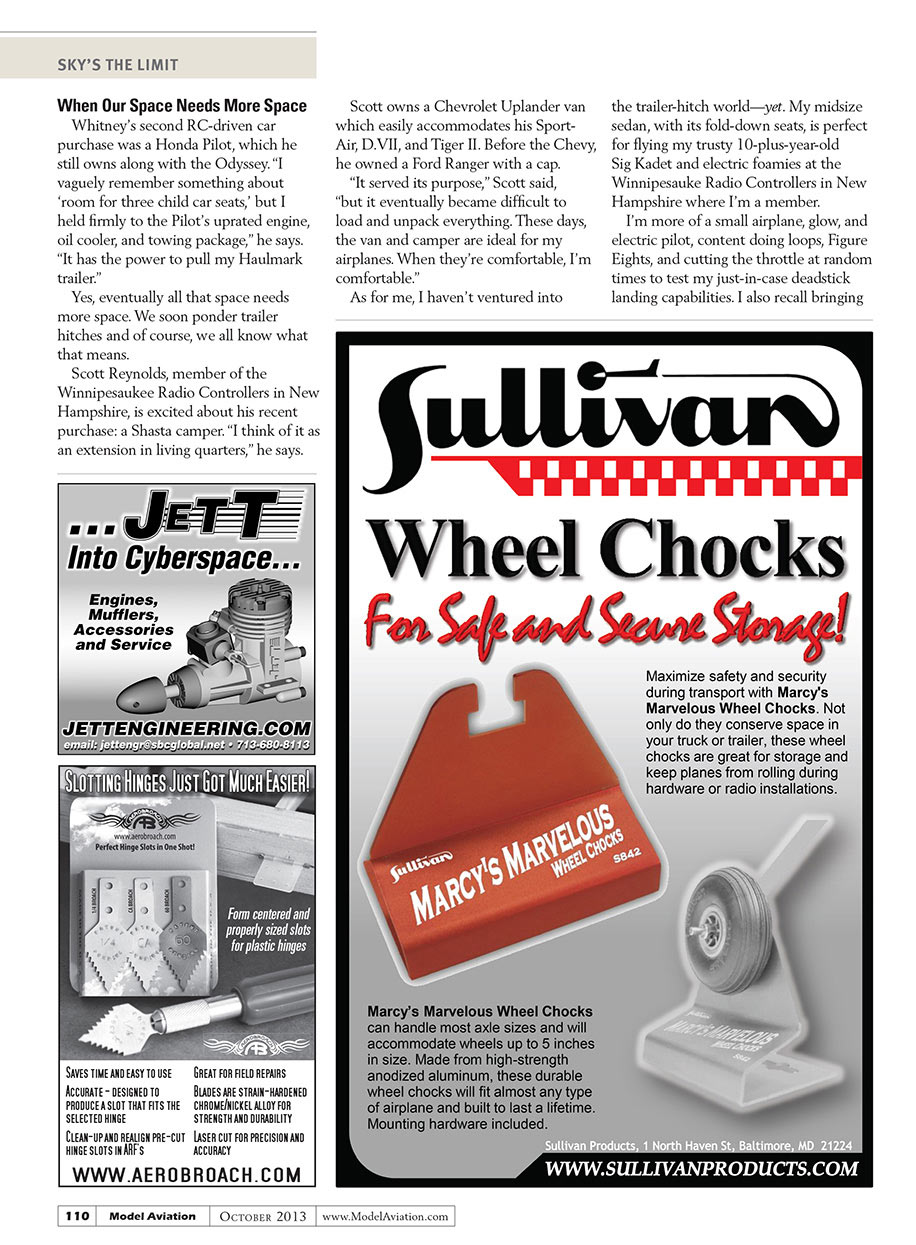
Whitney's second RC-driven car purchase was a Honda Pilot, which he still owns along with the Odyssey. "I vaguely remember something about 'room for three child car seats,' but I held firmly to the Pilot's uprated engine, oil cooler, and towing package," he says. "It has the power to pull my Haulmark trailer."
Yes, eventually all that space needs more space. We soon ponder trailer hitches and of course, we all know what that means.
Scott Reynolds, member of the Winnipesaukee Radio Controllers in New Hampshire, is excited about his recent purchase: a Shasta camper. "I think of it as an extension in living quarters," he says.
Scott owns a Chevrolet Uplander van which easily accommodates his SportAir, D.VII, and Tiger II. Before the Chevy, he owned a Ford Ranger with a cap.
"It served its purpose," Scott said, "but it eventually became difficult to load and unpack everything. These days, the van and camper are ideal for my airplanes. When they're comfortable, I'm comfortable."
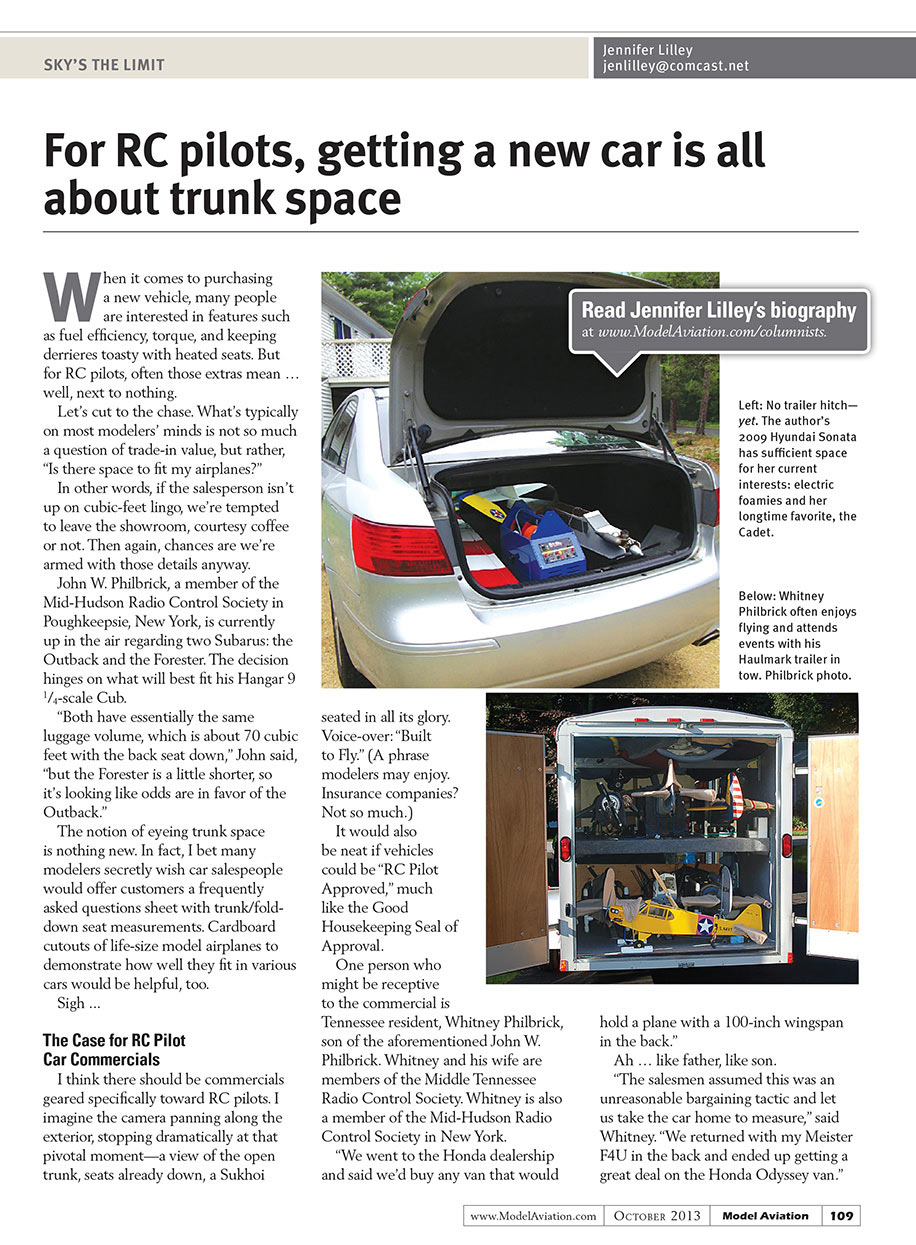
As for me, I haven't ventured into the trailer-hitch world—yet. My midsize sedan, with its fold-down seats, is perfect for flying my trusty 10-plus-year-old Sig Kadet and electric foamies at the Winnipesaukee Radio Controllers in New Hampshire where I'm a member.
I'm more of a small airplane, glow, and electric pilot, content doing loops, Figure Eights, and cutting the throttle at random times to test my just-in-case deadstick landing capabilities. I also recall bringing my E-flite heli to work. Lunch was all about the challenge of landing in that tight spot between the fax machine and a cactus.
Beyond Trunk Space
It seems we look at life around us with our airplanes in mind. If it isn't about carrying them in our cars, it's about finding space for them in and around our homes.
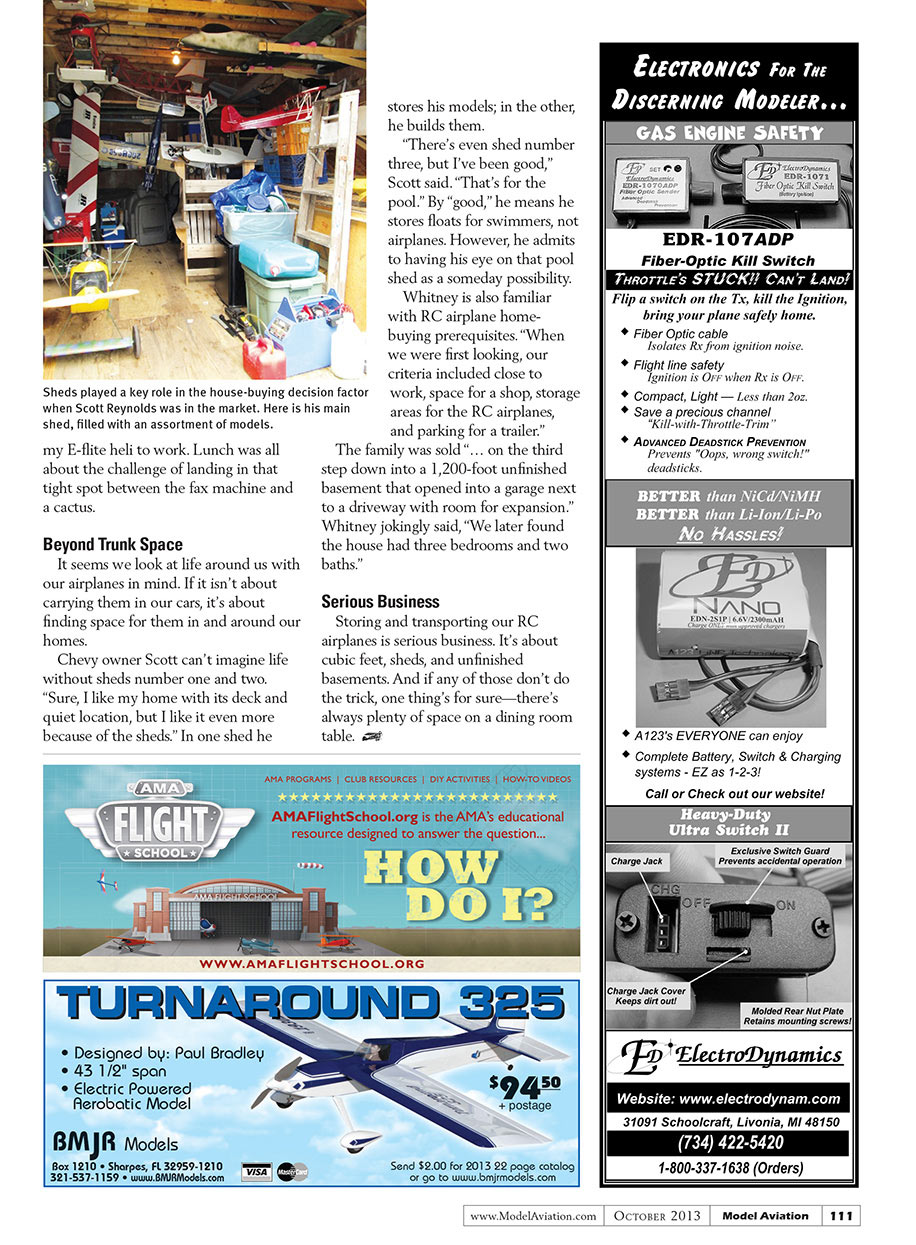
Chevy owner Scott can't imagine life without sheds number one and two. "Sure, I like my home with its deck and quiet location, but I like it even more because of the sheds." In one shed he stores his models; in the other, he builds them.
"There's even shed number three, but I've been good," Scott said. "That's for the pool." By "good," he means he stores floats for swimmers, not airplanes. However, he admits to having his eye on that pool shed as a someday possibility.
Whitney is also familiar with RC airplane home-buying prerequisites. "When we were first looking, our criteria included close to work, space for a shop, storage areas for the RC airplanes, and parking for a trailer."
The family was sold "... on the third step down into a 1,200-foot unfinished basement that opened into a garage next to a driveway with room for expansion." Whitney jokingly said, "We later found the house had three bedrooms and two baths."
Serious Business
Storing and transporting our RC airplanes is serious business. It's about cubic feet, sheds, and unfinished basements. And if any of those don't do the trick, one thing's for sure—there's always plenty of space on a dining room table.
Transcribed from original scans by AI. Minor OCR errors may remain.

