
Five common questions curious people ask RC pilots
Jennifer Lilley
Inevitably, whether we're at an event hundreds of miles away or flying locally, an observer begins asking about our hobby. Although there is no such thing as a silly or wrong question—I consider it a great opportunity to get him or her on a buddy box, simulator, or even better, to become a club member—sometimes these inquiries force us to take a closer look at ourselves.
Often, our responses end up shedding light on our thoughts and habits, reminding us of just how passionate, determined, and even defensive we are about flying RC.
So here we go:
"Do you own a real airplane?"
We can't help but feel a tad offended although we know what the person means. Let's see ... Real: live engine? Check. Real: live spinning propeller? Check again. Heck, this hobby even has insurance. Sounds pretty darn real to me.
Naturally we explain that yes, these are very real, and we go into the safety aspects as well as the variety of airplanes. Of course, many of us have a full-scale pilot license, so we'll happily talk about that "real" airplane, too.
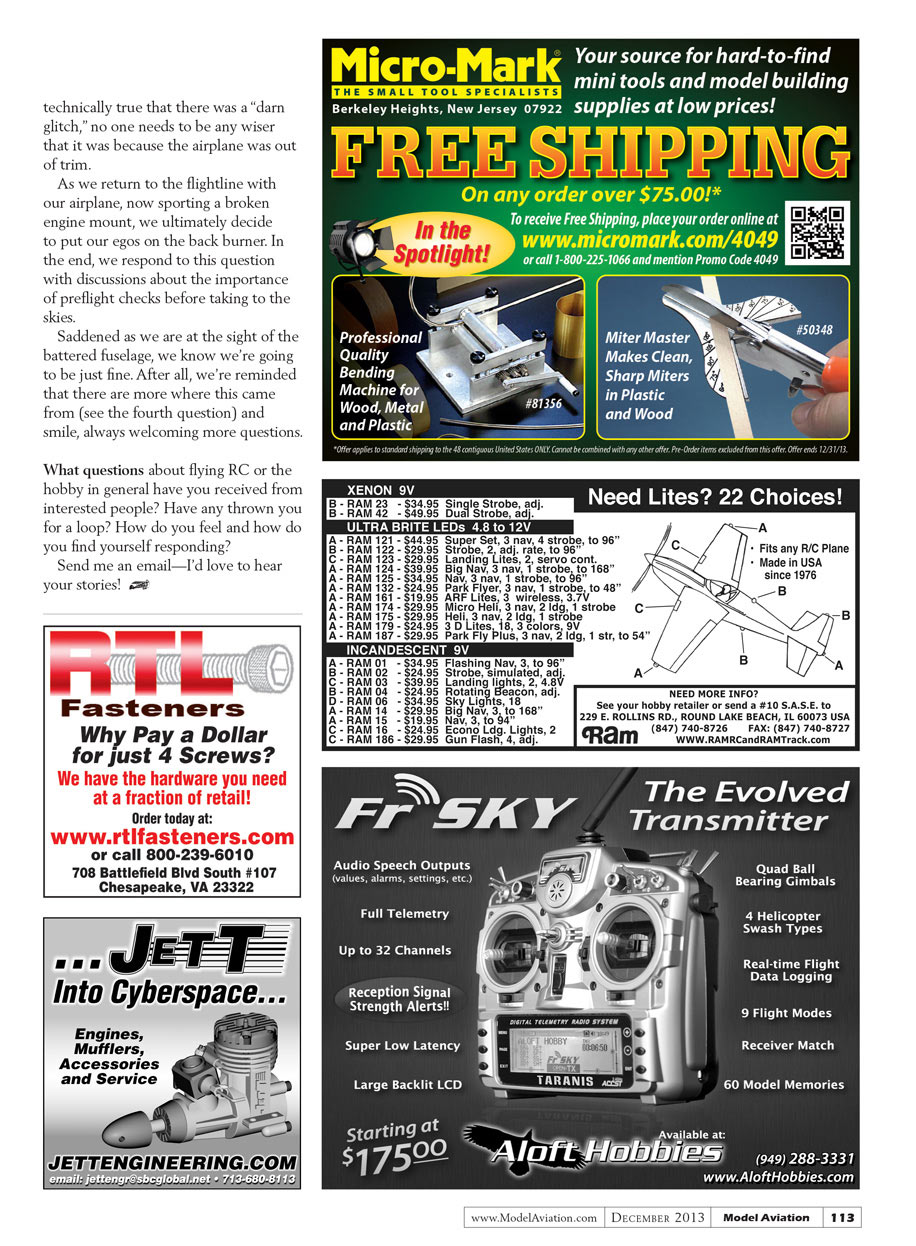
"You fly models? Oh. So you don't have any hobbies like golf or anything?"
Oh boy. Part of us wants to unleash a sarcastic zinger that's so clever that he or she may faint on the spot, but we know the question wasn't asked in jest, so we're okay with this one.
Although the suggestion that this is not a "normal" hobby (what's normal anyway?) makes our hearts sink a bit, at the same time we're thrilled to be involved with something unique. Depending on the airplane and our skills, we can fly in our own backyard, in a gym, over a lake, or in a living room.
We have variety in speed, size, and talent, all kinds of tools and glue, and similar to skiing or needlepoint, a bevy of other aspects such as community forums, trade shows, events, good days, and bad ones.
"How high do they go?"
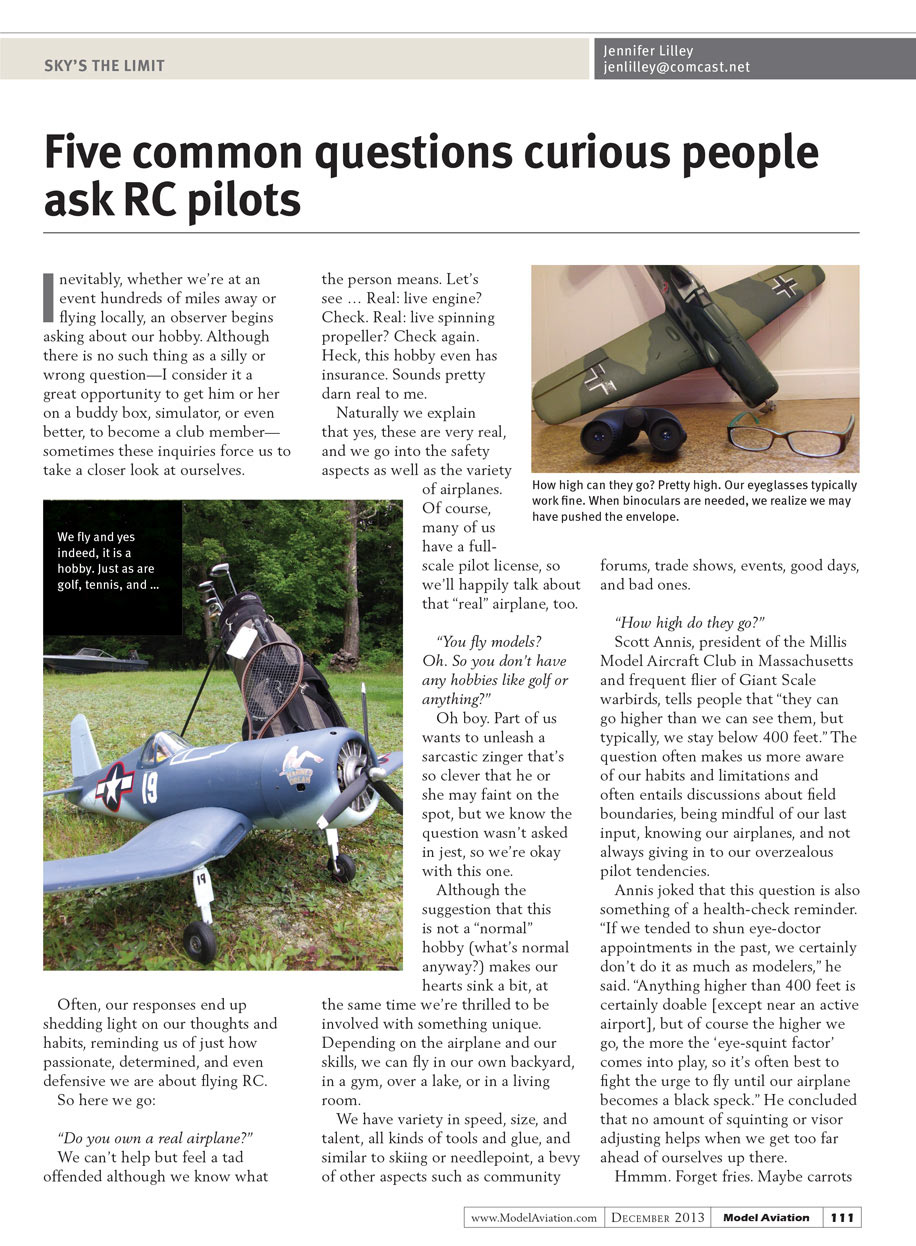
Scott Annis, president of the Millis Model Aircraft Club in Massachusetts and frequent flier of Giant Scale warbirds, tells people that "they can go higher than we can see them, but typically, we stay below 400 feet." The question often makes us more aware of our habits and limitations and often entails discussions about field boundaries, being mindful of our last input, knowing our airplanes, and not always giving in to our overzealous pilot tendencies.
Annis joked that this question is also something of a health-check reminder. "If we tended to shun eye-doctor appointments in the past, we certainly don't do it as much as modelers," he said. "Anything higher than 400 feet is certainly doable [except near an active airport], but of course the higher we go, the more the 'eye-squint factor' comes into play, so it's often best to fight the urge to fly until our airplane becomes a black speck." He concluded that no amount of squinting or visor adjusting helps when we get too far ahead of ourselves up there.
Hmmm. Forget fries. Maybe carrots with those hamburgers at events?
"How many airplanes do you have?"
Two things may happen when this question arises. One, our significant other or even another modeler may playfully jab us in the ribs and make a "there are more airplanes than food in their house" joke, or two, we realize that our interest in flying may be, ummm … borderline obsessive.
Our response is couched more in terms of a breakdown of where we store them, because truth is, we've lost count of how many we actually own. We begin to answer in a proud tone. "Eight in the spare bedroom, two on the dining room table …" As we realize that the enormity of our hobby is almost on par with the enormity of our mortgage and kids' college tuition, our voices trail off (although we're still very proud). "And four suspended from the attic rafters … one still in the trunk …"
In our minds we think we own a handful, but in reality, we haven't seen our basement floor in a long, long time.
And that's okay.
"Why did that just happen?"
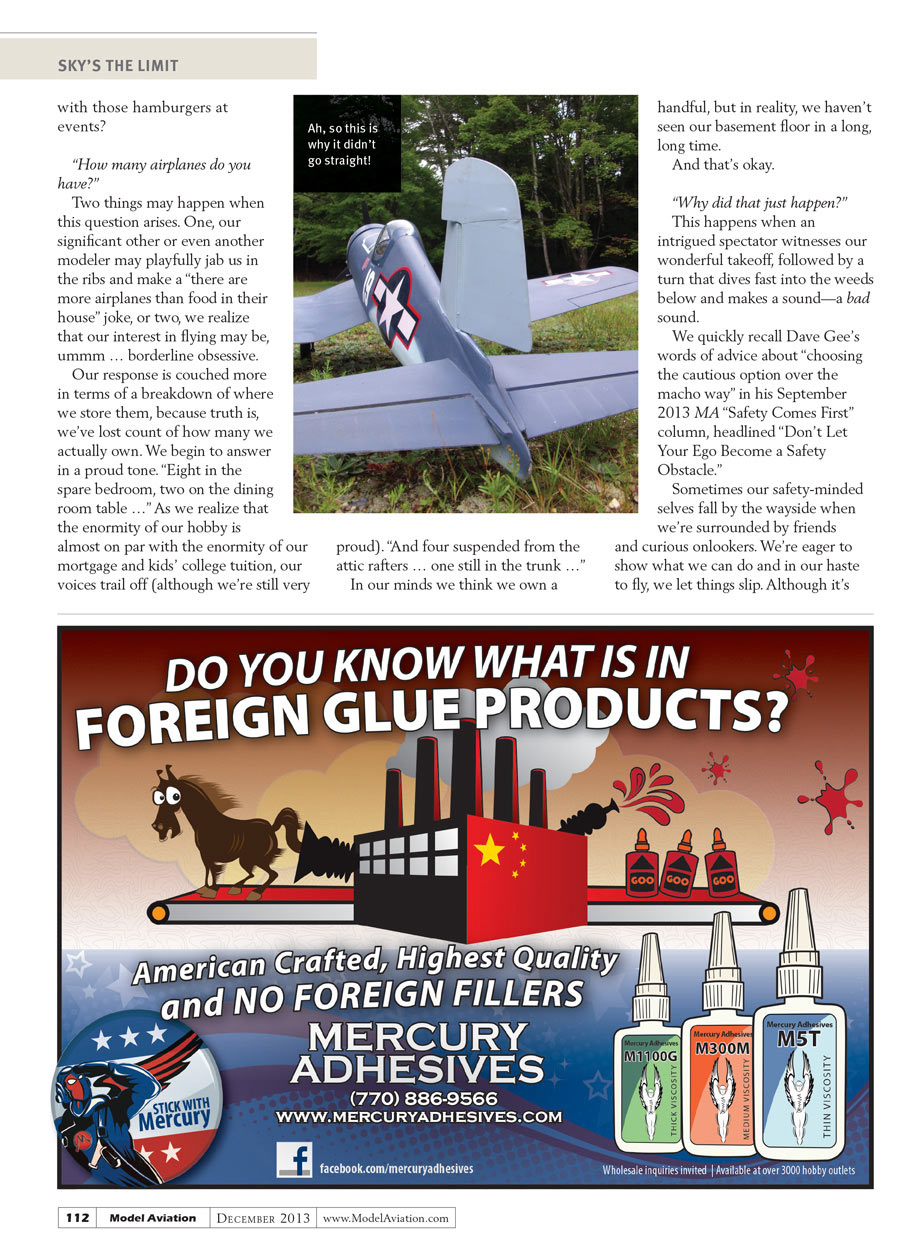
This happens when an intrigued spectator witnesses our wonderful takeoff, followed by a turn that dives fast into the weeds below and makes a sound—a bad sound.
We quickly recall Dave Gee's words of advice about "choosing the cautious option over the macho way" in his September 2013 MA "Safety Comes First" column, headlined "Don't Let Your Ego Become a Safety Obstacle."
Sometimes our safety-minded selves fall by the wayside when we're surrounded by friends and curious onlookers. We're eager to show what we can do and in our haste to fly, we let things slip. Although it's technically true that there was a "darn glitch," no one needs to be any wiser that it was because the airplane was out of trim.
As we return to the flightline with our airplane, now sporting a broken engine mount, we ultimately decide to put our egos on the back burner. In the end, we respond to this question with discussions about the importance of preflight checks before taking to the skies.
Saddened as we are at the sight of the battered fuselage, we know we're going to be just fine. After all, we're reminded that there are more where this came from (see the fourth question) and smile, always welcoming more questions.
What questions about flying RC or the hobby in general have you received from interested people? Have any thrown you for a loop? How do you feel and how do you find yourself responding?
Send me an email — I'd love to hear your stories!
Transcribed from original scans by AI. Minor OCR errors may remain.

