
Small-Field Flying
Paul Bradley
32238 Spinnaker Run, Magnolia TX 77354; E-mail: [email protected]
SAYING GOODBYE to a Friend: As I write this, the news of Randy Randolph's passing is still fresh. Since Randy was such a prominent figure in our hobby, you have probably heard the news by now.
As it was with so many modelers who knew Randy and his work, the news of his passing was hard for me to take. I feel privileged to have had the opportunity to get to know Randy on a personal basis after admiring his work for many years. As is the case with nearly every model-airplane nut I have ever met, Randy was a first-class person in all aspects.
We are so fortunate to have the wonderful legacy he leaves behind in the form of his many model designs and articles. It is especially noteworthy that Randy's work focused on the type of model that is so well suited to small-field flying.
Now that Randy has joined other modelers who gave us many great designs and an insight into how to be more skilled at this wonderful hobby, it is my sincere hope that the legacy created by this group will continue to be enjoyed by future generations of model-airplane builders and fliers. While technology continues to offer us magnificent opportunities to explore the world of flight on a miniature scale, the foundation laid by Randy and his peers is timeless.
My sincere thanks go out to Randy Randolph for enriching my modeling experience. I hope he is watching and smiling as we build his designs for our personal enjoyment. Regardless of the power system selected, Randy's designs fly wonderfully well.
If you are not familiar with a Randy Randolph design, do a little searching in the plans listings offered by the modeling press. You won't have to dig very far to find one. He had many published.
Randy, my friend, thanks for your time in this world, and I hope you are still designing those great models where you are now.
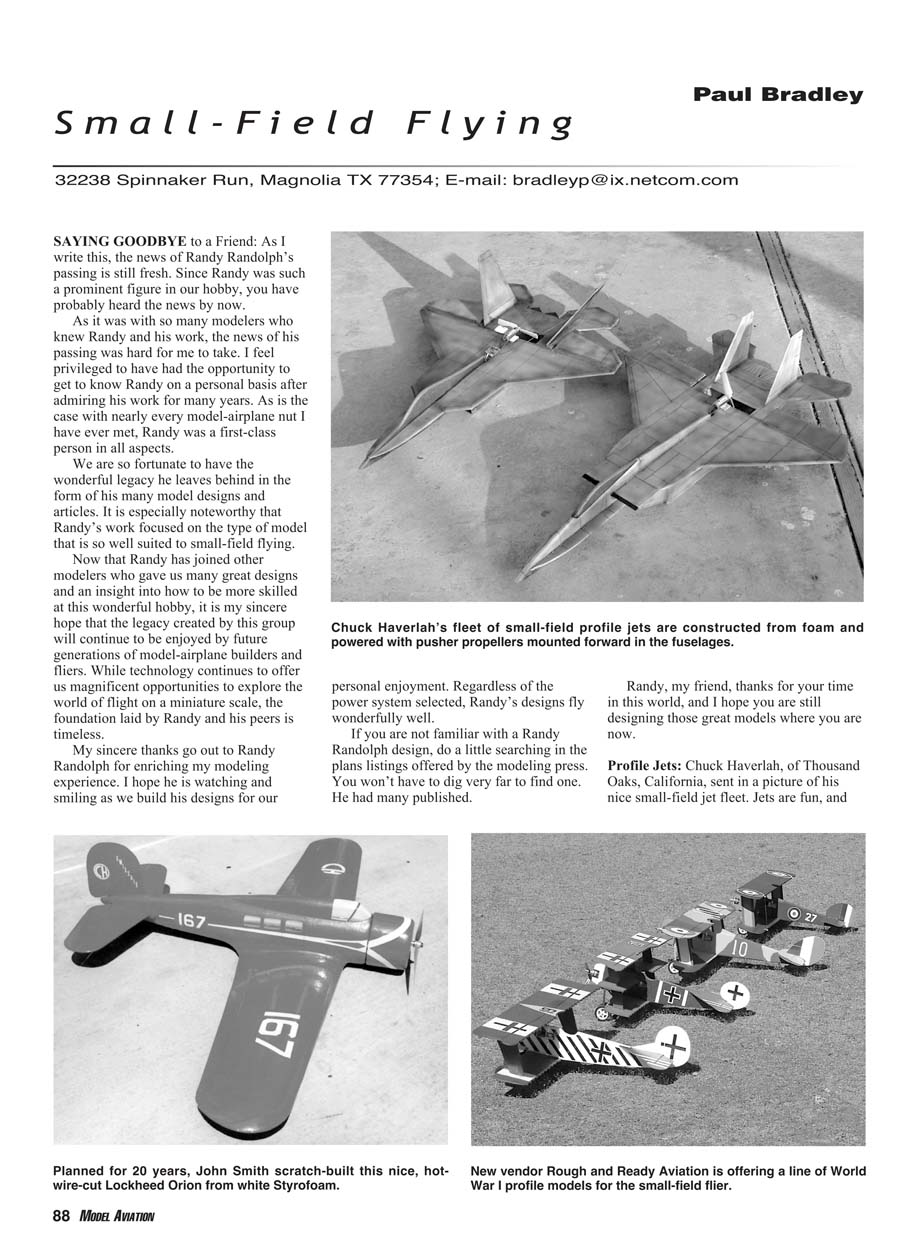
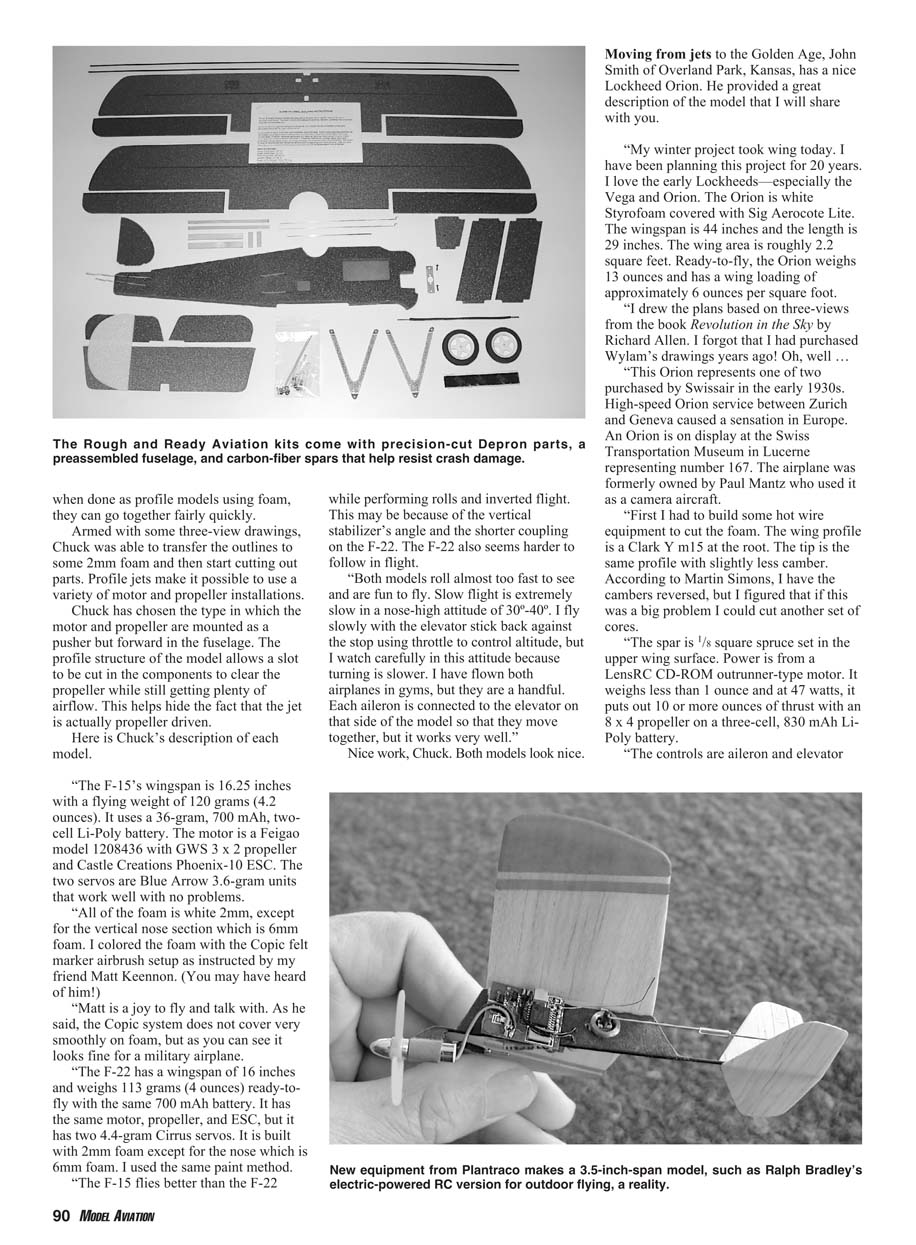
Profile Jets: Chuck Haverlah, of Thousand Oaks, California, sent in a picture of his nice small-field jet fleet. Jets are fun, and moving from jets to the Golden Age, John Smith of Overland Park, Kansas, has a nice Lockheed Orion. He provided a great description of the model that I will share with you.
“My winter project took wing today. I have been planning this project for 20 years. I love the early Lockheeds—especially the Vega and Orion. The Orion is white Styrofoam covered with Sig Aerocote Lite. The wingspan is 44 inches and the length is 29 inches. The wing area is roughly 2.2 square feet. Ready-to-fly, the Orion weighs 13 ounces and has a wing loading of approximately 6 ounces per square foot.
“I drew the plans based on three-views from the book Revolution in the Sky by Richard Allen. I forgot that I had purchased Wylam’s drawings years ago! Oh, well …
“This Orion represents one of two purchased by Swissair in the early 1930s. High-speed Orion service between Zurich and Geneva caused a sensation in Europe. An Orion is on display at the Swiss Transportation Museum in Lucerne representing number 167. The airplane was formerly owned by Paul Mantz who used it as a camera aircraft.
“First I had to build some hot wire equipment to cut the foam. The wing profile is a Clark Y with 1/4 inch at the root. The tip is the same profile with slightly less camber. According to Martin Simons, I have the cambers reversed, but I figured that if this was a big problem I could cut another set of cores.
“The spar is 1/8 square spruce set in the upper wing surface. Power is from a LensRC CD-ROM outrunner-type motor. It weighs less than 1 ounce and at 47 watts, it puts out 10 or more ounces of thrust with an 8 x 4 propeller on a three-cell, 830 mAh Li-Poly battery.
“The controls are aileron and elevator and the airplane is set up with flaperons. The markings are all cut from white Aerocote. The cabin windows and canopy reflections were airbrushed.
“I made the first Orion flights with Wally Freeburg assisting. The Orion flies beautifully. I did roughly six takeoffs and landings. The wind was mostly west at 5-10 mph. From launch, the model climbs at 45° and accelerates away nicely. It has a good turn of speed (for me)—I estimate 30-35 mph or maybe more.
“The Orion flies level at half to three-quarters throttle. With the power off and elevator neutral, the airplane’s nose drops to approximately 45° (it was balanced nose-heavy for the first flights). Landing without flaps, the airspeed appears to be 10-12 mph; with flaps it is 5-7 mph. The motor performed flawlessly with an 8 x 4 propeller.
“With the hot wire setup, I hope to build two or three semiscale models per year.”
John, if you do build some additional models with your hot-wire setup, please share some photos so we can admire your nice work.
News From the Industry: In these times of fast-paced developments, it is hard to keep up with all the good things coming from the model-aviation industry. I have a few items I want to bring to your attention since they relate directly to the world of small-field flying.
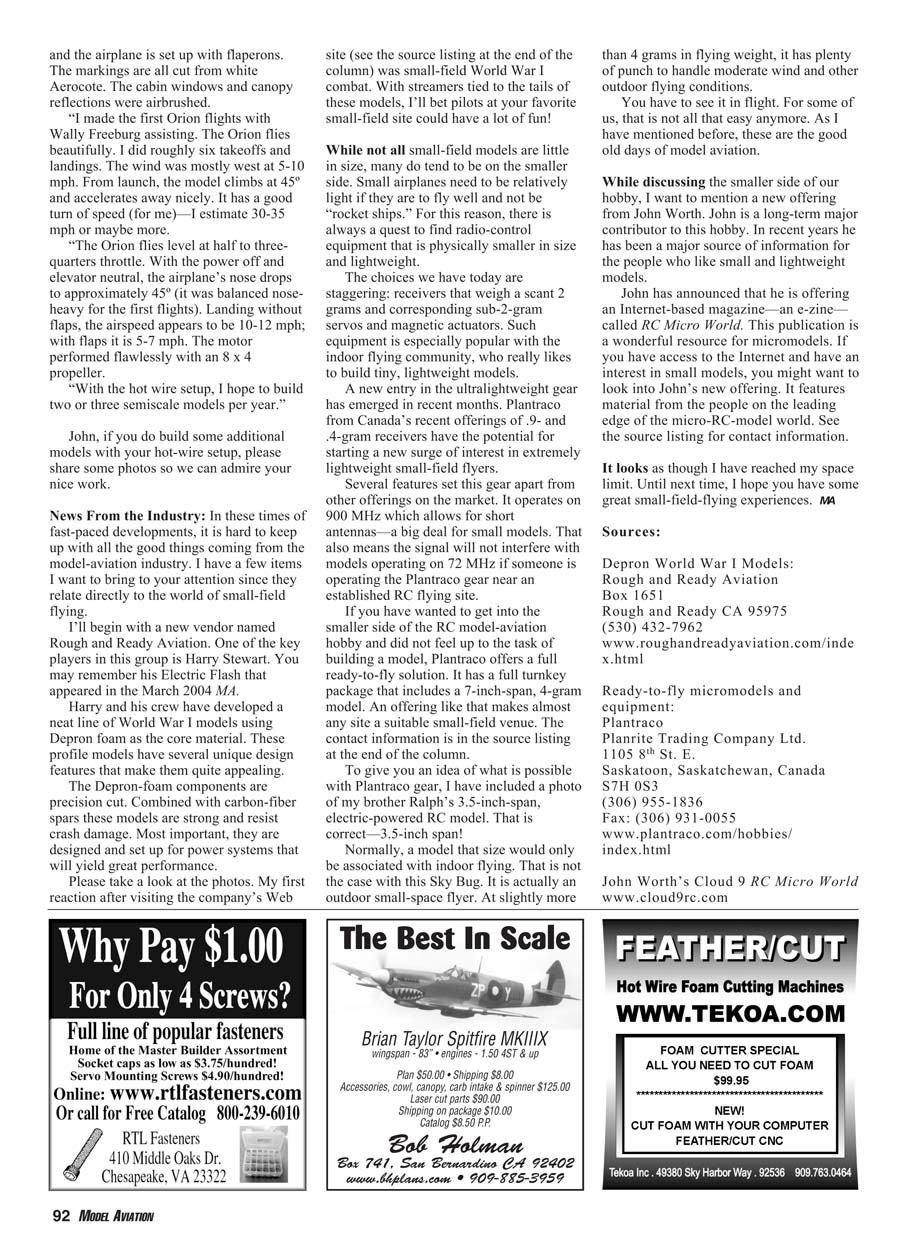
I’ll begin with a new vendor named Rough and Ready Aviation. One of the key players in this group is Harry Stewart. You may remember his Electric Flash that appeared in the March 2004 MA.
Harry and his crew have developed a neat line of World War I models using Depron foam as the core material. These profile models have several unique design features that make them quite appealing.
The Depron-foam components are precision cut. Combined with carbon-fiber spars these models are strong and resist crash damage. Most important, they are designed and set up for power systems that will yield great performance.
Please take a look at the photos. My first reaction after visiting the company’s Web site (see the source listing at the end of the column) was small-field World War I combat. With streamers tied to the tails of these models, I’ll bet pilots at your favorite small-field site could have a lot of fun!
While not all small-field models are little in size, many do tend to be on the smaller side. Small airplanes need to be relatively light if they are to fly well and not be “rocket ships.” For this reason, there is always a quest to find radio-control equipment that is physically smaller in size and lightweight.
The choices we have today are staggering: receivers that weigh a scant 2 grams and corresponding sub-2-gram servos and magnetic actuators. Such equipment is especially popular with the micro and indoor flying community, who really likes to build tiny, lightweight models.
A new entry in the ultralightweight gear has appeared in recent months. Plantraco from Canada’s recent offerings of .9- and .4-gram receivers have the potential for starting a new surge of interest in extremely lightweight small-field fliers.
Several features set this gear apart from other offerings on the market. It operates on 900 MHz which allows for short antennas—a big deal for small models. That also means the signal will not interfere with models operating on 72 MHz if someone is operating the Plantraco gear near an established RC flying site.
If you have wanted to get into the smaller side of the RC model-aviation hobby and did not feel up to the task of building a model, Plantraco offers a full ready-to-fly solution. It has a full turnkey package that includes a 7-inch-span, 4-gram model. An offering like that makes almost any site a suitable small-field venue. The contact information is in the source listing at the end of the column.
To give you an idea of what is possible with Plantraco gear, I have included a photo of my brother Ralph’s 3.5-inch-span, electric-powered RC model. That is correct—3.5-inch span!
Normally, a model that size would only be associated with indoor flying. That is not the case with this Sky Bug. It is actually an outdoor small-space flyer. At slightly more than 4 grams in flying weight, it has plenty of punch to handle moderate wind and other outdoor flying conditions.
You have to see it in flight. For some of us, that is not all that easy anymore. As I have mentioned before, these are the good old days of model aviation.
While discussing the smaller side of our hobby, I want to mention a new offering from John Worth. John is a long-term major contributor to this hobby. In recent years he has been a major source of information for the people who like small and lightweight models.
John has announced that he is offering an Internet-based magazine—an e-zine—called RC Micro World. This publication is a wonderful resource for micromodels. If you have access to the Internet and have an interest in small models, you might want to look into John’s new offering. It features material from the people on the leading edge of the micro-RC model world. See the source listing for contact information.
It looks as though I have reached my space limit. Until next time, I hope you have some great small-field-flying experiences. MA
Sources:
- Depron World War I Models:
Rough and Ready Aviation Box 1651 Rough and Ready CA 95975 (530) 432-7962 www.roughandreadyaviation.com/index.html
- Ready-to-fly micromodels and equipment:
Plantraco Plantrac Trading Company Ltd. 1105 8th St. E. Saskatoon, Saskatchewan, Canada S7H 0S3 (306) 955-1836 Fax: (306) 931-0055 www.plantraco.com/hobbies/index.html
- John Worth’s Cloud 9 RC Micro World
Transcribed from original scans by AI. Minor OCR errors may remain.

