
Small-Field Flying
Paul Bradley | [email protected]
More about tissue over film for covering small-field models
TISSUE OVER FILM: the Continuing Story. I want to pick up on an item I presented in the October 2005 column. You may recall that I wrote about a great technique — in my humble opinion — for developing striking, lightweight, and durable covering for our small-field models.
This technique, developed by the FF modeling community, involves the application of tissue paper on top of a lightweight, heat-shrinkable film covering material. The result is a durable covering that adds considerable stiffness to the model.
When the tissue has also been enhanced by decorating it using a computer-based ink-jet printer, you end up with a great-looking small-field model that can take some punishment.
In the previous column I focused on the use of clear Mylar film as the base covering material. In passing, I mentioned that we could also use one of the lightweight, white-colored films such as Solite.
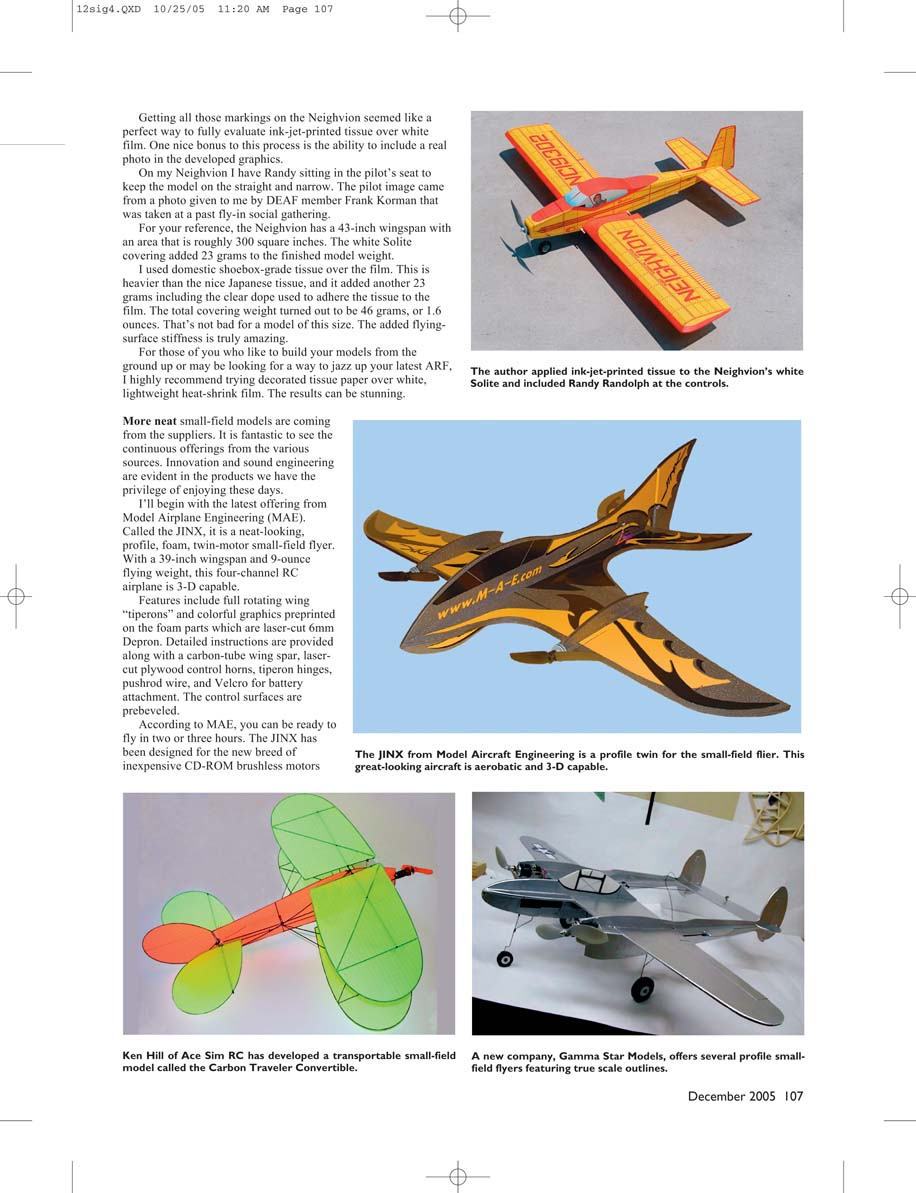
As noted previously, the clear films leave something to be desired when using tissue that is lighter in color or carries printing that has light-colored shades. The goal of using something such as white Solite is to provide a better background for the decorated tissue. To help demonstrate what is possible, I have presented one of my recent projects in the photos.
My airplane is the Randy Randolph-designed Neighvion. This nice small-field model was first presented to the public in the July 1982 MA. The plans, number 372, are still available from the AMA Plans Service.
I received word that the annual Dallas Electric Aircraft Flyers (DEAF) fly-in, held in October, would have a special event in memory of Randy. Any of his designs were eligible; they just had to be electric powered. I really liked his Neighvion design and decided to make that model my project for the event.
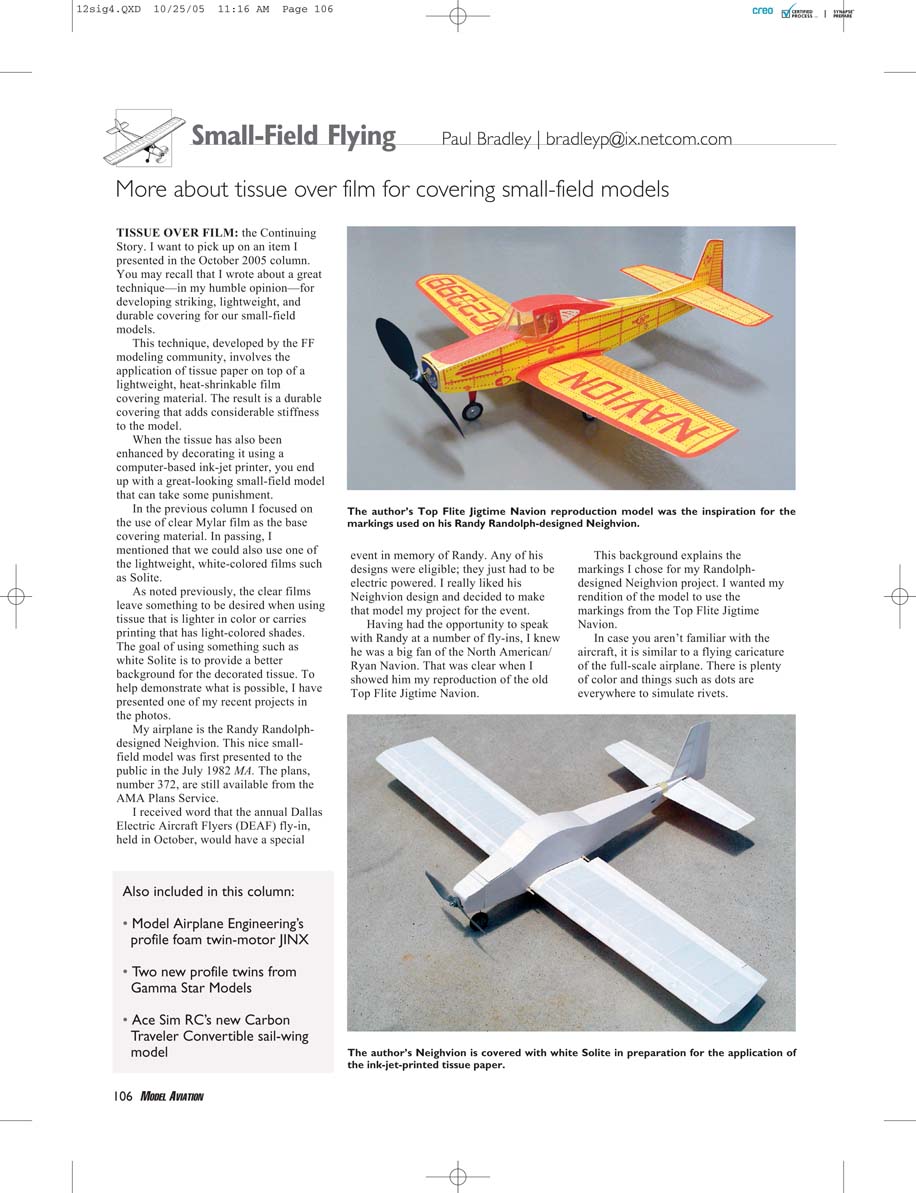
Having had the opportunity to speak with Randy at a number of fly-ins, I knew he was a big fan of the North American/Ryan Navion. That was clear when I showed him my reproduction of the old Top Flite Jigtime Navion.
This background explains the markings I chose for my Randolph-designed Neighvion project. I wanted my rendition of the model to use the markings from the Top Flite Jigtime Navion.
In case you aren't familiar with the aircraft, it is similar to a tiny caricature of the full-scale airplane. There is plenty of color and things such as dots are everywhere to simulate rivets.
Also included in this column:
- Model Airplane Engineering’s profile foam twin-motor JINX
- Two new profile twins from Gamma Star Models
- Ace Sim RC’s new Carbon Traveler Convertible sail-wing model
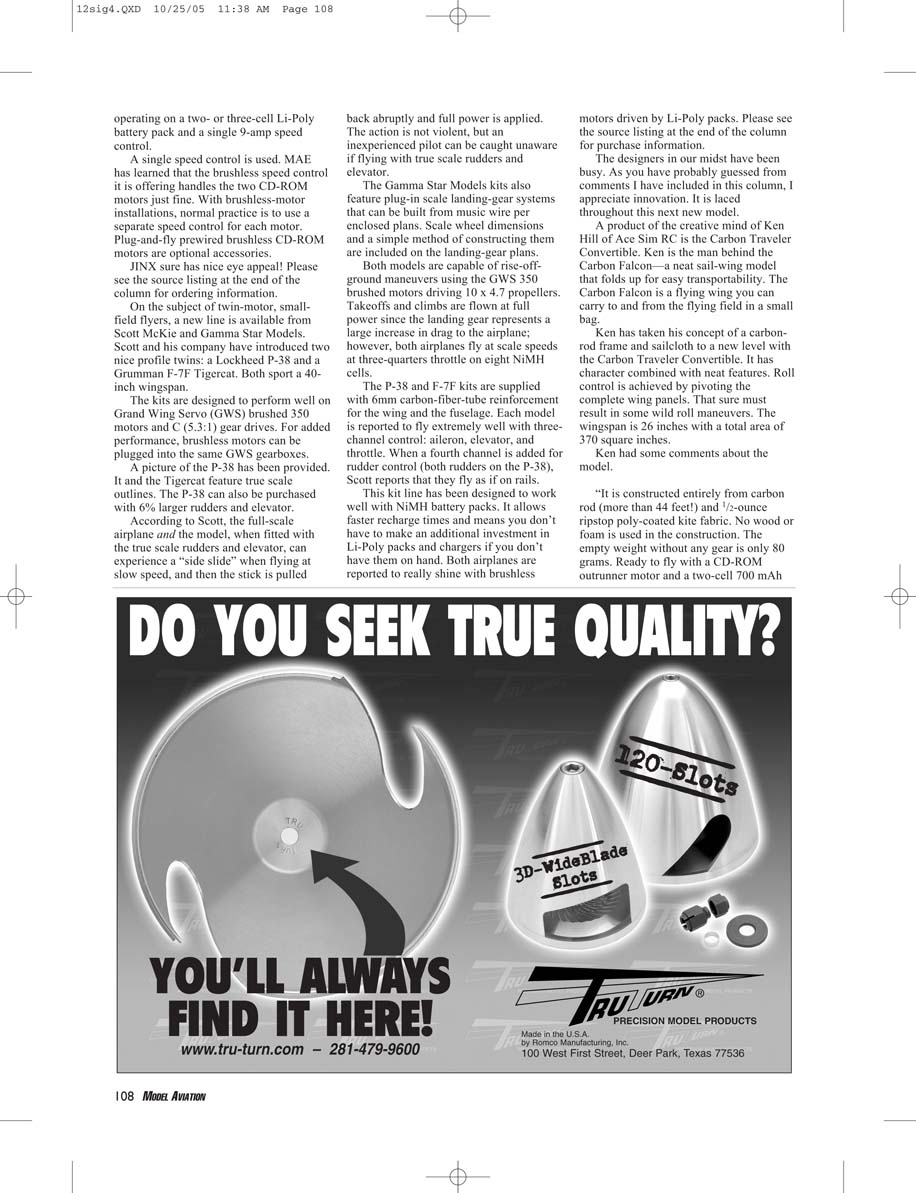
Getting all those markings on the Neighvion seemed like a perfect way to fully evaluate ink-jet-printed tissue over white film. One nice bonus to this process is the ability to include a real photo in the developed graphics.
On my Neighvion I have Randy sitting in the pilot's seat to keep the model on the straight and narrow. The pilot image came from a photo given to me by DEAF member Frank Korman that was taken at a past fly-in social gathering.
For your reference, the Neighvion has a 43-inch wingspan with an area that is roughly 300 square inches. The white Solite covering added 23 grams to the finished model weight.
I used domestic shoebox-grade tissue over the film. This is heavier than the nice Japanese tissue, and it added another 23 grams including the clear dope used to adhere the tissue to the film. The total covering weight turned out to be 46 grams, or 1.6 ounces. That's not bad for a model of this size. The added flying-surface stiffness is truly amazing.
For those of you who like to build your models from the ground up or may be looking for a way to jazz up your latest ARF, I highly recommend trying decorated tissue paper over white, lightweight heat-shrink film. The results can be stunning.
More neat small-field models are coming from the suppliers. It is fantastic to see the continuous offerings from the various sources. Innovation and sound engineering are evident in the products we have the privilege of enjoying these days.
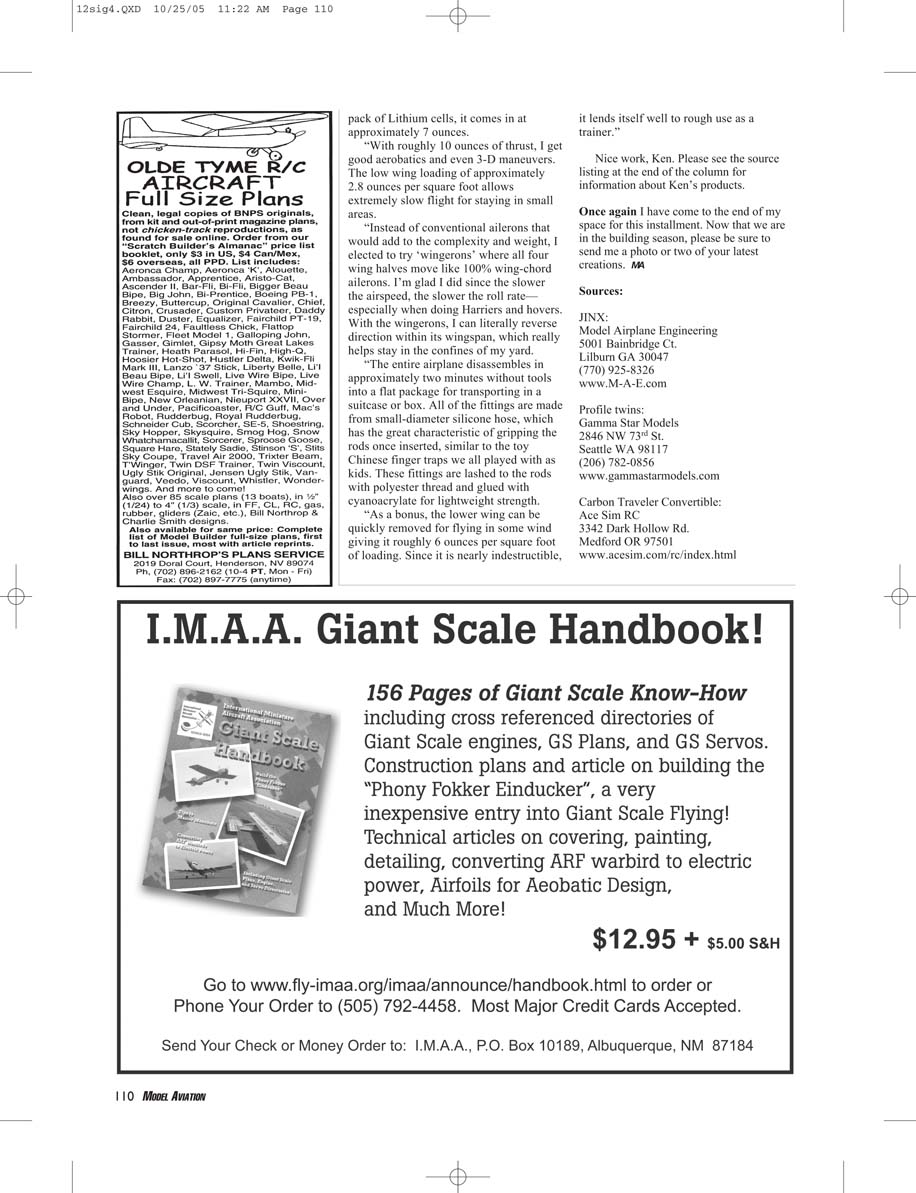
I'll begin with the latest offering from Model Airplane Engineering (MAE). Called the JINX, it is a neat-looking, profile, foam, twin-motor small-field flier. With a 39-inch wingspan and 9-ounce flying weight, this four-channel RC airplane is 3-D capable, operating on a two- or three-cell Li-Poly battery pack and a single 9-amp speed control.
A single speed control is used. MAE has learned that the brushless speed control it is offering handles the two CD-ROM motors just fine. With brushless-motor installations, normal practice is to use a separate speed control for each motor. Plug-and-fly prewired brushless CD-ROM motors are optional accessories.
JINX sure has nice eye appeal! Please see the source listing at the end of the column for ordering information.
On the subject of twin-motor, small-field flyers, a new line is available from Scott McKie and Gamma Star Models. Scott and his company have introduced two nice profile twins: a Lockheed P-38 and a Grumman F7F Tigercat. Both sport a 40-inch wingspan.
The kits are designed to perform well on Grand Wing Servo (GWS) brushed 350 motors and C (5.3:1) gear drives. For added performance, brushless motors can be plugged into the same GWS gearboxes.
A picture of the P-38 has been provided. It and the Tigercat feature true scale outlines. The P-38 can also be purchased with 6% larger rudders and elevator.
According to Scott, the full-scale airplane and the model, when fitted with the true scale rudders and elevator, can experience a “side slide” when flying at slow speed, and then the stick is pulled back abruptly and full power is applied. The action is not violent, but an inexperienced pilot can be caught unaware if flying with true scale rudders and elevator.
The Gamma Star Models kits also feature plug-in scale landing-gear systems that can be built from music wire per enclosed plans. Scale wheel dimensions and a simple method of constructing the gear are included on the landing-gear plans.
Both models are capable of rise-off-ground maneuvers using the GWS 350 brushed motors driving 10 x 4.7 propellers. Takeoffs and climbs are flown at full power since the landing gear represents a large increase in drag to the airplane; however, both airplanes fly at scale speeds at three-quarters throttle on eight NiMH cells.
The P-38 and F-7F kits are supplied with 6mm carbon-fiber-tube reinforcement for the wing and the fuselage. Each model is reported to fly extremely well with three-channel control: aileron, elevator, and rudder. When a fourth channel is added for rudder control (both rudders on the P-38), Scott reports that they fly as if on rails.
This kit line has been designed to work well with NiMH battery packs. It allows faster recharge times and means you don't have to make an additional investment in Li-Poly packs and chargers if you don't have them on hand. Both airplanes are reported to really shine with brushless motors driven by Li-Poly packs. Please see the source listing at the end of the column for purchase information.
The designers in our midst have been busy. As you have probably guessed from comments I have included in this column, I appreciate innovation. It is laced throughout this next new model.
A product of the creative mind of Ken Hill of Ace Sim RC is the Carbon Traveler Convertible. Ken is the man behind the Carbon Falcon — a neat sail-wing model that folds up for easy transportability. The Carbon Falcon is a flying wing you can carry to and from the flying field in a small bag.
Ken has taken his concept of a carbon-rod frame and sailcloth to a new level with the Carbon Traveler Convertible. It has character combined with neat features. Roll control is achieved by pivoting the complete wing panels. That sure must result in some wild roll maneuvers. The wingspan is 26 inches with a total area of 370 square inches.
Ken had some comments about the model.
“It is constructed entirely from carbon rod (more than 44 feet!) and 1/2-ounce ripstop rayon-coated kite fabric. No wood or foam is used in the construction. The empty weight without any gear is only 80 grams. Ready to fly with a CD-ROM outrunner motor and a two-cell 700 mAh pack of Lithium cells, it comes in at approximately 7 ounces.
"With roughly 10 ounces of thrust, I get good acrobatics and even 3-D maneuvers. The low wing loading of approximately 2.8 ounces per square foot allows extremely slow flight for staying in small areas.
"Instead of conventional ailerons that would add to the complexity and weight, I elected to try 'wingerons' where all four wing halves move like 100% wing-chord ailerons. I'm glad I did since the slower the airspeed, the slower the roll rate—especially when doing Harriers and hovers. With the wingerons, I can literally reverse direction within its wingspan, which really helps staying in the confines of my yard.
"The entire airplane disassembles in approximately two minutes without tools into a flat package for transporting in a suitcase or box. All of the fittings are made from small-diameter silicone hose, which has the great characteristic of gripping the rods once inserted, similar to the Chinese finger traps we all played with as kids. These fittings are lashed to the rods with polyester thread and glued with cyanoacrylate for lightweight strength.
"As a bonus, the lower wing can be quickly removed for flying in some wind giving it roughly 6 ounces per square foot of loading. Since it is nearly indestructible, it lends itself well to rough use as a trainer."
Nice work, Ken. Please see the source listing at the end of the column for information about Ken's products.
Once again I have come to the end of my space for this installment. Now that we are in the building season, please be sure to send me a photo or two of your latest creations. MA
Sources:
JINX: Model Airplane Engineering 5001 Bainbridge Ct. Lilburn GA 30047 (770) 925-8326 www.M-A-E.com
Profile twins: Gamma Star Models 2846 NW 73rd St. Seattle WA 98117 (206) 782-0856 www.gammastarmodels.com
Carbon Traveler Convertible: Ace Sim RC 3342 Dark Hollow Rd. Medford OR 97501 www.acesim.com/rc/index.html
Transcribed from original scans by AI. Minor OCR errors may remain.

