
Small-Field Flying
Paul Bradley | [email protected]
Big things were happening at the SMALL get-together
Also included in this column:
- Protect your propeller and motor
- Vintage plans source
FUN IN THE SUN: I don't know about you, but I have enjoyed the flying season this year. By the time you read this column, the outdoor flying season will be winding down in many parts of the country. That is one reason I like to take an opportunity this time of year to reflect on some of the fly-ins I had the chance to attend during the warmer months of the year.
The beginning of June saw the annual gathering of the Small Model Airplane Lovers' League (SMALL) near Little Rock, Arkansas. The name is misleading since there really is no formal organization; it is a group of model-airplane nuts who happen to like models on the smaller side.
The only limitation for participation is that the models must be powered—if powered—by nothing larger than the equivalent of a fueled .26 cu. in. displacement engine. Multiple engines or motors are allowed, as is any form of model-aviation interest. One of the unique features of this gathering is that you see RC, FF, and CL models at the same fly-in.
The 2008 SMALL event had a slight reduction in the number of pilots because of the high cost of traveling, but overall it was another great event representing a nice cross-section of models that
Small-Field Flying
Paul Bradley
are generally smaller. I use the word "generally" because there was a nice large model of the Howard Hughes Spruce Goose. It met the power requirement because it was powered by eight Speed 400 electric motors. It was impressive on the ground and in the air.
I like to look at the models relative to their ability to fly in smaller venues. There are always some great examples. Selecting a few to highlight in these pages is always difficult. Hopefully the ones I chose will give you a good feel for the event and let you see what others are up to as you make decisions about your future projects.
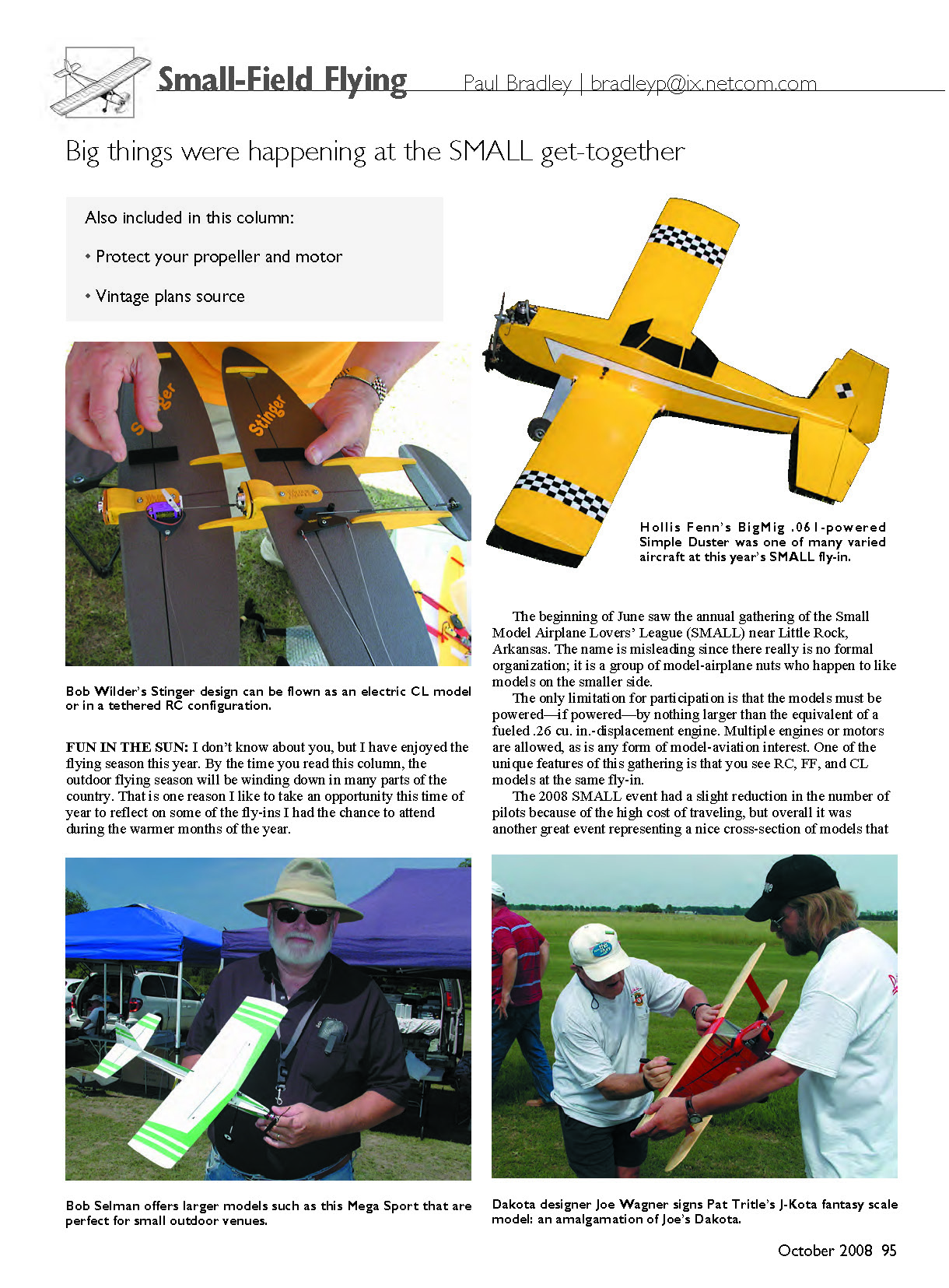
There was a nice glow-powered model by Hollis Fenn. Please see the picture of his BigMig .061-powered Simple Duster. This is a Fred Reese Simple Series design with a few tweaks by Hollis. He used a constant-chord wing rather than tapered, as the design called for.
The Duster has a wingspan of 35 inches and weighs 16 ounces ready to fly. The wing is foam and the rest of the airframe is balsa. Each time Hollis flew this model, it captured my attention. It looks great in the air and performs beautifully.
Because electric-powered models have become so popular for small-field flying, they tend to dominate the material that I have available for this column. I still love a nice glow-powered, small-field model, and it's nice to be able to feature them. If you are a small-field flier who likes glow- or other fuel-powered engines, don't let the popularity of electric models keep you from sharing your projects.
In the June column I had the opportunity to share some thoughts about tethered RC flying that Ralph Bradley and Bob Wilder are investigating. Both were at the SMALL gathering. It was interesting listening to them compare notes on the subject.
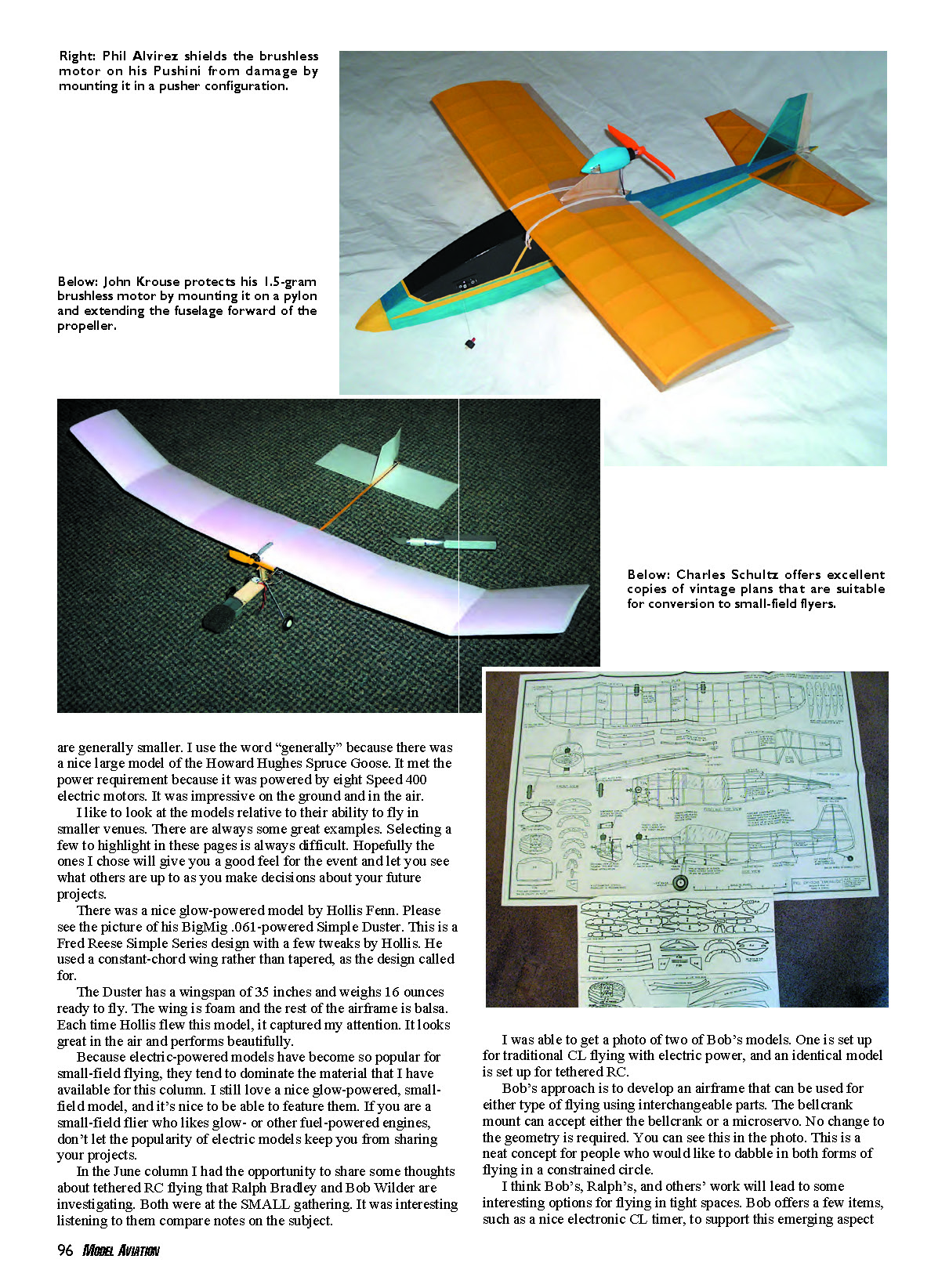
I was able to get a photo of two of Bob's models. One is set up for traditional CL flying with electric power, and an identical model is set up for tethered RC.
Bob's approach is to develop an airframe that can be used for either type of flying using interchangeable parts. The bellcrank mount can accept either the bellcrank or a microservo. No change to the geometry is required. You can see this in the photo. This is a neat concept for people who would like to dabble in both forms of flying in a constrained circle.
I think Bob's, Ralph's, and others' work will lead to some interesting options for flying in tight spaces. Bob offers a few items, such as a nice electronic CL timer, to support this emerging aspect
While at the SMALL event I had the opportunity to see some of the new models from Bob Selman Designs. His operation is best known for all the neat gear he offers to the micro-RC pilot.
Bob is expanding his offerings to include models that are well suited to small outdoor flying sites. These airplanes are slightly larger, with performance that really works in flying spaces the size of a big back yard or street cul-de-sac.
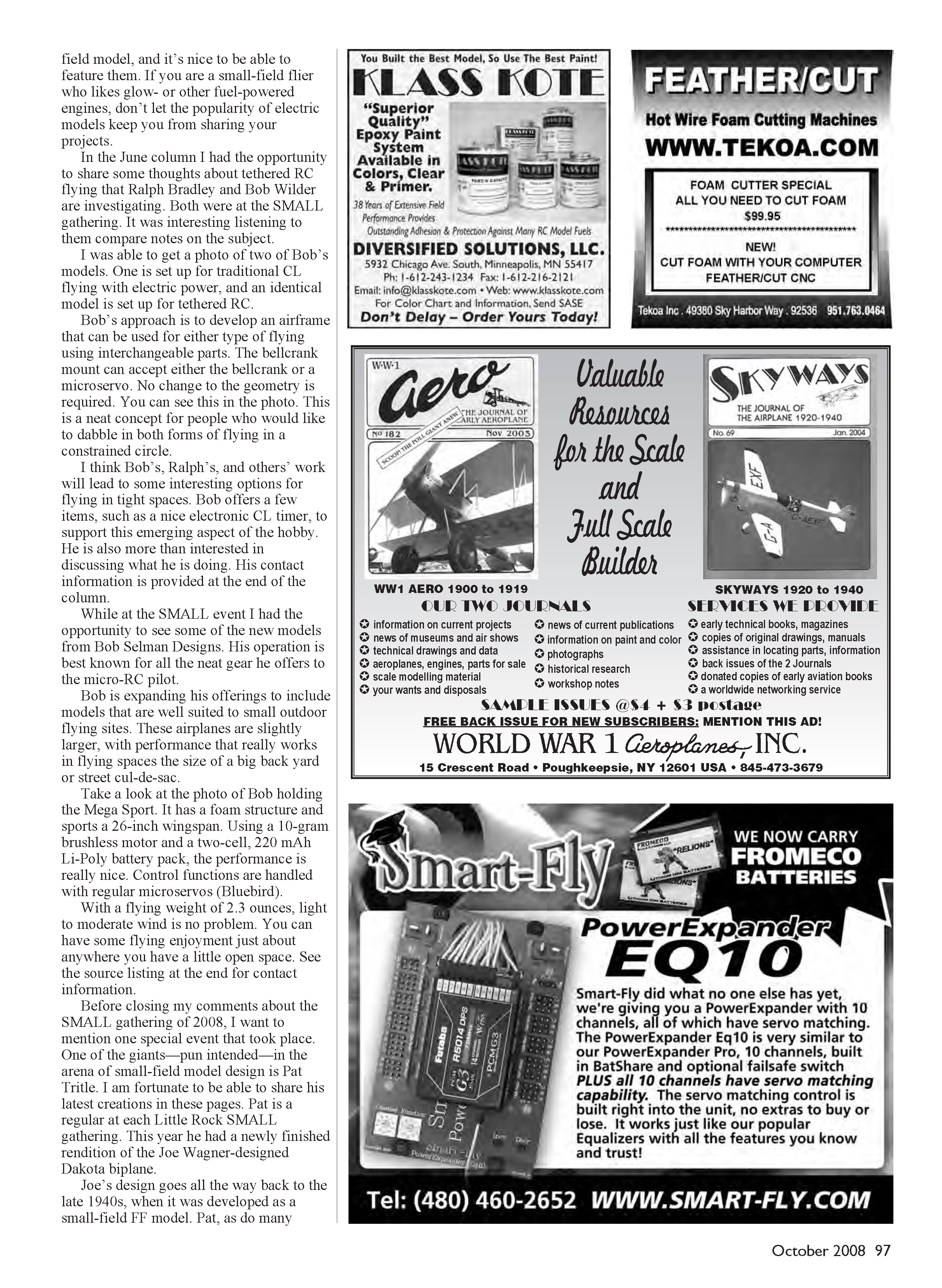
Take a look at the photo of Bob holding the Mega Sport. It has a foam structure and sports a 26-inch wingspan. Using a 10-gram brushless motor and a two-cell, 220 mAh Li-Poly battery pack, the performance is really nice. Control functions are handled with regular microservos (Bluebird).
With a flying weight of 2.3 ounces, light to moderate wind is no problem. You can have some flying enjoyment just about anywhere you have a little open space. See the source listing at the end for contact information.
Before closing my comments about the SMALL gathering of 2008, I want to mention one special event that took place. One of the giants—pun intended—in the arena of small-field model design is Pat Tritle. I am fortunate to be able to share his latest creations in these pages. Pat is a regular at each Little Rock SMALL gathering. This year he had a newly finished rendition of the Joe Wagner-designed Dakota biplane.
Joe’s design goes all the way back to the late 1940s, when it was developed as a small-field FF model. Pat, as do many
Small-Field Flying
Paul Bradley
longtime modelers, has a love affair with that airplane. Pat also feels that the basic design would be a good full-scale airplane, and he decided to develop a version of the Dakota as it might appear in full-scale format.
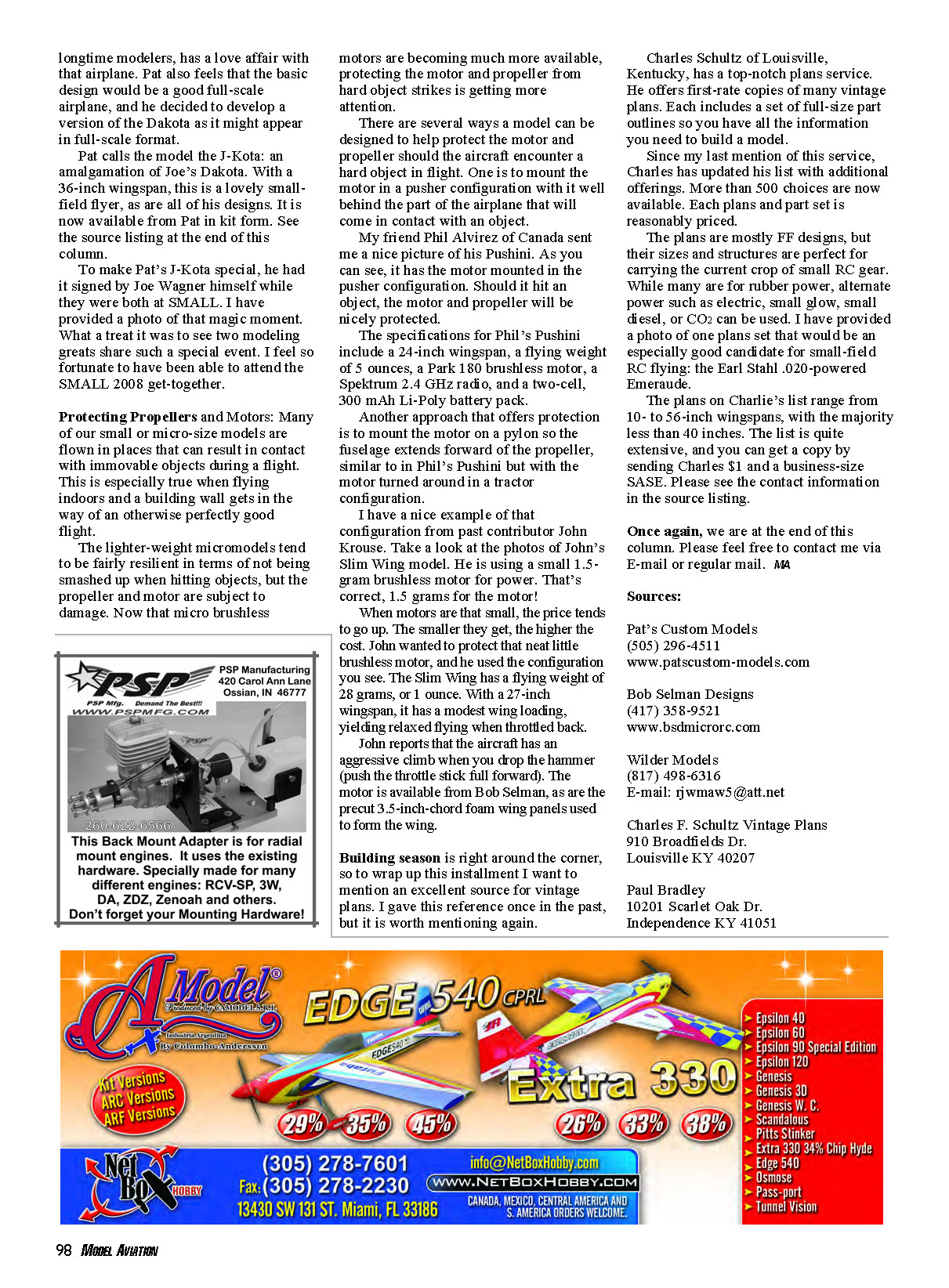
Pat calls the model the J-Kota: an amalgamation of Joe's Dakota. With a 36-inch wingspan, this is a lovely small-field flyer, as are all of his designs. It is now available from Pat in kit form. See the source listing at the end of this column.
To make Pat's J-Kota special, he had it signed by Joe Wagner himself while they were both at SMALL. I have provided a photo of that magic moment. What a treat it was to see two modeling greats share such a special event. I feel so fortunate to have been able to attend the SMALL 2008 get-together.
Protecting Propellers and Motors
Many of our small or micro-size models are flown in places that can result in contact with immovable objects during a flight. This is especially true when flying indoors and a building wall gets in the way of an otherwise perfectly good flight.
The lighter-weight micromodels tend to be fairly resilient in terms of not being smashed up when hitting objects, but the propeller and motor are subject to damage. Now that micro brushless motors are becoming much more available, protecting the motor and propeller from hard object strikes is getting more attention.
There are several ways a model can be designed to help protect the motor and propeller should the aircraft encounter a hard object in flight. One is to mount the motor in a pusher configuration with it well behind the part of the airplane that will come in contact with an object.
My friend Phil Alvirez of Canada sent me a nice picture of his Pushini. As you can see, it has the motor mounted in the pusher configuration. Should it hit an object, the motor and propeller will be nicely protected.
The specifications for Phil's Pushini include a 24-inch wingspan, a flying weight of 5 ounces, a Park 180 brushless motor, a Spektrum 2.4 GHz radio, and a two-cell, 300 mAh Li-Poly battery pack.
Another approach that offers protection is to mount the motor on a pylon so the fuselage extends forward of the propeller, similar to in Phil's Pushini but with the motor turned around in a tractor configuration.
I have a nice example of that configuration from past contributor John Krouse. Take a look at the photos of John's Slim Wing model. He is using a small 1.5-gram brushless motor for power. That's correct, 1.5 grams for the motor!
When motors are that small, the price tends to go up. The smaller they get, the higher the cost. John wanted to protect that neat little brushless motor, and he used the configuration you see. The Slim Wing has a flying weight of 28 grams, or 1 ounce. With a 27-inch wingspan, it has a modest wing loading, yielding relaxed flying when throttled back.
John reports that the aircraft has an aggressive climb when you drop the hammer (push the throttle stick full forward). The motor is available from Bob Selman, as are the precut 3.5-inch-chord foam wing panels used to form the wing.
Building season is right around the corner, so to wrap up this installment I want to mention an excellent source for vintage plans. I gave this reference once in the past, but it is worth mentioning again.
Charles Schultz of Louisville, Kentucky, has a top-notch plans service. He offers first-rate copies of many vintage plans. Each includes a set of full-size part outlines so you have all the information you need to build a model.
Since my last mention of this service, Charles has updated his list with additional offerings. More than 500 choices are now available. Each plans and part set is reasonably priced.
The plans are mostly FF designs, but their sizes and structures are perfect for carrying the current crop of small RC gear. While many are for rubber power, alternate power such as electric, small glow, small diesel, or CO2 can be used. I have provided a photo of one plans set that would be an especially good candidate for small-field RC flying: the Earl Stahl .020-powered Emeraude.
The plans on Charlie's list range from 10- to 56-inch wingspans, with the majority less than 40 inches. The list is quite extensive, and you can get a copy by sending Charles $1 and a business-size SASE. Please see the contact information in the source listing.
Once again, we are at the end of this column. Please feel free to contact me via E-mail or regular mail. MA
Sources:
- Pat's Custom Models
(505) 296-4511 www.patscustom-models.com
- Bob Selman Designs
(417) 358-9521 www.bsdmicrorc.com
- Wilder Models
(817) 498-6316 E-mail: [email protected]
- Charles F. Schultz Vintage Plans
910 Broadfields Dr. Louisville KY 40207
- Paul Bradley
10201 Scarlet Oak Dr. Independence KY 41051
Transcribed from original scans by AI. Minor OCR errors may remain.

