


Low cost and a high fun factor
Paul Bradley
In past columns I have shared with you model designs from Jack Pignolo. He likes to use fan-fold blue foam as a construction material. Jack is also a fan of inexpensive aircraft that deliver plenty of flying fun.
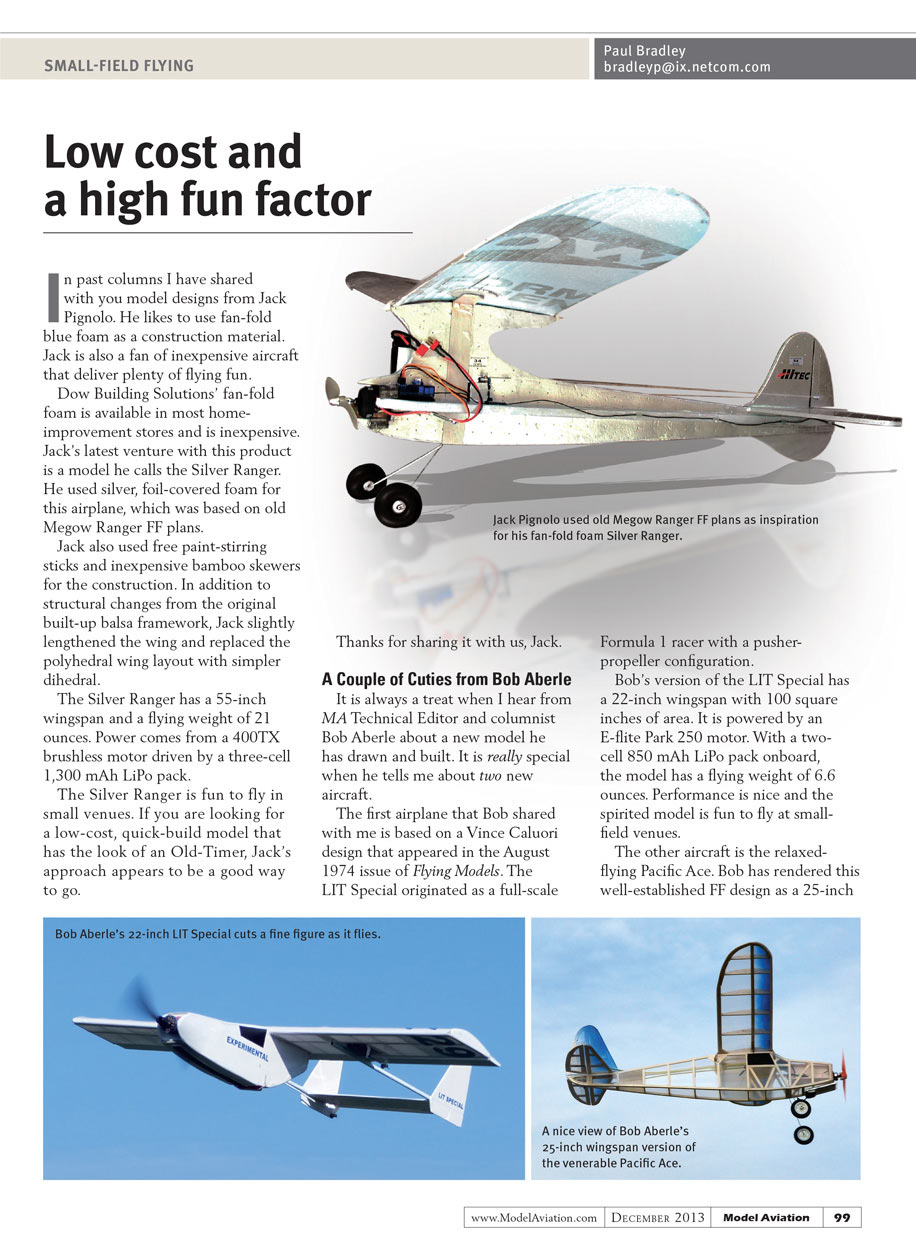
Dow Building Solutions' fan-fold foam is available in most home-improvement stores and is inexpensive. Jack's latest venture with this product is a model he calls the Silver Ranger. He used silver, foil-covered foam for this airplane, which was based on old Megow Ranger FF plans.
Jack also used free paint-stirring sticks and inexpensive bamboo skewers for the construction. In addition to structural changes from the original built-up balsa framework, Jack slightly lengthened the wing and replaced the polyhedral wing layout with simpler dihedral.
The Silver Ranger has a 55-inch wingspan and a flying weight of 21 ounces. Power comes from a 400TX brushless motor driven by a three-cell 1,300 mAh LiPo pack.
The Silver Ranger is fun to fly in small venues. If you are looking for a low-cost, quick-build model that has the look of an Old-Timer, Jack's approach appears to be a good way to go.
Thanks for sharing it with us, Jack.
A Couple of Cuties from Bob Aberle
It is always a treat when I hear from MA Technical Editor and columnist Bob Aberle about a new model he has drawn and built. It is really special when he tells me about two new aircraft.
The first airplane that Bob shared with me is based on a Vince Calouri design that appeared in the August 1974 issue of Flying Models. The LIT Special originated as a full-scale Formula 1 racer with a pusher-propeller configuration.
Bob's version of the LIT Special has a 22-inch wingspan with 100 square inches of area. It is powered by an E-flite Park 250 motor. With a two-cell 850 mAh LiPo pack onboard, the model has a flying weight of 6.6 ounces. Performance is nice and the spirited model is fun to fly at small-field venues.
The other aircraft is the relaxed-flying Pacific Ace. Bob has rendered this well-established FF design as a 25-inch
Variable-Speed CO2
One of the great benefits of writing this column is the opportunity to develop correspondence friendships, and to hear about other aspects of the hobby. When both coincide, I am a happy man.
Because of this column, I have added John Krouse to my list of correspondents. He has been a great source for innovation and the application of ideas that cause me to say, "What a neat way to do things." John recently introduced me to the world of variable-speed CO2 motors.
I understand how CO2 motors are used by FF modelers, but I did not know that their speeds could be altered during flight. John sent me a couple of photos of a model that he built that uses a Gasparian G28BBRV variable-speed CO2 motor. His own-design, 19-inch wingspan model weighs 32 grams ready to fly.
John is using a ParkZone brick receiver to control the motor's variable-speed feature. When he sent me the photos, he was using the radio to control the motor during flight. The brick receiver includes a second built-in servo. By only adding the weight of a pushrod, rudder control could easily be included. I guess John was so caught up in having a functioning variable-speed CO2 motor that hooking up the rudder was a low priority.
Black Sheep Squadron has information on Gasparin CO2 motors. See the "Sources" listing.
Nice work, John. Thanks for the variable-speed CO2 motor tip.
That's all for this installment. Please let me know what you are up to in the world of small-field flying. ✈
SOURCES:
RC Micro World www.fullsizeplans.com
Black Sheep Squadron (213) 747-7514 www.blacksheepsquadron.com
Paul Bradley 10201 Scarelook Dr. Independence KY 41051 [email protected] www.parmodels.com
Transcribed from original scans by AI. Minor OCR errors may remain.

