
Small-Field Flying
Paul Bradley | <REDACTED>
A loud report about a quiet event in Michigan
Mid-America
Two names that are significant within the world of electric-powered model aircraft are Keith Shaw and Ken Myers. Both have been associated with electric power from the early days. They have each made a number of contributions throughout the years that helped create the foundation for moving electric power into the mainstream.
During the gestation period of electric power, Keith and Ken organized an annual all-electric-power fly-in called Mid-America. This long-standing event is held in Michigan just outside of Detroit.
The year 2008 represented a much-appreciated continuation of the Mid-America event. I was fortunate to attend after missing it the past several years. This is a special gathering because of the people who participate. As usual, I was on the lookout for models that were well suited to the small-field venue. Several caught my eye.
Jim Young — WACO YMF-5
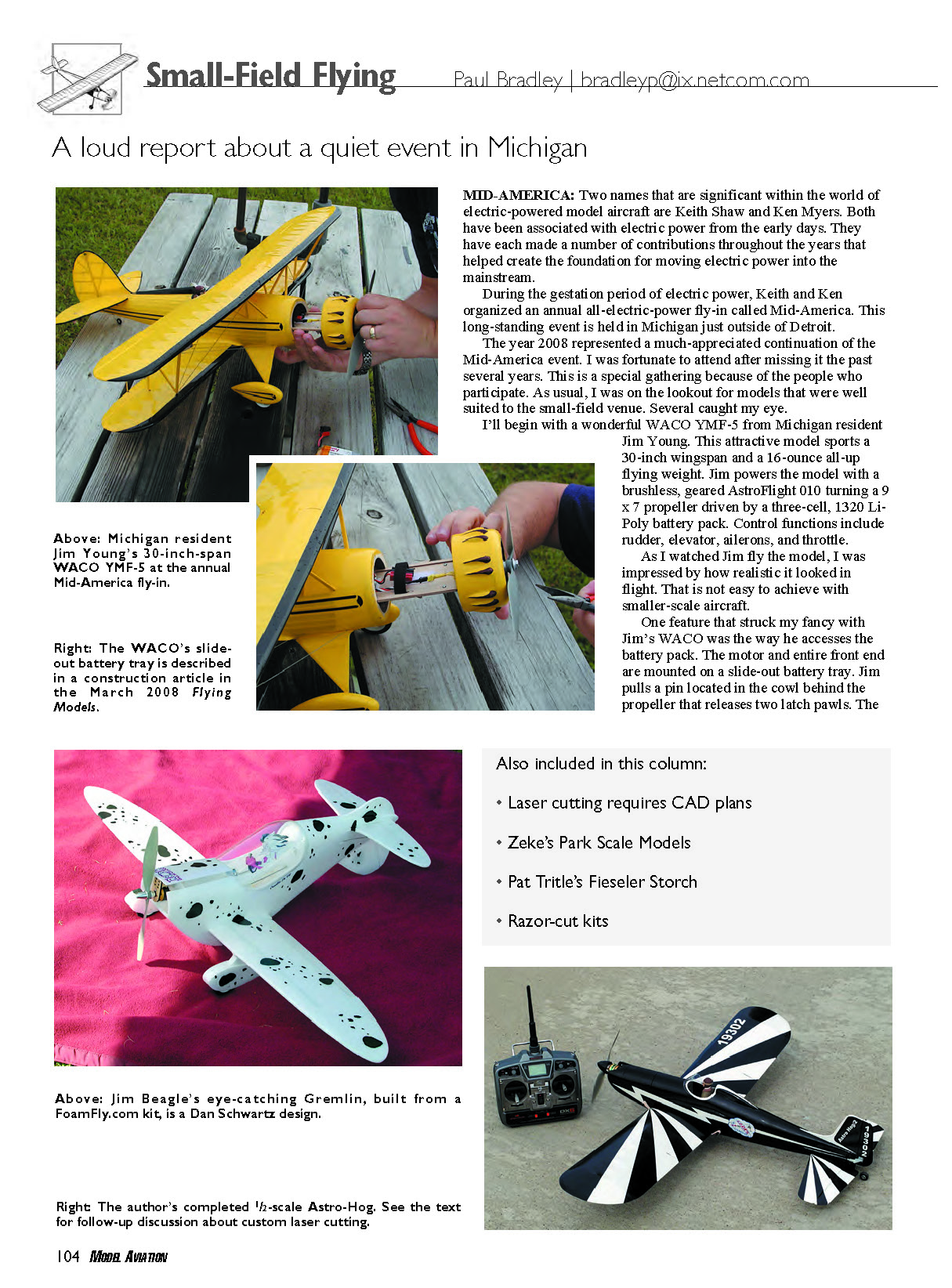
I’ll begin with a wonderful WACO YMF-5 from Michigan resident Jim Young. This attractive model sports a 30-inch wingspan and a 16-ounce all-up flying weight. Jim powers the model with a brushless, geared AstroFlight 010 turning a 9 x 7 propeller driven by a three-cell, 1320 mAh Li-Poly battery pack. Control functions include rudder, elevator, ailerons, and throttle.
As I watched Jim fly the model, I was impressed by how realistic it looked in flight. That is not easy to achieve with smaller-scale aircraft.
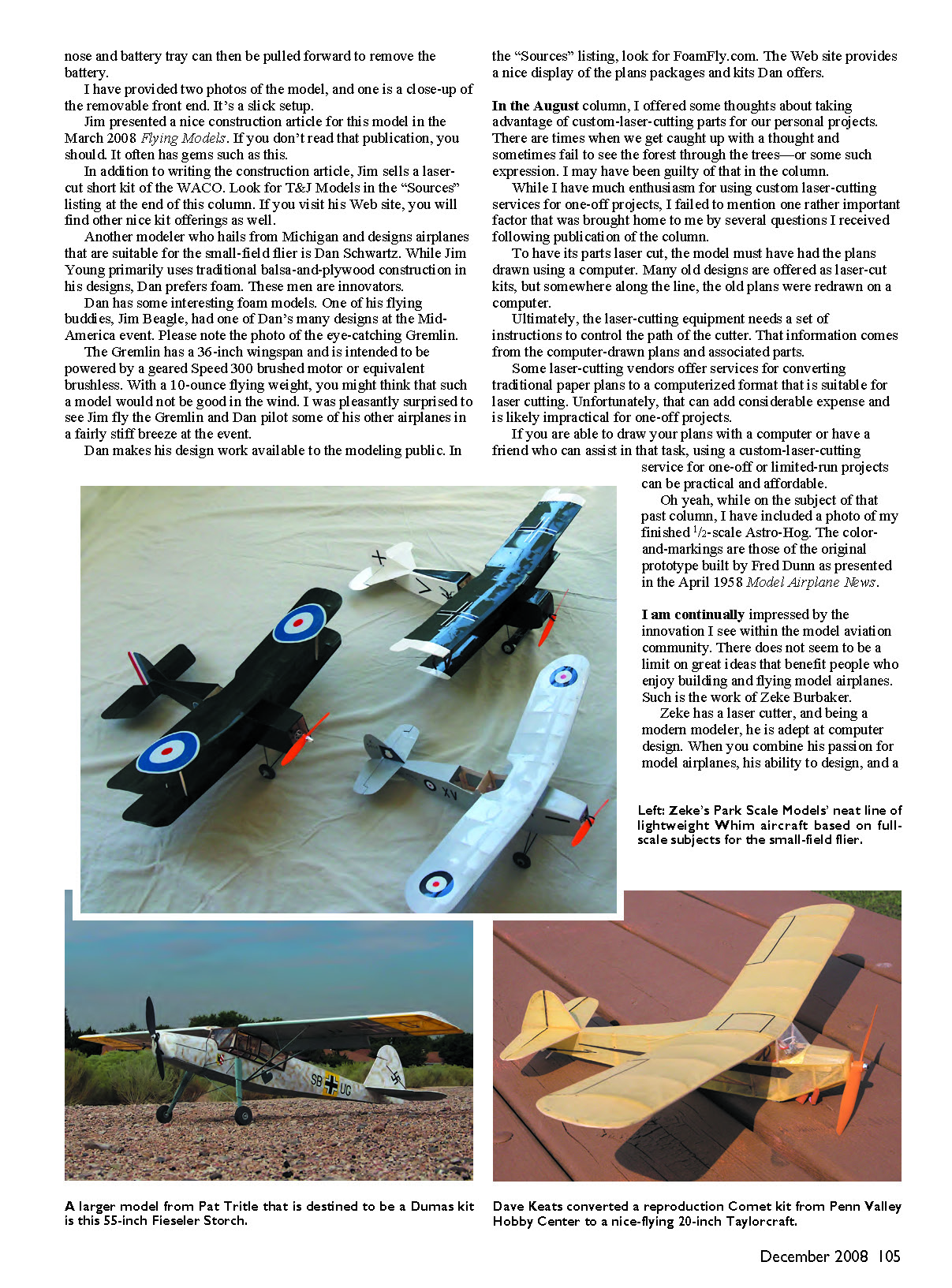
One feature that struck my fancy with Jim’s WACO was the way he accesses the battery pack. The motor and entire front end are mounted on a slide-out battery tray. Jim pulls a pin located in the cowl behind the propeller that releases two latch pawls. The nose and battery tray can then be pulled forward to remove the battery. I have provided two photos of the model, and one is a close-up of the removable front end. It’s a slick setup.
Jim presented a nice construction article for this model in the March 2008 Flying Models. If you don’t read that publication, you should. It often has gems such as this. In addition to writing the construction article, Jim sells a laser-cut short kit of the WACO. Look for T&J Models in the “Sources” listing at the end of this column. If you visit his website, you will find other nice kit offerings as well.
Dan Schwartz and the Gremlin
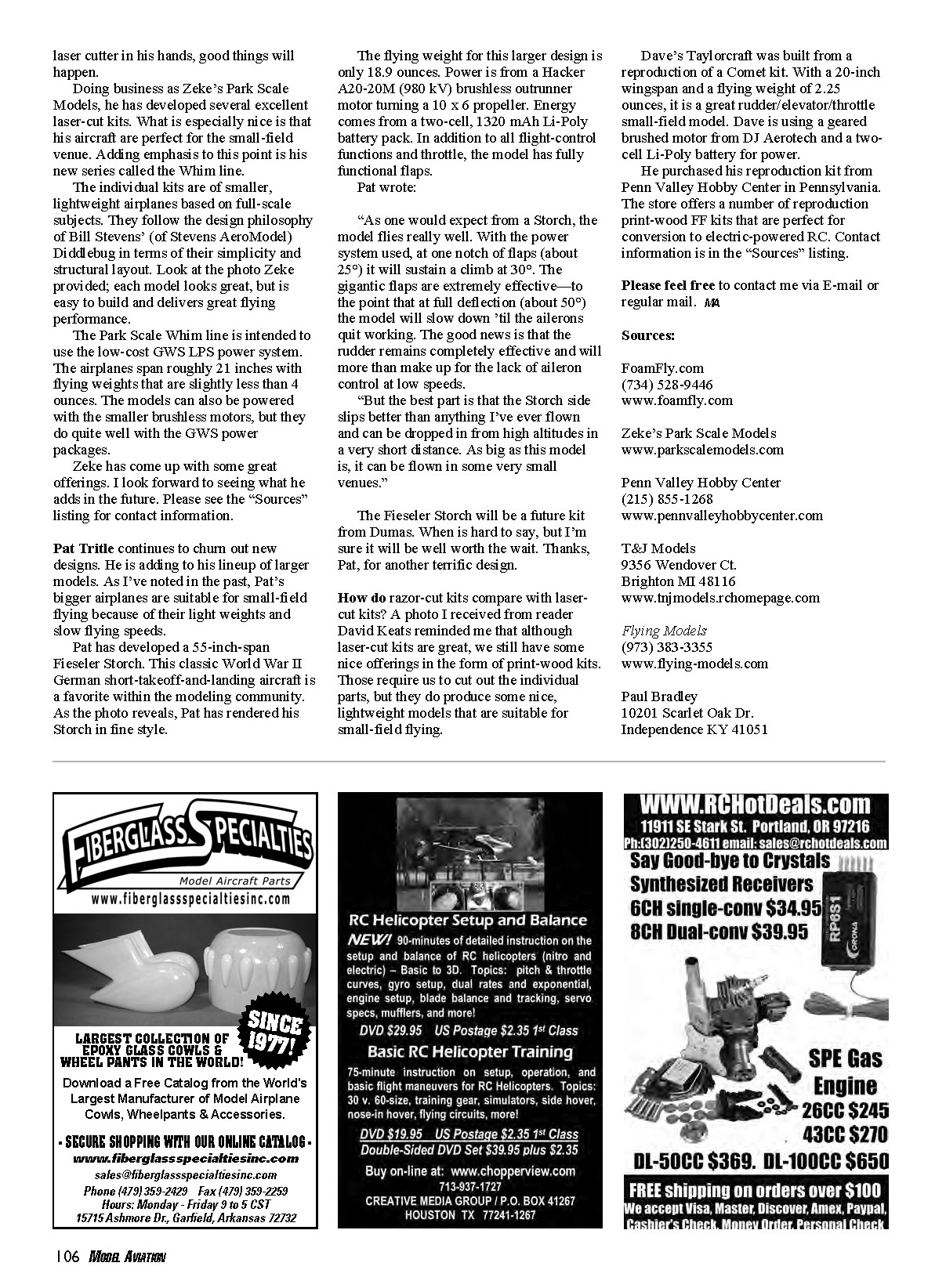
Another modeler who hails from Michigan and designs airplanes that are suitable for the small-field flier is Dan Schwartz. While Jim Young primarily uses traditional balsa-and-plywood construction in his designs, Dan prefers foam. These men are innovators. Dan has some interesting foam models. One of his flying buddies, Jim Beagle, had one of Dan’s many designs at the Mid-America event. Please note the photo of the eye-catching Gremlin.
The Gremlin has a 36-inch wingspan and is intended to be powered by a geared Speed 300 brushed motor or equivalent brushless. With a 10-ounce flying weight, you might think that such a model would not be good in the wind. I was pleasantly surprised to see Jim fly the Gremlin and Dan pilot some of his other airplanes in a fairly stiff breeze at the event.
Dan makes his design work available to the modeling public. In the “Sources” listing, look for FoamFly.com. The website provides a nice display of the plans packages and kits Dan offers.
Laser-Cutting Considerations
In the August column, I offered some thoughts about taking advantage of custom laser-cutting parts for our personal projects. There are times when we get caught up with a thought and sometimes fail to see the forest through the trees—or some such expression. I may have been guilty of that in the column. While I have much enthusiasm for using custom laser-cutting services for one-off projects, I failed to mention one rather important factor that was brought home to me by several questions I received following publication of the column. To have its parts laser cut, the model must have had the plans drawn using a computer. Many old designs are offered as laser-cut kits, but somewhere along the line, the old plans were redrawn on a computer.
Ultimately, the laser-cutting equipment needs a set of instructions to control the path of the cutter. That information comes from the computer-drawn plans and associated parts.
Some laser-cutting vendors offer services for converting traditional paper plans to a computerized format that is suitable for laser cutting. Unfortunately, that can add considerable expense and is likely impractical for one-off projects.
If you are able to draw your plans with a computer or have a friend who can assist in that task, using a custom laser-cutting service for one-off or limited-run projects can be practical and affordable.
Oh yeah, while on the subject of that past column, I have included a photo of my finished 1/2-scale Astro-Hog. The color-and-markings are those of the original prototype built by Fred Dunn as presented in the April 1958 Model Airplane News.
Zeke Burbaker — Park Scale Whim Line
I am continually impressed by the innovation I see within the model aviation community. There does not seem to be a limit on great ideas that benefit people who enjoy building and flying model airplanes. Such is the work of Zeke Burbaker.
Zeke has a laser cutter, and being a modern modeler, he is adept at computer design. When you combine his passion for model airplanes, his ability to design, and a laser cutter in his hands, good things will happen.
Doing business as Zeke’s Park Scale Models, he has developed several excellent laser-cut kits. What is especially nice is that his aircraft are perfect for the small-field venue. Adding emphasis to this point is his new series called the Whim line.
The individual kits are of smaller, lightweight airplanes based on full-scale subjects. They follow the design philosophy of Bill Stevens (of Stevens AeroModel) and his Diddlebug in terms of their simplicity and structural layout. Each model looks great, is easy to build, and delivers great flying performance.
The Park Scale Whim line is intended to use the low-cost GWS LPS power system. The airplanes span roughly 21 inches with flying weights that are slightly less than 4 ounces. The models can also be powered with the smaller brushless motors, but they do quite well with the GWS power packages.
Zeke has come up with some great offerings. I look forward to seeing what he adds in the future. Please see the “Sources” listing for contact information.
Pat Tritle — Fieseler Storch
Pat Tritle continues to churn out new designs. He is adding to his lineup of larger models. As I’ve noted in the past, Pat’s bigger airplanes are suitable for small-field flying because of their light weights and slow flying speeds.
Pat has developed a 55-inch-span Fieseler Storch. This classic World War II German short-takeoff-and-landing aircraft is a favorite within the modeling community. As the photo reveals, Pat has rendered his Storch in fine style.
The flying weight for this larger design is only 18.9 ounces. Power is from a Hacker A20-20M (980 kV) brushless outrunner motor turning a 10 x 6 propeller. Energy comes from a two-cell, 1320 mAh Li-Poly battery pack. In addition to all flight-control functions and throttle, the model has fully functional flaps.
Pat wrote: “As one would expect from a Storch, the model flies really well. With the power system used, at one notch of flaps (about 25°) it will sustain a climb at 30°. The gigantic flaps are extremely effective—to the point that at full deflection (about 50°) the model will slow down ’til the ailerons quit working. The good news is that the rudder remains completely effective and will more than make up for the lack of aileron control at low speeds.
“But the best part is that the Storch side slips better than anything I’ve ever flown and can be dropped in from high altitudes in a very short distance. As big as this model is, it can be flown in some very small venues.”
The Fieseler Storch will be a future kit from Dumas. When is hard to say, but I’m sure it will be well worth the wait. Thanks, Pat, for another terrific design.
Print-Wood Kits and David Keats
How do razor-cut kits compare with laser-cut kits? A photo I received from reader David Keats reminded me that although laser-cut kits are great, we still have some nice offerings in the form of print-wood kits. Those require us to cut out the individual parts, but they do produce some nice, lightweight models that are suitable for small-field flying.
Dave’s Taylorcraft was built from a reproduction of a Comet kit. With a 20-inch wingspan and a flying weight of 2.25 ounces, it is a great rudder/elevator/throttle small-field model. Dave is using a geared brushed motor from DJ Aerotech and a two-cell Li-Poly battery for power.
He purchased his reproduction kit from Penn Valley Hobby Center in Pennsylvania. The store offers a number of reproduction print-wood FF kits that are perfect for conversion to electric-powered RC. Contact information is in the “Sources” listing.
Please feel free to contact me via E-mail or regular mail. MA
Sources
- FoamFly.com
(734) 528-9446 www.foamfly.com
- Zeke’s Park Scale Models
- Penn Valley Hobby Center
(215) 855-1268 www.pennvalleyhobbycenter.com
- T&J Models
9356 Wendover Ct. Brighton MI 48116 www.tnjmodels.rchomepage.com
- Flying Models
(973) 383-3355 www.flying-models.com
Paul Bradley <REDACTED>
Transcribed from original scans by AI. Minor OCR errors may remain.

