

Small-Field Flying
Paul Bradley 32238 Spinnaker Run, Magnolia TX 77354 E-mail: [email protected]
Catapult Glider Project
I will lead with the material I promised in my last column regarding my little Catapult Glider project. You may recall that I had received one of the nice Jim Walker 404 Interceptor folding-wing gliders from Frank Macy. Frank offers reproductions of the classic RTF free-flight models that once appeared under the American Junior banner.
The folding-wing Catapult Interceptor glider seemed a perfect candidate to develop into an RC small-field flyer. The micro gear we have available today opens the door to almost any project. My goal with this project was simple: pure fun. I had no aspirations of building a killer thermal machine—only to enjoy a classic model without having to travel to a location suitable for letting the model fly at its full potential as a free-flight aircraft.
By adding micro radio gear, it would be possible to really pull back on the rubber catapult launcher and still keep the little airplane safely in my confined flying space—a fairly large back yard. With that objective in mind, the project was launched. (Yes, that was a weak pun.)
An interesting feature of Frank’s 404 Interceptor is the way he set up the folding-wing mechanism. The original used a wire hoop and an aluminum pivot. Frank engineered a plastic mechanism that allows a smoother transition between folded wings for launching and unfolded wings for gliding. This plastic wing mount also makes it possible to easily remove the wings from the fuselage—a nice feature when you want to start adding components that were never intended to be carried on such a model.
Components and Installation
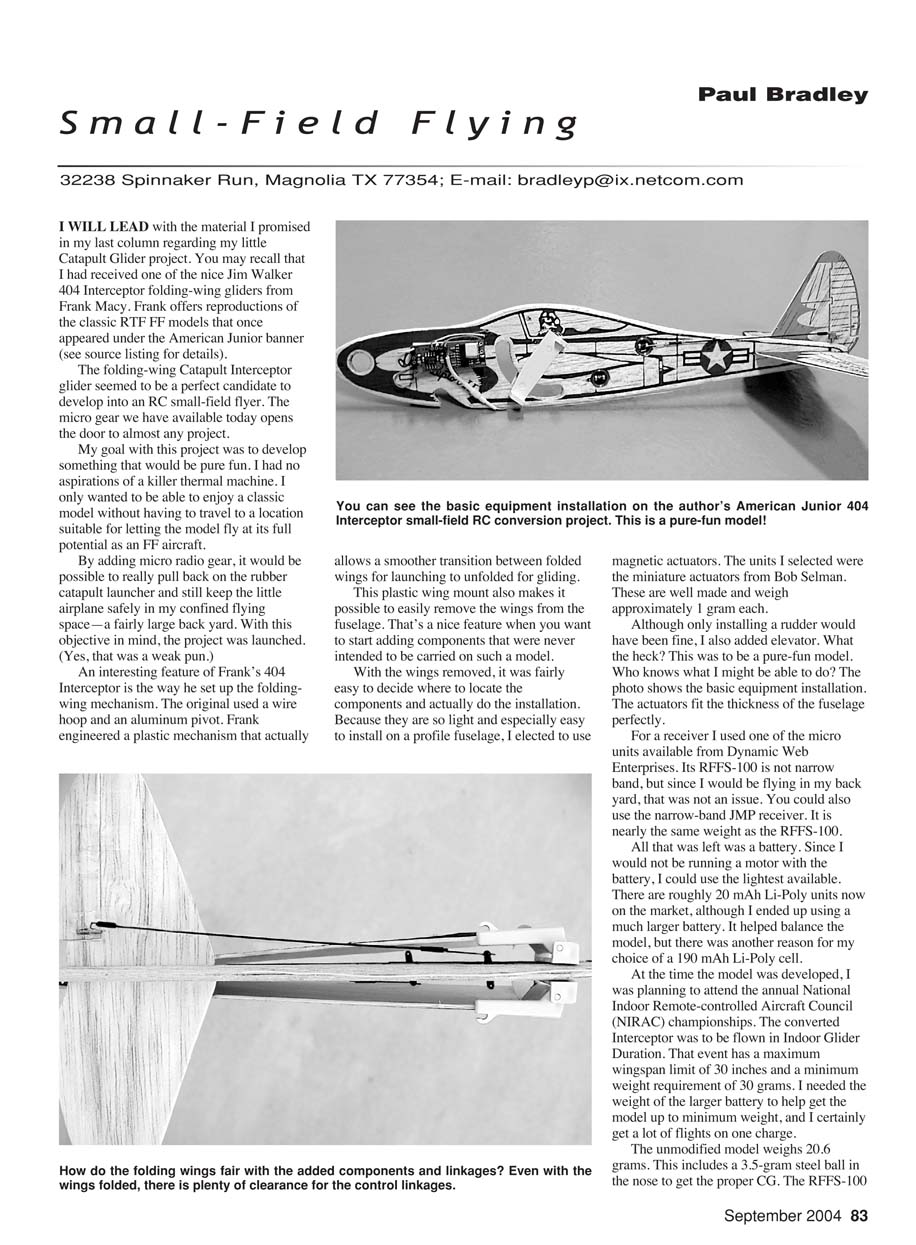
With the wings removed, it was fairly easy to decide where to locate the components and install them. Because they are so light and especially easy to install on a profile fuselage, I elected to use magnetic actuators. The units I selected were the miniature actuators from Bob Selman. These are well made and weigh approximately 1 gram each. Although installing only a rudder would have been fine, I also added elevator. What the heck? This was to be a pure-fun model.
The actuators fit the thickness of the fuselage perfectly.
For a receiver I used one of the micro units available from Dynamic Web Enterprises. Its RFFS-100 is not narrow-band, but since I would be flying in my back yard that was not an issue. You could also use the narrow-band JMP receiver; it is nearly the same weight as the RFFS-100.
All that was left was a battery. Since I would not be running a motor with the battery, I could use the lightest available. There are roughly 20 mAh Li-Poly units on the market, although I ended up using a much larger battery. It helped balance the model, and there was another reason for my choice of a 190 mAh Li-Poly cell.
At the time the model was developed, I was planning to attend the annual National Indoor R/C Aircraft Council (NIRAC) championships. The converted Interceptor was to be flown in Indoor Glider Duration. That event has a maximum wingspan limit of 30 inches and a minimum weight requirement of 30 grams. I needed the weight of the larger battery to help get the model up to minimum weight, and I certainly get a lot of flights on one charge.
The unmodified model weighs 20.6 grams. This includes a 3.5-gram steel ball in the nose to get the proper CG. The RFFS-100 receiver weighs slightly less than 2 grams. Adding the two 1-gram actuators only exceeded the weight of the nose ballast by 0.5 gram.
You can see my dilemma in getting the model up to minimum weight for the NIRAC event. The 190 mAh Li-Poly cell weighs 5 grams. Adding carbon-fiber pushrods and related hardware brought the total weight to 28 grams. Additional weight was still required to reach the 30-gram minimum, but at least most of the added weight was functional.
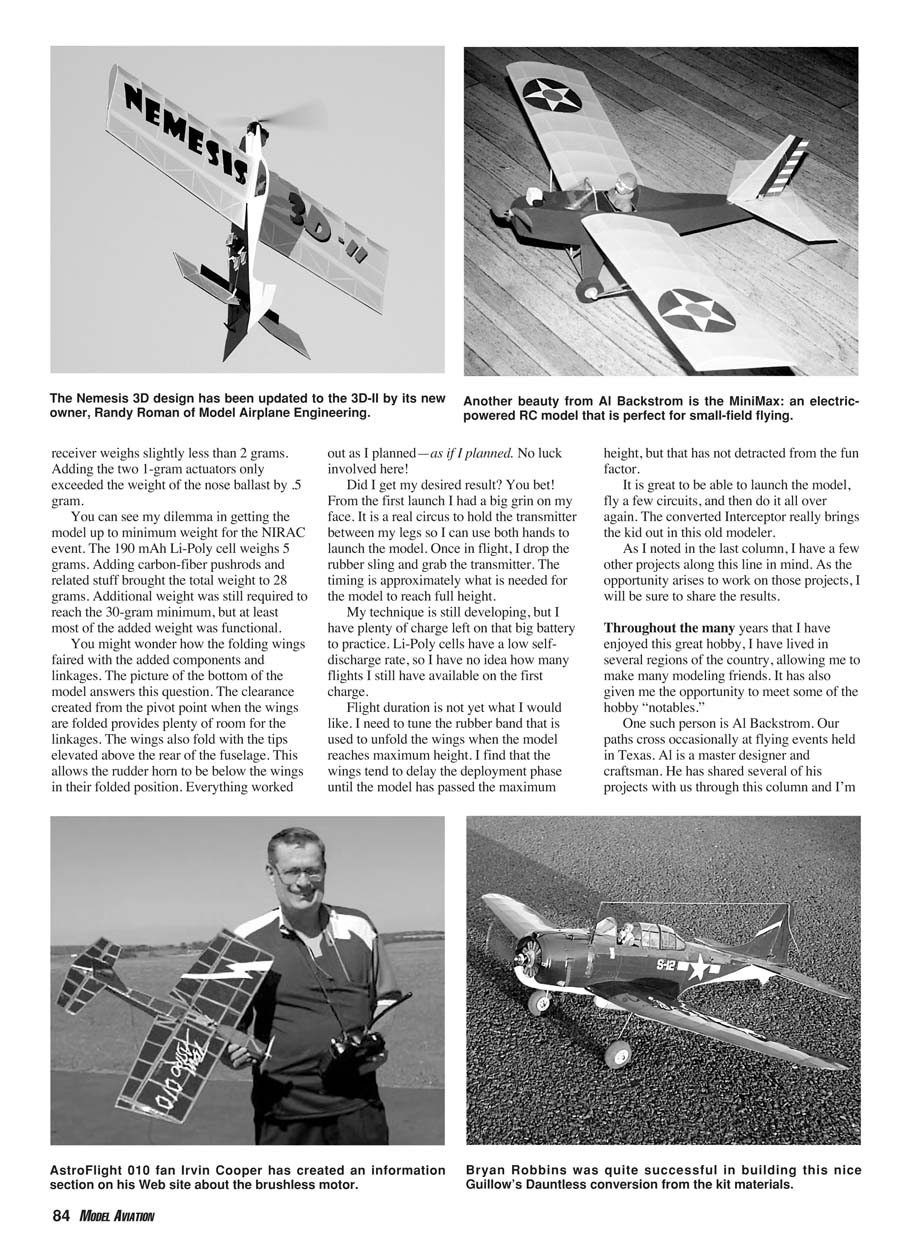
You might wonder how the folding wings fared with the added components and linkages. The clearance created from the pivot point when the wings are folded provides plenty of room for the linkages. The wings also fold with the tips elevated above the rear of the fuselage, which allows the rudder horn to be below the wings in their folded position. Everything worked out as I planned—no luck involved here!
Flight Experience
Did I get my desired result? You bet! From the first launch I had a big grin on my face. It is a real circus to hold the transmitter between my legs so I can use both hands to launch the model. Once in flight, I drop the rubber sling and grab the transmitter. The timing is approximately what is needed for the model to reach full height.
My technique is still developing, but I have plenty of charge left on that big battery to practice. Li-Poly cells have a low self-discharge rate, so I have no idea how many flights I still have available on the first charge.
Flight duration is not yet what I would like. I need to tune the rubber band that is used to unfold the wings when the model reaches maximum height. I find that the wings tend to delay the deployment phase until the model has passed the maximum height, but that has not detracted from the fun factor.
It is great to be able to launch the model, fly a few circuits, and then do it all over again. The converted Interceptor really brings the kid out in this old modeler.
As I noted in the last column, I have a few other projects along this line in mind. As the opportunity arises to work on those projects, I will be sure to share the results.
Other Models and Contributors
Throughout the many years that I have enjoyed this great hobby, I have lived in several regions of the country, allowing me to make many modeling friends and meet some of the hobby "notables."
One such person is Al Backstrom. Our paths cross occasionally at flying events held in Texas. Al is a master designer and craftsman. He has shared several of his projects with us through this column, and I'm sure many of you have seen his name connected with the Nemesis 3D design. Al has taken a nice, lightweight, full-scale home-built design known as the MiniMax and rendered it an alluring electric-powered RC model that is perfect for small-field flying.
The specifications of Al's aircraft include a 30-inch wingspan, a 165-square-inch wing area, a 5.5-ounce flying weight, a GWS IPS-DXA motor with a 7x6 propeller, and two 340 mAh Li-Poly cells in series. The flying surfaces are covered with yellow Litespan and the fuselage is covered with blue Japanese tissue. The markings are based on a full-scale MiniMax. As of this writing, Al had not decided about plans availability. If I hear anything, I will let you know.
I have been happy with the responses to my observations about the suitability of Guillow's designs for conversion to small-field RC aircraft. Two modelers in Vancouver, Washington—Eric Molstead and Bryan Robbins—noted their success converting Guillow's kits.
Eric sent pictures of a Guillow's Dauntless that Bryan converted to a great-flying, electric-powered small-field flyer. When Bryan built the model he used the wood supplied in the kit, removing material where possible to reduce weight, and was quite successful. The power comes from a PJS 300 external-rotor brushless motor available from Hobby Lobby, controlled via a Castle Creations Phoenix-10 ESC. Energy comes from two Li-Poly cells in series. Control functions include throttle, rudder, elevator, and a bomb drop. The model is covered with lightweight opaque Oracover and the total flying weight is 11 ounces. Great effort, Bryan and Eric!
Several columns ago I mentioned the emerging offerings for great-performing 3-D aerobatic-capable models in the small-field arena, including the Nemesis 3D. At that time the kit was offered by Aero Lock Models. A note from Randy Roman of Model Airplane Engineering let me know that he has acquired the Nemesis 3D design and reengineered the structure to gain strength with no additional weight.
The Nemesis 3D-II is a nice laser-cut kit that goes together quickly. For those wanting to get into small-field 3-D aerobatics, this model might be the ticket. It has a wide range of power options starting with readily available and reasonably priced brushed motors paired with a GWS gear drive. The kit will also accept outrunner brushless motors; to make that easy, Randy offers laser-cut plywood mounts designed for outrunners. These mounts make it a snap to switch between the brushed motor/GWS gearbox setup and an outrunner brushless installation.
With a 27-inch wingspan and a flying weight between 4.5 and 6.5 ounces, the Nemesis 3D-II is well suited to small-field flying.
I want to share one more picture: Irvin Cooper with his AstroFlight 010 brushless-powered Tumble Watt, designed by Tom Hunt. Irv reports that this is a great combination that gives satisfying performance. Irv is such a fan of the Astro 010 that he has developed a nice information section on his website covering the motor and associated models. The Astro 010 helped pioneer smaller high-performance electric motors and is still a viable power option for small-field models.
If you have Internet access, see Irv's site at www.cpinternet.com/~mnmpec535 and navigate to the section devoted to the Astro 010.
Events
If anyone is likely to be in the Dallas or Houston, Texas, area in October, there are two great flying gatherings scheduled:
- The 18th annual Dallas Electric Aircraft Flyers (DEAF) fly-in: October 2–3. See www.deaf-rc.org/
- The Barnstormers club all-electric fly-in, New Waverly, Texas: October 8–10. See www.tri-countybarnstormers.com
I plan to attend both events and would be pleased if any readers looked me up to say hello.
Here we are at the end once again. As always, please send in a picture or two of your models so we can all enjoy them.
Paul Bradley
Sources
- AJ 404 Interceptor:
Frank Macy 1501 SW Baker Street #53 McMinnville OR 97128 (503) 435-1916 [email protected]
- RFFS-100 Receiver:
Dynamic Web Enterprises 159 Little Robin Rd. Amherst NY 14228 (866) 359-6427 www.smallrc.com
- Magnetic Actuators:
Bob Selman Designs 9054 Gum Rd. Carthage MO 64836 (417) 358-9521 after 6 p.m. CST http://users.joplin.com/~bselman
- Nemesis 3D-II:
Model Airplane Engineering 5001 Bainbridge Ct. Lilburn GA 30047 (770) 925-8326 http://rroman.rchomepage.com/
- PJS 300 Motor:
Hobby Lobby International 5614 Franklin Pike Cir. Brentwood TN 37027 (615) 373-1444 www.hobby-lobby.com
- Castle Creations Phoenix-10 Brushless ESC:
New Creations R/C 9735 County Line Rd. Willis TX 77378 (936) 856-4630 www.newcreations-rc.com
Transcribed from original scans by AI. Minor OCR errors may remain.

