
Small-Field Flying - 2005/02
Paul Bradley 32238 Spinnaker Run, Magnolia TX 77354 E-mail: [email protected]
Based on this issue's cover date, you are probably in the middle of your winter building season, and visions of the coming flying season are dancing around in your mind's eye.
Joining those visions are memories of last season. I like to reflect on the past flying season at this time of year, especially when I can share some observations.
One event worth reviewing is the annual Dallas Electric Aircraft Flyers (DEAF) fly-in, held in early October. Attendees always bring some neat airplanes of interest to the small-field flier.
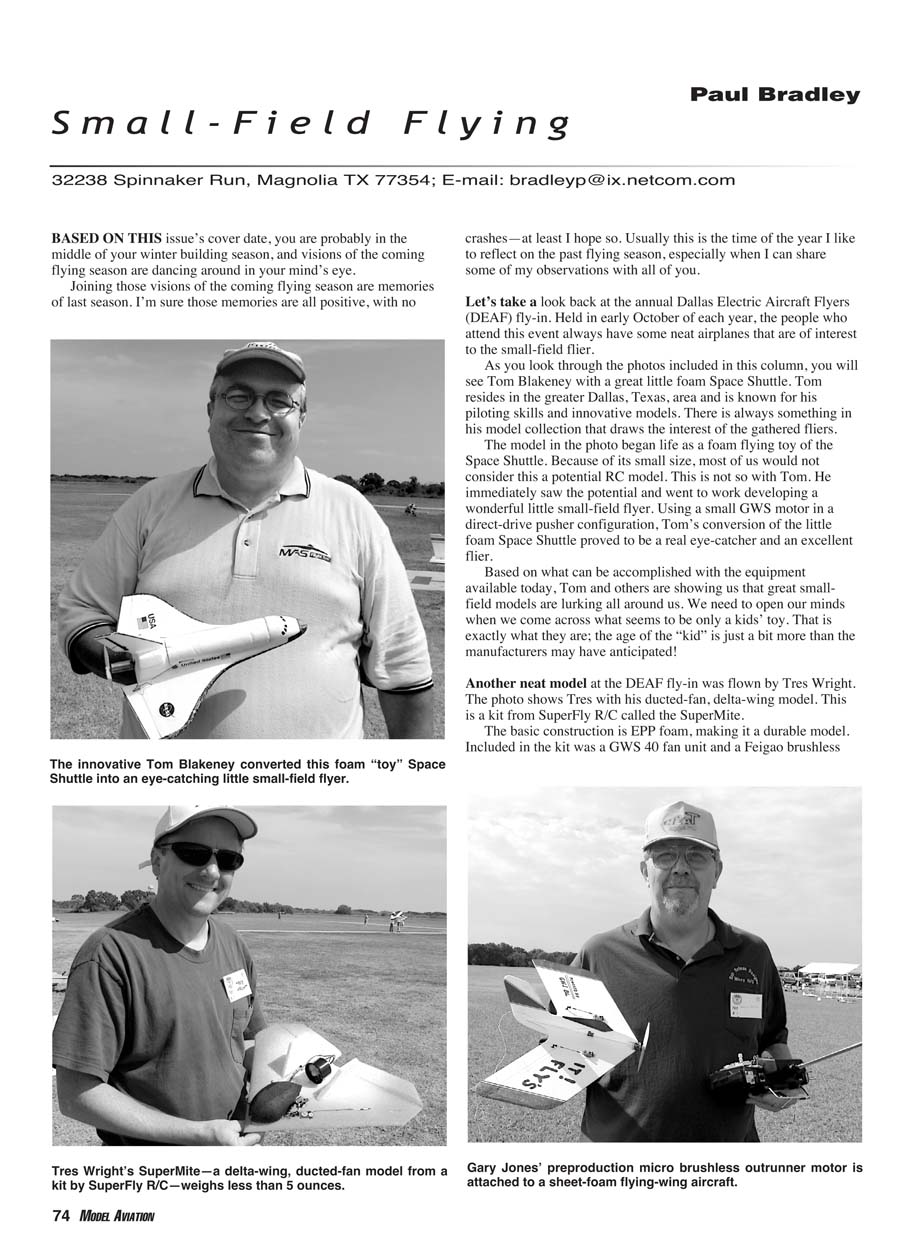
Tom Blakeney brought a great little foam Space Shuttle. Tom, from the greater Dallas area, is known for his piloting skills and innovative models. The model began life as a foam flying toy; because of its small size most of us would not consider it a potential RC model. Tom immediately saw the potential and converted it into a wonderful small-field flyer. Using a small GWS motor in a direct-drive pusher configuration, his conversion proved to be an eye-catcher and an excellent flier.
What Tom and others are doing shows that great small-field models are lurking all around us. We need to open our minds when we come across what seems to be only a kid's toy—the age of the "kid" is just a bit more than the manufacturers may have anticipated.
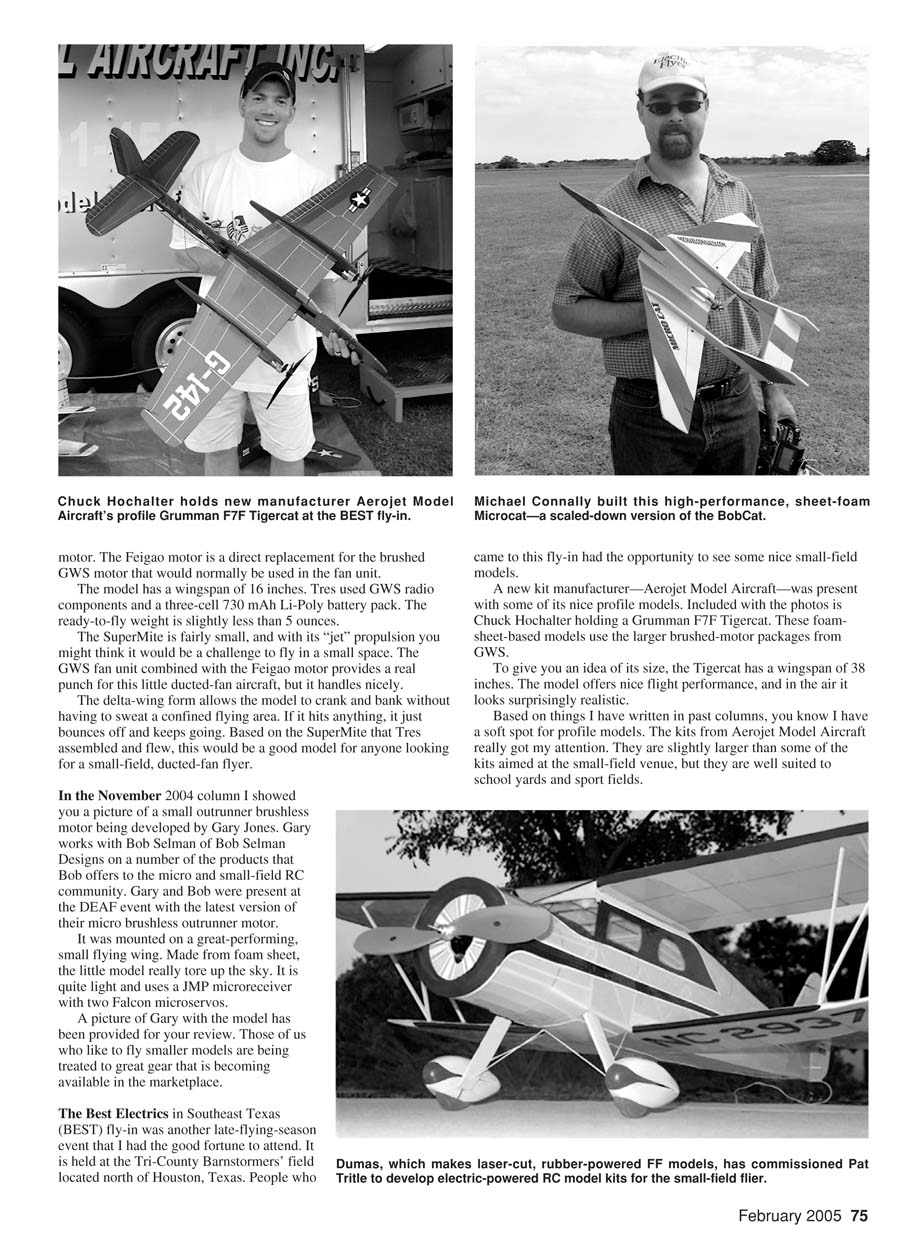
Another neat model at the DEAF fly-in was flown by Tres Wright. Tres flew a ducted-fan, delta-wing model—the SuperMite kit from SuperFly R/C. The basic construction is EPP foam, making it durable. The kit included a GWS 40 fan unit and a Feigao brushless motor (a direct replacement for the brushed GWS motor normally used in the fan unit). The model has a 16-inch wingspan. Tres used GWS radio components and a 3-cell 730 mAh Li-Poly battery pack. The ready-to-fly weight is slightly less than 5 ounces.
The SuperMite is fairly small, and with its "jet" propulsion you might think it would be a challenge to fly in a small space. The GWS fan unit combined with the Feigao motor provides a real punch, but the model handles nicely. The delta-wing allows the model to crank and bank without requiring a large flying area. If it hits anything, it just bounces off and keeps going. Based on the SuperMite Tres assembled and flew, it would be a good model for anyone looking for a small-field, ducted-fan flyer.
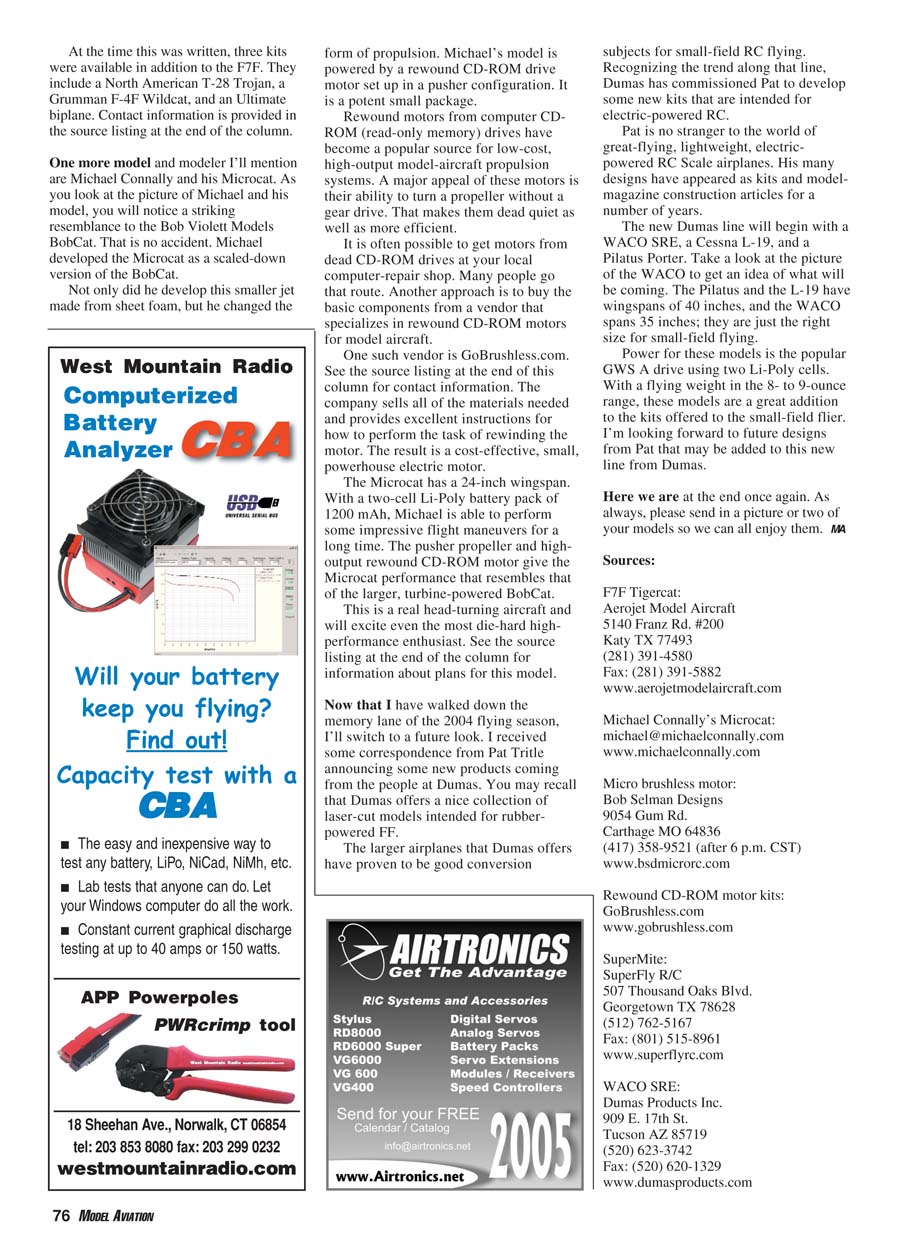
In the November 2004 column I showed a picture of a small outrunner brushless motor being developed by Gary Jones. Gary works with Bob Selman of Bob Selman Designs on a number of products for the micro and small-field RC community. At DEAF they had the latest version of their micro brushless outrunner motor mounted on a great-performing small flying wing. Made from foam sheet, the little model really tore up the sky. It is quite light and uses a JMP micro receiver with two Falcon microservos.
Those of us who like to fly smaller models are being treated to great gear that is becoming available in the marketplace.
The Best Electrics in Southeast Texas (BEST) fly-in was another late-season event I attended. It is held at the Tri-County Barnstormers' field north of Houston. Attendees had the opportunity to see some nice small-field models.
A new kit manufacturer, Aerojet Model Aircraft, was present with some of its profile models. Included in the photos is Chuck Hochalter holding a Grumman F7F Tigercat. These foam-sheet-based models use the larger brushed-motor packages from GWS. To give you an idea of its size, the Tigercat has a 38-inch wingspan. The model offers nice flight performance and looks surprisingly realistic in the air.
I have a soft spot for profile models, and the Aerojet kits really got my attention. They are slightly larger than some kits aimed strictly at the small-field venue, but they are well suited to schoolyards and sport fields. At the time this was written, three kits were available in addition to the F7F: a North American T-28 Trojan, a Grumman F4F Wildcat, and an Ultimate biplane. Contact information is included in the source listing below.
One more model and modeler to mention are Michael Connally and his Microcat. The Microcat closely resembles Bob Violett Models' BobCat—that is no accident. Michael developed the Microcat as a scaled-down version of the BobCat, and he changed the propulsion method. Michael’s model is powered by a rewound CD-ROM drive motor set up as a pusher. It is a potent small package.
Rewound CD-ROM motors have become a popular, low-cost, high-output propulsion source. A major appeal is their ability to turn a propeller without a gearbox, making them quiet and efficient. You can often get motors from dead CD-ROM drives at local computer-repair shops, or you can buy rewound motor kits from vendors that specialize in them.
One such vendor is GoBrushless.com; they sell the materials and provide excellent instructions for rewinding motors. The result is a cost-effective, small powerhouse motor.
The Microcat has a 24-inch wingspan. With a 2-cell Li-Poly pack of 1200 mAh, Michael can perform impressive maneuvers for a long time. The pusher propeller and the rewound CD-ROM motor give the Microcat performance that resembles the larger, turbine-powered BobCat. This is a real head-turning aircraft and will excite even die-hard high-performance enthusiasts. See the source listing for information about plans for this model.
Looking ahead, I received correspondence from Pat Tritle announcing new products from Dumas. Dumas has a nice collection of laser-cut models intended for rubber-powered free flight. The larger airplanes Dumas offers have proven to be good conversion subjects for small-field RC flying, and Dumas has commissioned Pat to develop new kits intended for electric-powered RC.
Pat is no stranger to lightweight, electric-powered RC scale airplanes—his designs have appeared as kits and in model-magazine construction articles for years. The new Dumas line will begin with a WACO SRE, a Cessna L-19, and a Pilatus Porter. The Pilatus and the L-19 have 40-inch wingspans; the WACO spans 35 inches. These are just the right size for small-field flying.
Power for these models is the popular GWS A-drive using two Li-Poly cells. With flying weights in the 8- to 9-ounce range, these models are a great addition to the kits available to small-field fliers. I’m looking forward to future designs from Pat that may be added to this new Dumas line.
As always, please send a picture or two of your models so we can all enjoy them.
Sources
- F7F Tigercat:
Aerojet Model Aircraft 5140 Franz Rd. #200 Katy TX 77493 (281) 391-4580 Fax: (281) 391-5882 www.aerojetmodelaircraft.com
- Michael Connally’s Microcat:
[email protected] www.michaelconnally.com
- Micro brushless motor:
Bob Selman Designs 9054 Gum Rd. Carthage MO 64836 (417) 358-9521 (after 6 p.m. CST) www.bsdmicro.com
- Rewound CD-ROM motor kits:
GoBrushless.com www.gobrushless.com
- SuperMite:
SuperFly R/C 507 Thousand Oaks Blvd. Georgetown TX 78628 (512) 762-5167 Fax: (801) 515-8961 www.superflyrc.com
- WACO SRE:
Dumas Products Inc. 909 E. 17th St. Tucson AZ 85719 (520) 623-3742 Fax: (520) 620-1329 www.dumasproducts.com
Transcribed from original scans by AI. Minor OCR errors may remain.

