
Small-Field Flying
Paul Bradley
Small-Field Ducted-Fan Models
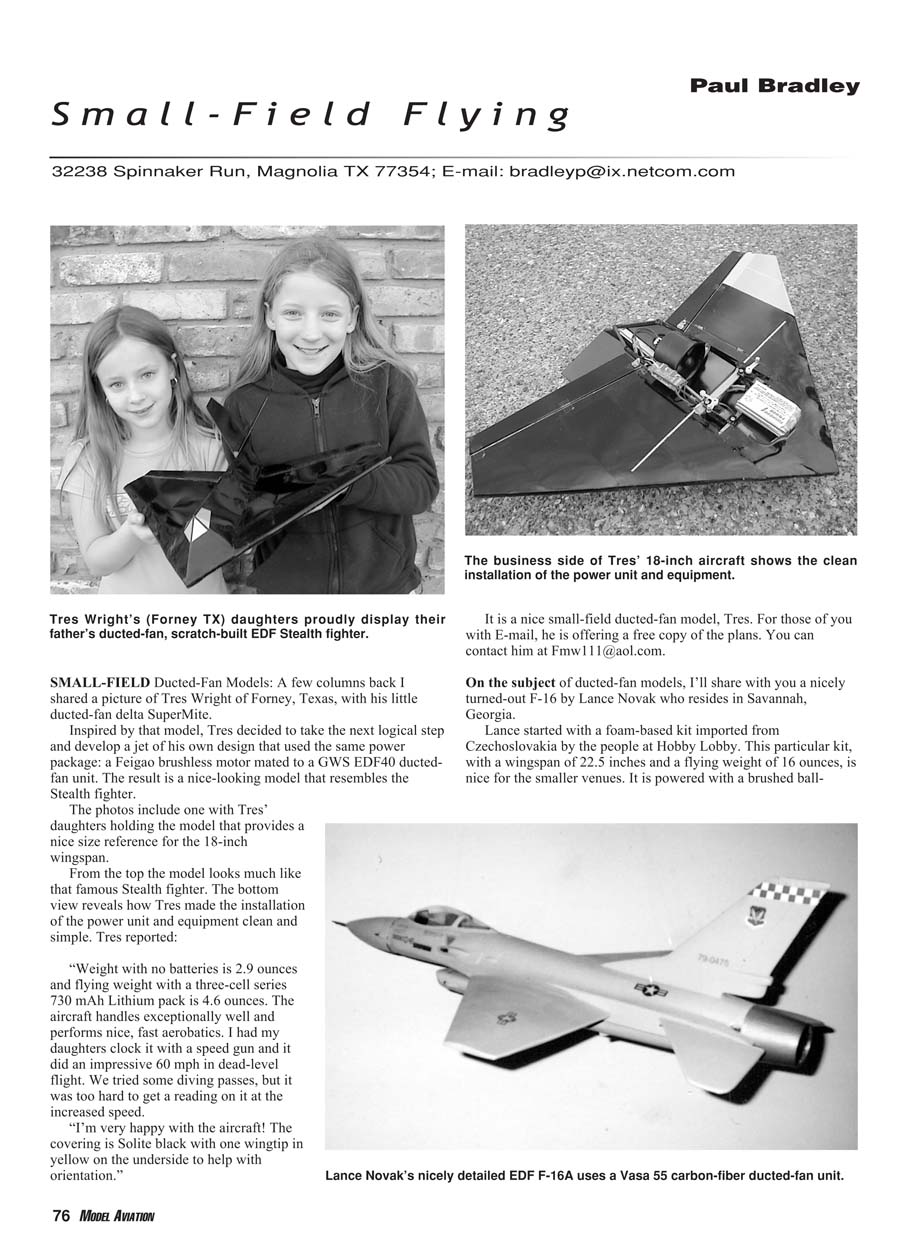
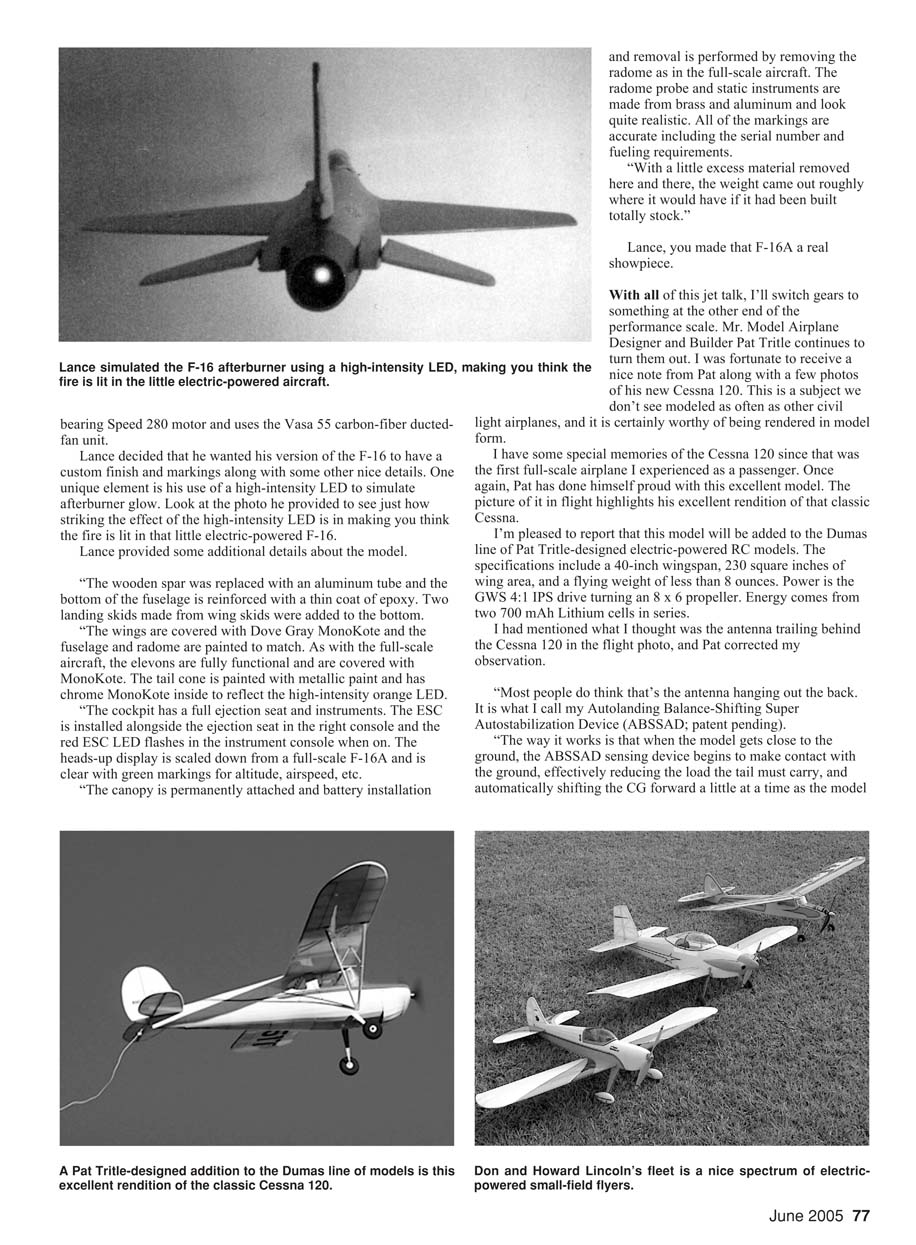
A few columns back I shared a picture of Tres Wright of Forney, Texas, with his little ducted-fan delta SuperMite. Inspired by that model, Tres decided to take the next logical step and develop a jet of his own design that used the same power package: a Feigao brushless motor mated to a GWS EDF40 ducted-fan unit. The result is a nice-looking model that resembles the Stealth fighter.
The photos include one with Tres’s daughters holding the model that provides a good size reference for the 18-inch wingspan. From the top the model looks much like that famous Stealth fighter. The bottom view reveals how Tres made the installation of the power unit and equipment clean and simple. Tres reported:
“Weight with no batteries is 2.9 ounces and flying weight with a three-cell series 730 mAh Lithium pack is 4.6 ounces. The aircraft handles exceptionally well and performs nice, fast aerobatics. I had my daughters clock it with a speed gun and it did an impressive 60 mph in dead-level flight. We tried some diving passes, but it was too hard to get a reading on it at the increased speed.
“I’m very happy with the aircraft! The covering is Solite black with one wingtip in yellow on the underside to help with orientation.”
It is a nice small-field ducted-fan model, Tres. For those of you with E-mail, he is offering a free copy of the plans. You can contact him at [email protected].
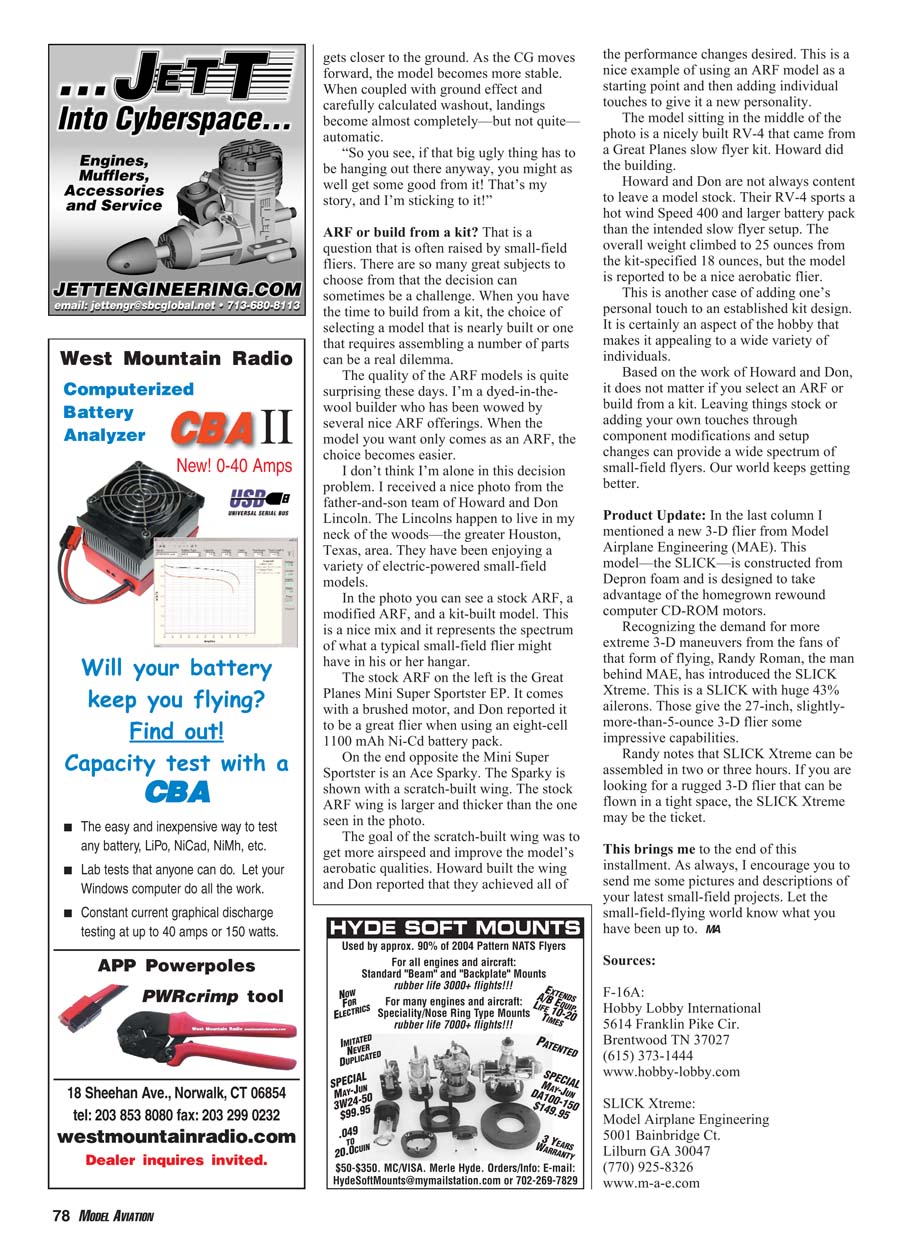
F-16A by Lance Novak
On the subject of ducted-fan models, here’s a nicely turned-out F-16 by Lance Novak of Savannah, Georgia. Lance started with a foam-based kit imported from Czechoslovakia by the people at Hobby Lobby. This kit has a wingspan of 22.5 inches and a flying weight of 16 ounces, which is nice for smaller venues. It is powered with a brushed ball-bearing motor and the model is removed by taking off the radome as in the full-scale aircraft. The radome probe and static instruments are made from brass and aluminum and look quite realistic. All markings are accurate including the serial number and fueling requirements.
“With a little excess material removed here and there, the weight came out roughly where it would have if it had been built totally stock.” Lance, you made that F-16A a real showpiece.
Cessna 120 by Pat Tritle
At the other end of the performance scale, Pat Tritle continues to turn out excellent models. I received a nice note and photos of his new Cessna 120. This is a subject we don’t see modeled as often as other civil light airplanes, and it is certainly worthy of being rendered in model form. I have special memories of the Cessna 120 since that was the first full-scale airplane I experienced as a passenger. Pat has done himself proud with this model; the flight photo highlights his excellent rendition of that classic Cessna.
This model will be added to the Dumas line of Pat Tritle–designed electric-powered RC models. Specifications include a 40-inch wingspan, 230 square inches of wing area, and a flying weight of less than 8 ounces. Power is the GWS 4:1 IPS drive turning an 8 x 6 propeller. Energy comes from two 700 mAh Lithium cells in series.
I had mentioned what I thought was an antenna trailing behind the Cessna 120 in the flight photo, and Pat corrected my observation:
“Most people do think that’s the antenna hanging out the back. It is what I call my Autolanding Balance-Shifting Super Autostabilization Device (ABSSAD; patent pending).
“The way it works is that when the model gets close to the ground, the ABSSAD sensing device begins to make contact with the ground, effectively reducing the load the tail must carry, and automatically shifting the CG forward a little at a time as the model gets closer to the ground. As the CG moves forward, the model becomes more stable. When coupled with ground effect and carefully calculated washout, landings become almost completely—but not quite—automatic.
“So you see, if that big ugly thing has to be hanging out there anyway, you might as well get some good from it! That’s my story, and I’m sticking to it!”
ARF or Build from a Kit?
ARF or build from a kit? That is a question often raised by small-field fliers. There are so many great subjects to choose from that the decision can sometimes be a challenge. When you have the time to build from a kit, the choice between a nearly-complete model and one that requires assembling many parts can be a real dilemma.
The quality of ARF models is quite surprising these days. I’m a dyed-in-the-wool builder who has been wowed by several nice ARF offerings. When the model you want only comes as an ARF, the choice becomes easier.
I received a nice photo from the father-and-son team of Howard and Don Lincoln from the greater Houston, Texas, area. They enjoy a variety of electric-powered small-field models. In the photo you can see a stock ARF, a modified ARF, and a kit-built model. This mix represents the spectrum of what a typical small-field flier might have in his or her hangar.
The stock ARF on the left is the Great Planes Mini Super Sportster EP. It comes with a brushed motor, and Don reported it to be a great flier when using an eight-cell 1100 mAh Ni-Cd battery pack.
On the opposite end is an Ace Sparky shown with a scratch-built wing. The stock ARF wing is larger and thicker than the one in the photo. The goal of the scratch-built wing was to get more airspeed and improve the model’s aerobatic qualities. Howard built the wing and Don reported that they achieved all the desired performance changes. This is a nice example of using an ARF model as a starting point and then adding individual touches to give it a new personality.
The model in the middle is a nicely built RV-4 that came from a Great Planes slow-flyer kit. Howard did the building. Howard and Don are not always content to leave a model stock. Their RV-4 sports a hot Wind Speed 400 motor and a larger battery pack than the intended slow-flyer setup. The overall weight climbed to 25 ounces from the kit-specified 18 ounces, but the model is reported to be a nice aerobatic flier.
This is another case of adding one’s personal touch to an established kit design. It does not matter if you select an ARF or build from a kit; leaving things stock or adding your own touches through component modifications and setup changes can provide a wide spectrum of small-field flyers.
Product Update: SLICK Xtreme
In the last column I mentioned a new 3-D flier from Model Airplane Engineering (MAE) called the SLICK. This model is constructed from Depron foam and is designed to take advantage of homegrown rewound computer CD-ROM motors.
Recognizing the demand for more extreme 3-D maneuvers, Randy Roman of MAE has introduced the SLICK Xtreme. This is a SLICK with huge 43% ailerons, giving the 27-inch, slightly-more-than-5-ounce 3-D flier impressive capabilities. Randy notes that the SLICK Xtreme can be assembled in two or three hours. If you are looking for a rugged 3-D flier that can be flown in a tight space, the SLICK Xtreme may be the ticket.
Closing
That brings me to the end of this installment. As always, I encourage you to send pictures and descriptions of your latest small-field projects. Let the small-field-flying world know what you have been up to.
Sources
- F-16A:
Hobby Lobby International 5614 Franklin Pike Cir. Brentwood, TN 37027 (615) 373-1444 www.hobby-lobby.com
- SLICK Xtreme:
Model Airplane Engineering 5001 Bainbridge Ct. Lilburn, GA 30047 (770) 925-8326 www.m-a-e.com
Transcribed from original scans by AI. Minor OCR errors may remain.

