
Small-Field Flying - 2006/03
Paul Bradley | [email protected]
The DiddleBug sets a modeling standard
Occasionally a design idea or approach will come along that creates a framework for many other models to follow. As you look back at the history of this hobby, a number of instances come to mind.
In the competitive engine-powered FF arena, the first designer to create a high-thrustline model influenced a large number of designers who followed suit with their creations. How about the use of flaps on CL Precision Aerobatics (Stunt) models? The designer who did that first set the stage for nearly every CL Stunt model that followed.
In the RC world, one approach that strikes me as a platform-changing design innovation is the strip aileron. Before they came onto the scene, models sporting ailerons used layouts similar to those of full-scale airplanes. Someone came up with the idea of strip ailerons and the world of sport RC models changed forever.
There are many other examples, but I think you get the idea. You know I'm going somewhere with this line of thought.
In the world of small-field flying, we have a set of parameters that tends to govern the emerging designs. The equipment and materials available to the designer today provide an almost limitless canvas for the next killer design. Those designs, though, need to live in spaces that can place some real constraints on the flight envelope. We want the models to have good flying qualities in a smaller venue and generally deliver a satisfying flying experience. Those reading this can probably name a number of models they would nominate as their favorite small-field flyer that delivers on the criteria I have mentioned.
I know one modeler who can name such a model and has recognized that aircraft as setting the stage for a complete design platform: Dave Blum of Cary, North Carolina.
Dave is a skilled designer and builder. I had the opportunity to showcase some of his models in the November 2002 column. While most of the models Dave owns and flies are his own design, he also builds and flies airplanes by other designers. One such model is the Bill Stevens / Stevens AeroModel-designed DiddleBug (see the source listing at the end of the column). That model is the epitome of a simple, fun-filled small-field flyer. Not overlooked by Dave's keen eye, the DiddleBug incorporates some design features that are suitable for transfer to other small-field models.
Its platform is characterized by several distinguishing features:
- The fuselage is a full three-dimensional affair, but the bottom is left open to gain easy access to the equipment mounted inside.
- The servos are mounted so that the control arms are outside the fuselage. The combination of that mounting scheme and the open bottom makes a simple, easy-to-adjust control system.
- The DiddleBug uses a unique wing structure that is reminiscent of a lightweight rubber-powered FF airplane.
- The model is a perfect size for small-field flying, with a wing area of approximately 100 square inches and a flying weight of slightly less than 3 ounces.
These features yield a model that is fun to fly indoors or outdoors in confined spaces.
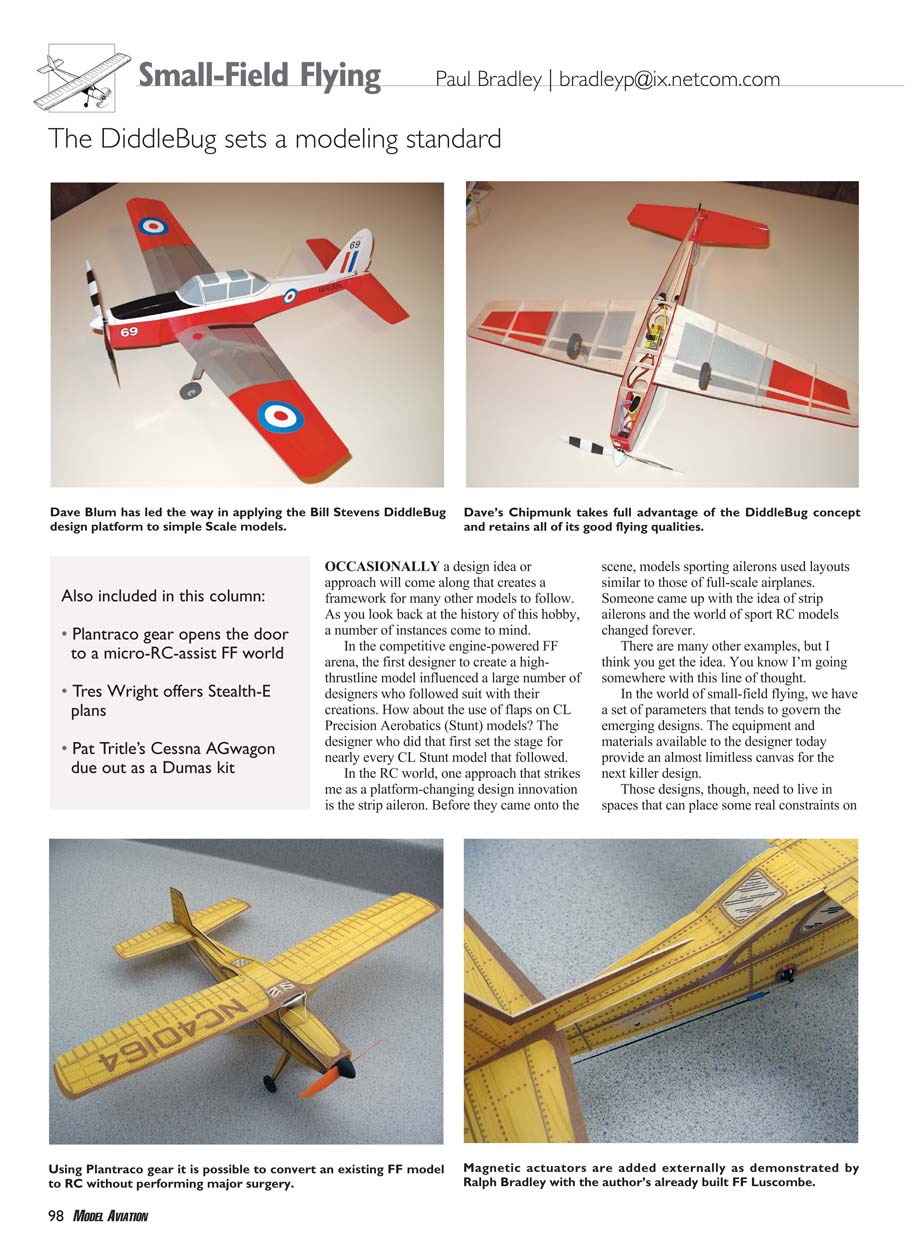
Dave's forte is Scale, and he translated the core design features of the DiddleBug to some simple, eye-catching, nice-flying scale models. The resulting aircraft offer the same flying qualities of the DiddleBug with the bonus of resembling a full-scale airplane.
Dave provided a few photos of his Chipmunk done up in the DiddleBug-style platform. It is so striking that a number of people who frequent the Internet-based discussion group called the E Zone (www.ezonemag.com) have followed Dave's lead and developed their own DiddleBug-style scale models.
These airplanes use the inexpensive GWS LPS drive system and a two-cell 250 mAh Li-Poly battery pack for power. As demonstrated by the Internet group, almost any scale subject can be nicely rendered in the DiddleBug platform. My hat is off to Bill Stevens for his DiddleBug design and to Dave Blum for leading the way in adapting that great platform to some excellent small-field scale models.
Micro equipment and FF-to-RC conversions
A few columns back I mentioned the wonderful new micro equipment that has been introduced by Plantraco. Dave Robelen has also featured the company's equipment in his "Micro-Flying" column.
You may recall that the Plantraco receiver weighs less than 1 gram and that the system operates on 900 MHz. The operating frequency allows for short antennae and its light weight opens the door to adding radio control to a wonderful array of subjects.
As you may have surmised by some of my comments, I am a FF modeler at heart. My association with FF throughout the years—I won't say just how many—has introduced me to many excellent model-airplane designers.
Many of those designs are intended for rubber power and are ideal candidates for conversion to electric-powered RC small-field flyers. Their size and flying qualities yield satisfying conversions, and such conversions are certainly nothing new.
Until recently, converting the models often involved making them bigger to accommodate the radio and power-system gear. The integration of the radio-control equipment also required careful planning during the construction of the model.
Equipment such as that being offered by Plantraco has forever changed the world of FF-to-RC conversions—at least for the smaller subjects. The small size, light weight, and easy actuator hookup of the new gear lets us convert almost any small rubber-powered FF model. Not only that, but you can do the conversion on models that are already built. There is no need to go through a big process for making the equipment fit in your chosen subject.
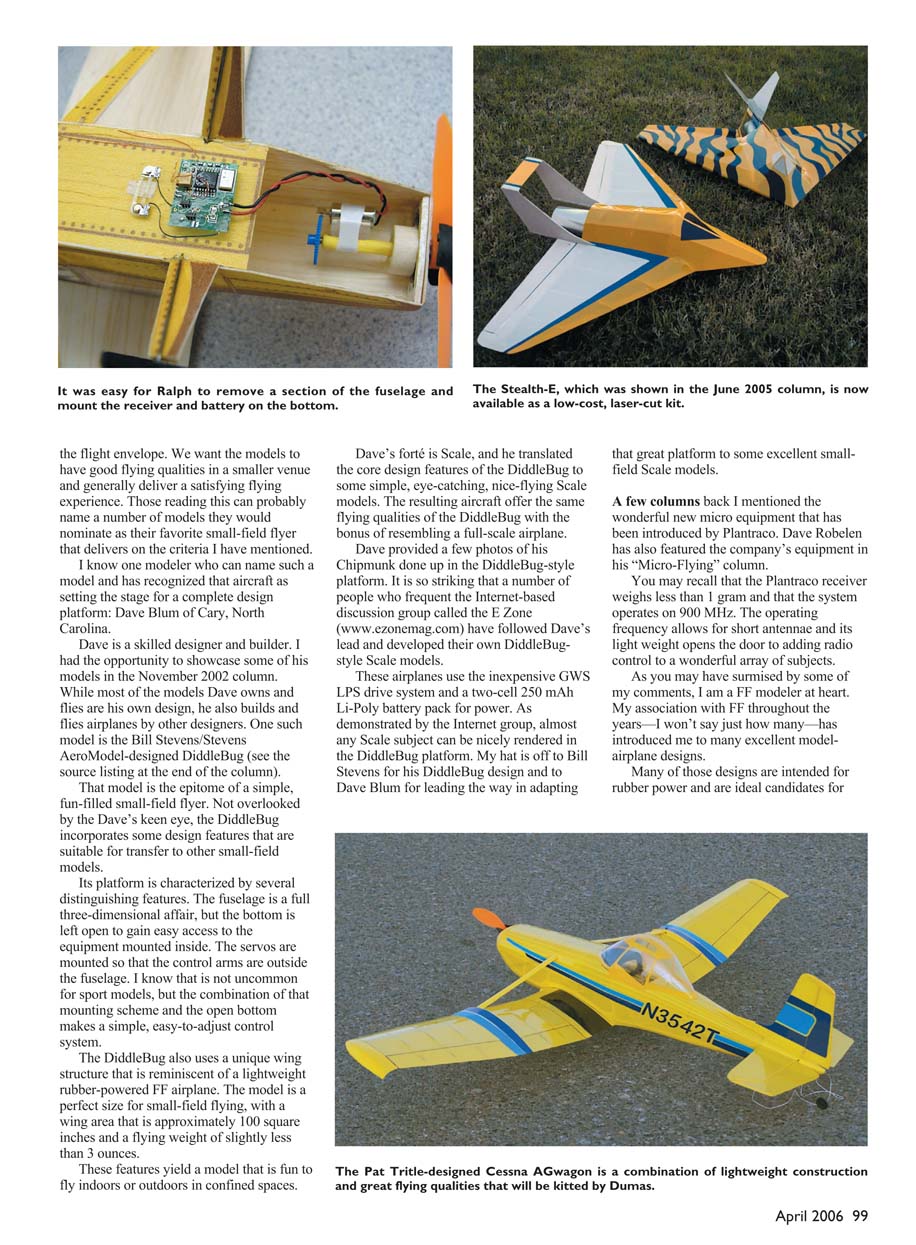
To demonstrate this point my brother Ralph elected to convert one of my already-built Top Flite Jigtime reproductions. He chose the Luscombe, which had been flown many times as a rubber-powered FF model. The task was to add a Plantraco setup without performing major surgery.
Our analysis suggested that the converted model would have minimal weight gain when the rubber motor and propeller were eliminated. The result of the project is shown in the photos.
The flight-control components were attached to the outside of the model. The magnetic actuator is connected to the receiver by thin magnet wire, which made the installation easy. The magnet wire was hidden by the printed lines on the model. A single, small 90 mAh Li-Poly battery is held in place on the bottom of the fuselage by two tiny magnets. The only surgery was to remove a section of the fuselage bottom to install the motor.
At first glance you are hard pressed to tell that the Luscombe had become an RC model. Flying weight before conversion, with a loop of 1/8-inch rubber for power, was 18 grams. After the conversion the flying weight is 20 grams. Since the weight gain was small, the model flies the way it did in FF form. The only difference is that we can keep it from hitting the walls of our indoor flying site and it can stay in the air much longer per flight.
The conversion Ralph did to the Jigtime Luscombe could be applied equally well to many other lightweight FF models available. For those who dabble in that form of our hobby, take a look in your hangar. You are bound to have subjects that would be perfect candidates.
This gives a new definition to ARF RC modeling. Source information for the Plantraco gear and the magnetic battery connector is provided at the end of this column.
Stealth-E kit and new products
Stealth-E is now a kit. You may recall a picture in the June 2005 column showing the lovely daughters of Tres Wright holding his little ducted-fan small-field flyer called the Stealth-E. Tres was generous enough to offer plans to readers who had an interest in the model. I received word from him that a nice, inexpensive, laser-cut kit is now available from Littlebirdz (see the source listing for details).
In case you don't remember the original picture of the model, I have included an updated one. The Stealth-E is the model in the background with the interesting zebra stripes. The model in the foreground is another design that may show up as a kit in the not-too-distant future.
The Stealth-E uses the GWS EDF-40 ducted-fan unit. With a wingspan of 18 inches and a flying weight of roughly 3 ounces, it is a real performer on either the GWS brushed motor or one of the drop-in replacement brushless-fan tuners.
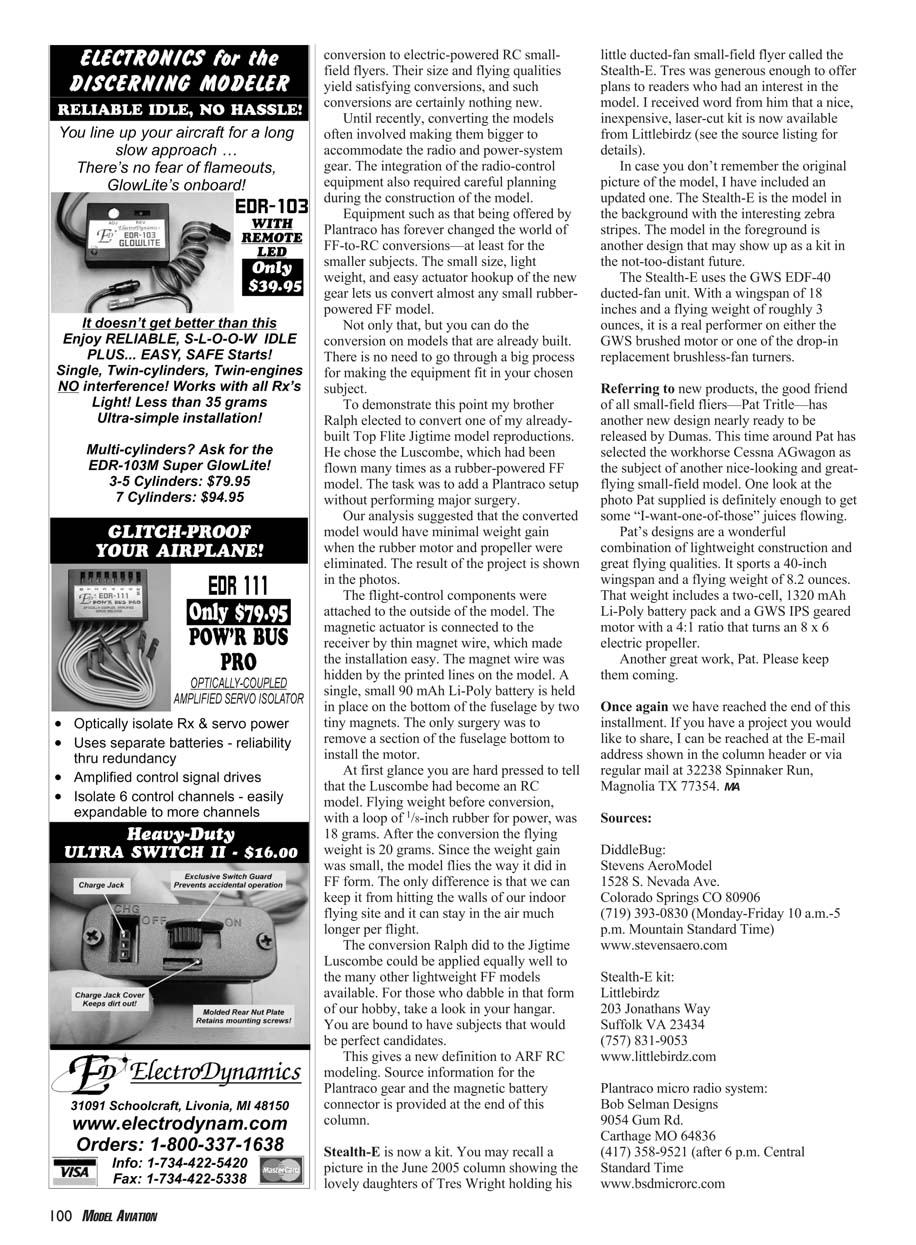
Referring to new products, the good friend of all small-field fliers—Pat Tritle—has another new design nearly ready to be released by Dumas. This time around Pat has selected the workhorse Cessna AGwagon as the subject of another nice-looking and great-flying small-field model. One look at the photo Pat supplied is definitely enough to get some "I-want-one-of-those" juices flowing.
Pat's designs are a wonderful combination of lightweight construction and great flying qualities. It sports a 40-inch wingspan and a flying weight of 8.2 ounces. That weight includes a two-cell, 1320 mAh Li-Poly battery pack and a GWS IP5 geared motor with a 4:1 ratio that turns an 8 x 6 electric propeller.
Another great work, Pat. Please keep them coming.
Once again we have reached the end of this installment. If you have a project you would like to share, I can be reached at the E-mail address shown in the column header or via regular mail at:
32238 Spinnaker Run Magnolia, TX 77354
Sources
- DiddleBug:
Stevens AeroModel 1528 S. Nevada Ave. Colorado Springs, CO 80906 (719) 393-0830 (Monday–Friday 10 a.m.–5 p.m. Mountain Standard Time) www.stevensaero.com
- Stealth-E kit:
Littlebirdz 203 Jonathans Way Suffolk, VA 23434 (757) 831-9053 www.littlebirdz.com
- Plantraco micro radio system:
Bob Selman Designs 9054 Gum Rd. Carthage, MO 64836 (417) 358-9521 (after 6 p.m. Central Standard Time) www.bsdmicro.com
Transcribed from original scans by AI. Minor OCR errors may remain.

