
2006 Small Model Airplane Lovers League fly-in
Paul Bradley | [email protected]
For many years the informal Small Model Airplane Lovers League (S.M.A.L.L.) has been gathering around Little Rock, Arkansas, during the month of June for a fly-in devoted to model airplanes that are on the smaller side of our hobby.
This annual gathering invites people to bring models that have engines or equivalent electric motors no larger than .26 (or .35 for control-line). Models with multiple engines are welcome, as are participants from all walks of the model aviation hobby. As a result, you will find FF (free flight), CL (control line), and RC (radio control) models flying around the skies at this wonderful event.
The 2006 edition of the S.M.A.L.L. fly-in was held in an excellent new location and under wonderful weather. As in the past, this year featured an excellent array of models representing the ingenuity and workmanship of many great modelers. Given the format of the models present, many of the aircraft are well suited for the small-field venue. Below are a few airplanes I enjoyed watching fly at the gathering.
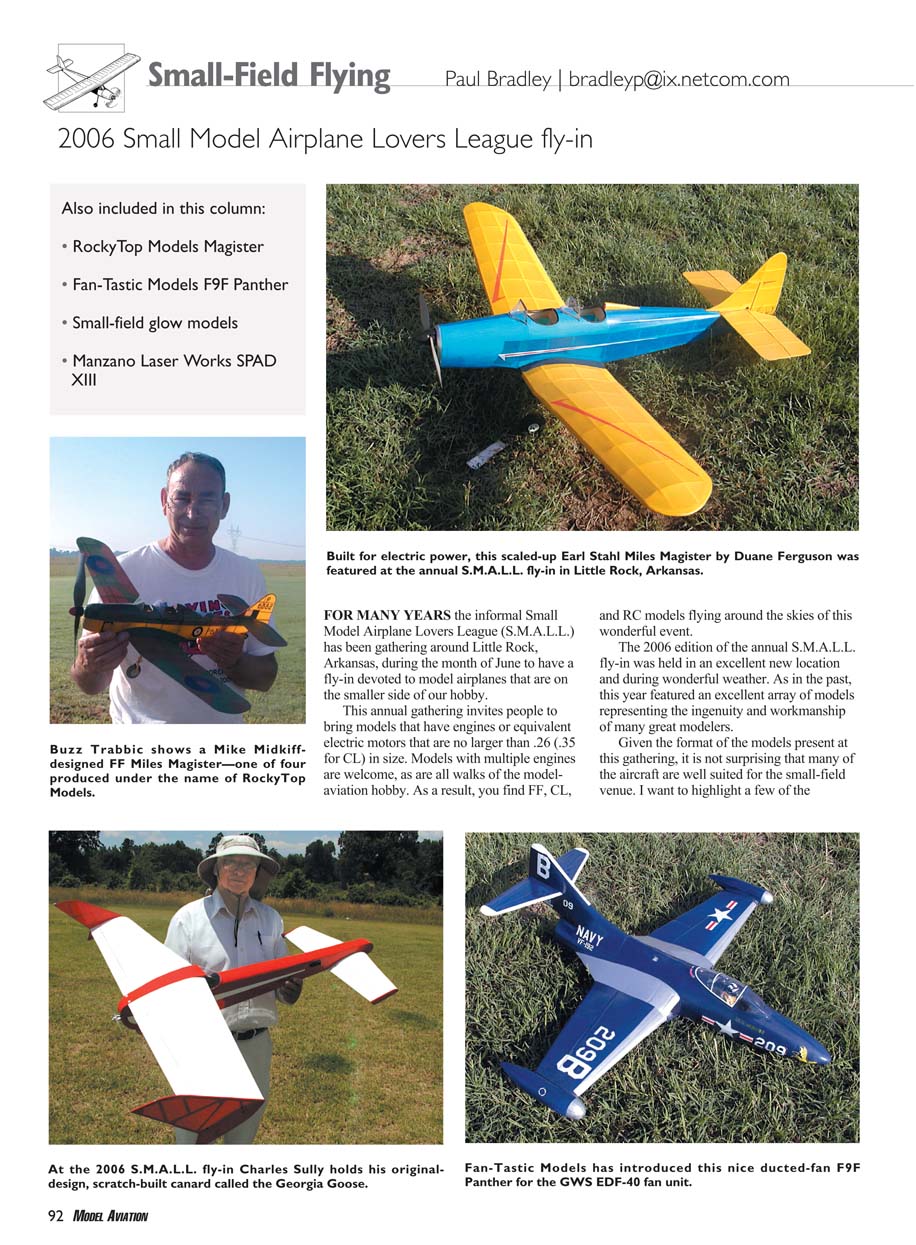
Earl Stahl–inspired Miles Magister (Duane Ferguson)
Duane Ferguson likes Earl Stahl designs and built a rubber-powered free-flight Miles Magister in a larger size for electric RC. The resulting model has a 36-inch wingspan and uses a GWS IPS drive system powered by a two-cell, 1200 mAh Li‑Poly battery pack. The model is covered with Litespan (CoverLite) and flies nicely. A number of modelers have demonstrated that classic Stahl designs make great modern electric RC models; Duane’s example shows that rescaling those designs is a great way to enjoy small-field flying.
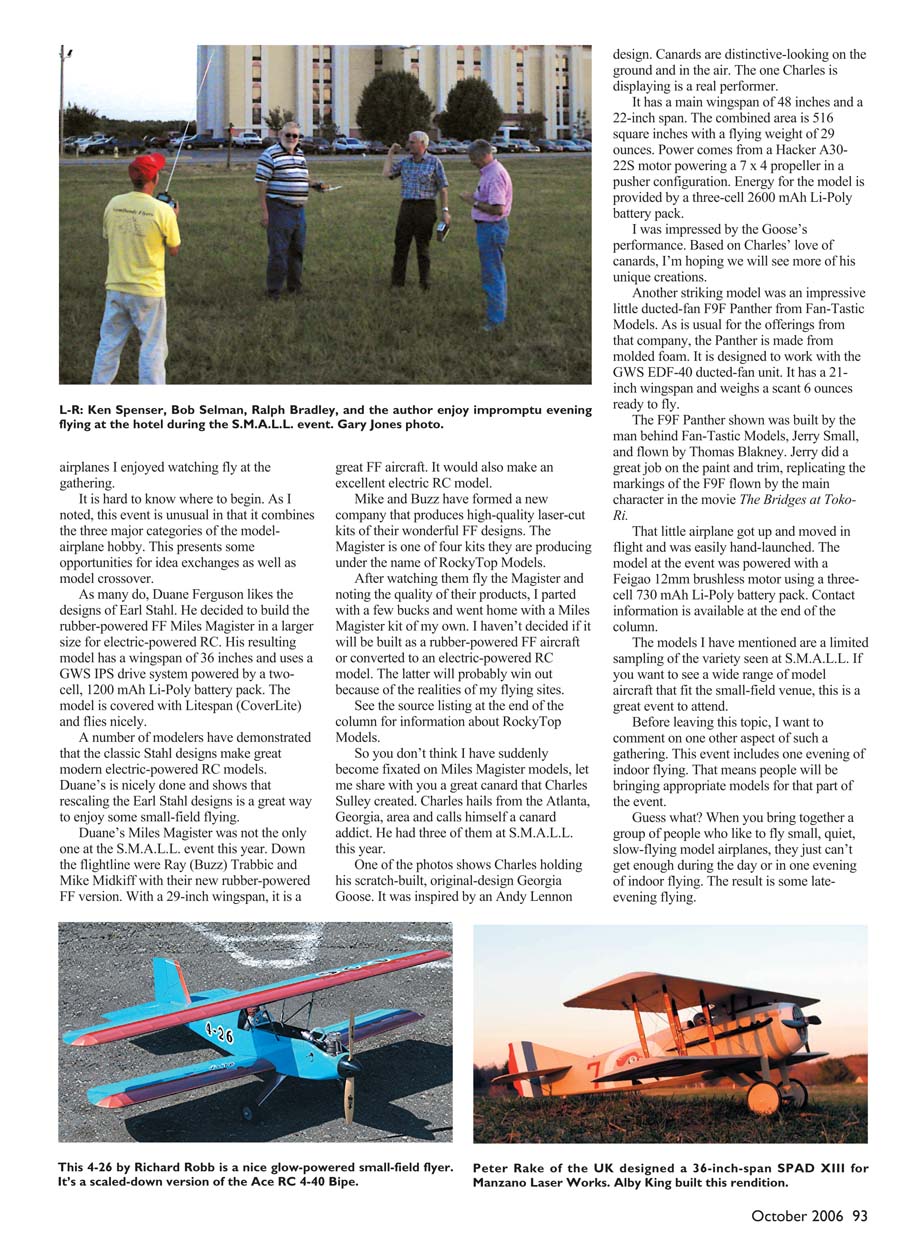
Miles Magister (Ray “Buzz” Trabbic and Mike Midkiff)
Down the flightline were Ray (Buzz) Trabbic and Mike Midkiff with a new rubber-powered free-flight version of the Miles Magister. With a 29-inch wingspan, it is a great FF aircraft and would also make an excellent electric RC model. Mike and Buzz have formed a new company producing high-quality laser-cut kits of their FF designs. The Magister is one of four kits they are producing under the RockyTop Models name. After watching them fly and seeing kit quality, I bought a Miles Magister kit myself. I haven’t yet decided whether to build it as a rubber-powered free-flight or convert it to electric RC; the latter will probably win out because of my flying sites.
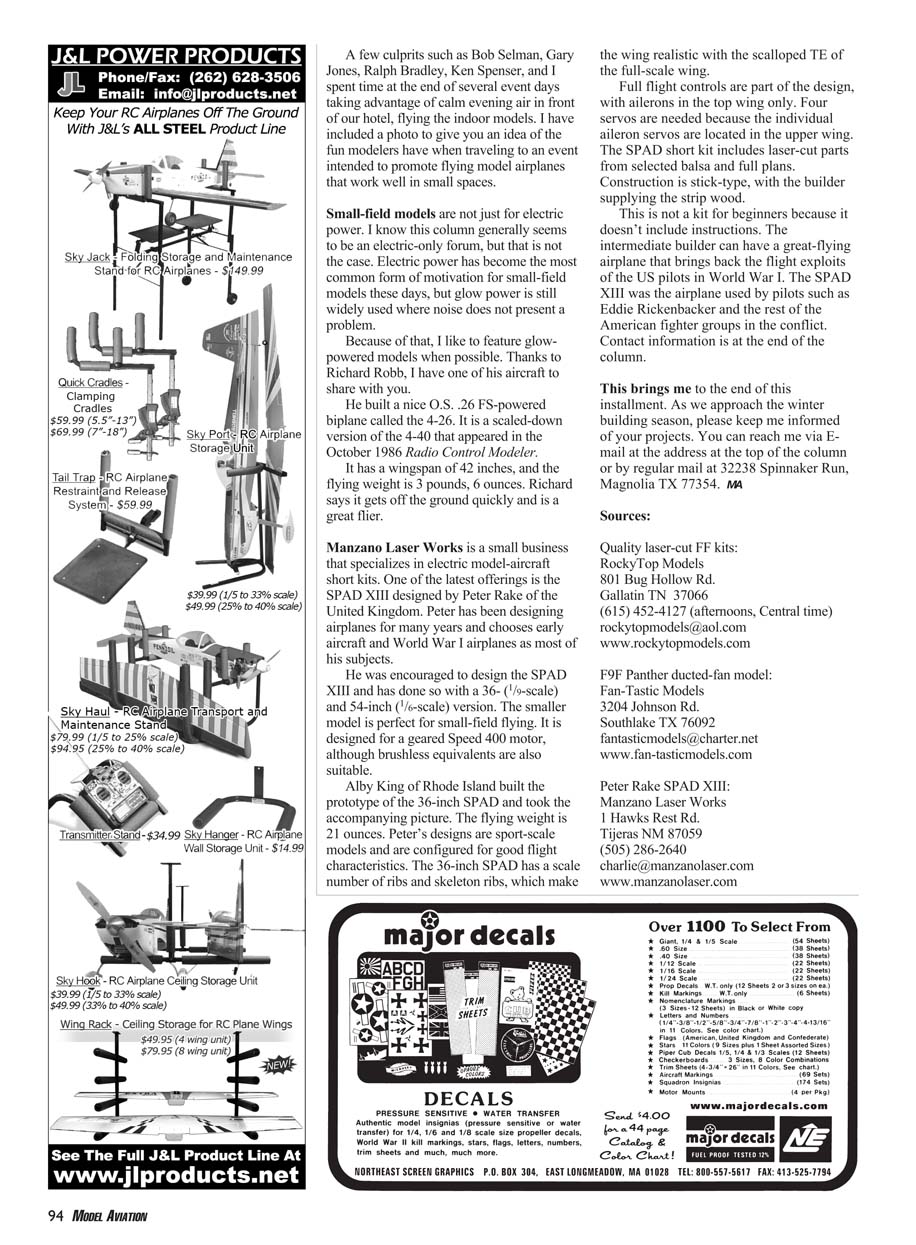
Canards (Charles Sully)
To show I’m not fixated on Miles Magisters, Charles Sully of Atlanta, Georgia, brought several canards—he calls himself a canard addict and had three at S.M.A.L.L. One of his scratch-built, original-design models is the Georgia Goose, inspired by an Andy Lennon design. Canards are distinctive on the ground and in the air; Charles’s Goose is a real performer.
Specifications for the Georgia Goose:
- Main wing span: 48 inches
- Canard span: 22 inches
- Combined wing area: 516 square inches
- Flying weight: 29 ounces
- Power: Hacker A30-22S motor driving a 7 x 4 prop in pusher configuration
- Battery: three-cell 2600 mAh Li‑Poly pack
I was impressed by the Goose’s performance, and based on Charles’ love of canards, I hope we’ll see more of his unique creations.
F9F Panther ducted-fan model (Fan-Tastic Models)
Another striking model was a small ducted-fan F9F Panther from Fan-Tastic Models. As is usual for that company, the Panther is made from molded foam and is designed to work with the GWS EDF-40 ducted-fan unit. It has a 21-inch wingspan and weighs a scant 6 ounces ready to fly.
The example shown was built by Jerry Small (the man behind Fan-Tastic Models) and flown by Thomas Blakney. Jerry did a great job on paint and trim, replicating the markings of the F9F flown by the main character in the movie The Bridges at Toko‑Ri. That little airplane moved well in flight and was easily hand-launched. The model at the event was powered with a Feigao 12mm brushless motor using a three-cell 730 mAh Li‑Poly battery pack.
Glow-powered biplane (Richard Robb)
Small-field models are not just for electric power. Glow power is still widely used where noise does not present a problem. Richard Robb built a nice O.S. .26 FS–powered biplane called the 4-26, a scaled-down version of the 4-40 that appeared in the October 1986 Radio Control Modeler. It has a 42-inch wingspan and a flying weight of 3 pounds 6 ounces. Richard says it gets off the ground quickly and is a great flier.
SPAD XIII short kit (Manzano Laser Works / Peter Rake)
Manzano Laser Works specializes in electric model-aircraft short kits. One of their offerings is the SPAD XIII designed by Peter Rake of the U.K. Peter favors early aircraft and World War I subjects. He designed the SPAD XIII in two sizes: 36 inches (1/9 scale) and 54 inches (1/6 scale). The smaller model is perfect for small-field flying and is designed for a geared Speed 400 motor, although modern brushless equivalents also work.
Alby King of Rhode Island built the 36-inch prototype, which has a flying weight of 21 ounces. Peter’s designs are sport-scale with good flight characteristics: the 36-inch SPAD has a scale number of ribs and skeleton ribs for a realistic wing with the scalloped trailing edge of the full-scale aircraft. Full flight controls are part of the design, with ailerons in the top wing only. Four servos are needed because the individual aileron servos are located in the upper wing. The SPAD short kit includes laser-cut parts from selected balsa and full plans. Construction is stick-type, with the builder supplying the strip wood. This is not a kit for beginners because it doesn’t include detailed instructions; the intermediate builder can produce a great-flying airplane that recalls the exploits of U.S. pilots such as Eddie Rickenbacker in World War I.
Evening and indoor flying
This event includes one evening of indoor flying, so people bring appropriate indoor models. When you bring together a group who like to fly small, quiet, slow-flying models, they just can’t get enough during the day or in one indoor evening. The result is some late-evening flying. A few culprits—Bob Selman, Gary Jones, Ralph Bradley, Ken Spenser, and I—spent time at the end of several event days taking advantage of calm evening air in front of our hotel, flying the indoor models. It’s fun to see modelers traveling to an event intended to promote flying airplanes that work well in small spaces.
As we approach the winter building season, please keep me informed of your projects. You can reach me via e-mail at the address at the top of the column or by regular mail at:
32238 Spinnaker Run Magnolia, TX 77354
MA
Sources
- RockyTop Models (quality laser-cut free-flight kits)
- 801 Big Hollow Rd.
- Gallatin, TN 37066
- (615) 452-4127 (afternoons, Central time)
- [email protected]
- www.rockytopmodels.com
- Fan-Tastic Models (F9F Panther ducted-fan model)
- 3204 Johnson Rd.
- Southlake, TX 76092
- [email protected]
- www.fan-tasticmodels.com
- Manzano Laser Works (Peter Rake SPAD XIII)
- 1 Hawks Rest Rd.
- Tijeras, NM 87059
- (505) 286-2640
- [email protected]
- www.manzanolaser.com
Transcribed from original scans by AI. Minor OCR errors may remain.

