
Small-Field Flying-2007/04
Paul Bradley | [email protected]
New kits from Acme Aircraft Company, Dumas Products, and Littlebirdz
As we enter the flying season I thought it would be nice to look at some new kits that have been introduced or are being readied for the market. I would love to say I am on top of everything that is in the works, but that is not the case. Based on what I am aware of, it looks as though 2007 will be another good year for new kits and related products for the small-field flier.
Also included in this column:
- Small-field models based on components from Spin Master Aero Aces
- An easy-to-make instrument panel
Acme Aircraft Company — 33-inch Beech Bonanza V-35
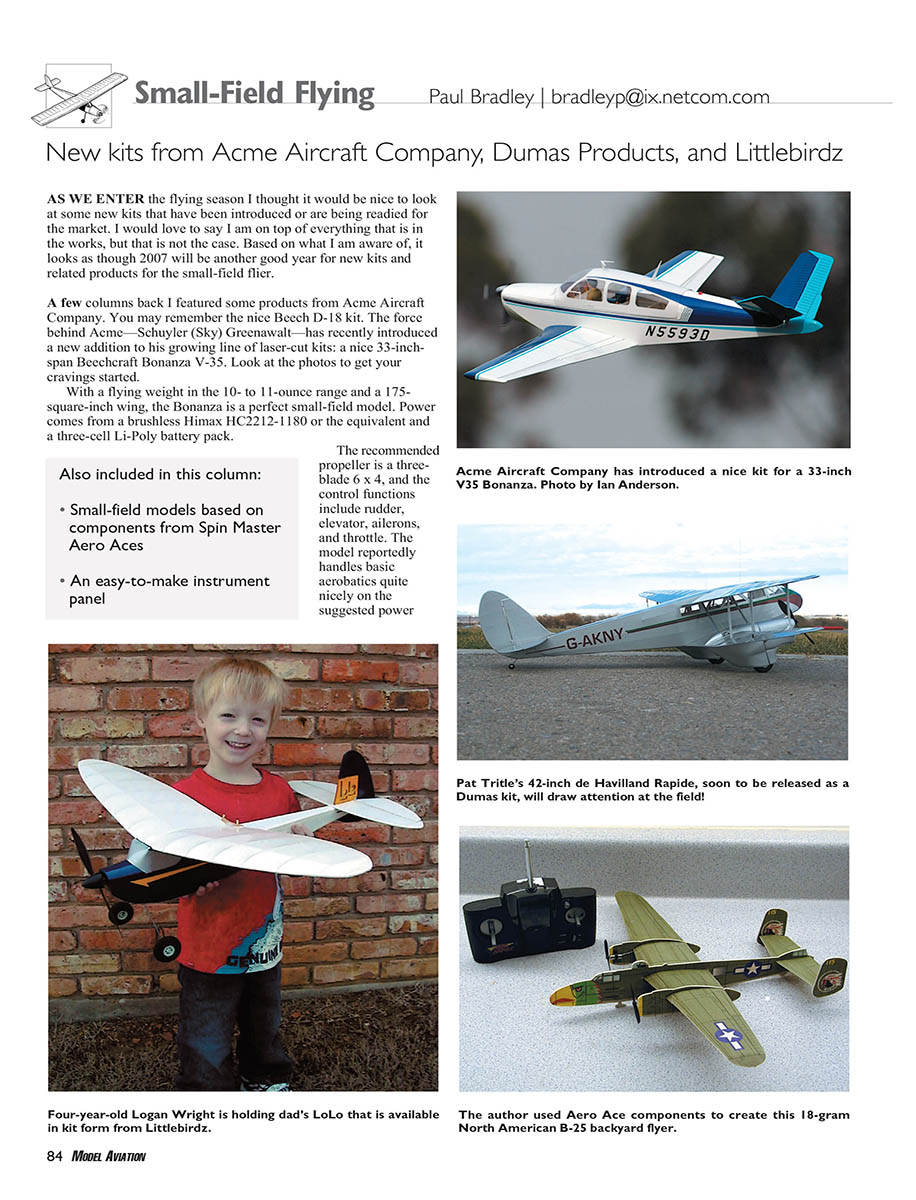
Schuyler (Sky) Greenawalt of Acme Aircraft Company has introduced a laser-cut 33-inch-span Beechcraft Bonanza V-35. With a flying weight in the 10–11 ounce range and a 175-square-inch wing, the Bonanza is a perfect small-field model.
Recommended power and equipment:
- Brushless Himax HC2212-1180 (or equivalent)
- Three-cell Li-Poly battery pack
- Three-blade 6 x 4 propeller
- Controls: rudder, elevator, ailerons, and throttle
The model reportedly handles basic aerobatics quite nicely on the suggested power setup. Photo credit: Ian Anderson (studio and action model photography), [email protected].
Dumas Products — de Havilland Rapide (Pat Tritle design)
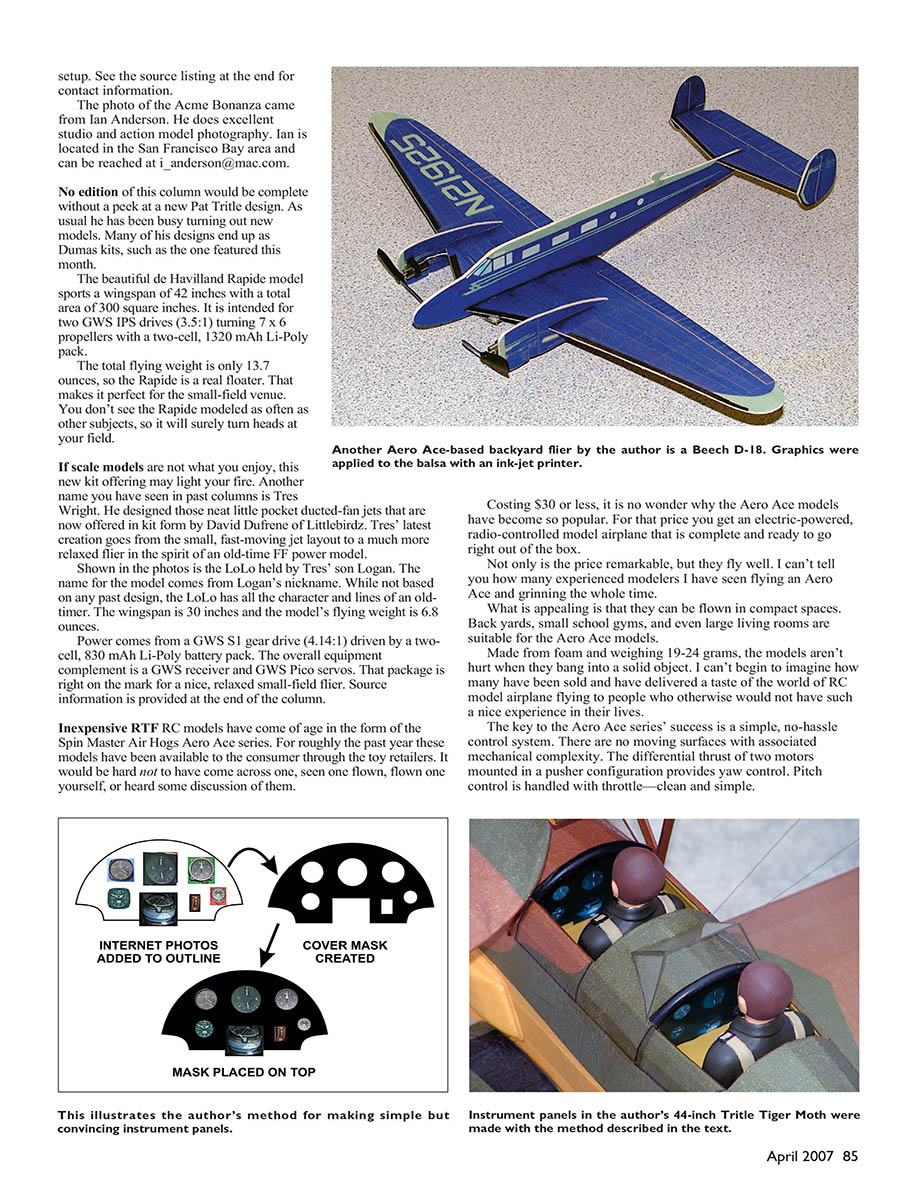
Pat Tritle’s design available from Dumas is a beautiful de Havilland Rapide model:
- Wingspan: 42 inches
- Total area: 300 square inches
- Power: two GWS IPS drives (3.5:1) turning 7 x 6 propellers
- Battery: two-cell, 1320 mAh Li-Poly pack
- Total flying weight: 13.7 ounces
The Rapide is a real floater and ideal for small-field flying. It’s a less-common subject that will turn heads at the field.
Littlebirdz — LoLo (Tres Wright design)
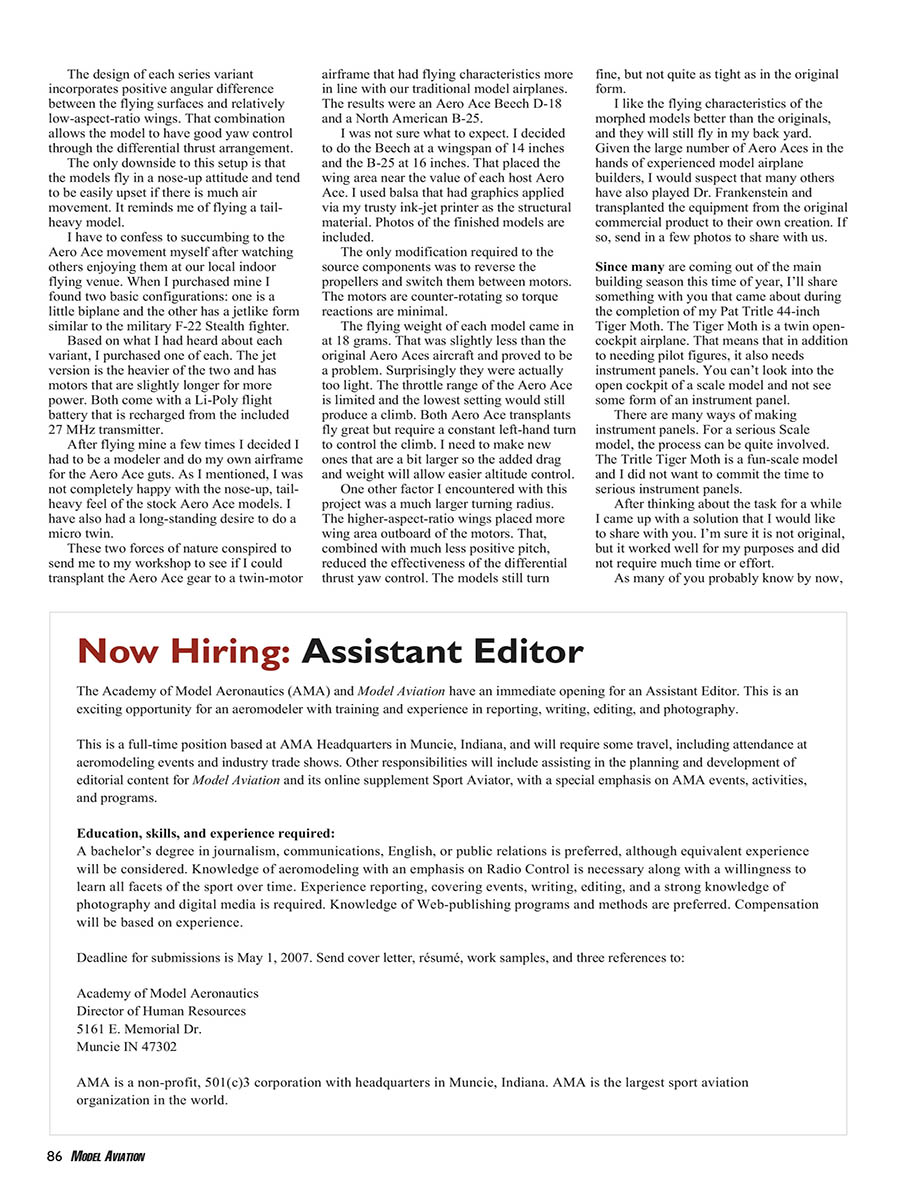
Tres Wright designed the LoLo, produced in kit form by David Dufrene of Littlebirdz. The LoLo is inspired by oldtimer lines rather than any specific historic design; its name comes from Tres’ son Logan (nicknamed “LoLo”).
- Wingspan: 30 inches
- Flying weight: 6.8 ounces
- Power: GWS S1 gear drive (4.14:1)
- Battery: two-cell, 830 mAh Li-Poly pack
- Equipment: GWS receiver and GWS Pico servos
This package is well suited for a relaxed small-field flier.
Spin Master Air Hogs Aero Ace series and transplants
Inexpensive RTF RC models have come of age with the Spin Master Air Hogs Aero Ace series. For roughly the past year these models have been widely available through toy retailers. Costing about $30 or less, they are electric-powered, radio-controlled airplanes that are complete and ready to go out of the box.
Why they matter:
- They fly well and are fun for experienced modelers and newcomers alike.
- They can be flown in compact spaces: back yards, small school gyms, and large living rooms.
- Built from foam and weighing 19–24 grams, they tolerate bumps and crashes well.
- Their simple control system uses differential thrust for yaw (two pusher motors) and throttle for pitch — no moving control surfaces.
Design characteristics:
- Positive angular difference between flying surfaces and relatively low-aspect-ratio wings aid yaw control via differential thrust.
- They tend to fly in a nose-up attitude and can be easily upset in windy conditions, resembling the behavior of a tail-heavy model.
My experience and modifications:
- I purchased two configurations (a small biplane and a jetlike F-22 form). Both use a Li-Poly flight battery recharged from the included 27 MHz transmitter.
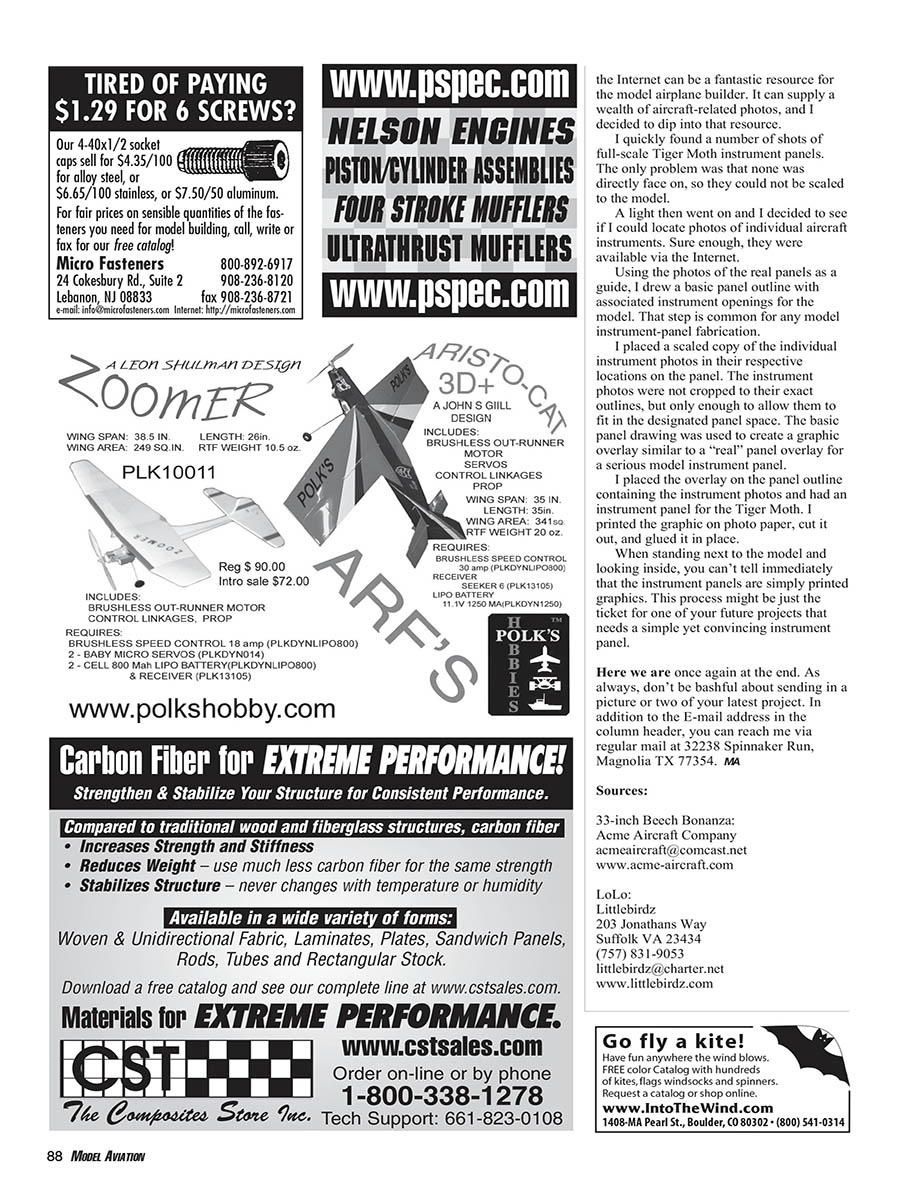
- Wanting more traditional handling, I transplanted Aero Ace components into my own twin-motor airframes: a Beech D-18 (14-inch wingspan) and a North American B-25 (16-inch wingspan). I used balsa with printed graphics for structure.
- Only modification to the source components was reversing the propellers and switching them between motors (motors are counter-rotating, so torque is minimal).
- Flying weight of each morphed model: 18 grams (slightly less than original). This proved problematic: the Aero Ace throttle’s lowest setting still produced climb, so the light transplants required a constant left-hand turn to control climb. Larger, slightly heavier builds would help.
- Higher-aspect-ratio wings resulted in a larger turning radius because more wing area was outboard of the motors and differential-thrust yaw control was somewhat less effective than in the originals.
Overall, I prefer the flying characteristics of the morphed models and they still fly in my back yard. Given how many Aero Aces are out there, I suspect many others have done similar transplants — if so, please send photos.
Instrument panel method — quick, convincing panels
If you’d like to add simple but convincing instrument panels to your models, here is a quick method I use:
- Find photographs of individual instrument faces on the Internet.
- Draw the basic panel outline (and instrument openings) in a graphics program at the desired scale.
- Place the scaled instrument photos into their respective locations on the panel outline.
- Create a cover mask: the silhouette of the panel with holes where the instruments will show through. Place the mask over the instrument images to give the appearance of framing and depth.
- Print the combined layout (photo paper works well), cut it to fit, and glue it in place.
This produces attractive instrument panels with minimal fuss and cost. The technique worked well on my Pat Tritle 44-inch Tiger Moth (a twin open-cockpit model). Using photos of individual instruments placed behind a printed overlay created a convincing look — when standing next to the model and looking into the cockpit you can’t immediately tell they are printed graphics.
Closing
As always, don't be bashful about sending in a picture or two of your latest project. In addition to the e-mail address above, you can reach me via regular mail at:
32238 Spinnaker Run Magnolia, TX 77354
PB
Sources
33-inch Beech Bonanza
Acme Aircraft Company [email protected] www.acme-aircraft.com
Photo credit: Ian Anderson — [email protected]
LoLo
Littlebirdz 203 Jonathans Way Suffolk, VA 23434 (757) 831-9053 [email protected] www.littlebirdz.com
Transcribed from original scans by AI. Minor OCR errors may remain.

