

Small-Field Flying
Paul Bradley | [email protected]
Upcoming Texas fly-ins you should attend
Also included in this column:
- The Elf by Canadian Phil Alvirez
- Trenton Terror from A.A. Lidberg Model Plan Service
- Winged Shadow Systems’ How Fast
- Past column follow-ups
One of my favorite things to do in this hobby is attend a fly-in or a gathering of other modelers. There is something special about seeing other people’s airplanes and sharing information face to face. The social aspects of such gatherings are special for me.
Circumstances this year have kept me from attending the fly-ins I normally haunt, but there are two I want to mention as we near the end of the traditional flying season. I hope to attend these gatherings if life events cooperate.
Coming up the weekend of September 29–30 is the annual fly-in hosted by the Dallas Electric Aircraft Flyers (DEAF). This is a laid-back, fun event that attracts a nice cross-section of models.
Farther south the following weekend—October 6–7—is the Best Electrics in Southeast Texas (BEST) event. This fly-in is hosted by the Tri-City Barnstormers, a club north of Houston. This is another relaxed gathering full of airplanes and flying fun.
If you find yourself with an acceptable commute to Dallas or Houston, it would be great to have you join in the fun. I would love to have the opportunity to say hello. Web addresses for more information about both events can be found at the end of the column.
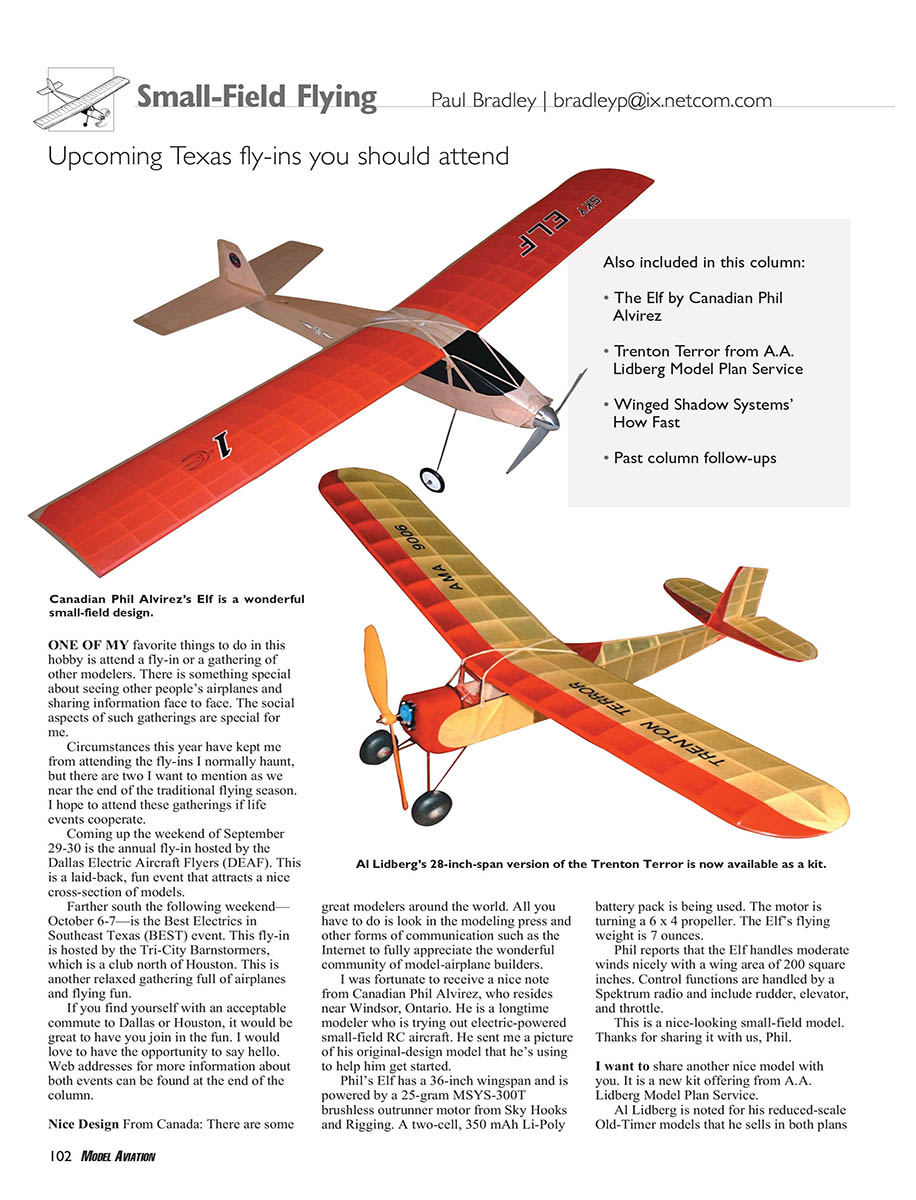
Nice Design From Canada There are some great modelers around the world. All you have to do is look in the modeling press and other forms of communication such as the Internet to fully appreciate the wonderful community of model-airplane builders. I was fortunate to receive a nice note from Canadian Phil Alvirez, who resides near Windsor, Ontario. He is a longtime modeler who is trying out electric-powered small-field RC aircraft. He sent me a picture of his original-design model that he’s using to help him get started.
Phil’s Elf has a 36-inch wingspan and is powered by a 25-gram MSYS-300T brushless outrunner motor from Sky Hooks and Rigging. A two-cell, 350 mAh Li-Poly battery pack is being used. The motor is turning a 6 x 4 propeller. The Elf’s flying weight is 7 ounces. Phil reports that the Elf handles moderate winds nicely with a wing area of 200 square inches. Control functions are handled by a Spektrum radio and include rudder, elevator, and throttle. This is a nice-looking small-field model. Thanks for sharing it with us, Phil.
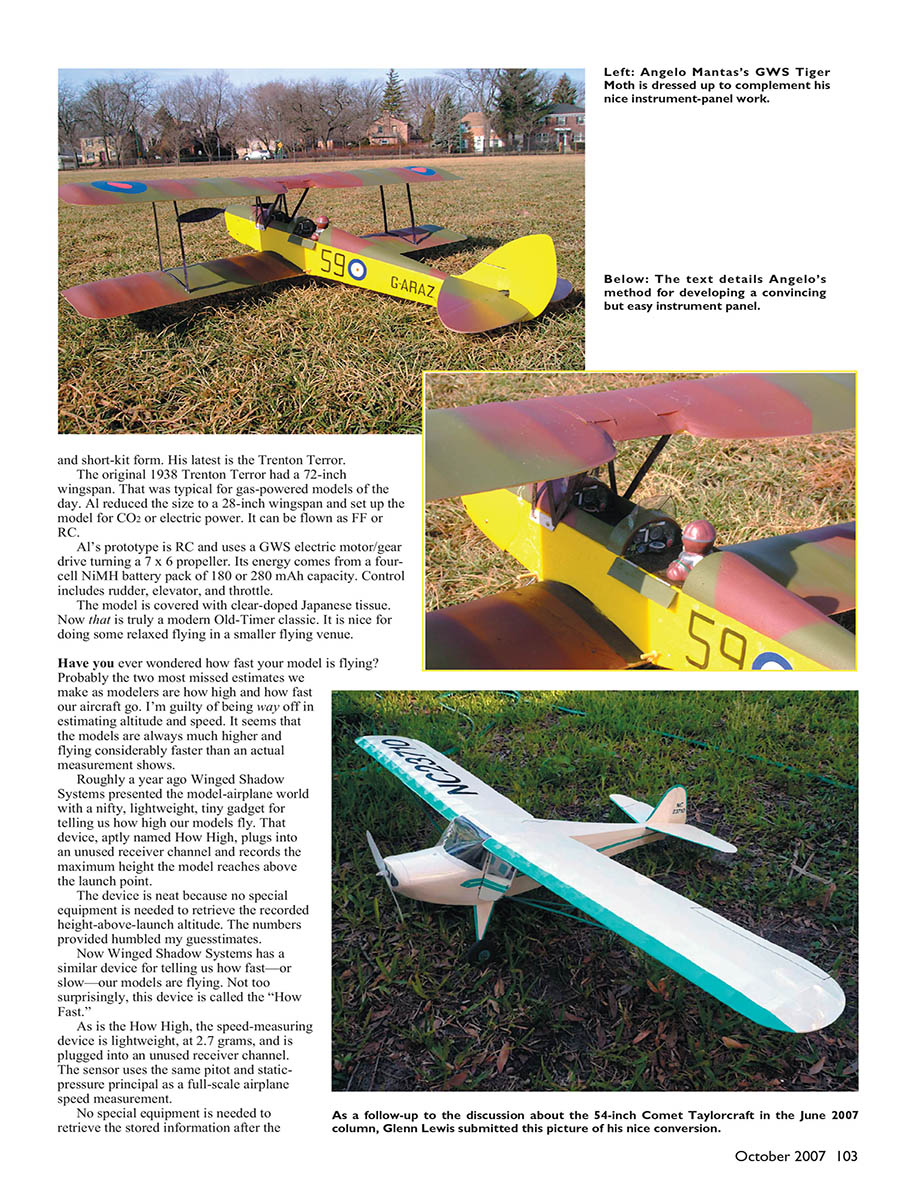
Trenton Terror — A Modern Old-Timer Classic I want to share another nice model with you. It is a new kit offering from A.A. Lidberg Model Plan Service. Al Lidberg is noted for his reduced-scale Old-Timer models that he sells in both plans and short-kit form. His latest is the Trenton Terror. The original 1938 Trenton Terror had a 72-inch wingspan, typical for gas-powered models of the day. Al reduced the size to a 28-inch wingspan and set up the model for CO2 or electric power. It can be flown as free flight (FF) or RC.
Al’s prototype is RC and uses a GWS electric motor/gear drive turning a 7 x 6 propeller. Its energy comes from a four-cell NiMH battery pack of 180 or 280 mAh capacity. Control includes rudder, elevator, and throttle. The model is covered with clear-doped Japanese tissue. Now that is truly a modern Old-Timer classic. It is nice for doing some relaxed flying in a smaller flying venue.
How Fast — Measuring Model Speed Have you ever wondered how fast your model is flying? Probably the two most missed estimates we make as modelers are how high and how fast our aircraft go. I’m guilty of being way off in estimating altitude and speed. It seems that the models are always much higher and flying considerably faster than an actual measurement shows.
Roughly a year ago Winged Shadow Systems presented the model-airplane world with a nifty, lightweight, tiny gadget for telling us how high our models fly. That device, aptly named How High, plugs into an unused receiver channel and records the maximum height the model reaches above the launch point. The device is neat because no special equipment is needed to retrieve the recorded height-above-launch altitude. The numbers provided humbled my guesstimates.
Now Winged Shadow Systems has a similar device for telling us how fast—or slow—our models are flying. Not too surprisingly, this device is called the How Fast.
As is the How High, the speed-measuring device is lightweight (2.7 grams) and plugs into an unused receiver channel. The sensor uses the same pitot and static-pressure principle as full-scale airplane speed measurement.
No special equipment is needed to retrieve the stored information after the flight. The company includes a software application (PC-only) that will download and display both the speed and altitude record. The How Fast will show true airspeed in miles per hour, feet per minute, or meters per second. It will also display speed over ground if a GPS module is used. The How Fast sells for about $99.95; the company sells a How Fast/How High combo for $149.95.
The How Fast can measure speeds of 15–500 mph with a 1 mph resolution. The lower end of the speed range is perfect for small-field-flying needs. The unit can be ordered to read in metric or US units.
Past Column Follow-Up It is gratifying to hear from readers regarding material presented in this column. It is especially nice when readers offer experiences and comments that add to it. I've received follow-up material to several recent columns.
Angelo Mantas sent me a nice note about my suggested method for making simple but convincing instrument panels for our models. I used photographs of instruments for a Tiger Moth to develop a panel for my 44-inch Pat Tritle Tiger Moth.
One of my objectives in presenting that material was to show how easy it can be to dress up the models that involve the complete airframe-building process and the many nice ARFs that are available. Angelo reinforced the latter point in his GWS foam-based Tiger Moth. The photos he provided show his nice, easy-to-make instrument panel. He wrote:
"Doing a search on the Web, I found several nice shots of Tiger Moth instrument panels. As you noted, none were taken straight on.
"I downloaded and opened a photo in PhotoShop then used the program to stretch and bend the photo until the perspective and size were correct. The instruments weren't sharp so I imported individual instruments from other photos. I then printed it on photo-quality ink-jet paper, cut it out, and glued it in place.
"Since the compass is mounted horizontally, I separated it from the printed instruments, pasted it onto a piece of leftover Depron cut with a circle cutter, and mounted it in a small depression I cut into the proper spot. I'm pretty happy with the results.
"The airplane itself is a GWS Pico Tiger Moth. The paint scheme is based on a currently flying Moth that's painted to resemble a World War II–era trainer.
"Leftover Depron was trimmed and sanded to shape for the cockpit doors, and I used some Du-Bro hinges to make the left rear door operational. Markings were made in PhotoShop, and then printed on ink-jet decal film."
Thanks, Angelo, for sharing your spruced-up Tiger Moth and your process for making the instrument panels.
In the June 2007 column I mentioned Ivo Lucchetti's quest to convert his already-built Comet Taylorcraft to an electric-powered RC model. I received two notes from readers who have gone down that path, the first of which came from Glenn Lewis.
Glenn started with TMRC (Tom Martin Radio Control) plans (see the source listing) to construct a lovely 54-inch Taylorcraft from the Comet design. Glenn used a Balsa Products BP-21 motor turning an 8 x 4 propeller and a two-cell Li-Poly battery to power his model. Using rudder and elevator control, he confirms that the Comet Taylorcraft makes a wonderful small-field flyer.
Lloyd McConnell did exactly what Ivo expressed an interest in doing: converting an already-built 54-inch Comet Taylorcraft that was initially constructed and flown as a rubber-powered free-flight aircraft. He did not have to do a lot of work to complete the conversion and was rewarded with a great little small-field scale model.
Lloyd did not have any photos, but he did provide a comprehensive description of his conversion. He wrote:
"I found one of these kits in 1972 for a few bucks and built it for rubber-band power. It hung around my shop until 2005 when I re-covered it with red tissue and Sig red dope.
"To convert it to electric, I hinged the rudder and elevator and left the ailerons with the wire hinges for trim adjustments. I sheeted the fuselage from the nose block to the front of the cabin and added Trexler balloon tires.
"For power I used an ElectriFly 400 can motor with a 3:1 gearbox turning an 11 x 7 E propeller. To mount the motor I removed the nose block, carved it out to fit the rear of the gearbox, and installed it on a plywood former behind the nose block. I built right and down thrust in the mount. The battery pack was an eight-cell 800 mAh NiMH.
"I made no other changes to the model. The all-up weight with battery was 17.7 ounces. Flight times were 12–15 minutes.
"Most of the time was spent cruising around the field at scale speed. It was fun to fly! I live in Greeley, Colorado, north of Denver, so it was nice to have an aircraft perform this well at this altitude.
"Someday I would like to build another one. The changes I would make would include a removable wing, aileron control, no functional doors, strengthen the cabin by running the 1/32 sheeting to the back of the cabin, and strengthen the landing gear. I would probably upgrade the power system to an AXI 2212/26 outrunner on an 11 x 4.7 propeller with Li-Poly 1500 mAh 3S batteries. This setup would result in the same flying weight with greatly enhanced flying times."
Thanks, Lloyd, for giving us a definitive approach to converting this model.
We are at the end of this column once again. As always, don't be bashful about sending me a picture or two of your latest project. In addition to the e-mail address in the column header, you can reach me via regular mail at 32238 Spinnaker Run, Magnolia TX 77354.
Sources
- Fall Fly-ins:
- DEAF: September 29–30 — www.deaf-rc.org
- BEST: October 6–7 — www.tri-countybarnstormers.com
- How Fast:
- Winged Shadow Systems
- Box 432
- Streamwood, IL 60107
- (630) 837-6553
- [email protected]
- www.wingedshadow.com
- Trenton Terror:
- A.A. (Al) Lidberg Model Plan Service
- 1030 E. Baseline Rd. Suite 105-1074
- Tempe, AZ 85283
- (480) 839-8154 (6–10 p.m. evenings and weekends)
- [email protected]
- www.aalmps.com
- Reproduction kits for 54-inch Comet series:
- TMRC
- 20808 S. Prospect Ave.
- Belton, MO 64012
- (816) 331-8807
- [email protected]
- www.tmrcsailplanes.com
Transcribed from original scans by AI. Minor OCR errors may remain.

