
A "SMALL" get-together in Arkansas
Paul Bradley | [email protected]
SMALL: A large gathering. Although it's not the largest assembly of aeromodeling enthusiasts in terms of numbers, the annual Small Model Airplane Lovers' League (SMALL) event in Little Rock, Arkansas, is huge in terms of the spectrum of models and modelers present. Besides AMA's Nats, there are few, if any, fly‑ins that include FF, CL, RC, and indoor aircraft.
Held in early June each year (5th–7th in 2009), the SMALL get-together is a cornucopia of aeromodeling. Wonderful FF aircraft are flown by the likes of Mike Midkiff; classic CL models are flown by legend Joe Wagner; indoor models are flown by industry leaders such as Bob Selman; and a nice array of RC airplanes is flown by people such as Pat Tritle and Steve Staples.
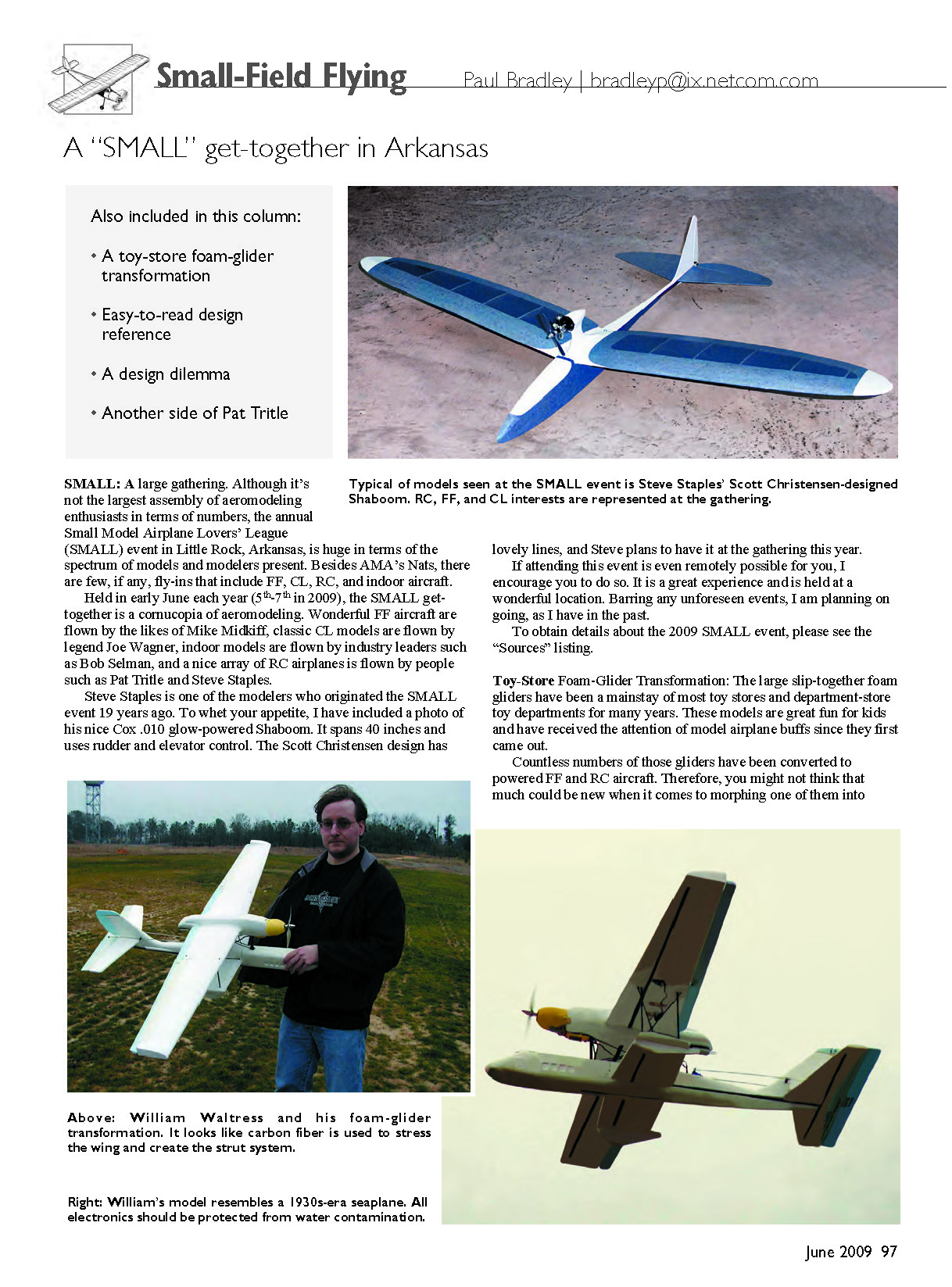
Steve Staples is one of the modelers who originated the SMALL event 19 years ago. To whet your appetite, I have included a photo of his nice Cox .010 glow-powered Shaboom. It spans 40 inches and uses rudder and elevator control. The Scott Christensen design has lovely lines, and Steve planned to have it at the gathering in 2009.
If attending this event is even remotely possible for you, I encourage you to do so. It is a great experience and is held at a wonderful location. Barring any unforeseen events, I was planning on going, as I have in the past. To obtain details about the 2009 SMALL event, please see the "Sources" listing.
Toy-Store Foam-Glider Transformation
The large slip-together foam gliders have been a mainstay of most toy stores and department-store toy departments for many years. These models are great fun for kids and have received the attention of model airplane buffs since they first came out.
Countless numbers of those gliders have been converted to powered FF and RC aircraft. Therefore, you might not think that much could be new when it comes to morphing one of them into something more in line with a traditional model setup. However, I have information about a noteworthy transformation.
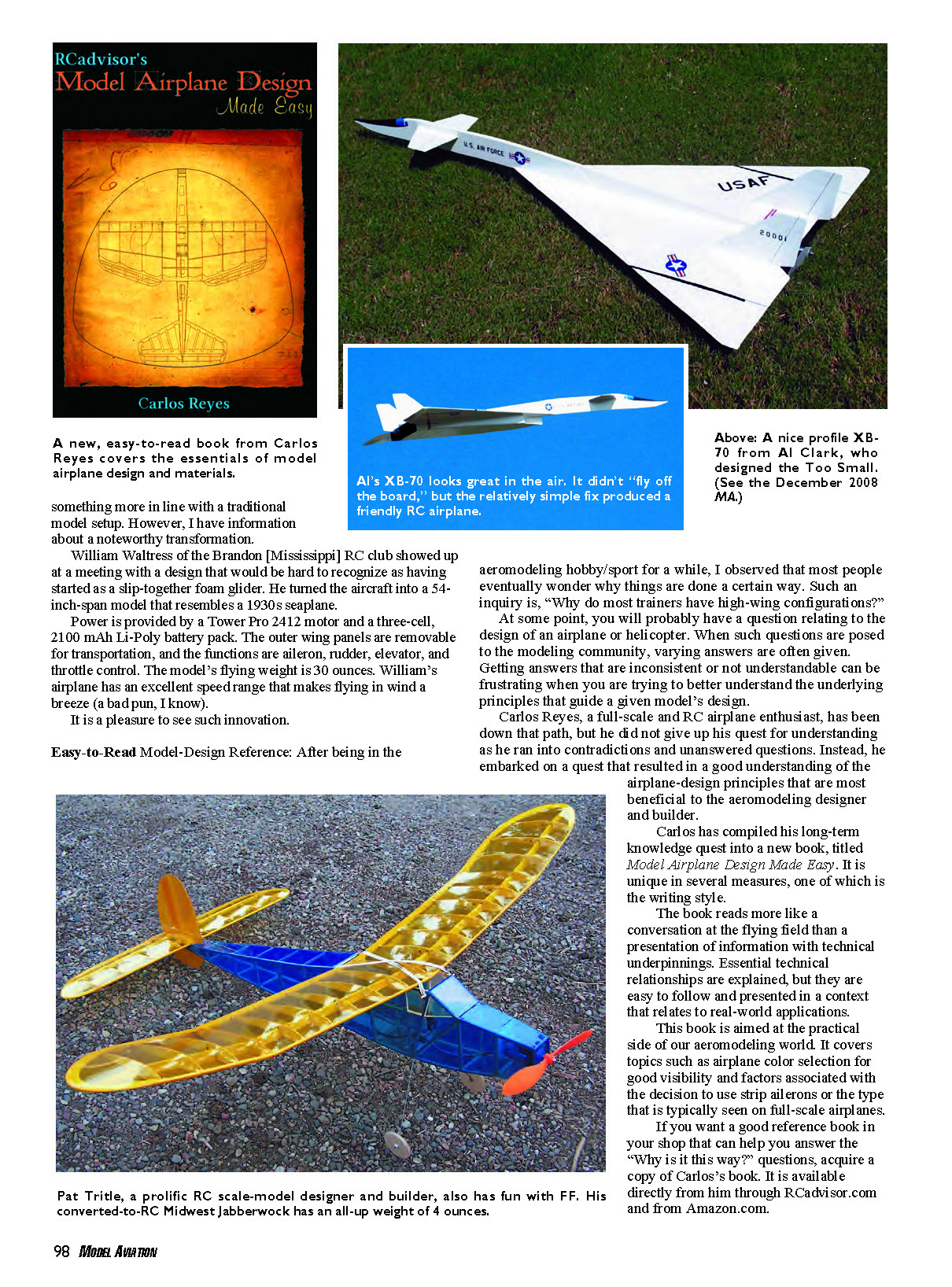
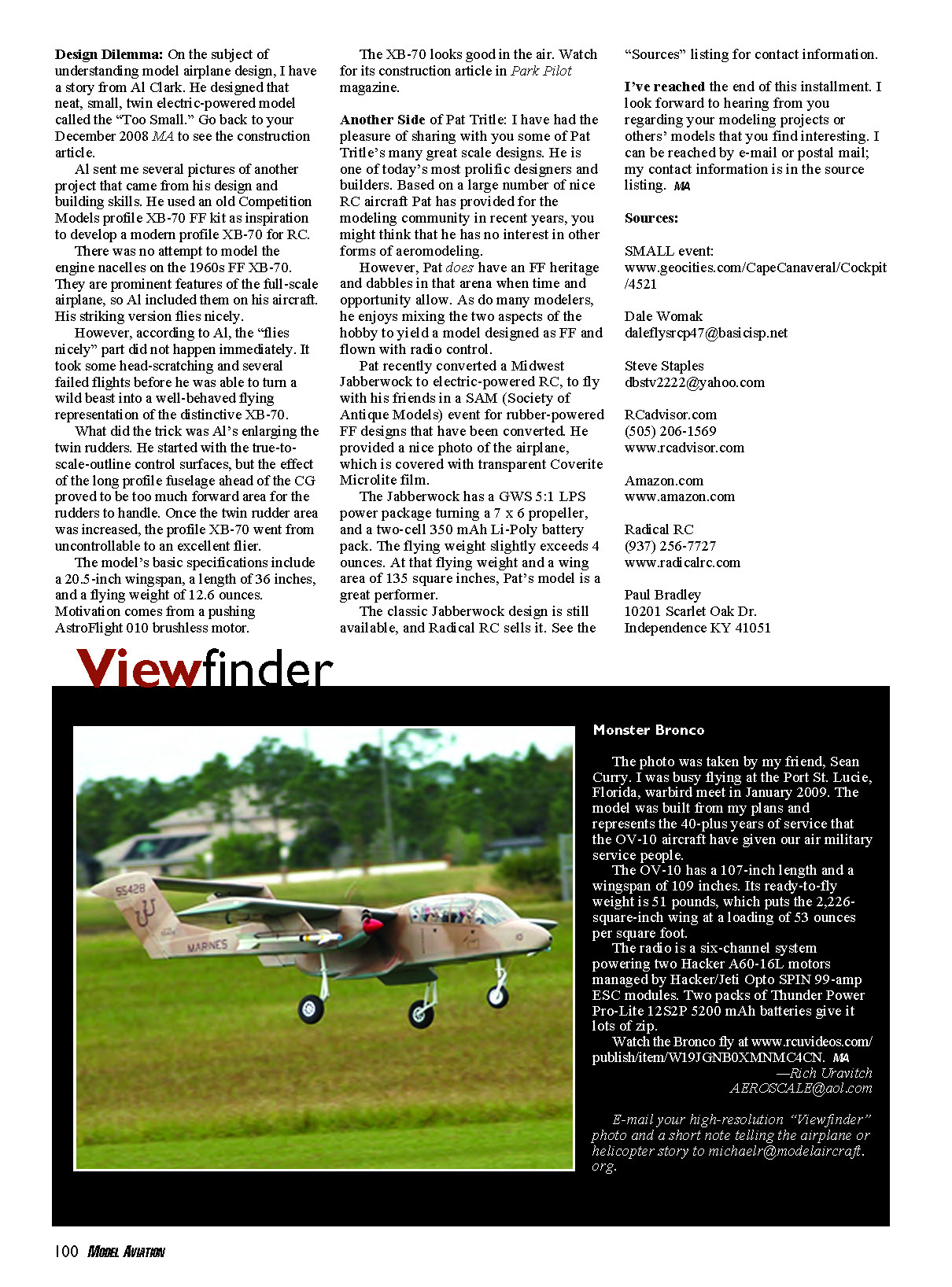
William Waltress of the Brandon, Mississippi RC club showed up at a meeting with a design that would be hard to recognize as having started as a slip-together foam glider. He turned the aircraft into a 54-inch-span model that resembles a 1930s seaplane.
Power is provided by a Tower Pro 2412 motor and a three-cell, 2100 mAh Li-Poly battery pack. The outer wing panels are removable for transportation, and the functions are aileron, rudder, elevator, and throttle control. The model's flying weight is 30 ounces. William's airplane has an excellent speed range that makes flying in wind a breeze.
It is a pleasure to see such innovation.
Easy-to-Read Model-Design Reference
After being in the aeromodeling hobby/sport for a while, I observed that most people eventually wonder why things are done a certain way. Such an inquiry is, "Why do most trainers have high-wing configurations?"
At some point, you will probably have a question relating to the design of an airplane or helicopter. When such questions are posed to the modeling community, varying answers are often given. Getting answers that are inconsistent or not understandable can be frustrating when you are trying to better understand the underlying principles that guide a given model's design.
Carlos Reyes, a full-scale and RC airplane enthusiast, has been down that path, but he did not give up his quest for understanding as he ran into contradictions and unanswered questions. Instead, he embarked on a quest that resulted in a good understanding of the airplane-design principles that are most beneficial to the aeromodeling designer and builder.
Carlos has compiled his long-term knowledge quest into a new book, titled Model Airplane Design Made Easy. It is unique in several measures, one of which is the writing style.
The book reads more like a conversation at the flying field than a presentation of information with heavy technical underpinnings. Essential technical relationships are explained, but they are easy to follow and presented in a context that relates to real-world applications.
This book is aimed at the practical side of our aeromodeling world. It covers topics such as airplane color selection for good visibility and factors associated with the decision to use strip ailerons or the type typically seen on full-scale airplanes. If you want a good reference book in your shop that can help you answer the "Why is it this way?" questions, acquire a copy of Carlos's book. It is available directly from him through RCadvisor.com and from Amazon.com.
Design Dilemma
On the subject of understanding model airplane design, I have a story from Al Clark. He designed that neat, small, twin electric-powered model called the "Too Small." Go back to your December 2008 MA to see the construction article.
Al sent me several pictures of another project that came from his design and building skills. He used an old Competition Models profile XB-70 FF kit as inspiration to develop a modern profile XB-70 for RC.
There was no attempt to model the engine nacelles on the 1960s FF XB-70. They are prominent features of the full-scale airplane, so Al included them on his aircraft. His striking version flies nicely.
However, according to Al, the "flies nicely" part did not happen immediately. It took some head-scratching and several failed flights before he was able to turn a wild beast into a well-behaved flying representation of the distinctive XB-70.
What did the trick was Al's enlarging the twin rudders. He started with the true-to-scale-outline control surfaces, but the effect of the long profile fuselage ahead of the CG proved to be too much forward area for the rudders to handle. Once the twin rudder area was increased, the profile XB-70 went from uncontrollable to an excellent flier.
The model's basic specifications include a 20.5-inch wingspan, a length of 36 inches, and a flying weight of 12.6 ounces. Motivation comes from a pushing AstroFlight 010 brushless motor.
The XB-70 looks good in the air. Watch for its construction article in Park Pilot magazine.
Another Side of Pat Tritle
I have had the pleasure of sharing with you some of Pat Tritle's many great scale designs. He is one of today's most prolific designers and builders. Based on a large number of nice RC aircraft Pat has provided for the modeling community in recent years, you might think that he has no interest in other forms of aeromodeling.
However, Pat does have an FF heritage and dabbles in that arena when time and opportunity allow. As do many modelers, he enjoys mixing the two aspects of the hobby to yield a model designed as FF and flown with radio control.
Pat recently converted a Midwest Jabberwock to electric-powered RC, to fly with his friends in a SAM (Society of Antique Models) event for rubber-powered FF designs that have been converted. He provided a nice photo of the airplane, which is covered with transparent Coverite Microlite film.
The Jabberwock has a GWS 5:1 LPS power package turning a 7 x 6 propeller, and a two-cell 350 mAh Li-Poly battery pack. The flying weight slightly exceeds 4 ounces. At that flying weight and a wing area of 135 square inches, Pat's model is a great performer.
The classic Jabberwock design is still available, and Radical RC sells it. See the "Sources" listing for contact information.
I've reached the end of this installment. I look forward to hearing from you regarding your modeling projects or others' models that you find interesting. I can be reached by e-mail or postal mail; my contact information is in the source listing.
MA
Sources
- SMALL event: www.geocities.com/CapeCanaveral/Cockpit/4521
- Dale Womak: [email protected]
- Steve Staples: [email protected]
- RCadvisor.com: (505) 206-1569, www.rcadvisor.com
- Amazon.com: www.amazon.com
- Radical RC: (937) 256-7727, www.radicalrc.com
- Paul Bradley: 10201 Scarlet Oak Dr., Independence KY 41051
Transcribed from original scans by AI. Minor OCR errors may remain.

