
Small-Field Flying
Paul Bradley | [email protected]
When okay is just not good enough
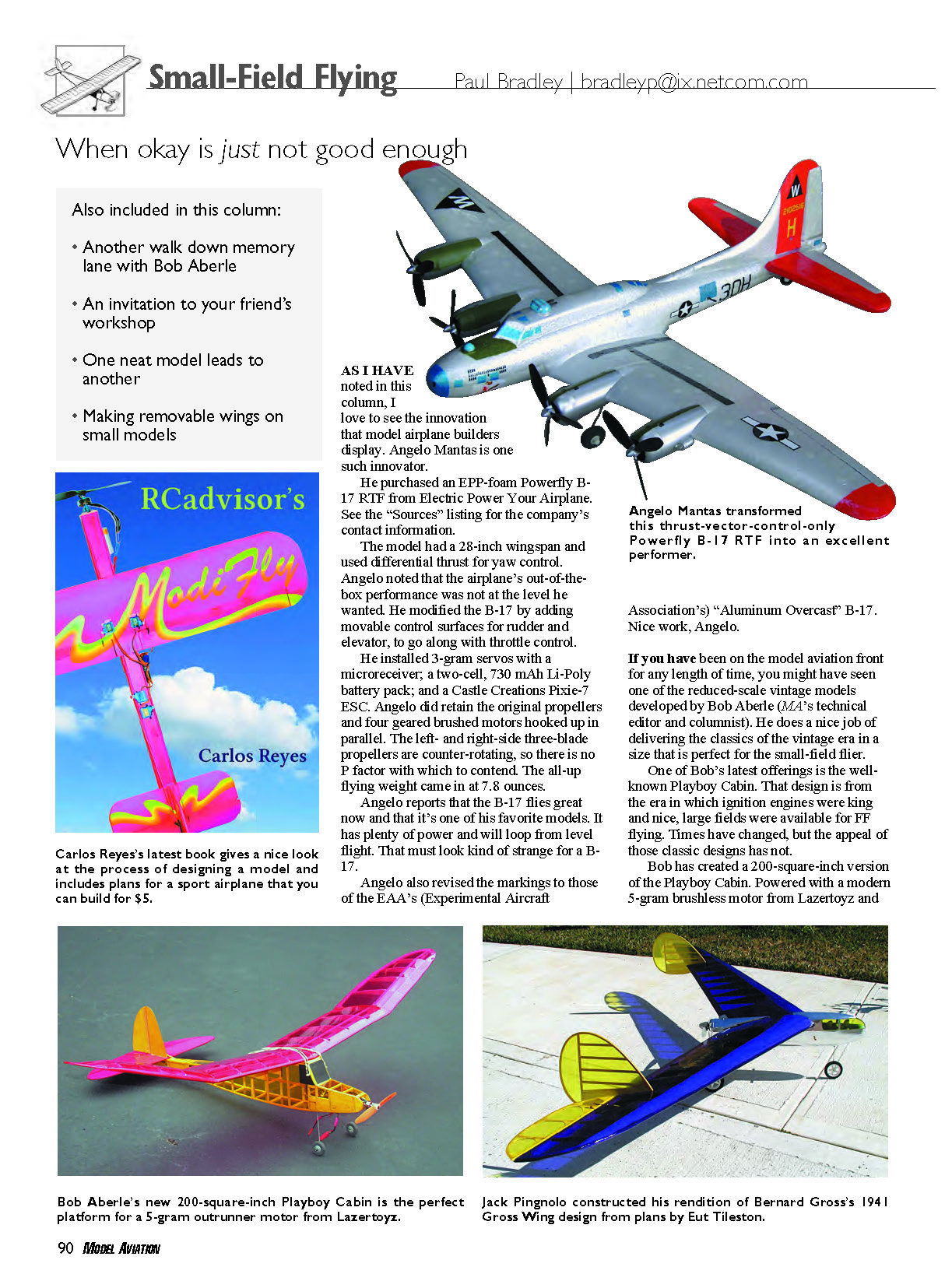
As I have noted in this column, I love to see the innovation that model airplane builders display. Angelo Mantas is one such innovator.
He purchased an EPP-foam Powerfly B-17 RTF from Electric Power Your Airplane. See the Sources listing for the company's contact information.
The model had a 28-inch wingspan and used differential thrust for yaw control. Angelo noted that the airplane's out-of-the-box performance was not at the level he wanted. He modified the B-17 by adding movable control surfaces for rudder and elevator, to go along with throttle control.
He installed 3-gram servos with a micro receiver; a two-cell, 730 mAh Li-Poly battery pack; and a Castle Creations Pixie-7 ESC. Angelo did retain the original propellers and four geared brushed motors hooked up in parallel. The left- and right-side three-blade propellers are counter-rotating, so there is no P-factor with which to contend. The all-up flying weight came in at 7.8 ounces.
Angelo reports that the B-17 flies great now and that it's one of his favorite models. It has plenty of power and will loop from level flight. That must look kind of strange for a B-17. Angelo also revised the markings to those of the EAA's "Aluminum Overcast" B-17. Nice work, Angelo.
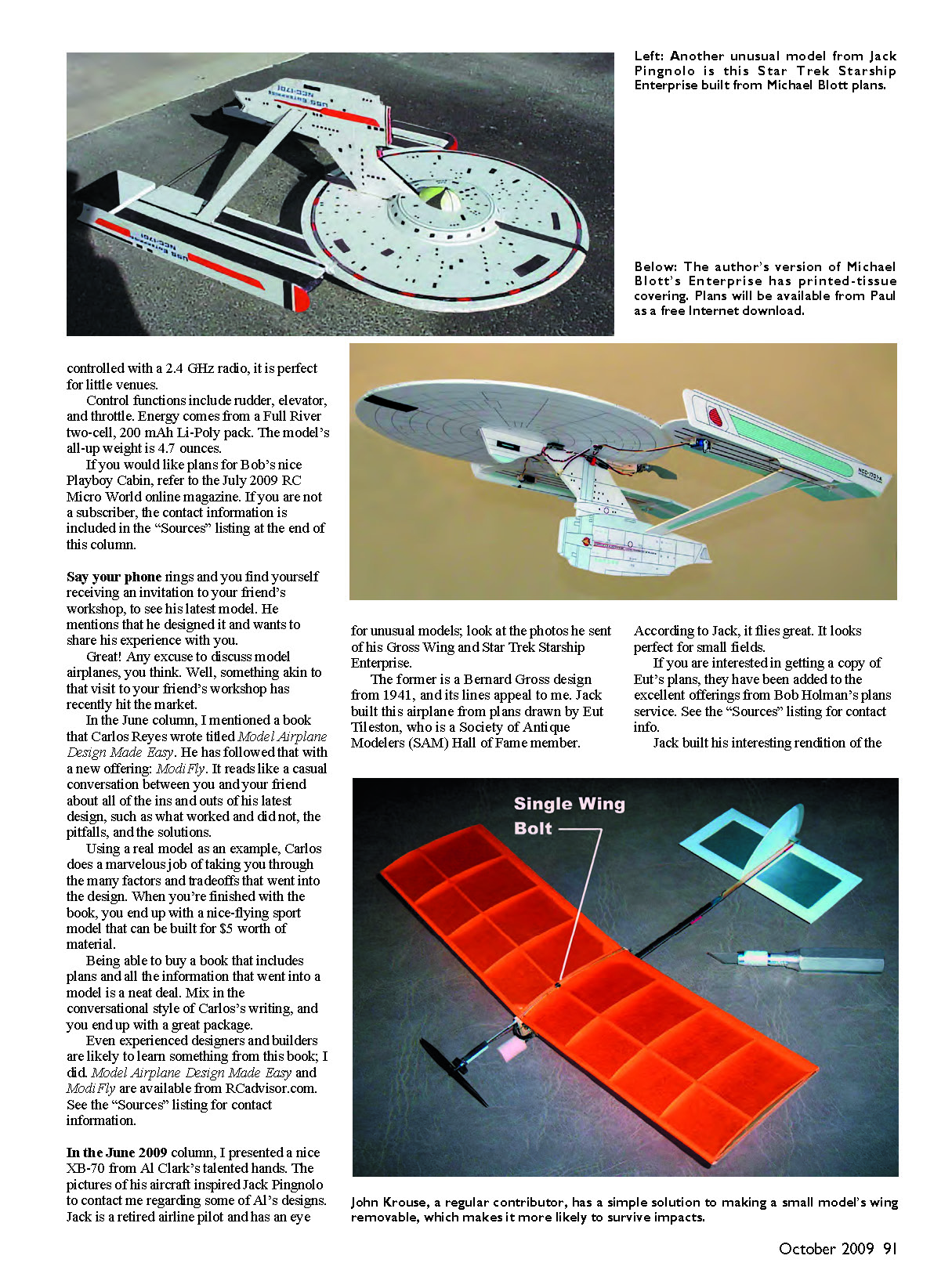
If you have been on the model aviation front for any length of time, you might have seen one of the reduced-scale vintage models developed by Bob Aberle (MA's technical editor and columnist). He does a nice job of delivering the classics of the vintage era in a size that is perfect for the small-field flier.
One of Bob's latest offerings is the well-known Playboy Cabin. That design is from the era in which ignition engines were king and nice, large fields were available for FF flying. Times have changed, but the appeal of those classic designs has not.
Bob has created a 200-square-inch version of the Playboy Cabin. Powered with a modern 5-gram brushless motor from Lazertoyz and controlled with a 2.4 GHz radio, it is perfect for little venues. Control functions include rudder, elevator, and throttle. Energy comes from a Full River two-cell, 200 mAh Li-Poly pack. The model's all-up weight is 4.7 ounces. If you would like plans for Bob's nice Playboy Cabin, refer to the July 2009 RC Micro World online magazine. If you are not a subscriber, the contact information is included in the Sources listing at the end of this column.
Say your phone rings and you find yourself receiving an invitation to your friend's workshop to see his latest model. He mentions that he designed it and wants to share his experience with you. Great! Any excuse to discuss model airplanes, you think. Well, something akin to that visit to your friend's workshop has recently hit the market.
In the June column, I mentioned a book that Carlos Reyes wrote titled Model Airplane Design Made Easy. He has followed that with a new offering: Model Fly. It reads like a casual conversation between you and your friend about all of the ins and outs of his latest design, such as what worked and did not, the pitfalls, and the solutions.
Using a real model as an example, Carlos does a marvelous job of taking you through the many factors and tradeoffs that went into the design. When you're finished with the book, you end up with a nice-flying sport model that can be built for $5 worth of material.
Being able to buy a book that includes plans and all the information that went into a model is a neat deal. Mix in the conversational style of Carlos's writing, and you end up with a great package. Even experienced designers and builders are likely to learn something from this book; I did. Model Airplane Design Made Easy and Model Fly are available from RCadvisor.com. See the Sources listing for contact information.
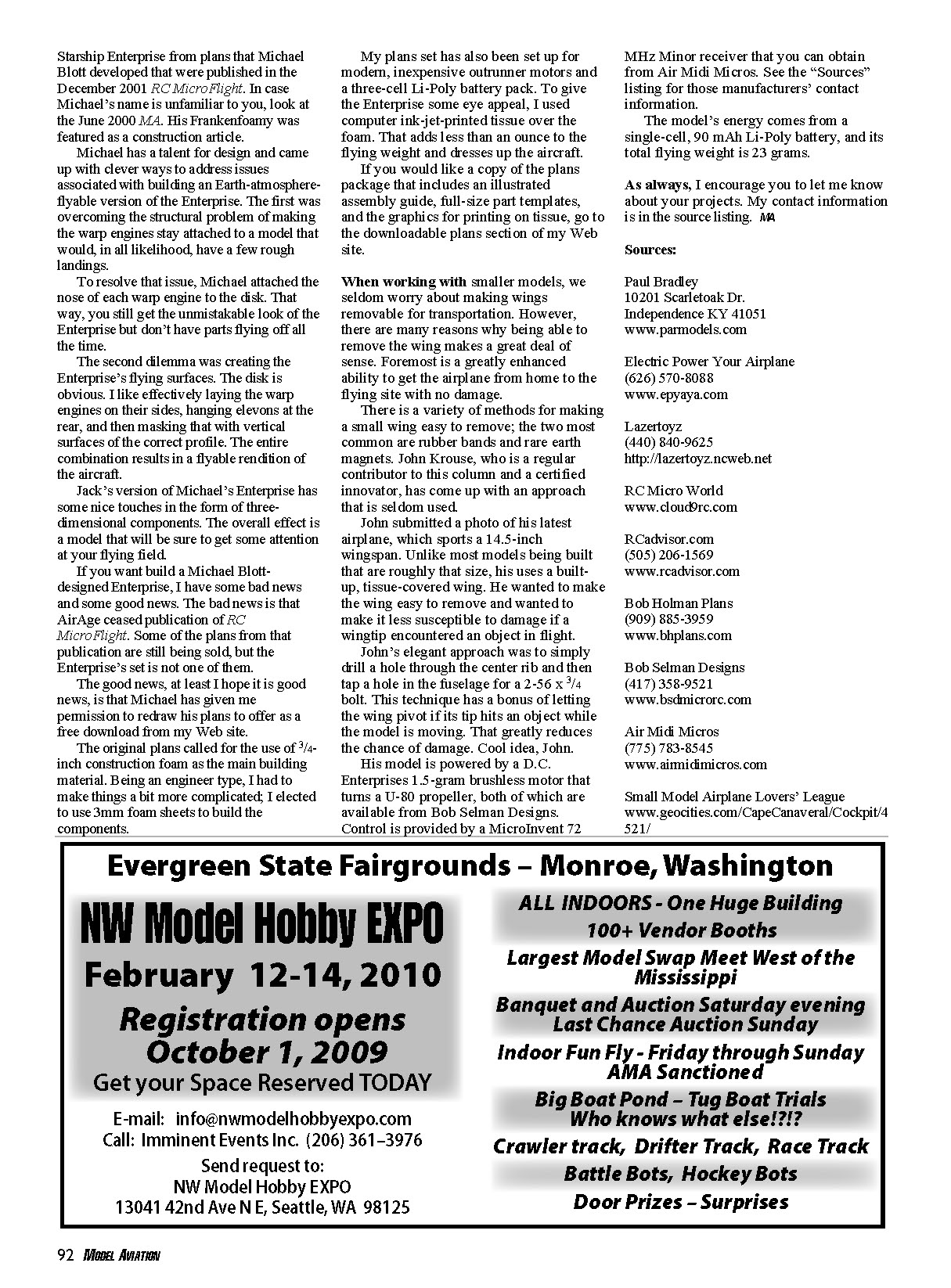
In the June 2009 column, I presented a nice XB-70 from Al Clark's talented hands. The pictures of his aircraft inspired Jack Pingnolo to contact me regarding some of Al's designs. Jack is a retired airline pilot and has an eye for unusual models; look at the photos he sent of his Gross Wing and Star Trek Starship Enterprise.
The Gross Wing is a Bernard Gross design from 1941, and its lines appeal to me. Jack built this airplane from plans drawn by Eut Tileston, who is a Society of Antique Modelers (SAM) Hall of Fame member. According to Jack, it flies great. It looks perfect for small fields.
If you are interested in getting a copy of Eut's plans, they have been added to the excellent offerings from Bob Holman's plans service. See the Sources listing for contact info.
Jack built his interesting rendition of the Starship Enterprise from plans that Michael Blott developed and that were published in the December 2001 RC MicroFlight. In case Michael's name is unfamiliar to you, look at the June 2000 MA; his Frankenfoamy was featured as a construction article.
Michael has a talent for design and came up with clever ways to address issues associated with building an Earth-atmosphere-flyable version of the Enterprise. The first was overcoming the structural problem of making the warp engines stay attached to a model that would, in all likelihood, have a few rough landings. To resolve that issue, Michael attached the nose of each warp engine to the disk. That way, you still get the unmistakable look of the Enterprise but don't have parts flying off all the time.
The second dilemma was creating the Enterprise's flying surfaces. The disk is obvious. I like effectively laying the warp engines on their sides, hanging elevons at the rear, and then masking that with vertical surfaces of the correct profile. The entire combination results in a flyable rendition of the aircraft.
Jack's version of Michael's Enterprise has some nice touches in the form of three-dimensional components. The overall effect is a model that will be sure to get some attention at your flying field.
If you want to build a Michael Blott-designed Enterprise, I have some bad news and some good news. The bad news is that AirAge ceased publication of RC MicroFlight. Some of the plans from that publication are still being sold, but the Enterprise's set is not one of them.
The good news, at least I hope it is good news, is that Michael has given me permission to redraw his plans to offer as a free download from my web site.
The original plans called for the use of 3/4-inch construction foam as the main building material. Being an engineer type, I had to make things a bit more complicated: I elected to use 3mm foam sheets to build the components.
My plans set has also been set up for modern, inexpensive outrunner motors and a three-cell Li-Poly battery pack. To give the Enterprise some eye appeal, I used computer inkjet-printed tissue over the foam. That adds less than an ounce to the flying weight and dresses up the aircraft.
If you would like a copy of the plans package that includes an illustrated assembly guide, full-size part templates, and the graphics for printing on tissue, go to the downloadable plans section of my web site.
When working with smaller models, we seldom worry about making wings removable for transportation. However, there are many reasons why being able to remove the wing makes a great deal of sense. Foremost is a greatly enhanced ability to get the airplane from home to the flying site with no damage.
There is a variety of methods for making a small wing easy to remove; the two most common are rubber bands and rare-earth magnets. John Krouse, who is a regular contributor to this column and a certified innovator, has come up with an approach that is seldom used.
John submitted a photo of his latest airplane, which sports a 14.5-inch wingspan. Unlike most models being built that are roughly that size, his uses a built-up, tissue-covered wing. He wanted to make the wing easy to remove and wanted to make it less susceptible to damage if a wingtip encountered an object in flight.
John's elegant approach was to simply drill a hole through the center rib and then tap a hole in the fuselage for a 2-56 x 3/4 bolt. This technique has the bonus of letting the wing pivot if its tip hits an object while the model is moving. That greatly reduces the chance of damage. Cool idea, John.
His model is powered by a D.C. Enterprises 1.5-gram brushless motor that turns a U-80 propeller, both of which are available from Bob Selman Designs. Control is provided by a MicroInvent 72 MHz Minor receiver that you can obtain from Air Midi Micros. See the Sources listing for those manufacturers' contact information.
The model's energy comes from a single-cell, 90 mAh Li-Poly battery, and its total flying weight is 23 grams.
As always, I encourage you to let me know about your projects. My contact information is in the Sources listing.
MA
Sources
- Paul Bradley
10201 Scarleton Dr. Independence KY 41051 www.parmodels.com
- Electric Power Your Airplane
(626) 570-8088 www.epyaya.com
- Lazertoyz
(440) 840-9625 http://lazertoyz.ncweb.net
- RC Micro World
- RCadvisor.com
(505) 206-1569 www.rcadvisor.com
- Bob Holman Plans
(909) 885-3959 www.bhplans.com
- Bob Selman Designs
(417) 358-9521 www.bsdmicrocr.com
- Air Midi Micros
(775) 783-8545 www.airmidmicros.com
- Small Model Airplane Lovers' League
www.geocities.com/CapeCanaveral/Cockpit/4521/
Transcribed from original scans by AI. Minor OCR errors may remain.

