
HobbyZone Aeronca Champ: a great trainer
Paul Bradley | [email protected]
THROUGHOUT the years in which I have been involved with model aviation I have observed a recurring situation. While flying my airplanes, someone who has no aeromodeling experience will happen along and get interested in what I am doing. He or she would like to try flying, but I typically have an aircraft that would be unsuitable for training.
I have often felt that it would be nice to have a model I could use to let someone test the water—er, air. I simply have not wanted to invest the time to build such an airplane.
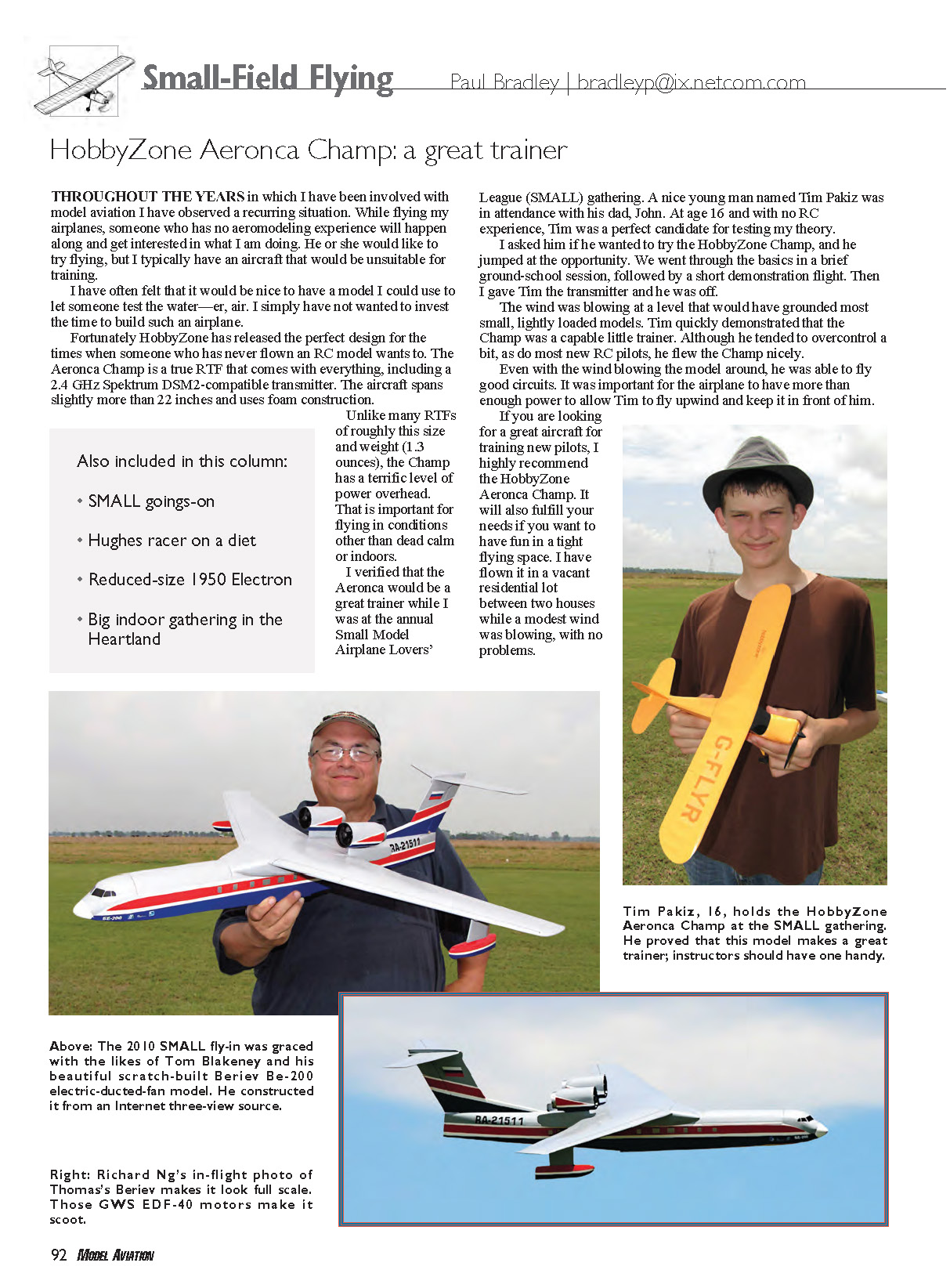
Fortunately, HobbyZone has released the perfect design for the times when someone who has never flown an RC model wants to try. The Aeronca Champ is a true RTF that comes with everything, including a 2.4 GHz Spektrum DSM2-compatible transmitter. The aircraft spans slightly more than 22 inches and uses foam construction.
Unlike many RTFs of roughly this size and weight (1.3 ounces), the Champ has a terrific level of power overhead. That is important for flying in conditions other than dead calm or indoors.
I verified that the Aeronca would be a great trainer while I was at the annual Small Model Airplane Lovers' League (SMALL) gathering. A nice young man named Tim Pakiz was in attendance with his dad, John. At age 16 and with no RC experience, Tim was a perfect candidate for testing my theory.
I asked him if he wanted to try the HobbyZone Champ, and he jumped at the opportunity. We went through the basics in a brief ground-school session, followed by a short demonstration flight. Then I gave Tim the transmitter and he was off.
The wind was blowing at a level that would have grounded most small, lightly loaded models. Tim quickly demonstrated that the Champ was a capable little trainer. Although he tended to overcontrol a bit, as do most new RC pilots, he flew the Champ nicely.
Even with the wind blowing the model around, he was able to fly good circuits. It was important for the airplane to have more than enough power to allow Tim to fly upwind and keep it in front of him.
If you are looking for a great aircraft for training new pilots, I highly recommend the HobbyZone Aeronca Champ. It will also fulfill your needs if you want to have fun in a tight flying space. I have flown it in a vacant residential lot between two houses while a modest wind was blowing, with no problems.
See the source listing at the end of the column for HobbyZone’s contact information.
SMALL Happenings
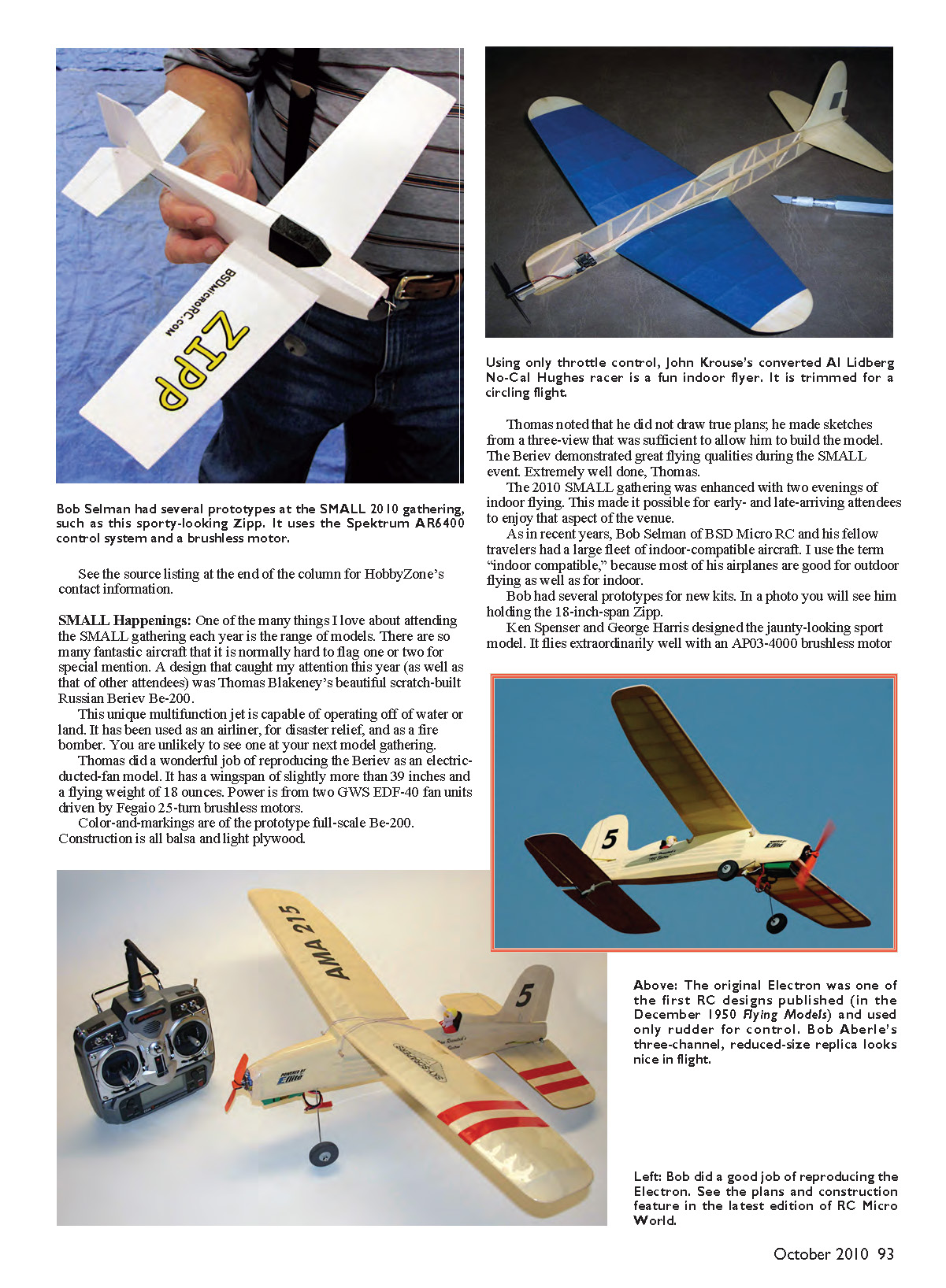
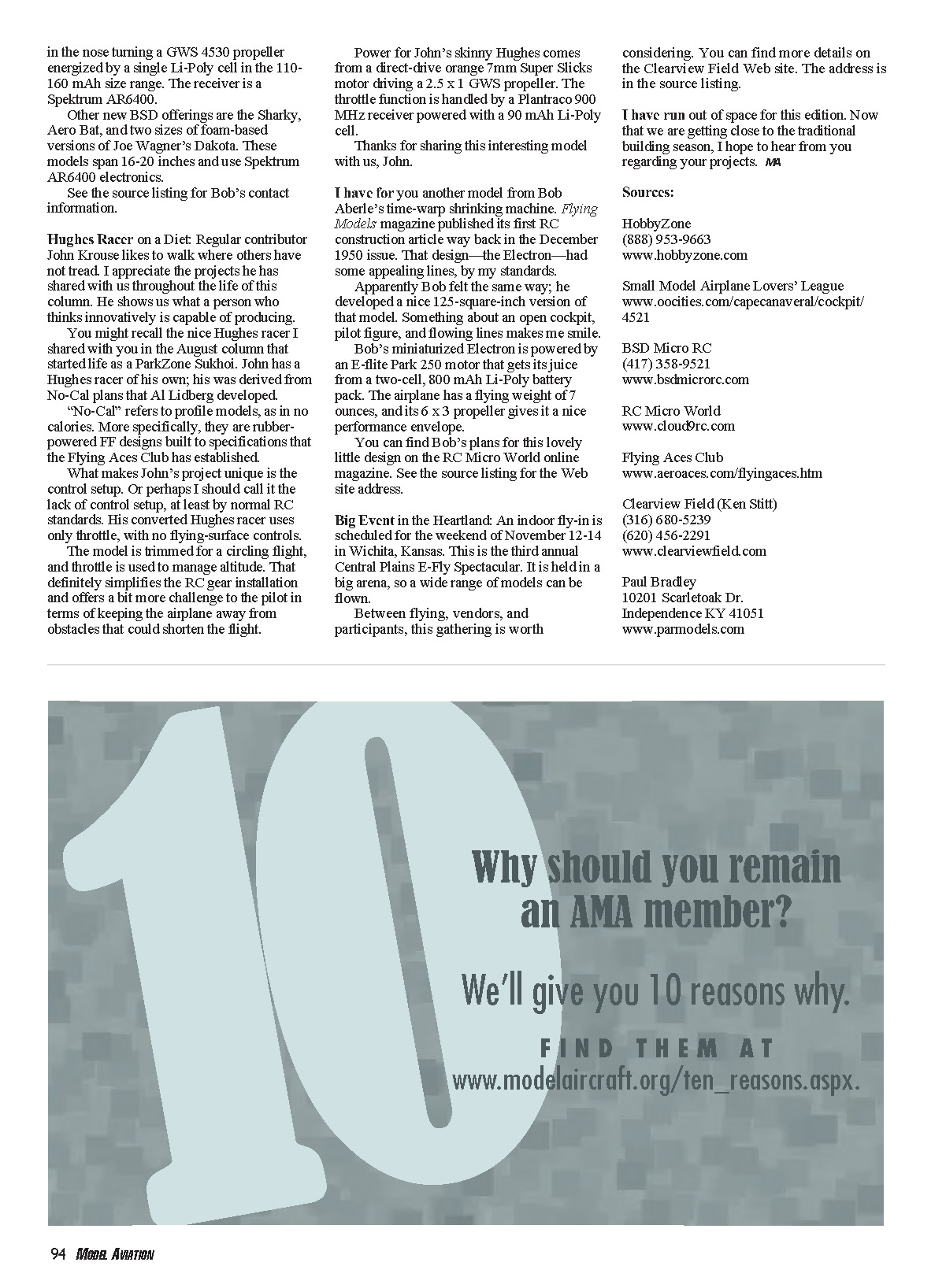
One of the many things I love about attending the SMALL gathering each year is the range of models. There are so many fantastic aircraft that it is normally hard to flag one or two for special mention. A design that caught my attention this year (as well as that of other attendees) was Thomas Blakeney’s beautiful scratch-built Russian Beriev Be-200.
This unique multifunction jet is capable of operating off water or land. It has been used as an airliner, for disaster relief, and as a fire bomber. You are unlikely to see one at your next model gathering.
Thomas did a wonderful job of reproducing the Beriev as an electric-ducted-fan model. It has a wingspan of slightly more than 39 inches and a flying weight of 18 ounces. Power is from two GWS EDF-40 fan units driven by Feigao 25-turn brushless motors.
Color and markings are of the prototype full-scale Be-200. Construction is all balsa and light plywood.
Thomas noted that he did not draw true plans; he made sketches from a three-view that were sufficient to allow him to build the model. The Beriev demonstrated great flying qualities during the SMALL event. Extremely well done, Thomas.
The 2010 SMALL gathering was enhanced with two evenings of indoor flying. This made it possible for early- and late-arriving attendees to enjoy that aspect of the venue.
As in recent years, Bob Selman of BSD Micro RC and his fellow travelers had a large fleet of indoor-compatible aircraft. I use the term "indoor compatible," because most of his airplanes are good for outdoor flying as well as for indoor.
Bob had several prototypes for new kits. In a photo you will see him holding the 18-inch-span Zipp.
Ken Spenser and George Harris designed the jaunty-looking sport model. It flies extraordinarily well with an AP03-4000 brushless motor in the nose turning a GWS 4530 propeller, energized by a single Li-Poly cell in the 110–160 mAh size range. The receiver is a Spektrum AR6400.
Other new BSD offerings are the Sharky, Aero Bat, and two sizes of foam-based versions of Joe Wagner's Dakota. These models span 16–20 inches and use Spektrum AR6400 electronics.
See the source listing for Bob's contact information.
Hughes Racer on a Diet
Regular contributor John Krouse likes to walk where others have not tread. I appreciate the projects he has shared with us throughout the life of this column. He shows us what a person who thinks innovatively is capable of producing.
You might recall the nice Hughes racer I shared with you in the August column that started life as a ParkZone Sukhoi. John has a Hughes racer of his own; his was derived from No-Cal plans that Al Lidberg developed.
"No-Cal" refers to profile models, as in no calories. More specifically, they are rubber-powered FF designs built to specifications that the Flying Aces Club has established.
What makes John's project unique is the control setup. Or perhaps I should call it the lack of a control setup, at least by normal RC standards. His converted Hughes racer uses only throttle, with no flying-surface controls.
The model is trimmed for a circling flight, and throttle is used to manage altitude. That definitely simplifies the RC gear installation and offers a bit more challenge to the pilot in terms of keeping the airplane away from obstacles that could shorten the flight.
Power for John's skinny Hughes comes from a direct-drive orange 7mm Super Slicks motor driving a 2.5 x 1 GWS propeller. The throttle function is handled by a Plantraco 900 MHz receiver powered with a 90 mAh Li-Poly cell.
Thanks for sharing this interesting model with us, John.
I have for you another model from Bob Aberle's time-warp shrinking machine. Flying Models magazine published its first RC construction article way back in the December 1950 issue. That design—the Electron—had some appealing lines, by my standards.
Apparently Bob felt the same way; he developed a nice 125-square-inch version of that model. Something about an open cockpit, pilot figure, and flowing lines makes me smile.
Bob's miniaturized Electron is powered by an E-flite Park 250 motor that gets its juice from a two-cell, 800 mAh Li-Poly battery pack. The airplane has a flying weight of 7 ounces, and its 6 x 3 propeller gives it a nice performance envelope.
You can find Bob's plans for this lovely little design on the RC Micro World online magazine. See the source listing for the Web site address.
Big Event in the Heartland
An indoor fly-in is scheduled for the weekend of November 12–14 in Wichita, Kansas. This is the third annual Central Plains E-Fly Spectacular. It is held in a big arena, so a wide range of models can be flown.
Between flying, vendors, and participants, this gathering is worth considering. You can find more details on the Clearview Field Web site. The address is in the source listing.
I have run out of space for this edition. Now that we are getting close to the traditional building season, I hope to hear from you regarding your projects.
PB
Sources
- HobbyZone — (888) 953-9663 — www.hobbyzone.com
- Small Model Airplane Lovers' League — www.oocities.com/capecanaveral/cockpit/4521
- BSD Micro RC — (417) 358-9521 — www.bsdmicrorc.com
- RC Micro World — www.cloud9rc.com
- Flying Aces Club — www.aeroaces.com/flyingaces.htm
- Clearview Field (Ken Stitt) — (316) 680-5239 / (620) 456-2291 — www.clearviewfield.com
- Paul Bradley — 10201 Scarlet Oak Dr., Independence, KY 41051 — www.parmodels.com
Transcribed from original scans by AI. Minor OCR errors may remain.

