
Small-Field Flying - 2011/04
Paul Bradley | [email protected]
A 60-inch-span Pilatus Porter from Pat Tritle
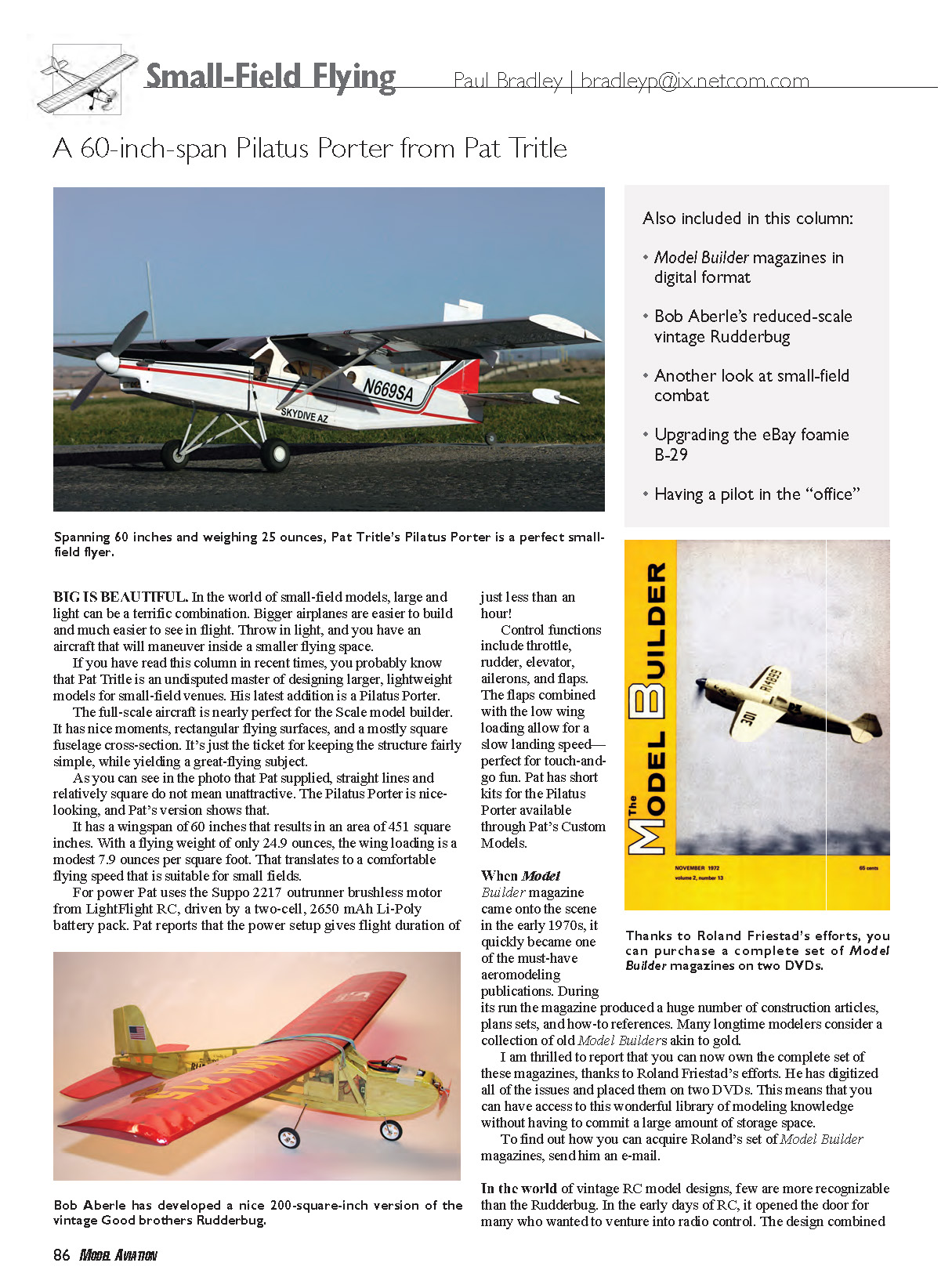
BIG IS BEAUTIFUL. In the world of small-field models, large and light can be a terrific combination. Bigger airplanes are easier to build and much easier to see in flight. Throw in light, and you have an aircraft that will maneuver inside a smaller flying space.
If you have read this column in recent times, you probably know that Pat Tritle is an undisputed master of designing larger, lightweight models for small-field venues. His latest addition is a Pilatus Porter.
The full-scale aircraft is nearly perfect for the scale model builder. It has nice moments, rectangular flying surfaces, and a mostly square fuselage cross-section. It's just the ticket for keeping the structure fairly simple, while yielding a great-flying subject.
As you can see in the photo that Pat supplied, straight lines and relatively square do not mean unattractive. The Pilatus Porter is nice-looking, and Pat's version shows that.
It has a wingspan of 60 inches that results in an area of 451 square inches. With a flying weight of only 24.9 ounces, the wing loading is a modest 7.9 ounces per square foot. That translates to a comfortable flying speed that is suitable for small fields.
For power Pat uses the Suppo 2217 outrunner brushless motor from LightFlight RC, driven by a two-cell, 2650 mAh Li-Poly battery pack. Pat reports that the power setup gives flight duration of just less than an hour!
Control functions include throttle, rudder, elevator, ailerons, and flaps. The flaps combined with the low wing loading allow for a slow landing speed—perfect for touch-and-go fun. Pat has short kits for the Pilatus Porter available through Pat's Custom Models.
When Model Builder magazine came onto the scene in the early 1970s, it quickly became one of the must-have aeromodeling publications. During its run the magazine produced a huge number of construction articles, plan sets, and how-to references. Many longtime modelers consider a collection of old Model Builder magazines akin to gold. I am thrilled to report that you can now own the complete set of these magazines, thanks to Roland Friestad's efforts. He has digitized all of the issues and placed them on two DVDs. This means that you can have access to this wonderful library of modeling knowledge without having to commit a large amount of storage space. To find out how you can acquire Roland's set of Model Builder magazines, send him an e-mail.
In the world of vintage RC model designs, few are more recognizable than the Rudderbug. In the early days of RC, it opened the door for many who wanted to venture into radio control. The design combined the lessons learned from flying free-flight airplanes with the RC gear of the day to produce a successful aircraft that could be controlled from the ground.
Bob Aberle has been rendering the foundation models of early RC in reduced-scale versions suitable for small-field flying. His Rudderbug has a wing area of 200 square inches and a flying weight of 7 ounces.
You can see from the photo that Bob provided that the model’s construction follows the original layout, using balsa and plywood. Control functions include throttle, rudder, and elevator.
Power is supplied by a Stevens AeroModel SA Sport BL-300 1400 kV brushless outrunner motor and a two-cell, 800 mAh Li-Poly battery pack. Bob reports that the design flies great.
Plans and a construction article for Bob’s Rudderbug can be found online at RC Micro World.
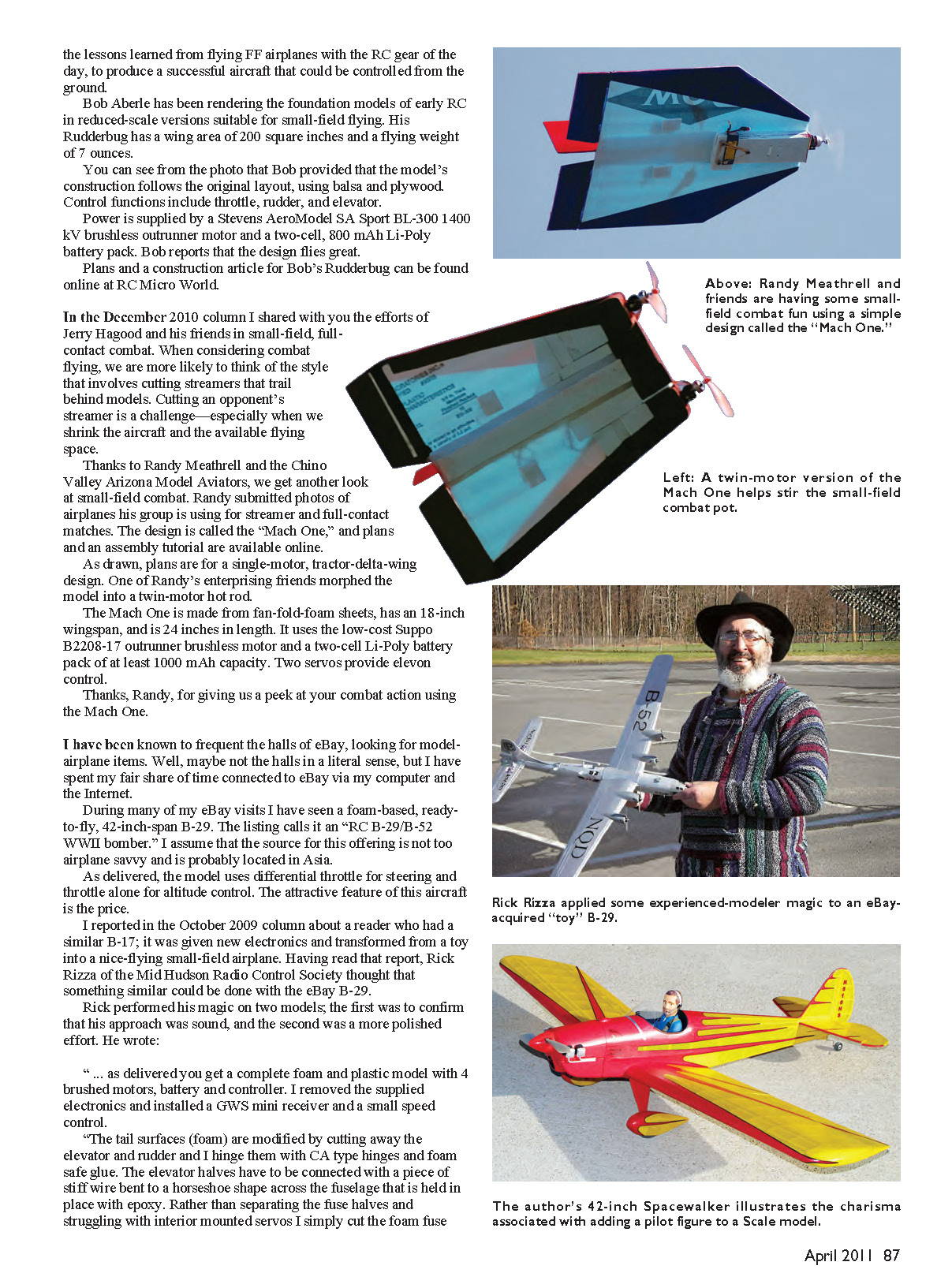
In the December 2010 column I shared with you the efforts of Jerry Hagood and his friends in small-field, full-contact combat. When considering combat flying, we are more likely to think of the style that involves cutting streamers that trail behind models. Cutting an opponent’s streamer is a challenge—especially when we shrink the aircraft and the available flying space.
Thanks to Randy Meathrell and the Chino Valley Arizona Model Aviators, we get another look at small-field combat. Randy submitted photos of airplanes his group is using for streamer and full-contact matches. The design is called the “Mach One,” and plans and an assembly tutorial are available online.
As drawn, plans are for a single-motor, tractor-delta-wing design. One of Randy’s enterprising friends morphed the model into a twin-motor hot rod.
The Mach One is made from fan-fold-foam sheets, has an 18-inch wingspan, and is 24 inches in length. It uses the low-cost Suppo B2208-17 outrunner brushless motor and a two-cell Li-Poly battery pack of at least 1000 mAh capacity. Two servos provide elevon control.
Thanks, Randy, for giving us a peek at your combat action using the Mach One.
I have been known to frequent the halls of eBay, looking for model-airplane items. Well, maybe not the halls in a literal sense, but I have spent my fair share of time connected to eBay via my computer and the Internet.
During many of my eBay visits I have seen a foam-based, ready-to-fly, 42-inch-span B-29. The listing calls it an “RC B-29/B-52 WWII bomber.” I assume that the source for this offering is not too airplane savvy and is probably located in Asia.
As delivered, the model uses differential throttle for steering and throttle alone for altitude control. The attractive feature of this aircraft is the price.
I reported in the October 2009 column about a reader who had a similar B-17; it was given new electronics and transformed from a toy into a nice-flying small-field airplane. Having read that report, Rick Rizza of the Mid Hudson Radio Control Society thought that something similar could be done with the eBay B-29.
Rick performed his magic on two models; the first was to confirm that his approach was sound, and the second was a more polished effort. He wrote:
"…as delivered you get a complete foam and plastic model with 4 brushed motors, battery and controller. I removed the supplied electronics and installed a GWS mini receiver and a small speed controller.
"The tail surfaces (foam) are modified by cutting away the elevator and rudder and I hinge them with CA type hinges and foam-safe glue. The elevator halves have to be connected with a piece of stiff wire bent to a horseshoe shape across the fuselage that is held in place with epoxy. Rather than separating the fuselage halves and struggling with interior-mounted servos I simply cut the foam fuselage along the back and installed them there with a touch of soft glue.
"The first one I built left the wheels off and was hand launched. For the second model I decided to install the wheels, including the non-steerable nose wheel, as I planned to mainly fly it off a paved school parking lot and I enjoy ROG. I found that if you taxi moderately fast the rudder effectively turns the model on the ground.
"In flight, the model is quite controllable. I had to add 2 ounces of lead to the nose to get a balance point around one-third back on the wings. Because it originated as a 2-channel model there is a fair amount of dihedral built in, and in flight the dihedral is enhanced so it is well suited to rudder-only yaw control.
"Four motors turning and burning is a lot of fun and it sounds great at the field."
Nice work, Rick. Having a good-flying B-29 in your stable must be fun.
Occupying the "Office" With a Pilot
Scale models are often built and flown without pilot figures in their cockpits. The main reason for this is the lack of lightweight figures in the proper sizes. It might not be a big deal to some, but, for me, having a pilot in a scale model adds much charisma.
Fortunately the small-field community has a great resource for pilot figures: Keith Sparks of Park Flyer Plastics. He has a huge variety of figures made from vacuum-formed plastic. They are light, look great, and come in so many sizes that one must be suitable for your model.
I have provided a photo of a 42-inch-wingspan Spacewalker that I completed. The pilot figure from Keith helps create the feel of a full-scale airplane.
As always, let me know what you are up to in the wonderful world of small-field flying. MA
Sources
- Pat's Custom Models (505) 296-4511 www.patscustom-models.com
- LightFlight RC www.lightflightrc.com
- RC Micro World plans: www.co-op-plans.info
- Roland Friestad [email protected]
- Stevens AeroModel (719) 387-4187 www.stevensaero.com
- Mach One http://bit.ly/hhX9Pj
- Park Flyer Plastics (817) 233-1215 http://parkflyerplastics.com
- Paul Bradley 10201 Scarloteak Dr. Independence KY 41051 www.parmodels.com
Transcribed from original scans by AI. Minor OCR errors may remain.

