
The 2011 SMALL fly-in: be there if you can
The SMALL Model Airplane Lovers’ League (SMALL) is holding its annual fly-in June 2–5 at the FARM (Fraternal Association of Radio Control Modelers) Club field, a few miles south of the Little Rock, Arkansas, airport. This is strictly a fun-fly and is always enjoyable.
The only restriction for participating is that your aircraft’s power source must not exceed the equivalent of a .26 two-stroke glow engine. Multiple engines/motors are allowed.
Gliders and rubber-powered models are welcome. All aspects of the hobby are represented, including RC, FF, and CL.
If you can travel to Little Rock for this gathering, I encourage you to do so. This is the 21st year the fly-in has been held. Dale Womack will be the event CD; his contact information is in the Sources listing.
Also included in this column:
- A Pilatus Porter goes from big to small
- Spektrum provides frequency-hopping options
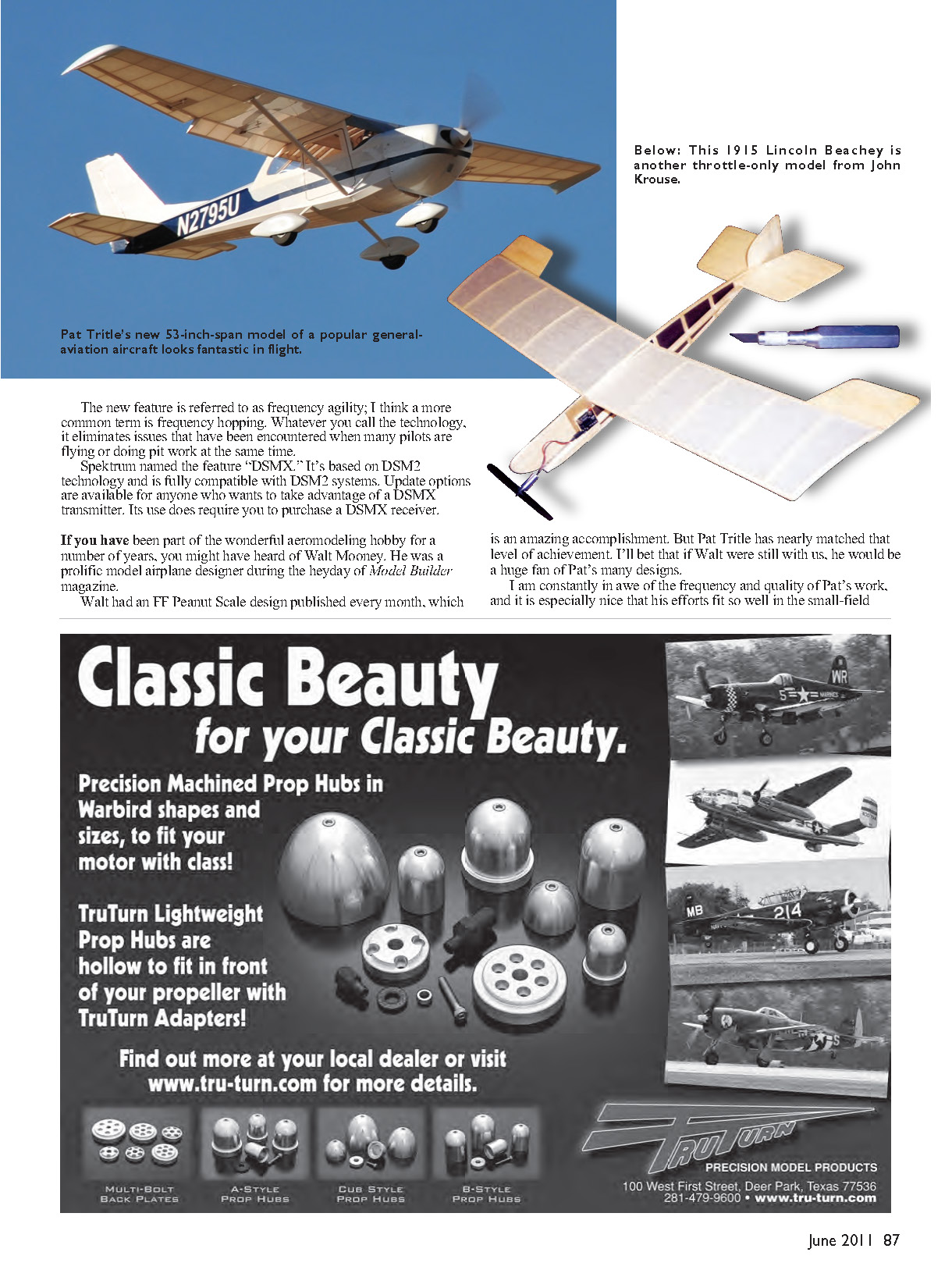
- New offerings from Pat Tritle
- Bill Bradley’s Fiat C.R.32 short kit
- John Krouse’s latest hangar addition
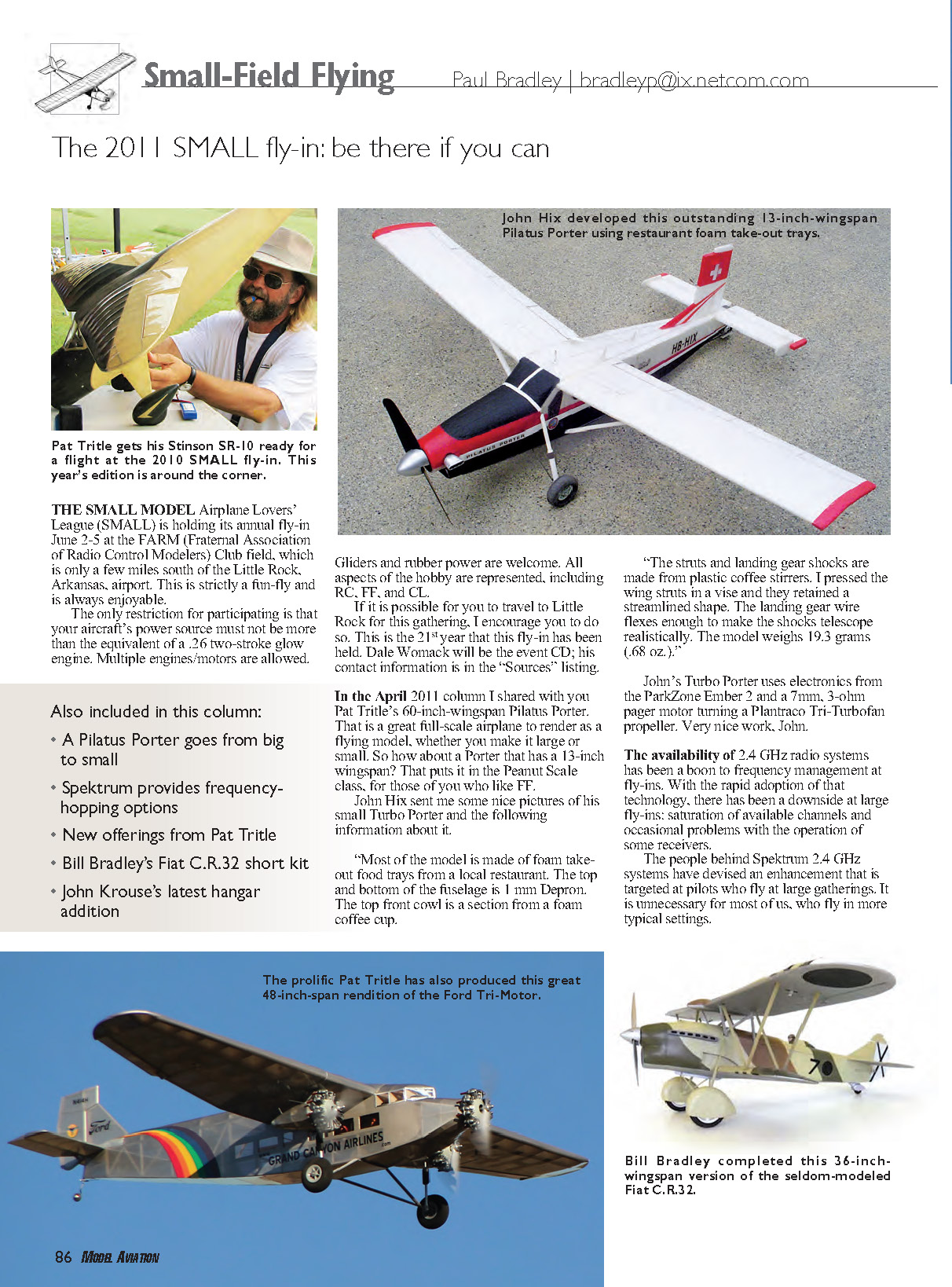
In the April 2011 column I shared Pat Tritle’s 60-inch-wingspan Pilatus Porter. That full-scale airplane makes a great flying model at many sizes. How about a Porter with a 13-inch wingspan? That puts it in the Peanut Scale class, popular with FF enthusiasts.
John Hix sent photos of his small Turbo Porter and the following notes:
"Most of the model is made of foam take-out food trays from a local restaurant. The top and bottom of the fuselage is 1 mm Depron. The top front cowl is a section from a foam coffee cup.
"The struts and landing gear shocks are made from plastic coffee stirrers. I pressed the wing struts in a vise and they retained a streamlined shape. The landing gear wire flexes enough to make the shocks telescope realistically. The model weighs 19.3 grams (0.68 oz.)."
John’s Turbo Porter uses electronics from the ParkZone Ember 2 and a 7 mm, 3-ohm pager motor turning a Plantraco Tri-Turbofan propeller. Very nice work.
The availability of 2.4 GHz radio systems has greatly improved frequency management at fly-ins. With rapid adoption, however, some large fly-ins have experienced channel saturation and occasional receiver problems.
Spektrum has devised an enhancement targeted at pilots who fly at large gatherings. Most fliers in typical settings won’t need it, but it can help where many pilots operate simultaneously. The feature is referred to as frequency agility (frequency hopping). Spektrum calls it DSMX. It’s based on DSM2 technology and is fully compatible with DSM2 systems. Update options are available for those who want a DSMX-capable transmitter, but use requires purchasing a DSMX receiver.
If you’ve been part of aeromodeling for years, you may remember Walt Mooney, a prolific designer during the heyday of Model Builder magazine. Walt published an FF Peanut Scale design every month, an amazing accomplishment. Pat Tritle has produced a similarly impressive cadence of designs, and I suspect Walt would have been a fan.
Pat has two new models to share this month that fit the small-field arena nicely.
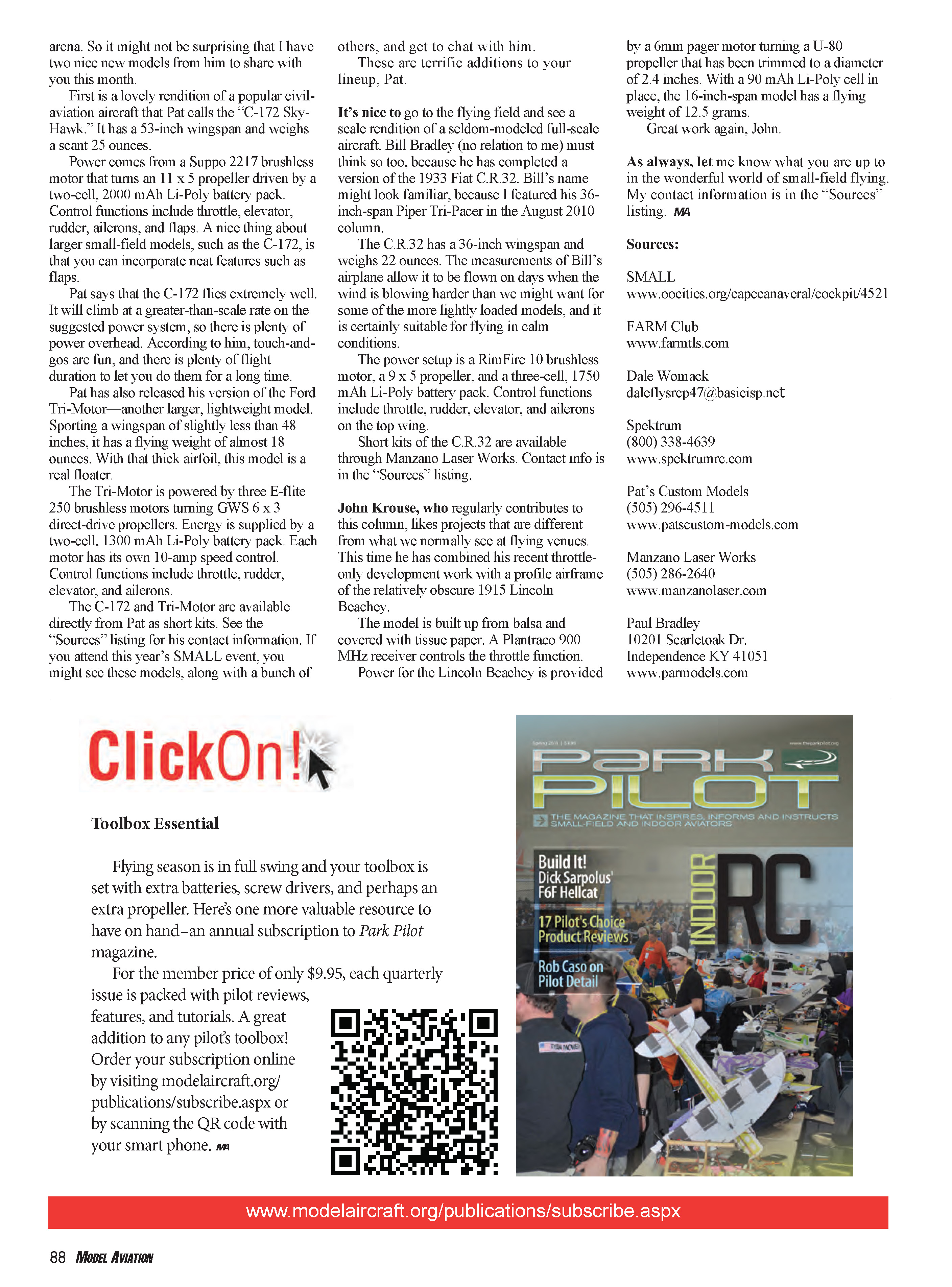
First is Pat’s rendition of the Cessna C-172 Skyhawk. It has a 53-inch wingspan and weighs about 25 ounces. Power is a Suppo 2217 brushless motor turning an 11x5 prop, driven by a two-cell 2000 mAh Li-Poly battery. Controls include throttle, elevator, rudder, ailerons, and flaps. The larger small-field size allows neat features such as flaps; Pat says the C-172 climbs at a greater-than-scale rate on the suggested power system, making touch-and-goes enjoyable with good duration.
Pat’s Ford Tri-Motor is another larger, lightweight model. It has a wingspan just under 48 inches and a flying weight of about 18 ounces. With its thick airfoil the Tri-Motor is a real floater. Power comes from three E-flite 250 brushless motors turning GWS 6x3 direct-drive props. Energy is supplied by a two-cell 1300 mAh Li-Poly pack; each motor uses its own 10-amp ESC. Controls include throttle, rudder, elevator, and ailerons. Both the C-172 and Tri-Motor are available as short kits from Pat. See the Sources listing for contact information.
Bill Bradley (no relation) has completed a version of the 1933 Fiat C.R.32. His C.R.32 has a 36-inch wingspan and weighs 22 ounces. The dimensions make it suitable for days with stronger winds as well as calm conditions. The power setup is a RimFire 10 brushless motor, a 9x5 prop, and a three-cell 1750 mAh Li-Poly battery. Controls include throttle, rudder, elevator, and ailerons on the top wing. Short kits of the C.R.32 are available from Manzano Laser Works.
Regular contributor John Krouse likes projects that are different from what we normally see. He combined recent throttle-only development work with a profile airframe of the relatively obscure 1915 Lincoln Beachey. The model is built from balsa and covered with tissue. A Plantraco 900 MHz receiver controls the throttle. Power is a 6 mm pager motor turning a U-80 prop trimmed to 2.4 inches in diameter. With a 90 mAh Li-Poly cell, the 16-inch-span model has a flying weight of 12.5 grams. Great work again, John.
As always, let me know what you’re up to in the wonderful world of small-field flying. My contact information is in the Sources listing.
MA
Sources
- SMALL: www.oocities.org/capecanaveral/cockpit/4521
- FARM Club: www.farmtls.com
- Dale Womack: [email protected]
- Spektrum: (800) 338-4639, www.spektrumrc.com
- Pat's Custom Models: (505) 296-4511, www.patscustom-models.com
- Manzano Laser Works: (505) 286-2640, www.manzanolaser.com
- Paul Bradley: 10201 Scarlet Oak Dr., Independence KY 41051, www.parmodels.com
Transcribed from original scans by AI. Minor OCR errors may remain.

