
SMALL 2012 continues its legacy as a fun gathering
Small Model Airplane Lovers League (SMALL) 2012 was a great gathering of people with perfect models for small fields. This issue's cover date suggests that the outdoor flying season is drawing to a close for many of us. This is a good time to reflect on the flying fun we had during the warm months of 2012.
One of the flying season's highlights is the annual SMALL gathering near Little Rock, Arkansas, in early June. This year's event was graced with nice weather—much cooler than the previous year, with manageable winds. The Fraternal Association of Radio Control Modelers (FARM) club did its usual outstanding job of hosting the event.
As in past years, I saw some great models that are in our wheelhouse for small-field flying. I can't begin to cover all of them, but I want to mention several.
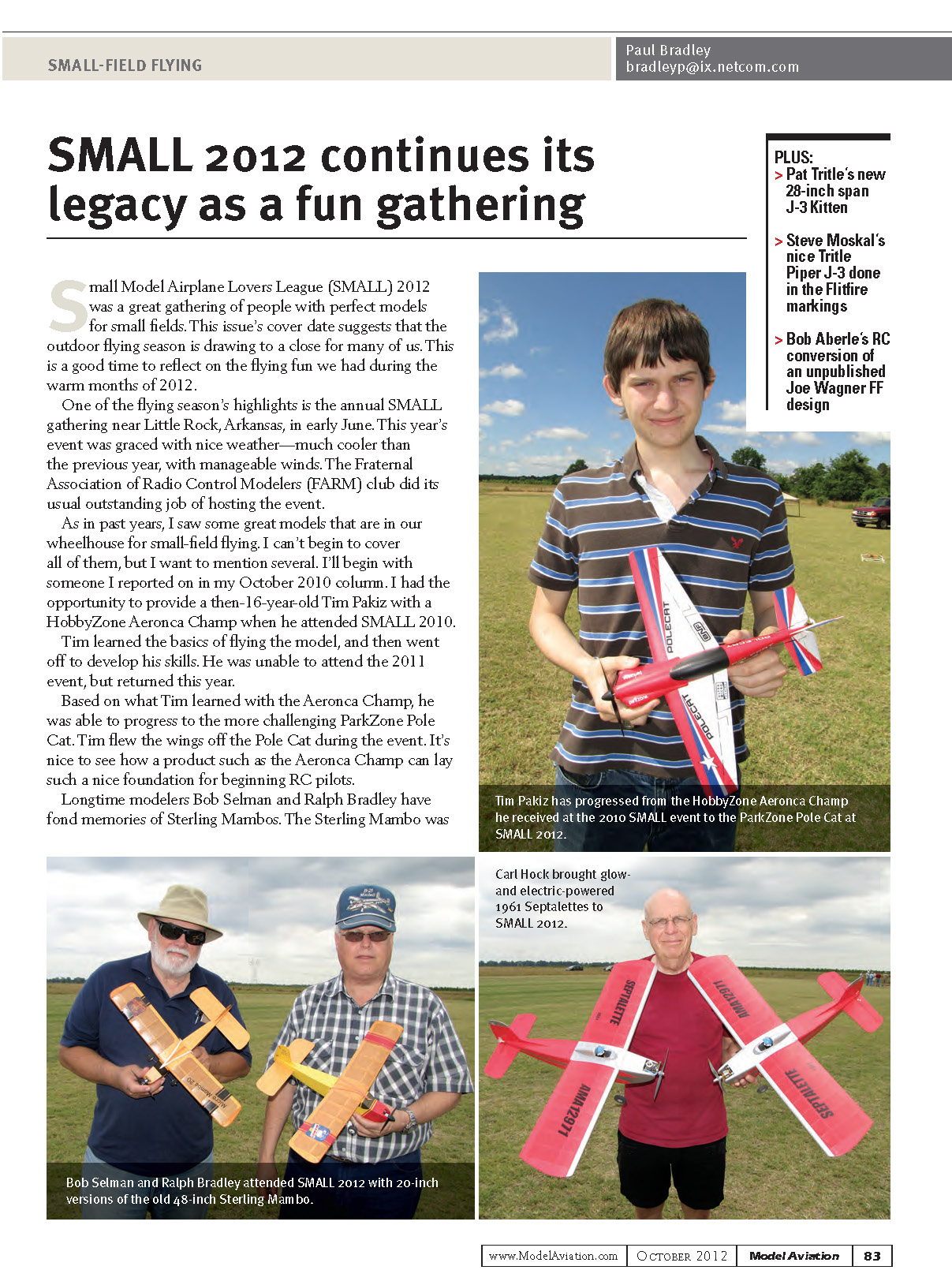
I had the opportunity to provide a then-16-year-old Tim Pakiz with a HobbyZone Aeronca Champ when he attended SMALL 2010. Tim learned the basics of flying the model, and then went off to develop his skills. He was unable to attend the 2011 event, but returned this year. Based on what Tim learned with the Aeronca Champ, he was able to progress to the more challenging ParkZone Pole Cat. Tim flew the wings off the Pole Cat during the event. It's nice to see how a product such as the Aeronca Champ can lay such a nice foundation for beginning RC pilots.
Micro Mambo
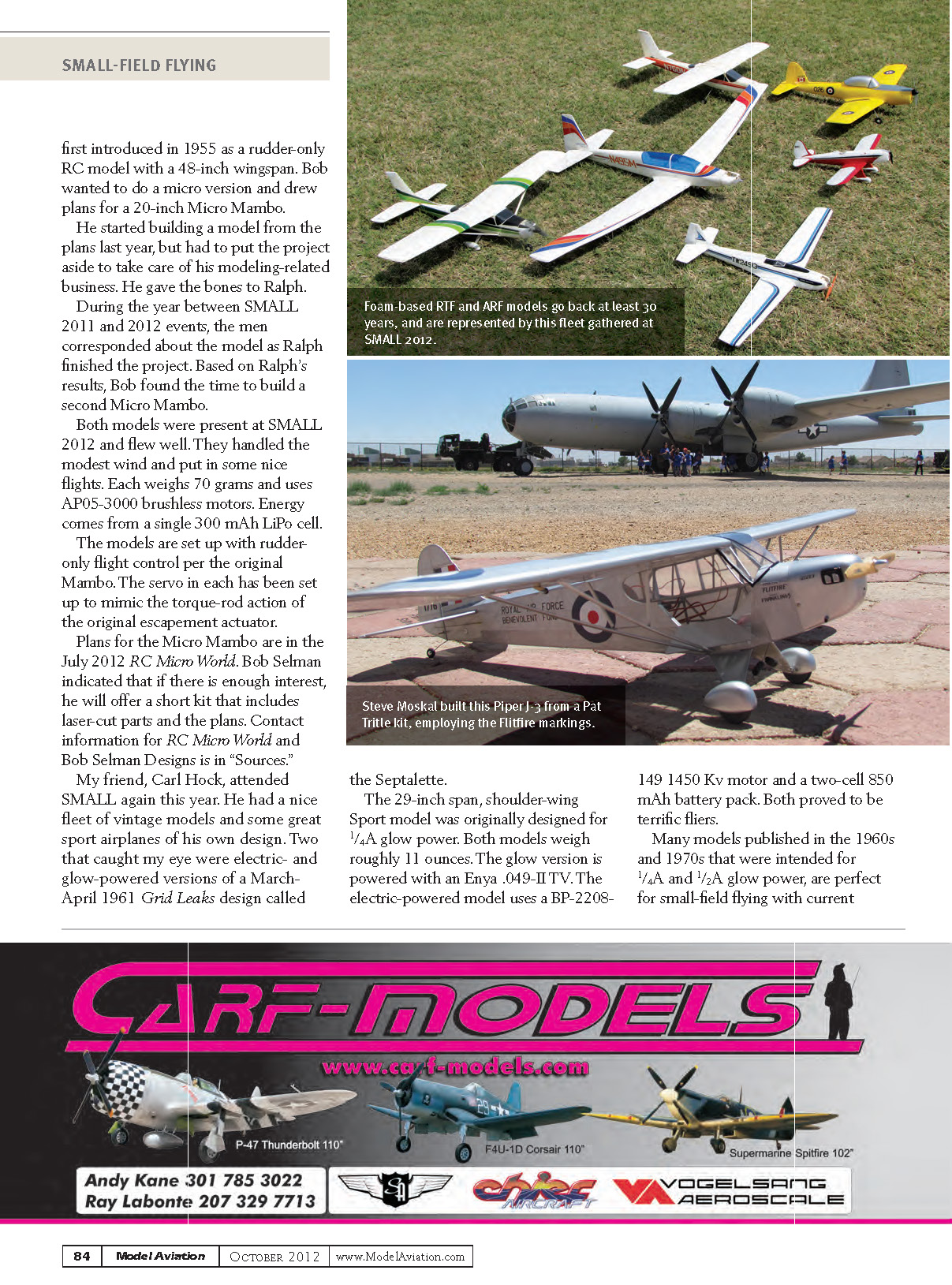
Longtime modelers Bob Selman and Ralph Bradley have fond memories of Sterling Mambos. The Sterling Mambo was first introduced in 1955 as a rudder-only RC model with a 48-inch wingspan. Bob wanted to do a micro version and drew plans for a 20-inch Micro Mambo. He started building a model from the plans last year but had to put the project aside to take care of his modeling-related business. He gave the bones to Ralph.
During the year between SMALL 2011 and 2012 events, the men corresponded about the model as Ralph finished the project. Based on Ralph’s results, Bob found the time to build a second Micro Mambo. Both models were present at SMALL 2012 and flew well. They handled the modest wind and put in some nice flights.
Each Micro Mambo weighs 70 grams and uses AP05-3000 brushless motors. Energy comes from a single 300 mAh LiPo cell. The models are set up with rudder-only flight control per the original Mambo. The servo in each has been set up to mimic the torque-rod action of the original escapement actuator.
Plans for the Micro Mambo are in the July 2012 RC Micro World. Bob Selman indicated that if there is enough interest, he will offer a short kit that includes laser-cut parts and the plans. Contact information for RC Micro World and Bob Selman Designs is in "Sources."
Vintage foam models
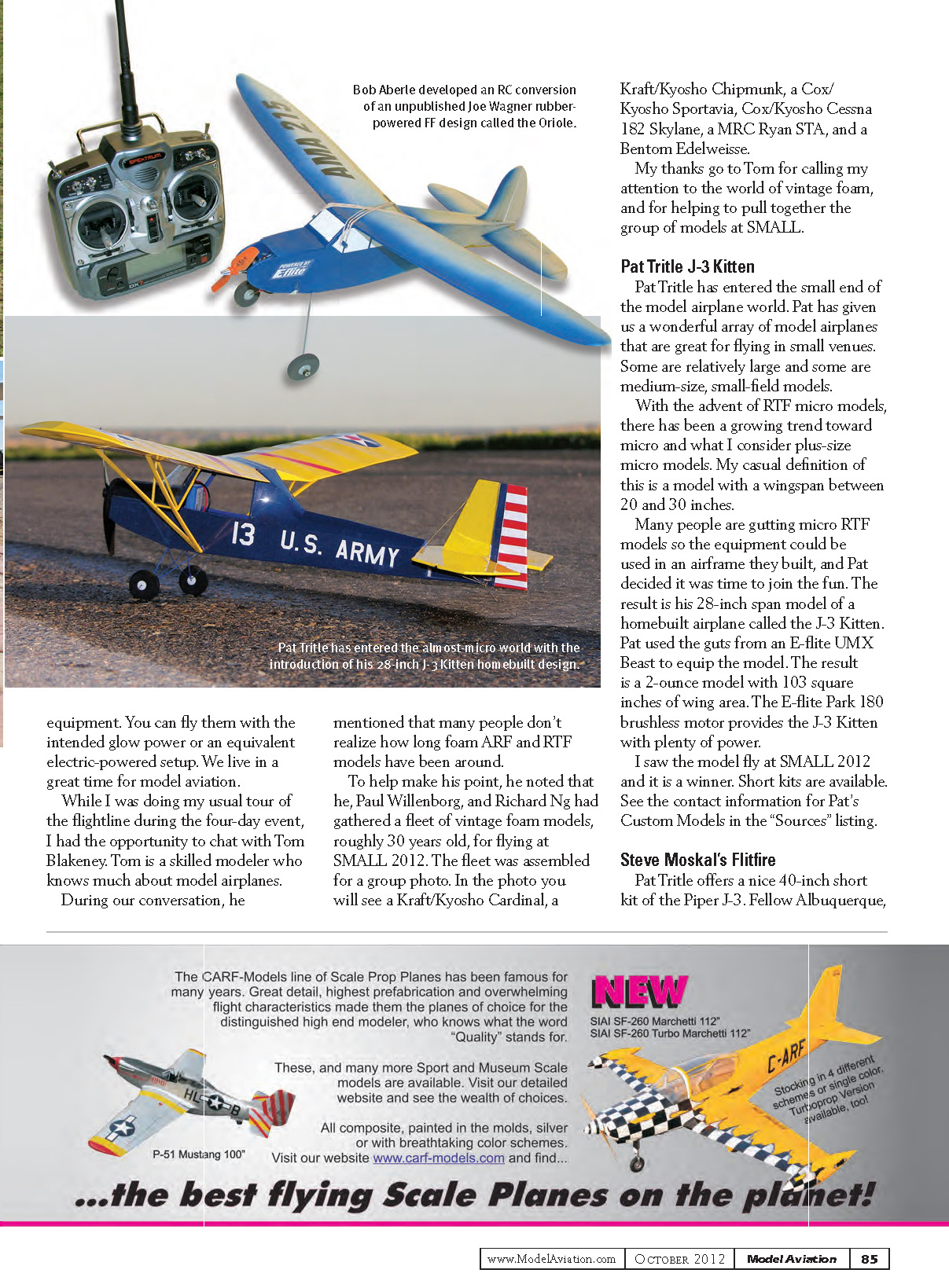
Many models published in the 1960s and 1970s that were intended for 1/4A and 1/2A glow power are perfect for small-field flying with current equipment. You can fly them with the intended glow power or an equivalent electric setup. We live in a great time for model aviation.
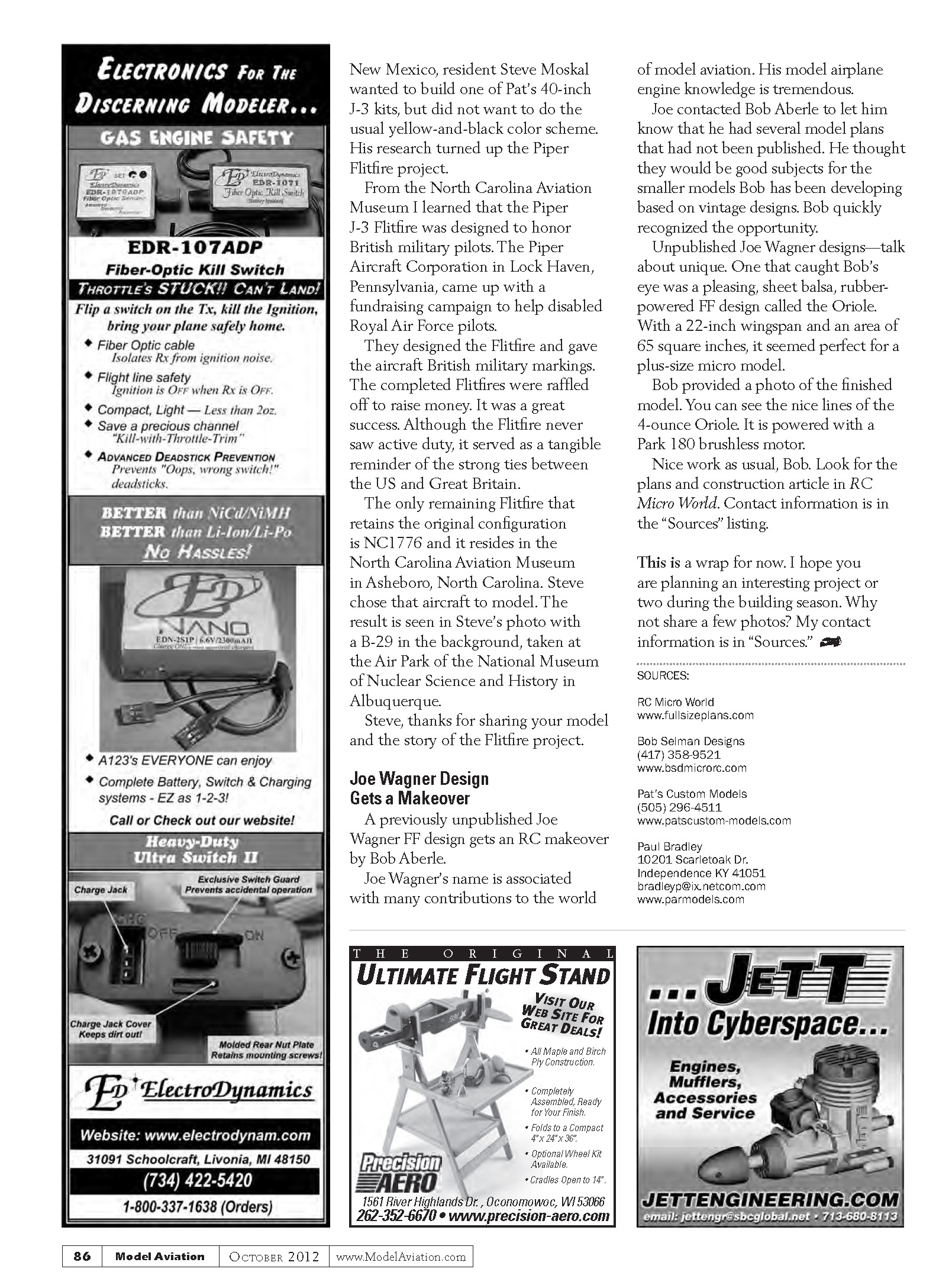
While I was doing my usual tour of the flightline during the four-day event, I had the opportunity to chat with Tom Blakeney. Tom is a skilled modeler who knows much about model airplanes. During our conversation, he mentioned that many people don't realize how long foam ARF and RTF models have been around. To help make his point, he noted that he, Paul Willenborg, and Richard Ng had gathered a fleet of vintage foam models, roughly 30 years old, for flying at SMALL 2012. The fleet was assembled for a group photo and included:
- Kraft/Kyosho Cardinal
- Kraft/Kyosho Chipmunk
- Cox/Kyosho Sportavia
- Cox/Kyosho Cessna 182 Skylane
- MRC Ryan STA
- Benton Edelweisse
My thanks go to Tom for calling my attention to the world of vintage foam, and for helping to pull together the group of models at SMALL.
Pat Tritle J-3 Kitten
Pat Tritle has entered the small end of the model airplane world, offering a wonderful array of airplanes that are great for flying in small venues. Some are relatively large and some are medium-size, small-field models.
With the advent of RTF micro models, there has been a growing trend toward micro and what I consider plus-size micro models (casually defined as a model with a wingspan between 20 and 30 inches). Many people are gutting micro RTF models so the equipment can be used in an airframe they built, and Pat decided it was time to join the fun.
The result is his 28-inch-span model of a homebuilt airplane called the J-3 Kitten. Pat used the guts from an E-flite UMX Beast to equip the model. The result is a 2-ounce model with 103 square inches of wing area. The E-flite Park 180 brushless motor provides the J-3 Kitten with plenty of power. I saw the model fly at SMALL 2012 and it is a winner. Short kits are available. See the contact information for Pat's Custom Models in the "Sources" listing.
Steve Moskal's Flitfire
Pat Tritle also offers a nice 40-inch short kit of the Piper J-3. Fellow Albuquerque, New Mexico resident Steve Moskal wanted to build one of Pat's 40-inch J-3 kits, but did not want to do the usual yellow-and-black color scheme. His research turned up the Piper Flitfire project.
From the North Carolina Aviation Museum I learned that the Piper J-3 Flitfire was designed to honor British military pilots. The Piper Aircraft Corporation in Lock Haven, Pennsylvania, came up with a fundraising campaign to help disabled Royal Air Force pilots. They designed the Flitfire and gave the aircraft British military markings. The completed Flitfires were raffled off to raise money. Although the Flitfire never saw active duty, it served as a tangible reminder of the strong ties between the U.S. and Great Britain.
The only remaining Flitfire that retains the original configuration is NC1776 and it resides in the North Carolina Aviation Museum in Asheboro, North Carolina. Steve chose that aircraft to model. The result is seen in Steve's photo with a B-29 in the background, taken at the Air Park of the National Museum of Nuclear Science and History in Albuquerque. Steve, thanks for sharing your model and the story of the Flitfire project.
Joe Wagner design gets a makeover
A previously unpublished Joe Wagner free-flight design gets an RC makeover by Bob Aberle.
Joe Wagner's name is associated with many contributions to the world of model aviation. His model airplane engine knowledge is tremendous. Joe contacted Bob Aberle to let him know that he had several model plans that had not been published. He thought they would be good subjects for the smaller models Bob has been developing based on vintage designs. Bob quickly recognized the opportunity.
One unpublished Joe Wagner design that caught Bob's eye was a pleasing sheet-balsa, rubber-powered free-flight design called the Oriole. With a 22-inch wingspan and an area of 65 square inches, it seemed perfect for a plus-size micro model. Bob provided a photo of the finished model. You can see the nice lines of the 4-ounce Oriole. It is powered with a Park 180 brushless motor. Look for the plans and a construction article in RC Micro World. Contact information is in the "Sources" listing.
This is a wrap for now. I hope you are planning an interesting project or two during the building season. Why not share a few photos? My contact information is in "Sources."
SOURCES
- RC Micro World
- Bob Selman Designs
(417) 358-9521 www.bsdmicrorc.com
- Pat's Custom Models
(505) 296-4511 www.patscustom-models.com
- Paul Bradley
10201 Scarletoak Dr. Independence KY 41051 [email protected] www.parmodels.com
Transcribed from original scans by AI. Minor OCR errors may remain.

