
Small-Field Flying
51 Blvd. des Allies, Quebec, QC G1L 1Y3, Canada; E-mail: [email protected]
THIS WOULD be a dull world if people were to think twice before speaking their minds. Frank Zaic
I'm sure Frank wasn't referring to Dale Singleton when he spoke this month's quote, but I sure thought of Frank's statement when I read Dale's letter in the February Model Aviation.
Dale made some good points in that letter, but all of those good points faded into the background when he wrote, "The fact that they are Electric hides their existence from serious modelers."
For purposes of enlightenment and for those who believe that one must build large and powerful models to be "serious modelers," it just ain't so, and nothing but bad feelings are gained by suggesting otherwise.
As a serious modeler, I tried hard to overlook Dale's statement and read the rest of what he wrote.
He identified a problem that those of us who fly outside formal flying fields need to think about. It's a problem worthy of discussion among those of us who like the freedom to fly at informal fields.
Whether we are at formal flying fields or not, being concerned and prudent about frequency use is no less an issue to be taken lightly.
Frequency awareness and small-field flying
For those of us scouting schools and parks as prospective flying sites, it's a really good idea to determine the locations of formal flying fields in that area. If there is one within a couple miles, find another prospective site.
Remember that interference is a two-way street; you can be shot down just as easily as you can shoot down others, and either way it leads to unhappy modelers and unsafe flying.
Presuming you know there is no formal flying field nearby, use your newfound site but don't stop thinking about the possibility of interference. There may be someone flying at that school down the street, or maybe in the gymnasium on the other side of that field.
How would you know?
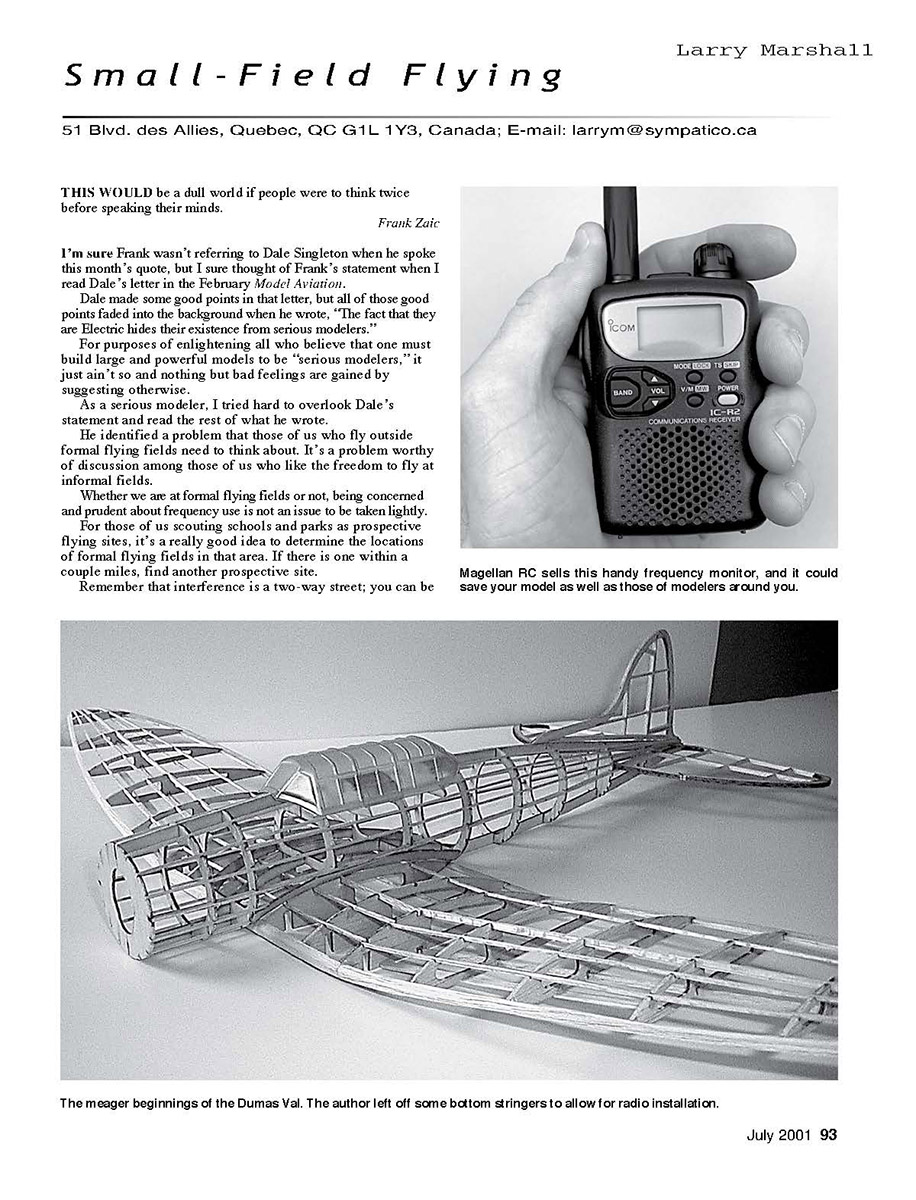
One way is to use a frequency monitor before you turn on your transmitter. Magellan RC sells a dandy monitor, which is the best insurance policy you'll ever buy for your model airplanes. This monitor is capable of scanning all legitimate Radio Control (RC) aircraft frequencies, and it's simple to use. You can contact Magellan RC at www.magtechinc.com.
If you don't have a frequency monitor, use your model's receiver as a monitor. This is certainly not ideal; if you do use it, be prepared for the motor to come on. This isn't a perfect solution, and some receivers will send your servos to their limits. But if your receiver is cooperative, you can at least do this cursory check before turning on your transmitter.
When flying from a small field, don't fly your model very far away. The farther you fly, the closer you may be to a potential interfering signal from somebody else.
If you keep your model over the field you're flying from, it's less likely that a failure of any kind will result in your model falling somewhere you'd rather not have it fall.
Small-model flying hasn't created interference problems; these difficulties have existed for a very long time. Nor is off-field flying by the ill-informed a new phenomenon. I remember two guys who decided that the school parking lot was a great place to learn how to fly—with their .40-size trainer.
Although we haven't created these problems, small-field fliers can certainly make them worse—or better, by flying prudently at our small fields and helping to educate those who join us there.
Converting Free Flight (FF) models
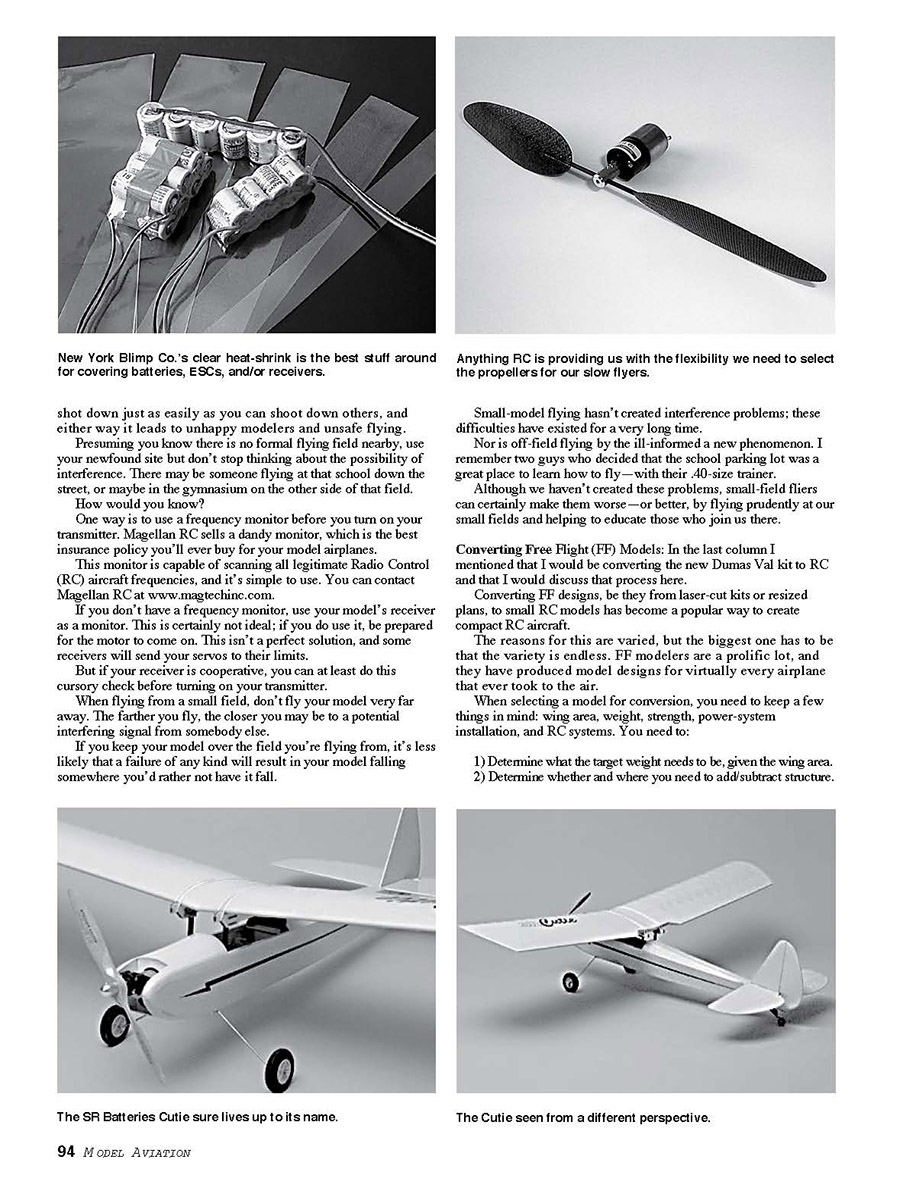
In the last column I mentioned that I would be converting the new Dumas Val kit to RC and that I would discuss that process here.
Converting FF designs, be they from laser-cut kits or resized plans, to small RC models has become a popular way to create compact RC aircraft. The reasons for this are varied, but the biggest one has to be that the variety is endless. FF modelers are a prolific lot, and they have produced model designs for virtually every airplane that ever took to the air.
When selecting a model for conversion, you need to keep a few things in mind: wing area, weight, strength, power-system installation, and RC systems. You need to:
- Determine what the target weight needs to be, given the wing area.
- Determine whether and where you need to add/subtract structure.
The wheel pant and nose pieces weigh 403 grams, so I've got 80 grams to work with to finish it up.
Next time I'll get into the actual building.
Cable's heat-shrink tubing
Cable Baitian of the New York Blimp Co. has been selling clear heat-shrink tubing for some time. I'd used clear heat-shrink tubing before, and I didn't see much of a change—until he sent me some.
Wow! The stuff is really nice. It's thinner and clearer than other clear heat-shrink I've seen, and Cable has it in really small sizes so you can even shrinkwrap sticks of 50 mAh cells if you want.
I've started reshrinking all of my small packs, and I will be using it on my ESCs and recessed receivers.
The New York Blimp Co. (www.nyblimp.com) will send you free samples if you send a self-addressed stamped envelope, but I recommend heading to the Web site and purchasing some in whatever sizes you need. On his site, Cable clearly describes what sizes are used for what cells.
Propellers / high-performance props
I have become frustrated by the lack of pitch in the props that we use for slow flyers.
We're starting to see more props come onto the market, but they all seem to be following the lead of the WES-Technik carbon-fiber props and provide diameter/pitch ratios that are less than 0.5. This makes little sense to me, given what we know about low-rpm prop dynamics from FF and Electric RC. There, diameter/pitch ratios from 0.8 to 1.3 are common.
There's one exception in this world of high-priced mass-produced props. A guy named Chris Ham and Carl Martin have done their homework—lots of homework—and they produce beautiful hex-cut fiberglass props with nicely machined prop hubs that fit just dandy on the front of a WES-Technik 24 or 17/7.
Their ready-made props have sufficient pitch to actually be efficient at lower voltages. Maybe best of all is that you can buy a nice hub/prop fixture from them, along with prop hubs and blades, and make propellers of whatever pitch you deem suitable.
Now, what's best of all is that their props sell for half the price of the carbon-fiber props on the market.
If you haven't checked out the Anything RC Web site (www.anythingrc.com), do so.
SR's new Cutie
In the 1970s Cox .049-powered models were very popular. One of the kits most often built was the Cutie, produced by Airtronics.
It was a simple plan and model, and it was a good subject for conversion to electric. I have fond memories of the days of my Q-Tee, which remains one of the biggest bang-for-the-buck models I've enjoyed in this hobby.
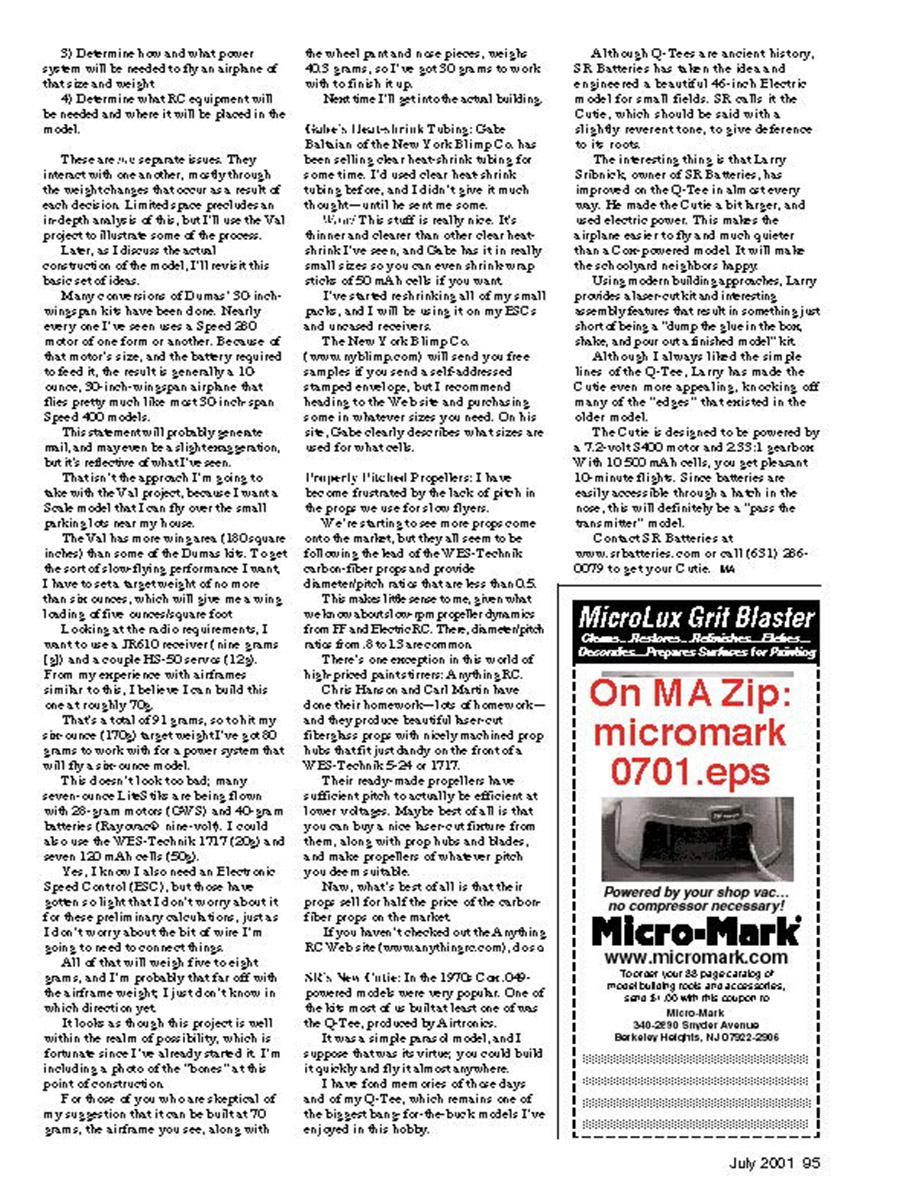
Although Q-Tees are ancient history, SR Batteries has taken the idea and engineered a beautiful 46-inch electric model for small fields. SR calls it the Cutie, which should be said with a slightly reverent tone, to give deference to its roots.
The interesting thing is that Larry Brixsch, owner of SR Batteries, has improved on the Q-Tee in a lot of ways. He made the Cutie a bit larger, and used electric power. This makes the airplane easier to fly and much quieter than a Cox-powered model. It will make the schoolyard neighbors happy also.
Using a modern build approach, Larry provides laser-cut kits and interesting assembly features that result in something just short of being a "dump-the-glue-in-the-box, shake, and pour out a finished model" kit.
Although I always liked the simple lines of the Q-Tee, Larry has made the Cutie even more appealing, knocking off many of the "edges" that existed in the older model.
The Cutie is designed to be powered by a 7.2-volt 540 motor and 2.35:1 gearbox. With a 1050 mAh cell, you get pleasant 10-minute flights. Since batteries are easily accessible through a hatch in the nose, this will definitely be a "pass the transmitter" model.
Contact SR Batteries at www.srbatteries.com or call (631) 286-0079 to get your Cutie.
Transcribed from original scans by AI. Minor OCR errors may remain.

