
Small-Field Flying
51 Blvd. des Allies, Quebec, QC G1L 1Y3, Canada; E-mail: [email protected]
WHEN YOU READ this it will be the beginning of fall, but I'm writing it in midsummer. I've just returned from attending the Kingston RC Electric meet (Kingston, Ontario) and the mid-America Electric meet (Livonia MI).
Flying season is in full swing, and there are lots of great things to talk about, so I'm going to postpone talking about finishing the Val project until next time.
BEC Cutoff Voltage: I've received several E-mails asking me about Battery Eliminator Circuit (BEC) and the associated feature that cuts the voltage to the motor at a particular voltage. First, let's be clear: they are different things.
The BEC taps 5 volts from the power-system battery for receiver and servo use. Most model-aircraft speed controls with BEC, and almost no Radio Control (RC) car ESCs, have a separate voltage cutoff circuit that prevents the battery from becoming so depleted that it can't supply power for the radio.
Typically, these circuits cut the voltage to the motor at roughly 5-5.5 volts. This was fine for flying 7-cell Ni-Cd packs, but these days we're flying models with Ni-Cds, NiMH, and Lithium cells and batteries composed of 3-10 cells (larger than that, and you should be using a separate receiver battery).
Our microreceivers will generally operate at voltages well below 5 volts, so sometimes we'd like the cutoff voltage to be near 3.5 volts. At other times, it's the battery itself that must be protected against overdischarging.
Tadiran lithium-metal batteries (3 volts per cell) need the BEC to shut down at approximately 2 volts per cell, or the cells will be destroyed. What's a guy to do?
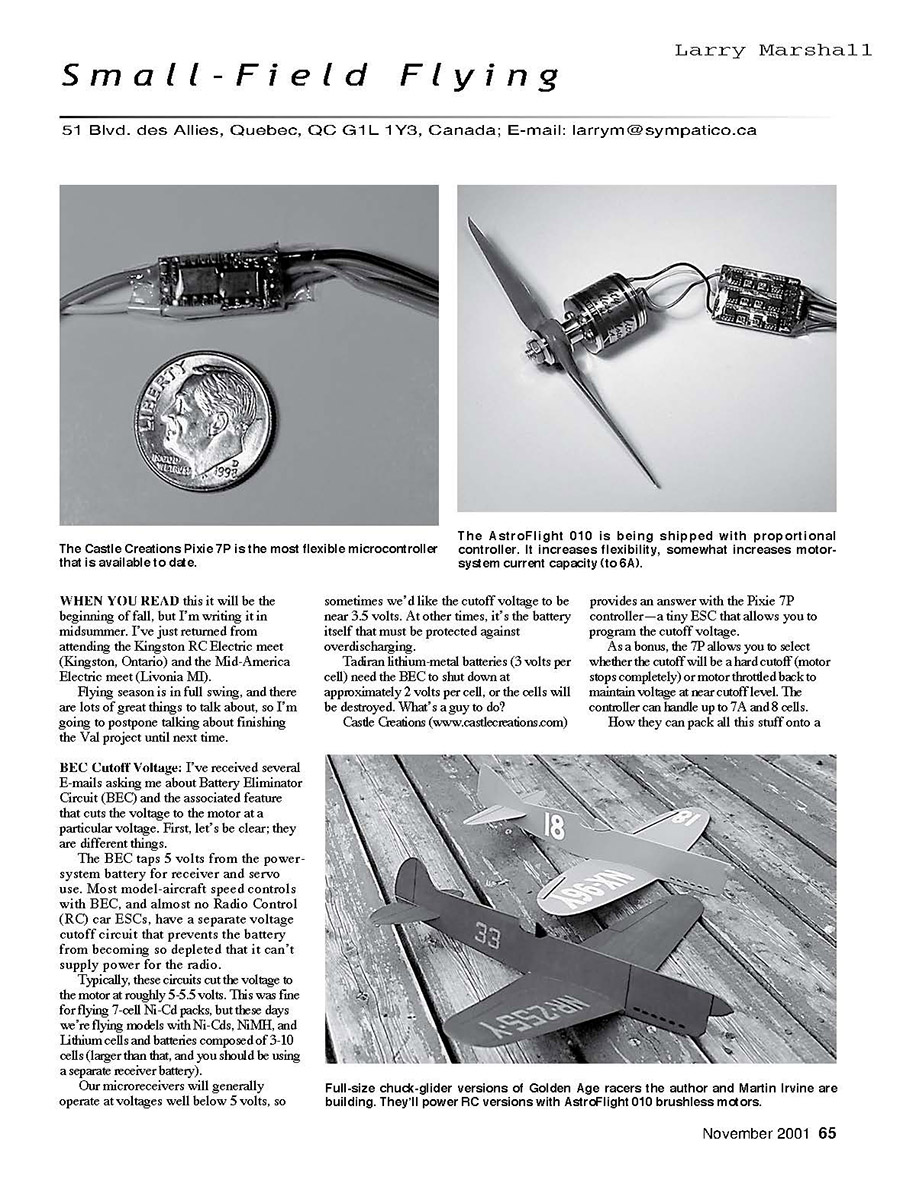
Castle Creations (www.castlecreations.com) provides an answer with the Pixie 7P controller — a tiny ESC that allows you to program the cutoff voltage.
As a bonus, the 7P allows you to select whether the cutoff will be a hard cutoff (motor stops completely) or motor throttled back to maintain voltage at near cutoff level. The controller can handle up to 7A and 8 cells.
How they can pack all this stuff onto a circuit board that would get lost under a dime is beyond me.
Higher-Capacity Cells: I tend to be pretty conservative in jumping on a new cell's bandwagon, but one of my favorite things to do is fly small, Speed 400-size warbirds, and sometimes duration is a problem when flying them with 600AE cells.
This becomes a tougher nut to crack when you replace the Speed 400 motor with an AstroFlight 020 brushless motor. Although the performance improves considerably, duration suffers, mostly because I can't bring myself to pull the left stick back when I'm zipping around doing the big maneuvers that the 020 allows.
I've been flying a 020-powered Ryan Bearcat (http://home.fuse.net/ryan/) and 7 600AE cells for a while, and it's a sweet combination with an all-up weight of 17.5 ounces.
I recently replaced the 600AE pack with a 7-1400AE pack. This increased the weight to 20 ounces, and the 020 doesn't even notice.
However, duration has increased from 4.5 minutes to 8 minutes. I do notice a bit more inertia on the backside of loops, and I suppose landing speed is a bit higher, but largely the airframe performs the same way it did with the lighter battery. I've been thrilled with the flight results.
What's a bit of a problem, though, is that the charge times, at a 2A charge rate, are long. The solution seems to be an "industrial" cell Sanyo produces for drills and such.
These have a very short, sub-C case and have a weight that is nearly the same as the 1400AE and 800AR cells and are designed to be rapid charged/discharged. With these I can charge at 4A (20-minute charge) and fly to my heart's content.
Another kind I've bought, but have yet to use, are the Panasonic 2000 NiMH cells. These are also smaller than a full sub-C cell and weigh a mere 40 grams. Replacing standard sub-C cells with these results in a loss of a half pound from a 14-cell airplane, so the weight savings is significant.
For many of the earlier-generation NiMH cells, we've experienced fairly fragile cells that required low charge rates and low current draws. This doesn't seem to be the case for these cells.
Some guys have been flying them for more than a year with as many as 100 flights on them without seeing any degradation in performance, even though they're charging at 4A and flying them at 20-30A. I'll be getting some into an airplane real soon.
I told you I was conservative about jumping on the new-cell bandwagon. Both of these cells are available from Ralph Weaver (www.magtechnic.net).
Golden-Age Racers: One of the best things about model aviation is a bull session where a group of modelers brainstorm about potential models.
Following the Kingston meet, I was part of one of those involving Martin Irvine (columnist for Electric Flight International) and Keith Shaw (clearly the king of Electrics).
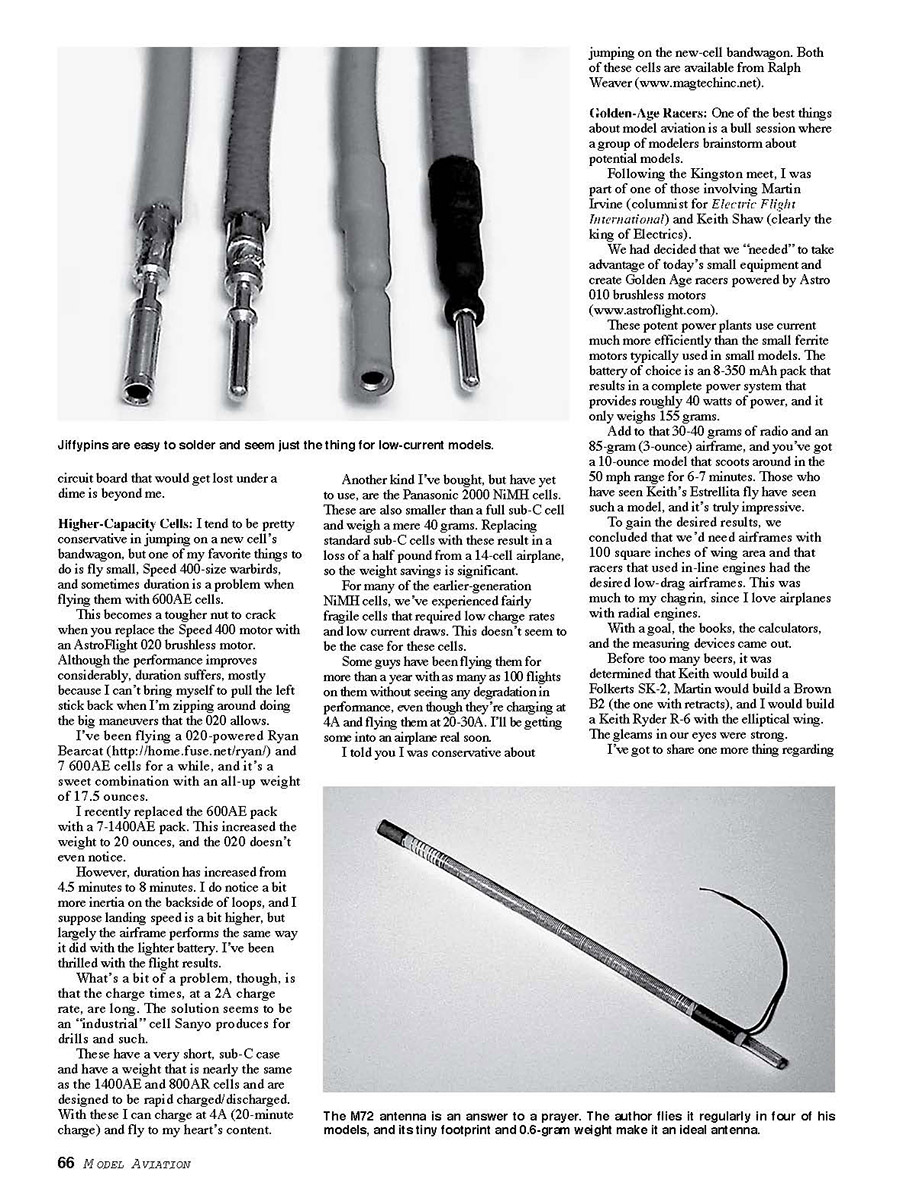
We had decided that we "needed" to take advantage of today's small equipment and create Golden Age racers powered by Astro 010 brushless motors (www.astroflight.com).
These potent power plants use current much more efficiently than the small ferrite motors typically used in small models. The battery of choice is an 8-350 mAh pack that results in a complete power system that provides roughly 40 watts of power, and it only weighs 15 grams.
Add to that 30-40 grams of radio and an 85-gram (3-ounce) airframe, and you've got a 10-ounce model that scoots around in the 50 mph range for 6-7 minutes. Those who have seen Keith's Estrellita fly have seen such a model, and it's truly impressive.
To gain the desired results, we concluded that we'd need airframes with 100 square inches of wing area and that racers that used in-line engines had the desired low-drag airframes. This was not to my chagrin, since I love airplanes with radial engines.
With a goal, the books, the calculators, and the measuring devices came out.
Before too many beers, it was determined that Keith would build a Folkerts SK-2, Martin would build a Brown B2 (the one with retracts), and I would build a Keith Ryder R-6 with the elliptical wing. The gleams in our eyes were strong.
I've got to share one more thing regarding this project. Possibly it admits some sort of pathology on my part, but I must confess. As Keith left the next morning, he joked with us, saying, "I expect to see those racers at Mid-America" (only three days away).
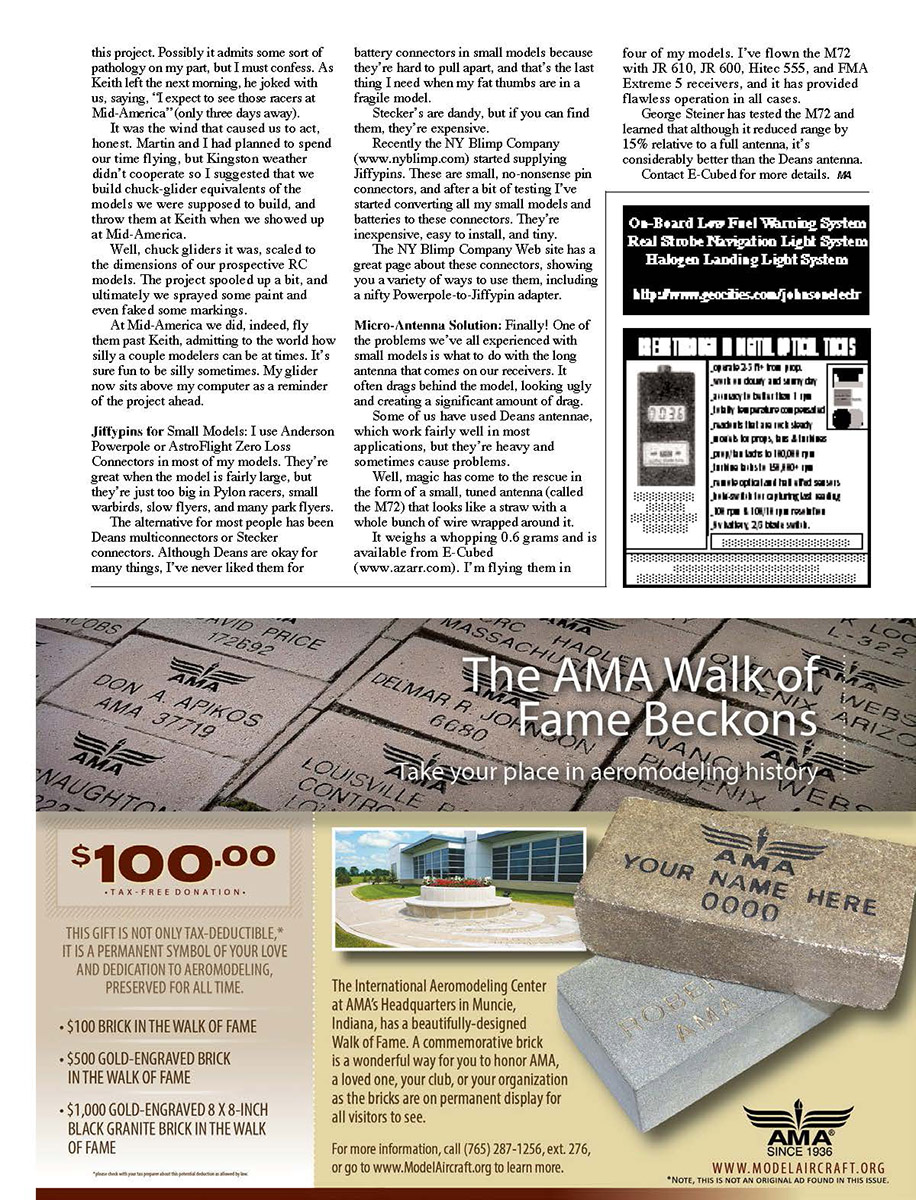
It was the wind that caused us to act, honest. Martin and I had planned to spend our time flying, but Kingston weather didn't cooperate so I suggested that we build chuck-glider equivalents of the model we were supposed to build, and throw them at Keith when we showed up at Mid-America.
Well, chuck gliders it was, scaled to the dimensions of our prospective RC models. The project spooled up a bit, and ultimately we sprayed some paint and even faked some markings.
At Mid-America we did, indeed, fly them past Keith, admitting to the world how silly a couple modelers can be at times. It's sure fun to be silly sometimes. My glider now sits above my computer as a reminder of the project ahead.
Jiffypins for Small Models: I use Anderson Powerpole or AstroFlight Zero Loss Connectors in most of my models. They're great when the model is fairly large, but they're just too big in Pylon racers, small warbirds, slow flyers, and many park fliers.
The alternative for most people has been Deans multicontactors or Stecker connectors. Although Deans are okay for many things, I've never liked them for battery connectors in small models because they're hard to pull apart, and that's the last thing I need when my fat thumbs are in a fragile model.
Stecker's are dandy, but if you can find them, they're expensive.
Recently the NY Blimp Company (www.nyblimp.com) started supplying Jiffypins. These are small, no-nonsense pin connectors, and after a bit of testing I've started converting all my small models and batteries to these connectors. They're inexpensive, easy to install, and tiny.
The NY Blimp Company Web site has a great page about these connectors, showing a variety of ways to use them, including a nifty Powerpole-to-Jiffypin adapter.
Micro-Antenna Solution: Finally! One of the problems we've all experienced with small models is what to do with the long antenna that comes on our receivers. It often drags behind the model, looking ugly and creating a significant amount of drag.
Some of us have used Deans antennae, which work fairly well in most applications, but they're heavy and sometimes cause problems.
Well, magic has come to the rescue in the form of a small, tuned antenna (called the M72) that looks like a straw with a bunch of wire wrapped around it. It weighs a whopping 0.6 grams and is available from E-Cubed (www.azarr.com). I'm flying them in four of my models. I've flown the M72 with JR 610, JR 600, Hitec 555, and FMA Extreme 5 receivers, and it has provided flawless operation in all cases.
George Steiner has tested the M72 and learned that although it reduced range by 15% relative to a full antenna, it's considerably better than the Deans antenna.
Contact E-Cubed for more details. MA
Transcribed from original scans by AI. Minor OCR errors may remain.

