
Small-Field Flying
Larry Marshall
51 Blvd. des Allies, Quebec, QC G1L 1Y3, Canada; E-mail: [email protected]
"THE ONLY way to have a friend is to be one." Ralph Waldo Emerson
Here are some interesting facts. In the past 25 years, the number of people attending club meetings of any kind has declined by 58%. At the same time, joining one club cuts your chance of dying next year in half.
So what has that got to do with model aviation, you ask? Well, maybe nothing. Then again, maybe everything.
My mail contains a lot of interesting information from a lot of interesting people (keep 'em coming). One group of those people are telling me how much they enjoy flying park flyers "because" they don't have to join a club.
Another group of people are telling me that the reason clubs are in decline is that people are flying park flyers.
If nothing else, these two groups have identified a potential problem for model aviation, as clubs form the backbone of our recruitment activities.
Further, one of the most important things that keeps people in model aviation is the social aspect of building and flying model airplanes with friends, so these are important observations for the future of model aviation.
So what do we do about this "park flyer problem"? Some suggest that we shouldn't promote park flyers. Others want to have competitions for park flyers.
I'm here to tell you that this phenomenon has nothing to do with park flyers. Park flyers are merely the way in which some people, who are part of a much larger social trend, are enjoying model airplanes. It's that social trend that we need to address — not park flyers.
Do I have any evidence for this view? Sure, though the evidence is largely not my own. Much has been written about this trend by people who study such things.
One author, Robert Putnam, wrote a book called Bowling Alone, which describes the decline of the "social fabric" (translation: all the minicommunication networks our society relies upon) of our society.
Robert documents how people are joining fewer organizations, know their neighbors less, and interact with friends less often.
Bowling Alone gets its name from the fact that more people are bowling than ever before, yet fewer people are bowling in leagues than ever before.
This seems far removed from park flyers, but it's the same phenomenon we're seeing in model aviation. We've got many people coming into the hobby and flying by themselves.
So what, if anything, do we do about it? Isn't trying to change how society works much like pushing against a rope?
I'm not sure, and I don't have room here to bore you with all my ideas. But model aviation organizations, and the people in them, are full of good intentions. Maybe we should reorient our energies.
To promote model aviation, and our clubs, we typically put on shows — either static or flying. These present the best we can muster in terms of our modeling efforts in an attempt to show people what we have done.
We plunk our masterpieces down in front of people and believe that the models will inspire them to join our ranks.
However, the social-fabric people are telling us that the problem here is that people have grown to distrust organizations, the people in them, and that they don't see any value in joining groups.
Inspiration to buy and fly model airplanes is different from motivation to join our clubs and interact with us. Maybe we need to address this difference.
Instead of letting our models present model aviation, maybe we need to shake hands a lot more and show personal interest in potential modelers.
Instead of putting on competitions, maybe we need to conduct building clinics or have a family day where the kids and family participation are the emphasis.
Maybe we need to do whatever it takes to show potential modelers the value of being part of our group. To illustrate how little we actually do this, ask yourself, "What are the benefits of joining our club?" Follow that up with "What do we have in place to show this to potential members?"
There's an organization that seems devoted to working generally on the social-fabric problem, and it has some ideas. Most are little more than reminders of things we used to do with one another.
I'm not associated with this group in any way, but if you're interested in its work or want to get some ideas, check out www.bettertogether.org.
Flexible Models
As do many people, I like building Scale model airplanes. I also like to build small models, and sometimes these two desires are in conflict with one another.
When you scale down many of the projections associated with Scale models, they become fragile and prone to breaking.
Solutions often come in the form of stiffening the connection of the projection and the model with carbon fiber and such. Although this works sometimes, at other times the optimum solution is to have the projection "give" if it's bumped.
This is an ideal time for the technique(s) I'm going to describe that use craft foam to form the base of wheel pants, antenna, slats, guns, airster hooks, etc. The first thing you need is a project, and I'm going to use the Dumas Val I've been writing about in previous columns; it has big wheel pants and a set of air-brake panels under the wings that are just itching for an added bounce factor.
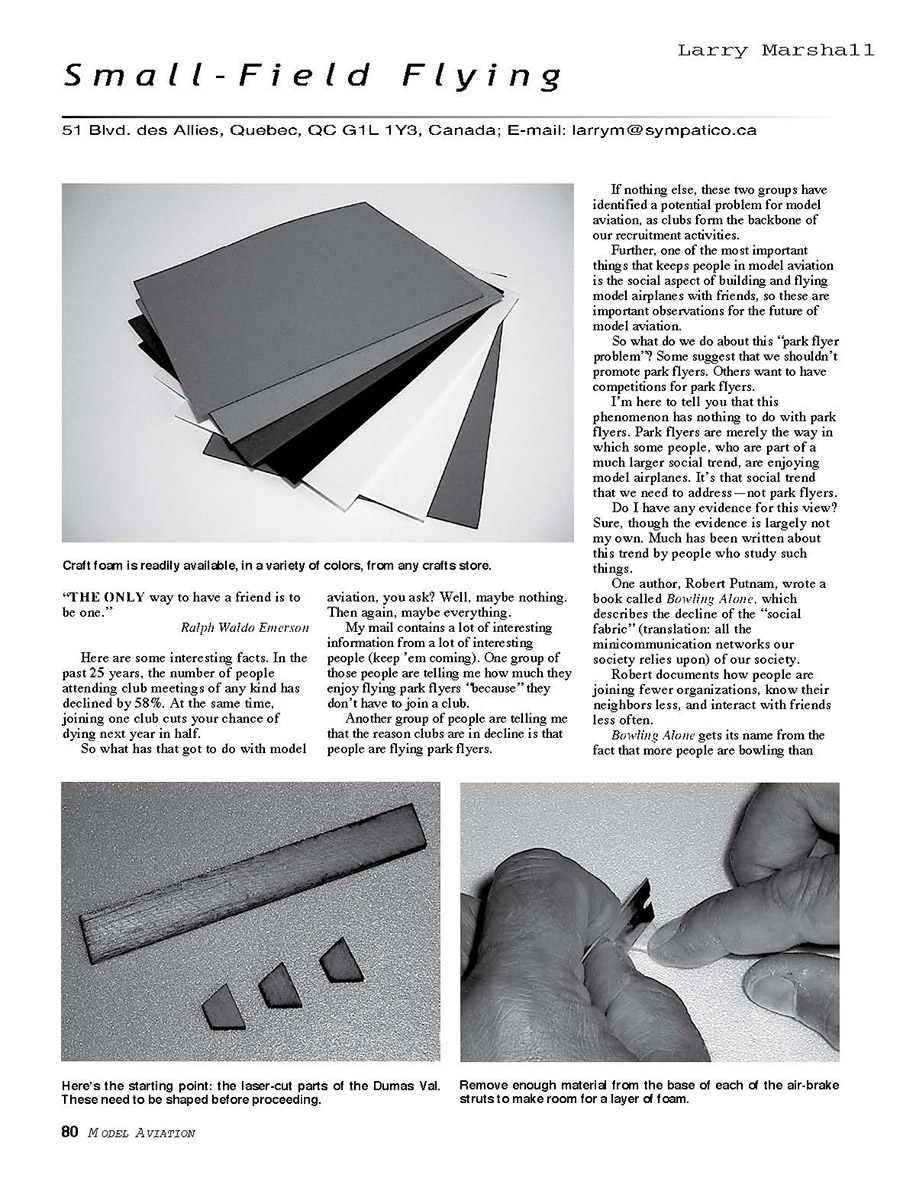
The material you need for this technique is readily available at most arts and crafts stores, and it comes in a variety of colors.
It's typically called craft foam, but you can even find a nice range of browns, grays, white, and black that are the handiest for modeling because you can often get away without having to paint it.
Craft foam comes in colored sheets that are normally 220 x 300 mm. Although the thickness is fairly consistent within a brand, you can find it in 0.050 or .080 (1.27 and 1.98 mm) thicknesses and in a wide range of colors.
The basic technique is to replace some segment of the part in question with foam rather than harder materials. This "base," when the part is glued in place, creates a point of flexion so that the piece gets handled by one of your three thumbs, it will bend rather than break.
It takes a bit of practice to get used to working with the foam; it doesn't sand well, so the basic shaping operation is done with scissors. I use small pairs of outside scissors, fly-tying scissors, and sharp blades removed from disposable razors.
The smaller scissors aren't anything special, except that they have smallish blades and cut at their tips. The "trick" is to learn how much you can push on the foam while cutting so you get the result you want when the pressure is released.
In the finish work it doesn't hurt to use a magnifying glass and move slowly, making very small nibbles rather than large cuts.
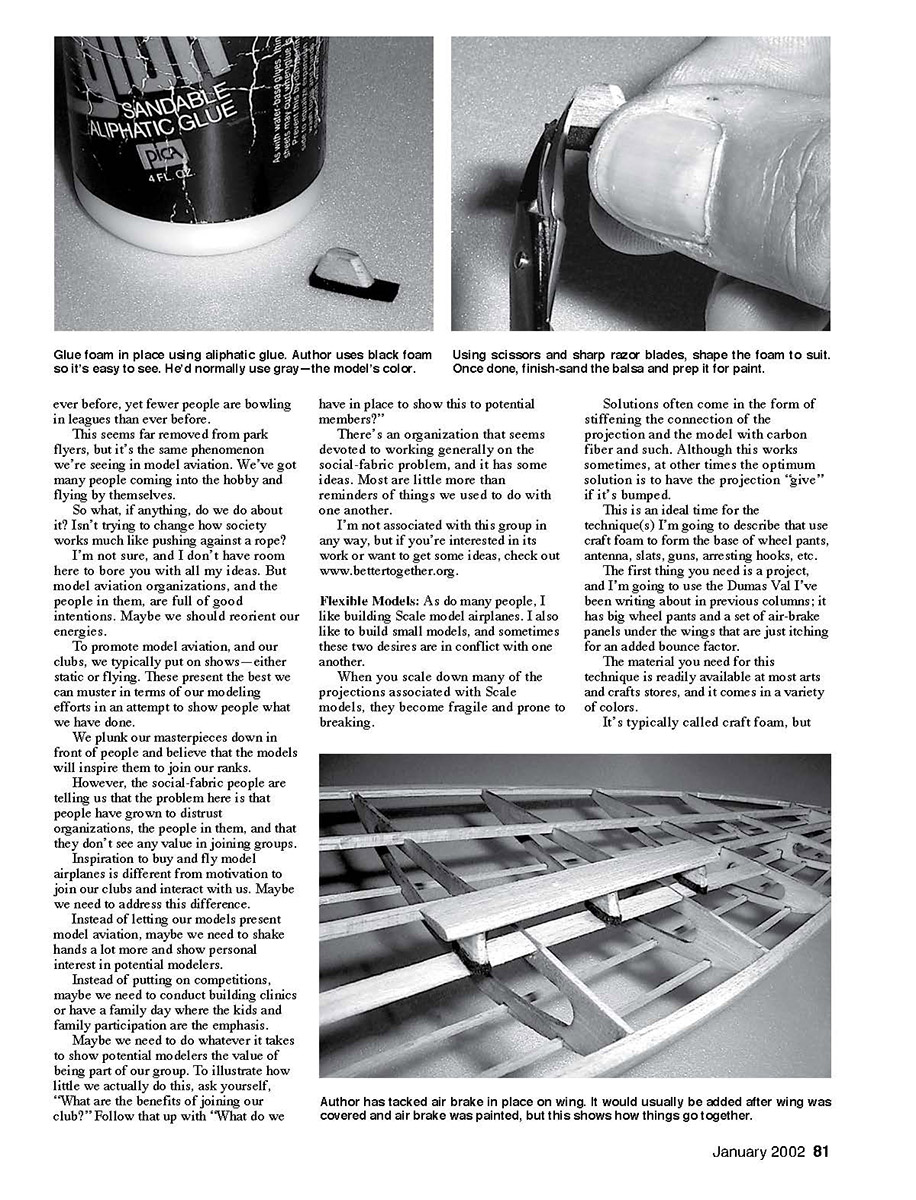
I'll do the Val air-brake struts as an example. The Dumas kit provides the struts as laser-cut balsa pieces.
There are two ways we can approach it. We could cut an entirely new set of struts completely from foam. This is probably the easier way to go. It would provide the most flexibility, and shaping these struts would be fairly simple.
Another approach is to remove enough wood from the strut to make room for the addition of a foam pad to the base. This is what I'm going to illustrate, since this is the technique used most often for gun barrels, antennae, etc.
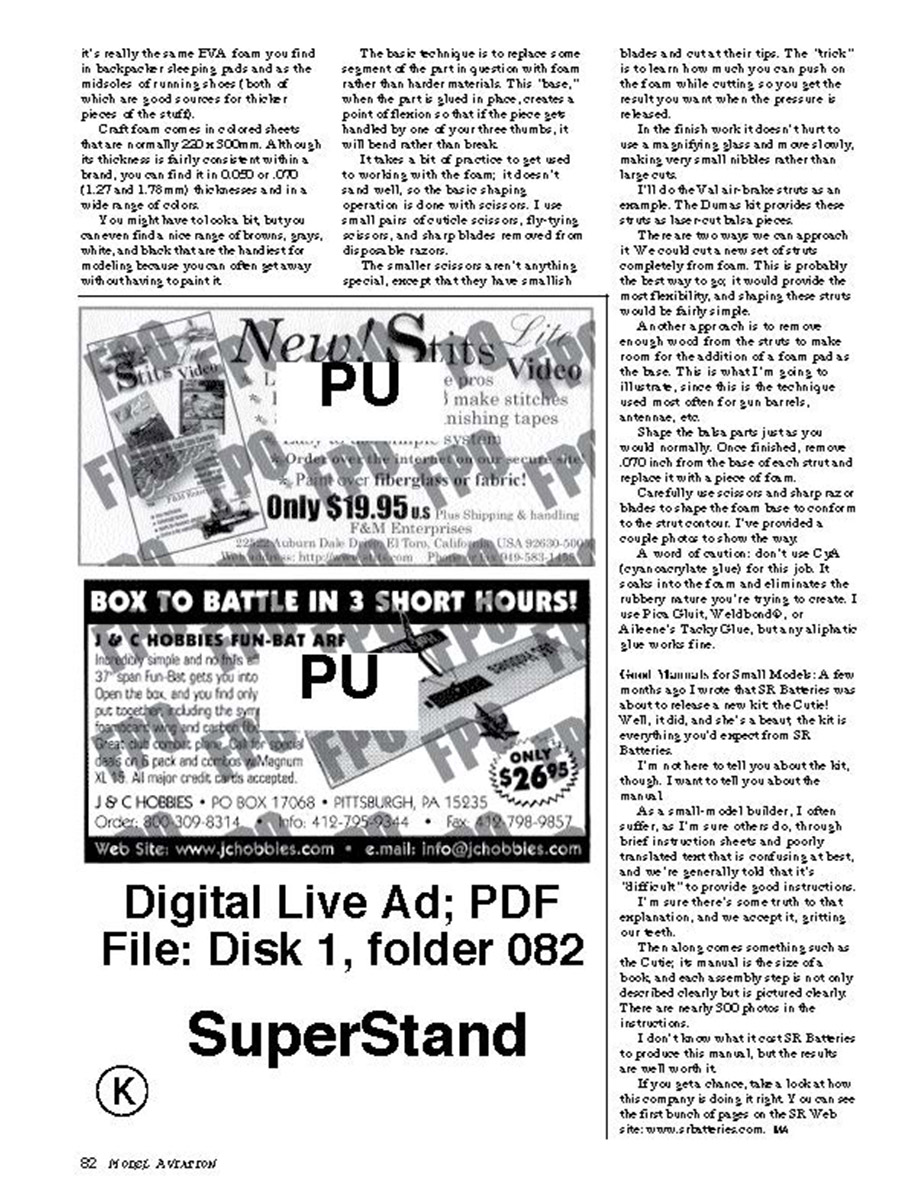
Shape the balsa parts just as you would normally. Once finished, remove 1/32" from the base of each strut and replace it with a piece of foam.
Carefully use scissors and a sharp razor blade to shape the foam base to conform to the strut contour. I've provided a couple photos to show the way.
A word of caution: don't use CA (cyanoacrylate glue) for this job. It soaks into the foam and eliminates the rubbery nature you're trying to create. I use Pacer Glue, Weldbond®, or Aleene's Tacky Glue, but any aliphatic-type glue works fine.
Small Manuals for Small Models
A few months ago I wrote that SR Batteries was about to release a new kit: the Cutie! Well, it did, and she's a beaut; the kit is everything you'd expect from SR Batteries.
I'm not here to tell you about the kit, though. I want to tell you about the manual.
As a small-model builder, I often suffer, as I'm sure others do, through brief instruction sheets and poorly translated text that is confusing at best, and we're generally told that it's "difficult" to provide good instructions.
I'm sure there's some truth to that explanation, and we accept it, gritting our teeth.
The manual for the Cutie is the size of a book, and each assembly step is not only described clearly but is pictured clearly. There are nearly 300 photos in the instructions.
I don't know what it cost SR Batteries to produce this manual, but the results are well worth it.
If you get a chance, take a look at how this company is doing it. You can see the first bunch of pages on the SR Web site: www.srbatteries.com.
Transcribed from original scans by AI. Minor OCR errors may remain.

