
Small-Field Flying
Paul Bradley
32238 Spinnaker Run, Magnolia TX 77354; E-mail: [email protected]
WHOOPS! I goofed. In the September column I presented a diagram for laying out a set of floats for your favorite small-field flyer. Unfortunately I did a poor job of proofreading the diagram before sending it in to be printed.
I inadvertently used the parameter L for two different measurements. The parameter is shown on the diagram as the distance from the back of the propeller to the rudder hinge line. That distance should have been shown as RL, or the reference length. The parameter L is the float length that is calculated as .75 x RL. Since the final float length can vary somewhat from the calculated value, all of the float-layout dimensions are based on the final float length (L).
I apologize for this error and hope that it has not caused a problem for anyone who has already made a set of floats from the diagram.
A Great New Reference Book
The interest in small-field-capable electric-powered Radio Control (RC) model aircraft seems to be growing everywhere I look these days. The manufacturers introduce new kits and products almost monthly.
For those of us who like to include some of the small-field models in our flying stable, opportunities just get better and better. The continued growth of the interest in small-field models, especially those which are electric powered, brings some interesting challenges; namely, where does a person find information about this aspect of our hobby?
Certainly this is an issue for someone who is just entering the hobby, but it is also a problem for the established modeler who has no prior experience with electric power systems or smaller airplanes. There are so many questions regarding selecting components, selecting airframes, installing the gear, and flying small models.
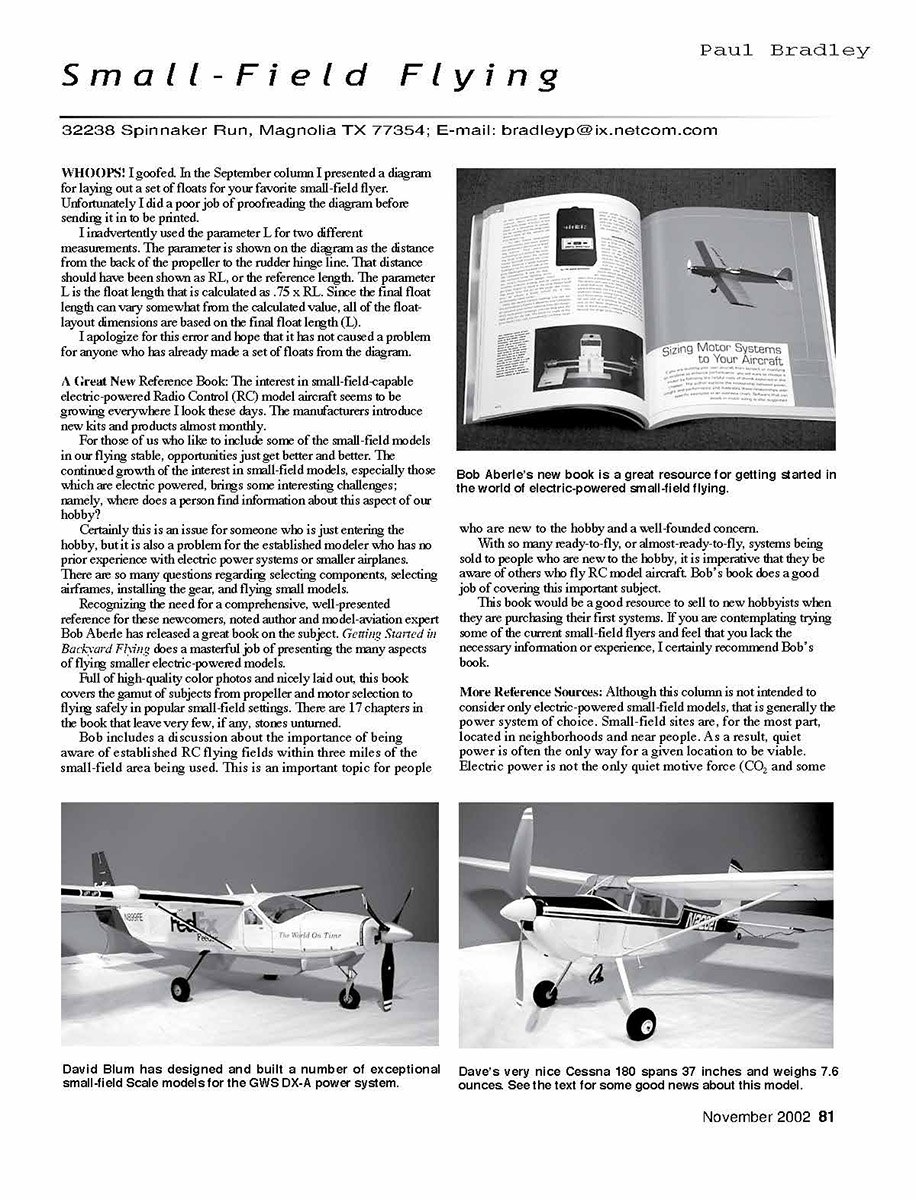
Recognizing the need for a comprehensive, well-presented reference for these newcomers, noted author and model-aviation expert Bob Aberle has released a great book on the subject. Getting Started in Backyard Flying does a masterful job of presenting the many aspects of flying smaller electric-powered models.
Full of high-quality color photos and nicely laid out, this book covers the gamut of subjects from propeller and motor selection to flying safely in popular small-field settings. There are 17 chapters in the book that leave very few, if any, stones unturned.
Bob includes a discussion about the importance of being aware of established RC flying fields within three miles of the small-field area being used. This is an important topic for people who are new to the hobby and a well-founded concern.
With so many ready-to-fly, or almost-ready-to-fly, systems being sold to people who are new to the hobby, it is imperative that they be aware of others who fly RC model aircraft. Bob's book does a good job of covering this important subject.
This book would be a good resource to sell to new hobbyists when they are purchasing their first systems. If you are contemplating trying some of the current small-field flyers and feel that you lack the necessary information or experience, I certainly recommend Bob's book.
More Reference Sources
Although this column is not intended to consider only electric-powered small-field models, that is generally the power system of choice. Small-field sites are, for the most part, located in neighborhoods and near people. As a result, quiet power is often the only way for a given location to be viable. Electric power is not the only quiet motive force (CO2 and some diesels are also options), but it is the most common.
Bob Aberle's new book provides an excellent foundation, but as we gain experience and our range of small-field interests grows, questions arise that are simply not practical to cover in such references. Fortunately, today we have the Internet.
If you have paid many visits to this land of information milk and honey, you have probably been overwhelmed by the volume of material available on almost any subject; model aviation is no exception. This can lead to conflicting information, and sometimes information that is incorrect.
Weeding out the wheat from the chaff when searching the Internet can be a real challenge, especially when you are looking for information in an area where your own knowledge is being developed.
For this reason, I have a site to recommend to those of you who have Internet access: the E Zone located at www.ezonemag.com. It has been mentioned previously in the pages of this publication (in Bob Kopski's Electrics column, for example). Although the focus is on electric-powered model aircraft, there is a wealth of information for the small-field flyer.
Active discussion forums are presented that allow questions to be posed then answered by a large array of modelers with similar interests. Three of the forums relate directly to small-field flying: Indoor and Micro Models, Park Flyers, and Sport Flying. The latter category goes beyond small-field-type models, but it often includes real nuggets of information for the small-field flyer as well.
For those of you who are Internet-connected and have not visited the E Zone, surf on over and pay the site a visit.
Scale Modeler Extraordinaire
To add emphasis to the Internet being a great resource, and the E Zone in particular, I want to share some of the beautiful small-field Scale models created by master craftsman David Blum of Cary, North Carolina.
During one of my many visits to the E Zone, I happened onto one of the projects David was discussing with the forum participants. In subsequent correspondence I learned that he had designed and developed some truly beautiful small-field Scale models.
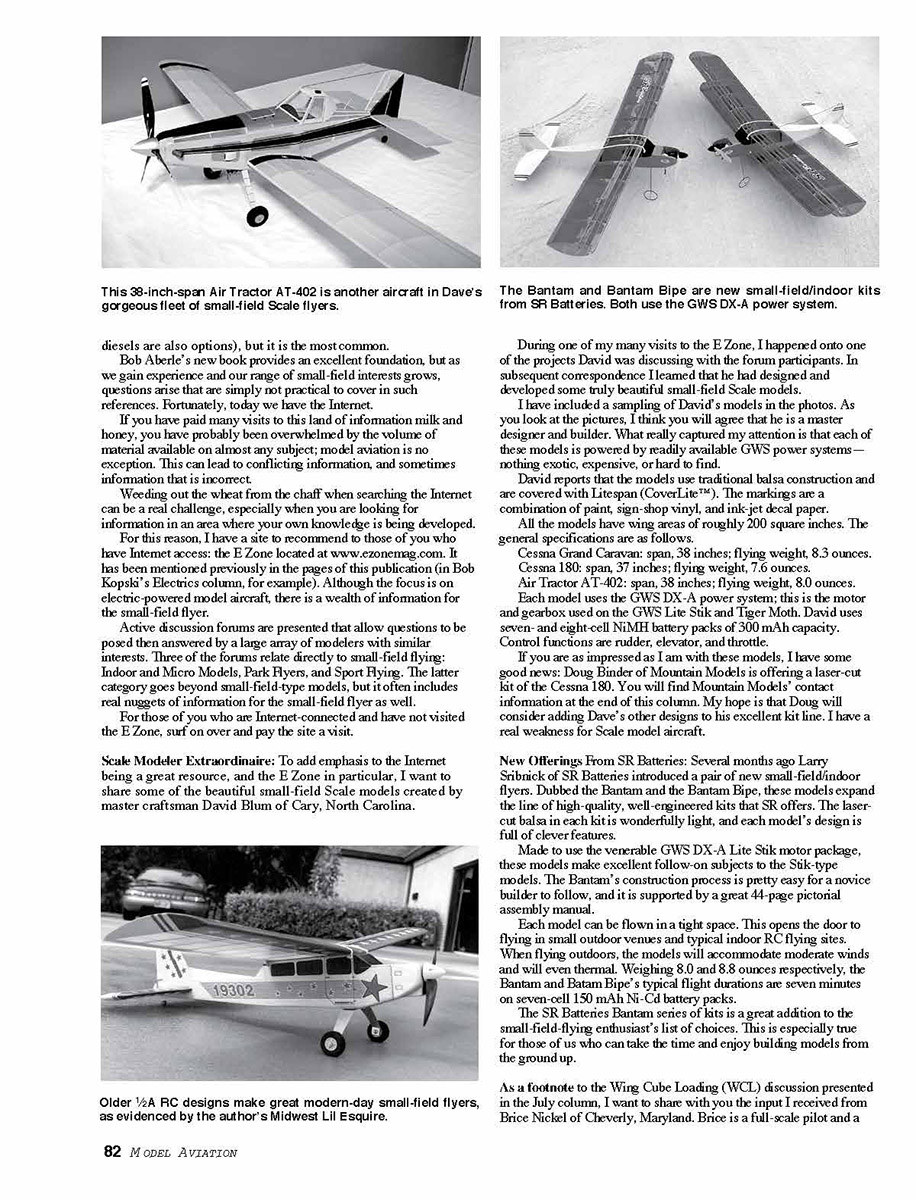
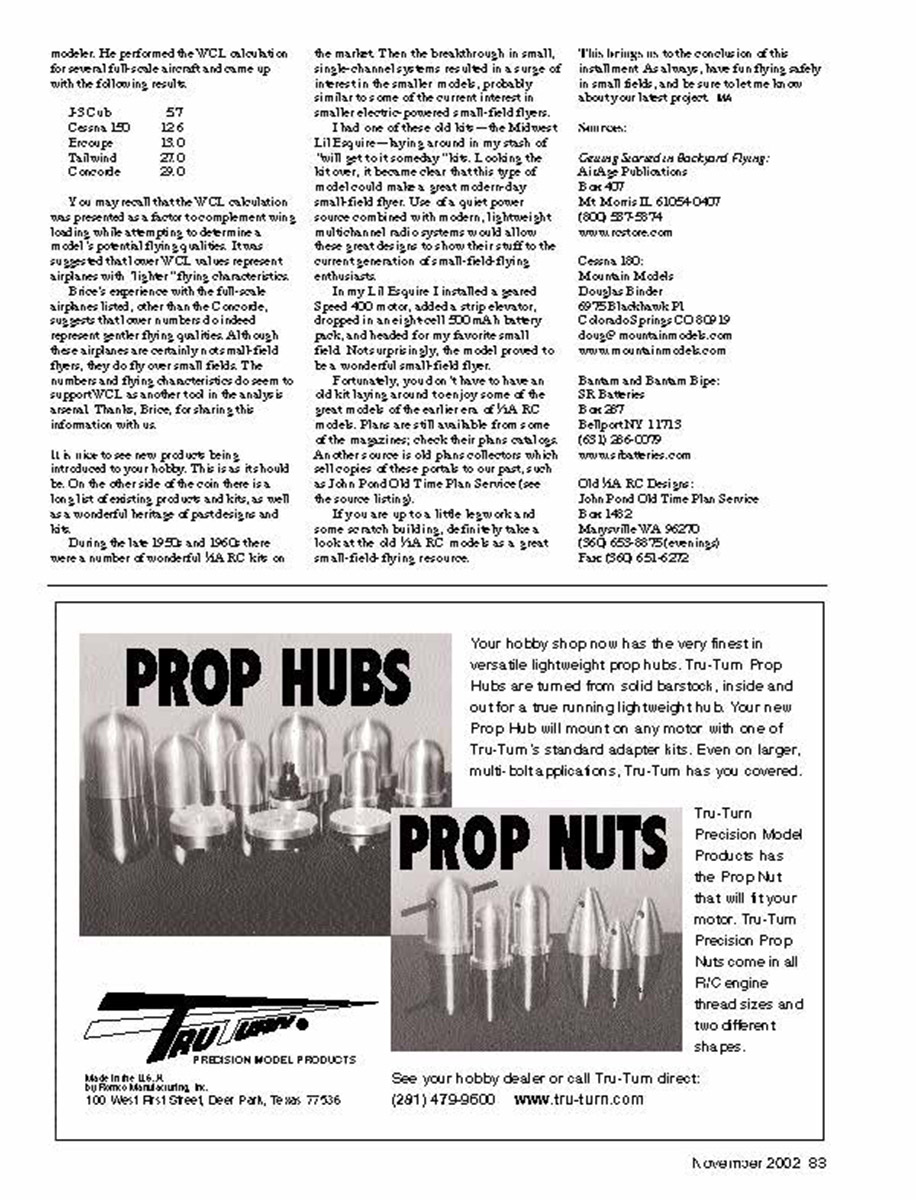
I have included a sampling of David's models in the photos. As you look at the pictures, I think you will agree that he is a master designer and builder. What really captured my attention is that each of these models is powered by readily available GWS power systems—nothing exotic, expensive, or hard to find.
David reports that the models use traditional balsa construction and are covered with LiteSpan (Coverite™). The markings are a combination of paint, sign-shop vinyl, and ink-jet decal paper.
All the models have wing areas of roughly 200 square inches. The general specifications are as follows.
- Cessna Grand Caravan: span, 38 inches; flying weight, 8.3 ounces.
- Cessna 180: span, 37 inches; flying weight, 7.6 ounces.
- Air Tractor AT-402: span, 38 inches; flying weight, 8.0 ounces.
Each model uses the GWS DX-A power system; this is the motor and gearbox used on the GWS Lite Stik and Tiger Moth. David uses seven- and eight-cell NiMH battery packs of 300 mAh capacity. Control functions are rudder, elevator, and throttle. I have some good news: Doug Binder of Mountain Models is offering a laser-cut kit of the Cessna 180. You will find Mountain Models' contact information at the end of this column. My hope is that Doug will consider adding David's other designs to his excellent kit line. I have a real weakness for Scale model aircraft.
New Offerings From SR Batteries
Several months ago Larry Stribnick of SR Batteries introduced a pair of new small-field/indoor flyers. Dubbed the Bantam and the Bantam Bipe, these models expand the line of high-quality, well-engineered kits that SR offers. The laser-cut balsa in each kit is wonderfully light, and each model's design is full of clever features.
Made to use the venerable GWS DX-A Lite Stik motor package, these models make excellent follow-on subjects to the Stik-type models. The Bantam's construction process is pretty easy for a novice builder to follow, and it is supported by a great 44-page pictorial assembly manual.
Each model can be flown in a tight space. This opens the door to flying in small outdoor venues and typical indoor RC flying sites. When flying outdoors, the models will accommodate moderate winds and will even thermal. Weighing 8.0 and 8.8 ounces respectively, the Bantam and Bantam Bipe's typical flight durations are seven minutes on seven-cell 150 mAh Ni-Cd battery packs.
The SR Batteries Bantam series of kits is a great addition to the small-field-flying enthusiast's list of choices. This is especially true for those of us who can take the time and enjoy building models from the ground up.
As a footnote to the Wing Cube Loading (WCL) discussion presented in the July column, I want to share with you the input I received from Brice Nickel of Cheverly, Maryland. Brice is a full-scale pilot and a modeler. He performed the WCL calculation for several full-scale aircraft and came up with the following results.
- J3Cub 57
- Cessna 150 126
- Ercoupe 130
- Tailwind 270
- Concorde 29.0
You may recall that the WCL calculation was presented as a factor to complement wing loading while attempting to determine a model's potential flying qualities. It was suggested that lower WCL values represent airplane with lighter "flying characteristics."
Brice's experience with the full-scale airplanes listed, other than the Concorde, suggests that lower numbers do indeed represent gentler flying qualities. Although those airplanes are certainly not small-field flyers, they do fly over small fields. The numbers and flying characteristics do seem to support WCL as another tool in the analysis arsenal. Thanks, Brice, for sharing this information with us.
It is nice to see new products being introduced to your hobby. This is as it should be. On the other side of the coin there is a long list of existing products and kits, as well as wonderful offerings of parts, designs and kits.
During the late 1940s and 1950s there were a number of wonderful small RC kits on the market. Then the breakthrough in small, single-channel systems resulted in a surge of interest in the smaller models, probably similar to some of the current interest in smaller electric-powered small-field flyers.
I had one of these old kits—the Midwest Lil Esquire—lying around in my stash of "will get to it someday" kits. Looking the kit over, it became clear that this type of model could make a great modern-day small-field flyer. Use of a quiet power source combined with modern, lightweight multi-channel radio systems would allow these great designs to show their stuff to the current generation of small-field-flying enthusiasts.
In my Lil Esquire I installed a geared Speed 400 motor, added a strip of elevator, dropped in a lightweight 500 mAh battery pack, and headed for my favorite small field. Not surprisingly, the model proved to be a wonderful small-field flyer.
Fortunately, you don't have to have an old kit laying around to enjoy some of the great models of the earlier era of R/C. Plans are still available from some of the magazines; check their plan catalogs. Another source is old plans collectors who sell copies of their plans to our past, such as John Pond Old Time Plan Service (see the source listing).
If you are up to a little rework and some scratch building, definitely take a look at the old R/C models as a great small-field-flying resource.
This brings us to the conclusion of this installment. As always, have fun flying safely in small fields, and be sure to let me know about your latest project. MA
Sources
- Growing Standards Backyard Flyers
Aerocraft Publications Box 407 Mt Morris IL 61054-0407 (800) 527-5744 www.aerocraft.com
- Cessna 180:
Mountain Models Douglas Binder 675 Blackhawk Pl Colorado Springs CO 80919 [email protected] www.mountainmodels.com
- Bantam and Bantam Bipe:
SR Batteries Box 287 Bellport NY 11713 (631) 286-0079 www.srbatteries.com
- Old USA RC Designs:
John Pond Old Time Plan Service Box 1492 Marysville WA 98270 (360) 659-8756 (evenings) Fax (360) 659-6272
Transcribed from original scans by AI. Minor OCR errors may remain.

