
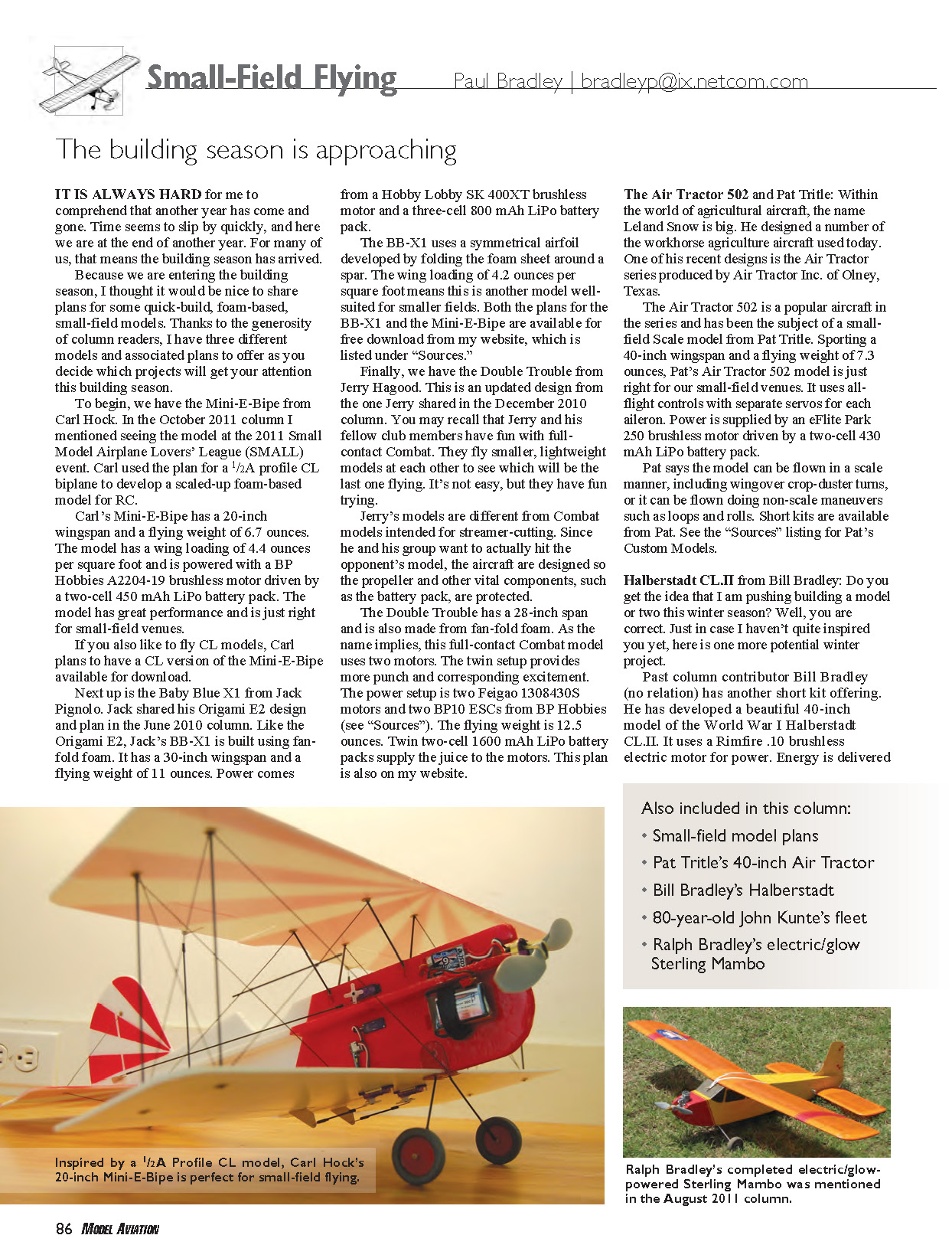
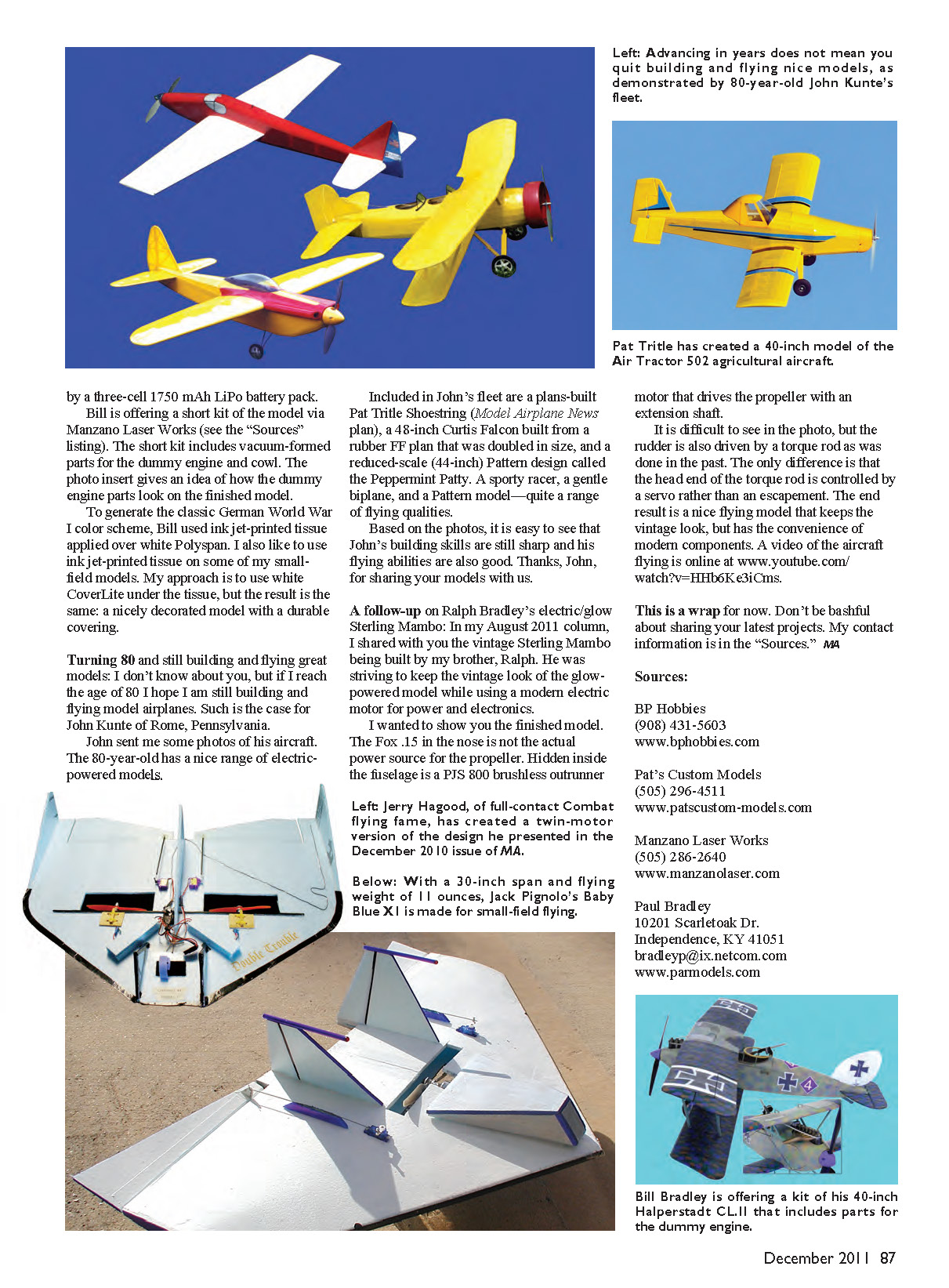
Small-Field Flying
Paul Bradley | [email protected]
The building season is approaching
It is always hard for me to comprehend that another year has come and gone. Time seems to slip by quickly, and here we are at the end of another year. For many of us, that means the building season has arrived.
Because we are entering the building season, I thought it would be nice to share plans for some quick-build, foam-based, small-field models. Thanks to the generosity of column readers, I have three different models and associated plans to offer as you decide which projects will get your attention this building season.
Mini-E-Bipe (Carl Hock)
To begin, we have the Mini-E-Bipe from Carl Hock. In the October 2011 column I mentioned seeing the model at the 2011 Small Model Airplane Lovers' League (SMALL) event. Carl used the plan for a 1/2A profile CL biplane to develop a scaled-up foam-based model for RC.
Carl's Mini-E-Bipe has a 20-inch wingspan and a flying weight of 6.7 ounces. The model has a wing loading of 4.4 ounces per square foot and is powered with a BP Hobbies A2204-19 brushless motor driven by a two-cell 450 mAh LiPo battery pack. The model has great performance and is just right for small-field venues.
If you also like to fly CL models, Carl plans to have a CL version of the Mini-E-Bipe available for download.
Baby Blue X1 (Jack Pignolo)
Next up is the Baby Blue X1 from Jack Pignolo. Jack shared his Origami E2 design and plan in the June 2010 column. Like the Origami E2, Jack's BB-X1 is built using fan-fold foam. It has a 30-inch wingspan and a flying weight of 11 ounces. Power comes from a Hobby Lobby SK 400XT brushless motor and a three-cell 800 mAh LiPo battery pack.
The BB-X1 uses a symmetrical airfoil developed by folding the foam sheet around a spar. The wing loading of 4.2 ounces per square foot means this is another model well-suited for smaller fields. Both the plans for the BB-X1 and the Mini-E-Bipe are available for free download from my website (see "Sources").
Double Trouble (Jerry Hagood)
Finally, we have the Double Trouble from Jerry Hagood. This is an updated design from the one Jerry shared in the December 2010 column. You may recall that Jerry and his fellow club members have fun with full-contact Combat. They fly smaller, lightweight models at each other to see which will be the last one flying. It's not easy, but they have fun trying.
Jerry's models are different from Combat models intended for streamer-cutting. Since he and his group want to actually hit the opponent's model, the aircraft are designed so the propeller and other vital components, such as the battery pack, are protected.
The Double Trouble has a 28-inch span and is also made from fan-fold foam. As the name implies, this full-contact Combat model uses two motors. The twin setup provides more punch and corresponding excitement. The power setup is two Feigao 1308430S motors and two BP10 ESCs from BP Hobbies. The flying weight is 12.5 ounces. Twin two-cell 1600 mAh LiPo battery packs supply the juice to the motors. This plan is also on my website.
Air Tractor 502 (Pat Tritle)
Within the world of agricultural aircraft, the name Leland Snow is big. He designed a number of the workhorse agriculture aircraft used today. One of his recent designs is the Air Tractor series produced by Air Tractor Inc. of Olney, Texas.
The Air Tractor 502 is a popular aircraft in the series and has been the subject of a small-field scale model from Pat Tritle. Sporting a 40-inch wingspan and a flying weight of 7.3 ounces, Pat's Air Tractor 502 model is just right for our small-field venues. It uses all-flight controls with separate servos for each aileron. Power is supplied by an eFlite Park 250 brushless motor driven by a two-cell 430 mAh LiPo battery pack.
Pat says the model can be flown in a scale manner, including wingover crop-duster turns, or it can be flown doing non-scale maneuvers such as loops and rolls. Short kits are available from Pat. See the "Sources" listing for Pat's Custom Models.
Halberstadt CL.II (Bill Bradley)
Do you get the idea that I am pushing building a model or two this winter season? Well, you are correct. Just in case I haven't quite inspired you yet, here is one more potential winter project.
Past column contributor Bill Bradley (no relation) has another short kit offering. He has developed a beautiful 40-inch model of the World War I Halberstadt CL.II. It uses a Rimfire .10 brushless electric motor for power. Energy is delivered by a three-cell 1750 mAh LiPo battery pack.
Bill is offering a short kit of the model via Manzano Laser Works (see the "Sources" listing). The short kit includes vacuum-formed parts for the dummy engine and cowl. The photo insert gives an idea of how the dummy engine parts look on the finished model.
To generate the classic German World War I color scheme, Bill used ink-jet-printed tissue applied over white Polyspan. I also like to use ink-jet-printed tissue on some of my small-field models. My approach is to use white CoverLite under the tissue, but the result is the same: a nicely decorated model with a durable covering.
Turning 80 and still building and flying great models
I don't know about you, but if I reach the age of 80 I hope I am still building and flying model airplanes. Such is the case for John Kunte of Rome, Pennsylvania.
John sent me some photos of his aircraft. The 80-year-old has a nice range of electric-powered models. Included in John's fleet are a plans-built Pat Tritle Shoestring (Model Airplane News plan), a 48-inch Curtis Falcon built from a rubber free-flight plan that was doubled in size, and a reduced-scale (44-inch) Pattern design called the Peppermint Patty. A sporty racer, a gentle biplane, and a Pattern model—quite a range of flying qualities.
Based on the photos, it is easy to see that John's building skills are still sharp and his flying abilities are also good. Thanks, John, for sharing your models with us.
A follow-up on Ralph Bradley's electric/glow Sterling Mambo
In my August 2011 column, I shared with you the vintage Sterling Mambo being built by my brother, Ralph. He was striving to keep the vintage look of the glow-powered model while using a modern electric motor for power and electronics.
I wanted to show you the finished model. The Fox .15 in the nose is not the actual power source for the propeller. Hidden inside the fuselage is a PJS 800 brushless outrunner motor that drives the propeller with an extension shaft.
It is difficult to see in the photo, but the rudder is also driven by a torque rod as was done in the past. The only difference is that the head end of the torque rod is controlled by a servo rather than an escapement. The end result is a nice flying model that keeps the vintage look, but has the convenience of modern components. A video of the aircraft flying is online at www.youtube.com/watch?v=HHb6Ke3iCms.
This is a wrap for now. Don't be bashful about sharing your latest projects. My contact information is in the "Sources."
Sources
- BP Hobbies — (908) 431-5603 — www.bphobbies.com
- Pat's Custom Models — (505) 296-4511 — www.patscustom-models.com
- Manzano Laser Works — (505) 286-2640 — www.manzanolaser.com
- Paul Bradley — 10201 Scaletook Dr., Independence, KY 41051 — [email protected] — www.parmodels.com
Transcribed from original scans by AI. Minor OCR errors may remain.

