
So Different, Yet So Familiar
by Frank Granelli
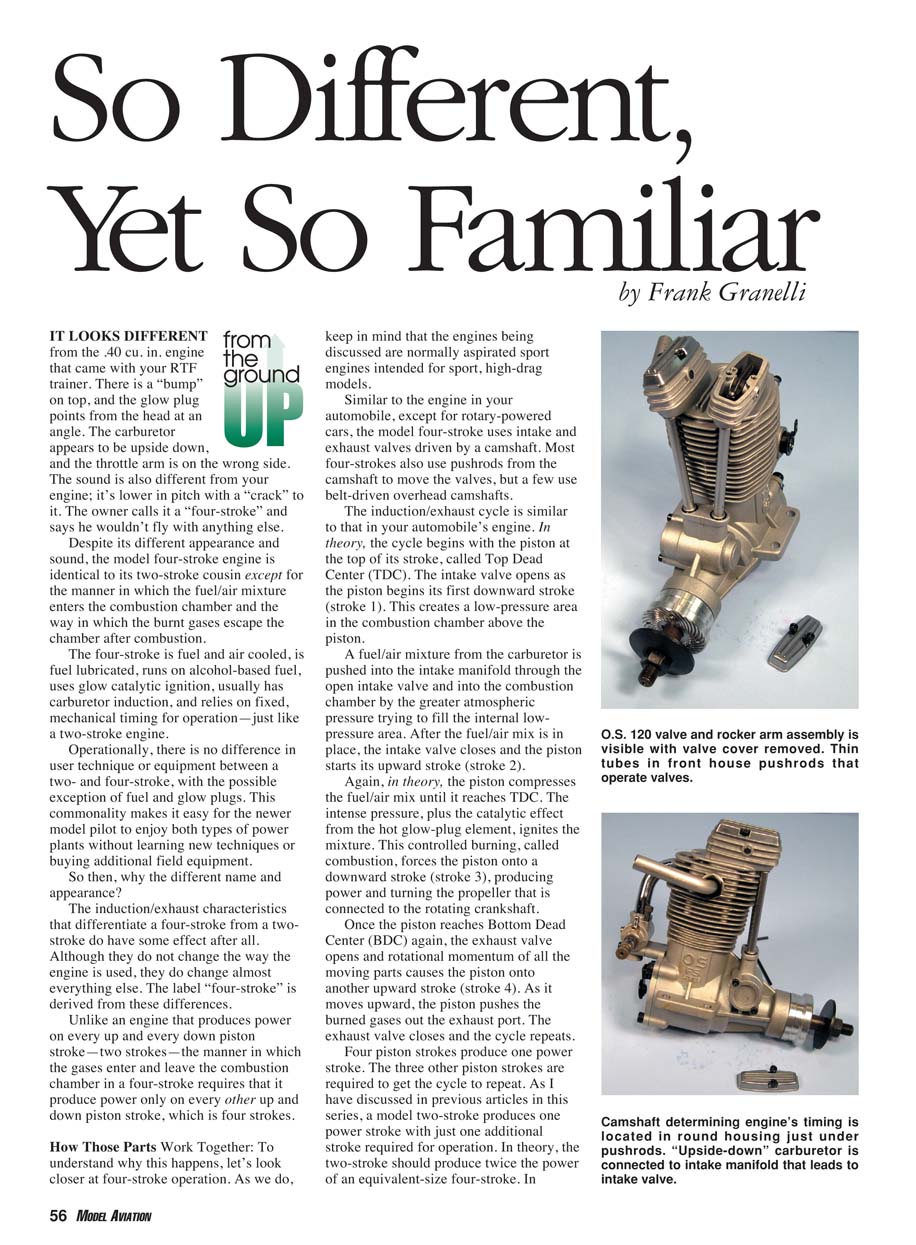
It looks different from the .40 cu. in. engine that came with your RTF trainer. There is a "bump" on top, the glow plug points from the head at an angle, the carburetor appears to be upside down, and the throttle arm is on the wrong side. The sound is also different from your engine: it's lower in pitch with a distinctive "crack." The owner calls it a "four-stroke" and says he wouldn't fly with anything else.
Despite its different appearance and sound, the model four-stroke engine is identical to its two-stroke cousin except for the manner in which the fuel/air mixture enters the combustion chamber and the way in which the burnt gases escape the chamber after combustion.
The four-stroke is fuel-and-air cooled, fuel-lubricated, runs on alcohol-based fuel, uses glow catalytic ignition, usually has carburetor induction, and relies on fixed, mechanical timing for operation—just like a two-stroke engine.
Operationally, there is no difference in user technique or equipment between a two- and four-stroke, with the possible exception of fuel and glow plugs. This commonality makes it easy for the newer model pilot to enjoy both types of power plants without learning new techniques or buying additional field equipment.
So then, why the different name and appearance?
The induction/exhaust characteristics that differentiate a four-stroke from a two-stroke do have some effect after all. Although they do not change the way the engine is used, they do change almost everything else. The label "four-stroke" is derived from these differences. Unlike an engine that produces power on every up and every down piston stroke—two strokes—the manner in which the gases enter and leave the combustion chamber in a four-stroke requires that it produce power only on every other up-and-down piston stroke, which is four strokes.
How Those Parts Work Together
To understand why this happens, let's look closer at four-stroke operation. As we do, keep in mind that the engines being discussed are normally aspirated sport engines intended for sport, high-drag models.
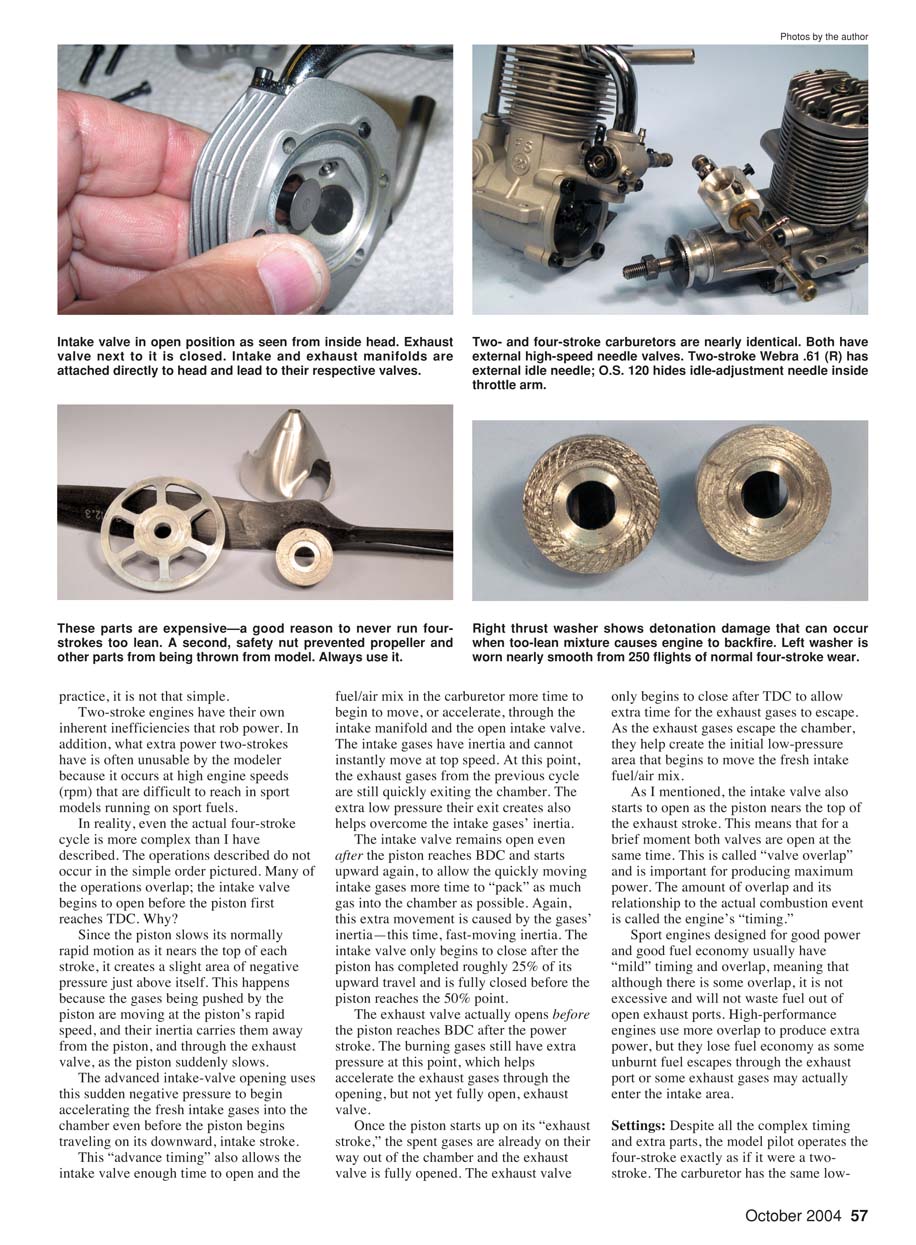
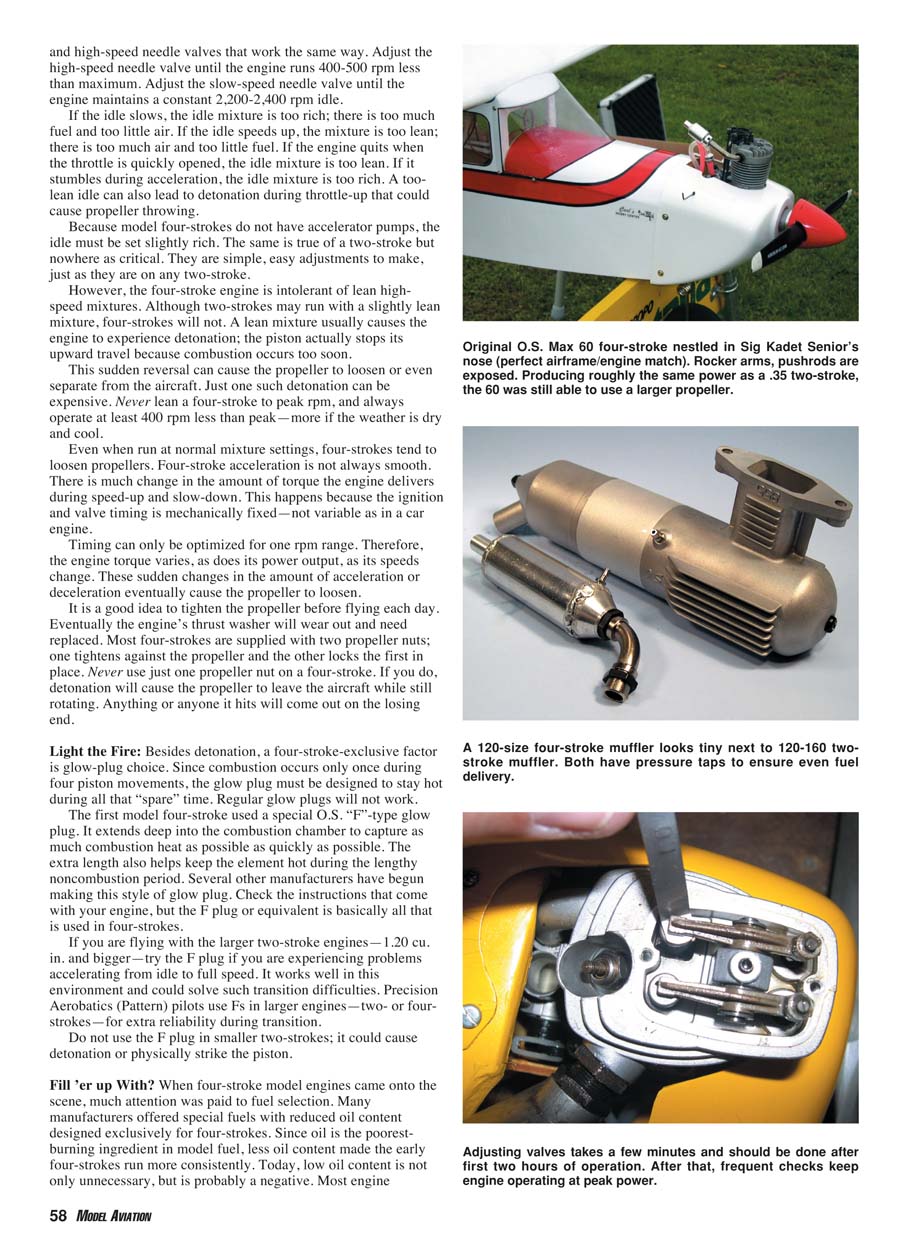
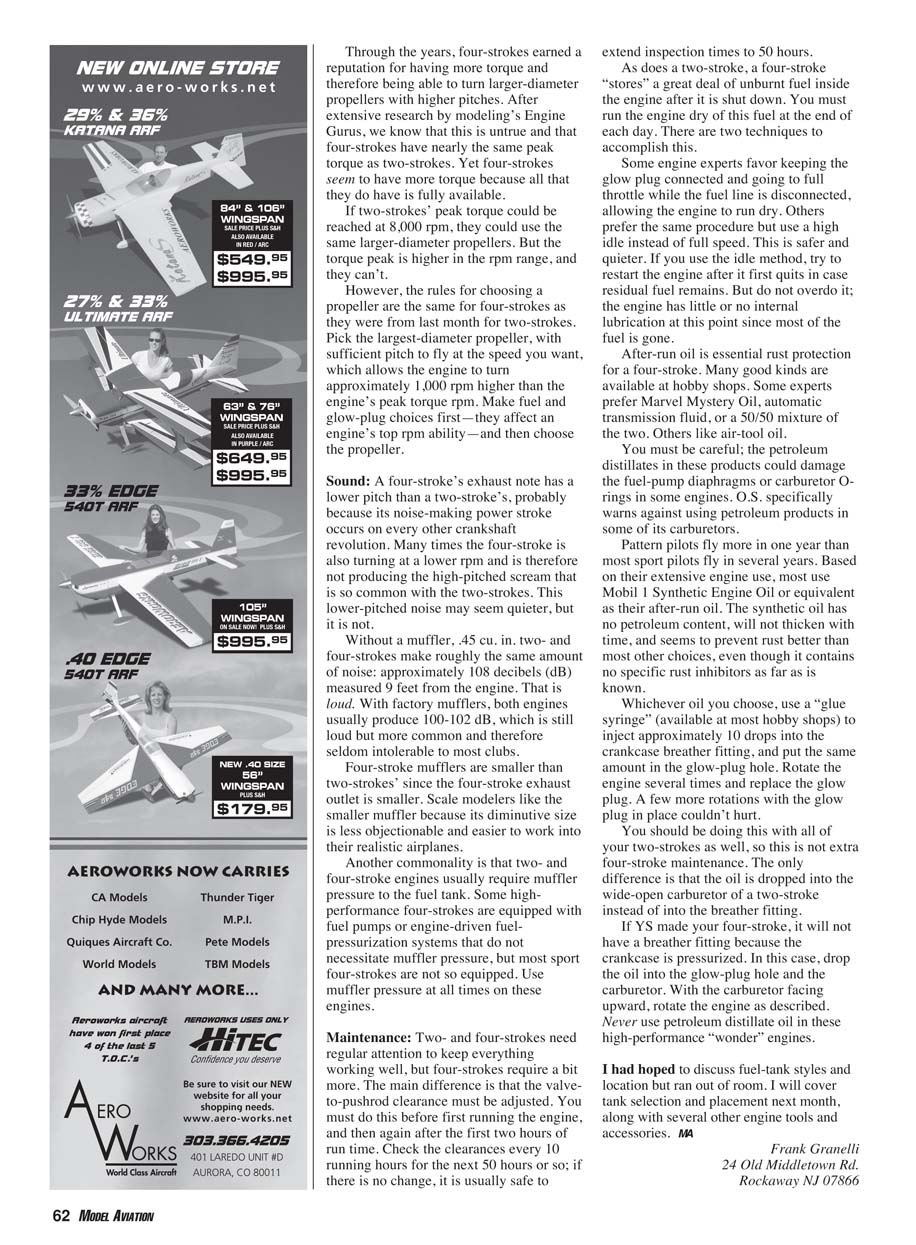
Similar to the engine in your automobile (except rotary-powered cars), the model four-stroke uses intake and exhaust valves driven by a camshaft. Most four-strokes also use pushrods from the camshaft to move the valves, but a few use belt-driven overhead camshafts.
The induction/exhaust cycle is similar to that in your automobile's engine. In theory, the cycle begins with the piston at the top of its stroke, called Top Dead Center (TDC):
- Intake (stroke 1): The intake valve opens as the piston begins its first downward stroke. This creates a low-pressure area in the combustion chamber above the piston. A fuel/air mixture from the carburetor is pushed into the intake manifold through the open intake valve and into the combustion chamber by the greater atmospheric pressure trying to fill the internal low-pressure area.
- Compression (stroke 2): After the fuel/air mix is in place, the intake valve closes and the piston starts its upward stroke. The piston compresses the fuel/air mix until it reaches TDC. The intense pressure, plus the catalytic effect from the hot glow-plug element, ignites the mixture.
- Power (stroke 3): Combustion forces the piston onto a downward stroke, producing power and turning the propeller that is connected to the rotating crankshaft.
- Exhaust (stroke 4): Once the piston reaches Bottom Dead Center (BDC) again, the exhaust valve opens and the rotational momentum of the moving parts causes the piston to move onto another upward stroke. As it moves upward, the piston pushes the burned gases out the exhaust port. The exhaust valve closes and the cycle repeats.
Four piston strokes produce one power stroke. The three other piston strokes are required to get the cycle to repeat. As discussed in previous articles, a model two-stroke produces one power stroke with just one additional stroke required for operation. In theory, the two-stroke should produce twice the power. In practice, it is not that simple.
Two-stroke engines have their own inherent inefficiencies that rob power. In addition, what extra power two-strokes have is often unusable by the modeler because it occurs at high engine speeds (rpm) that are difficult to reach in sport models running on sport fuels.
In reality, the actual four-stroke cycle is more complex than the idealized sequence above. The operations described do not occur in the simple order pictured; many of the operations overlap. For example, the intake valve begins to open before the piston first reaches TDC. Why?
Since the piston slows its normally rapid motion as it nears the top of each stroke, it creates a slight area of negative pressure just above itself. This happens because the gases being pushed by the piston are moving at the piston’s rapid speed, and their inertia carries them away from the piston and through the exhaust valve as the piston suddenly slows.
The advanced intake-valve opening uses this slight negative pressure to begin accelerating the fresh intake gases into the chamber even before the piston begins its downward intake stroke. This advance timing also allows the intake valve enough time to open and the fuel/air mix in the carburetor more time to begin to move, or accelerate, through the intake manifold and the open intake valve. The intake gases have inertia and cannot instantly move at top speed. At this point, the exhaust gases from the previous cycle are still quickly exiting the chamber; the extra low pressure their exit creates also helps overcome the intake gases' inertia.
The intake valve remains open even after the piston reaches BDC and starts upward again, to allow the quickly moving intake gases more time to "pack" as much gas into the chamber as possible. This extra movement is caused by the gases' inertia — this time, fast-moving inertia. The intake valve only begins to close after the piston has completed roughly 25% of its upward travel and is fully closed before the piston reaches the 50% point.
The exhaust valve actually opens before the piston reaches BDC after the power stroke. The burning gases still have extra pressure at this point, which helps accelerate the exhaust gases through the opening, though the valve is not yet fully open. Once the piston starts the exhaust stroke, the spent gases are already on their way out and the exhaust valve is fully open. The exhaust valve only begins to close after TDC to allow extra time for the exhaust gases to escape. As the exhaust gases leave the chamber, they help create the initial low-pressure area that begins to move the fresh intake fuel/air mix.
As mentioned, the intake valve also starts to open as the piston nears the top of the exhaust stroke. This means that for a brief moment both valves are open at the same time. This brief period is called valve overlap and is important for producing maximum power. The amount of overlap and its relationship to the actual combustion event is called the engine's timing.
Sport engines designed for good power and good fuel economy usually have mild timing and overlap—enough overlap to help breathing but not so much as to waste fuel through the open exhaust. High-performance engines use more overlap to produce extra power, but they sacrifice fuel economy as some unburnt fuel escapes through the exhaust or some exhaust gases enter the intake area.
Settings
Despite all the complex timing and extra parts, the model pilot operates the four-stroke exactly as if it were a two-stroke. The carburetor has the same low- and high-speed needle valves that work the same way.
- Adjust the high-speed needle valve until the engine runs 400–500 rpm less than maximum.
- Adjust the slow-speed needle valve until the engine maintains a constant 2,200–2,400 rpm idle.
If the idle slows, the idle mixture is too rich (too much fuel, too little air). If the idle speeds up, the mixture is too lean (too much air, too little fuel). If the engine quits when the throttle is quickly opened, the idle mixture is too lean. If it stumbles during acceleration, the idle mixture is too rich. A too-lean idle can also lead to detonation during throttle-up that could cause propeller throwing.
Because model four-strokes do not have accelerator pumps, the idle must be set slightly rich. The same is true of a two-stroke but it is less critical. These are simple, easy adjustments to make, just as they are on any two-stroke.
However, the four-stroke engine is intolerant of lean high-speed mixtures. Although two-strokes may run with a slightly lean mixture, four-strokes will not. A lean mixture usually causes the engine to experience detonation: the piston actually stops its upward travel because combustion occurs too soon. This sudden reversal can cause the propeller to loosen or even separate from the aircraft. Just one such detonation can be expensive. Never lean a four-stroke to peak rpm; always operate at least 400 rpm less than peak—more if the weather is dry and cool.
Even when run at normal mixture settings, four-strokes tend to loosen propellers. Four-stroke acceleration is not always smooth; there is much change in the amount of torque the engine delivers during speed-up and slow-down. This happens because the ignition and valve timing is mechanically fixed—not variable as in a car engine. Timing can only be optimized for one rpm range. Therefore, the engine torque varies, as does its power output, as its speeds change. These sudden changes in acceleration or deceleration eventually cause the propeller to loosen.
- It is a good idea to tighten the propeller before flying each day.
- Eventually the engine's thrust washer will wear out and need replacement.
- Most four-strokes are supplied with two propeller nuts; one tightens against the propeller and the other locks the first in place. Never use just one propeller nut on a four-stroke.
If you use only one nut, detonation could cause the propeller to leave the aircraft while still rotating. Anything or anyone it hits will come out on the losing end.
Light the Fire
Besides detonation, a four-stroke‑exclusive factor is glow-plug choice. Since combustion occurs only once during four piston movements, the glow plug must be designed to stay hot during all that “spare” time. Regular glow plugs will not work reliably.
The first model four-stroke used a special O.S. “F”-type glow plug. It extends deep into the combustion chamber to capture as much combustion heat as possible as quickly as possible. The extra length also helps keep the element hot during the lengthy noncombustion period. Several other manufacturers have begun making this style of glow plug. Check the instructions that came with your engine, but the F plug or equivalent is basically what is used in four-strokes.
If you are flying with the larger two-stroke engines—1.20 cu. in. and bigger—try the F plug if you are experiencing problems accelerating from idle to full speed. It works well in this environment and could solve such transition difficulties. Precision aerobatics (pattern) pilots use F plugs in larger engines—two- or four-strokes—for extra reliability during transition.
Do not use the F plug in smaller two-strokes; it could cause detonation or physically strike the piston.
Fill 'er up With?
When four-stroke model engines first appeared, much attention was paid to fuel selection. Many manufacturers offered special fuels with reduced oil content designed exclusively for four-strokes. Since oil is the poorest-burning ingredient in model fuel, less oil content made the early four-strokes run more consistently.
Today, low oil content is not only unnecessary but is probably a negative. Most engine manufacturers recommend fuels with higher oil content to ensure adequate lubrication of the valve train and other parts that do not receive as much lubrication as crankcase-lubricated two-strokes. Use the fuel recommended by your engine's manufacturer; 12–18% oil is common, and some makers advise as much as 25%.
Through the years, four-strokes earned a reputation for having more torque and therefore being able to turn larger-diameter propellers with higher pitches. After extensive research by engine experts, we know this is untrue: four-strokes have nearly the same peak torque as two-strokes. Yet four-strokes seem to have more torque because all that torque is fully available in the usable rpm range.
If two-strokes' peak torque could be reached at 8,000 rpm, they could use the same larger-diameter propellers. But the torque peak is higher in the rpm range, and they can't.
The rules for choosing a propeller are the same for four-strokes as they were for two-strokes: pick the largest-diameter propeller, with sufficient pitch to fly at the speed you want, which allows the engine to turn approximately 1,000 rpm higher than the engine's peak torque rpm. Make fuel and glow-plug choices first—they affect an engine's top rpm ability—and then choose the propeller.
Sound
A four-stroke's exhaust note has a lower pitch than a two-stroke's, probably because its power stroke occurs on every other crankshaft revolution. Many times the four-stroke is also turning at a lower rpm and therefore is not producing the high-pitched scream common with two-strokes. This lower-pitched noise may seem quieter, but it is not.
Without a muffler, .45 cu. in. two- and four-strokes make roughly the same amount of noise: approximately 108 decibels (dB) measured 9 feet from the engine. That is loud. With factory mufflers, both engines usually produce 100–102 dB, which is still loud but more common and therefore seldom intolerable to most clubs.
Four-stroke mufflers are smaller than two-strokes' since the four-stroke exhaust outlet is smaller. Scale modelers like the smaller muffler because its diminutive size is less objectionable and easier to work into their realistic airplanes.
Another commonality is that two- and four-stroke engines usually require muffler pressure to the fuel tank. Some high-performance four-strokes are equipped with fuel pumps or engine-driven fuel pressurization systems that do not necessitate muffler pressure, but most sport four-strokes are not so equipped. Use muffler pressure at all times on these engines.
Maintenance
Two- and four-strokes need regular attention to keep everything working well, but four-strokes require a bit more. The main difference is that the valve-to-pushrod clearance must be adjusted. Do this before the first run-in of a new engine, and then again after the first two hours of run time. Check the clearances every 10 running hours for the next 50 hours or so; if there is no change, it is usually safe to extend inspection intervals to 50 hours.
As with a two-stroke, a four-stroke "stores" a great deal of unburnt fuel inside the engine after it is shut down. You must run the engine dry of this fuel at the end of each day. There are two common techniques to accomplish this:
- Keep the glow plug connected and go to full throttle while the fuel line is disconnected, allowing the engine to run dry.
- Or use the same procedure but use a high idle instead of full speed. This is safer and quieter. If you use the idle method, try to restart the engine after it first quits in case residual fuel remains. But do not overdo it; the engine has little or no internal lubrication at this point since most of the fuel is gone.
After-run oil is essential rust protection for a four-stroke. Many good kinds are available at hobby shops. Some experts prefer Marvel Mystery Oil, automatic transmission fluid, or a 50/50 mixture of the two. Others like air-tool oil. Be careful: the petroleum distillates in these products could damage the fuel-pump diaphragms or carburetor O-rings in some engines. O.S. specifically warns against using petroleum products in some of its carburetors.
Pattern pilots, who fly a lot, often use Mobil 1 synthetic engine oil or an equivalent as their after-run oil. The synthetic oil has no petroleum content, will not thicken with time, and seems to prevent rust better than most other choices, even though it contains no specific rust inhibitors as far as is known.
Whichever oil you choose, use a "glue syringe" (available at most hobby shops) to inject approximately 10 drops into the crankcase breather fitting, and put the same amount in the glow-plug hole. Rotate the engine several times and replace the glow plug. A few more rotations with the glow plug in place couldn't hurt.
You should be doing this with all of your two-strokes as well, so this is not extra four-stroke maintenance. The only difference is that the oil is dropped into the wide-open carburetor of a two-stroke instead of into the breather fitting.
If YS made your four-stroke, it will not have a breather fitting because the crankcase is pressurized. In this case, drop the oil into the glow-plug hole and the carburetor. With the carburetor facing upward, rotate the engine as described. Never use petroleum-distillate oil in these high-performance engines.
I had hoped to discuss fuel-tank styles and location but ran out of room. I will cover tank selection and placement next month, along with several other engine tools and accessories.
Frank Granelli 24 Old Middletown Rd. Rockaway, NJ 07866
Transcribed from original scans by AI. Minor OCR errors may remain.

