
Soaring With Simple Sailplanes
By Dave Garwood
BENT-WING GLIDERS are often the workhorses of radio-controlled flight instruction, particularly in self-instruction, partly because they do such a good job of flying themselves if the pilot will let them. Another reason is that they tend to be built from inexpensive kits and require the simplest and least costly radio sets.
Without an engine and fuel or electric motor, controller, battery pack, and charger to worry about, a 2-meter-span polyhedral glider kit can lead to a successful introduction to RC flight.
Across the country I see evidence that something about these seemingly simple gliders holds the interest of highly experienced RC Soaring pilots for many years after they "graduate" to "more sophisticated" sailplanes. This article will focus on why this is so.
But first I'll describe the models themselves. Then I'll explore why the bent-wing gliders can hold fliers' attention for many years and how they can be your ticket into Soaring competition.
The Sailplanes:
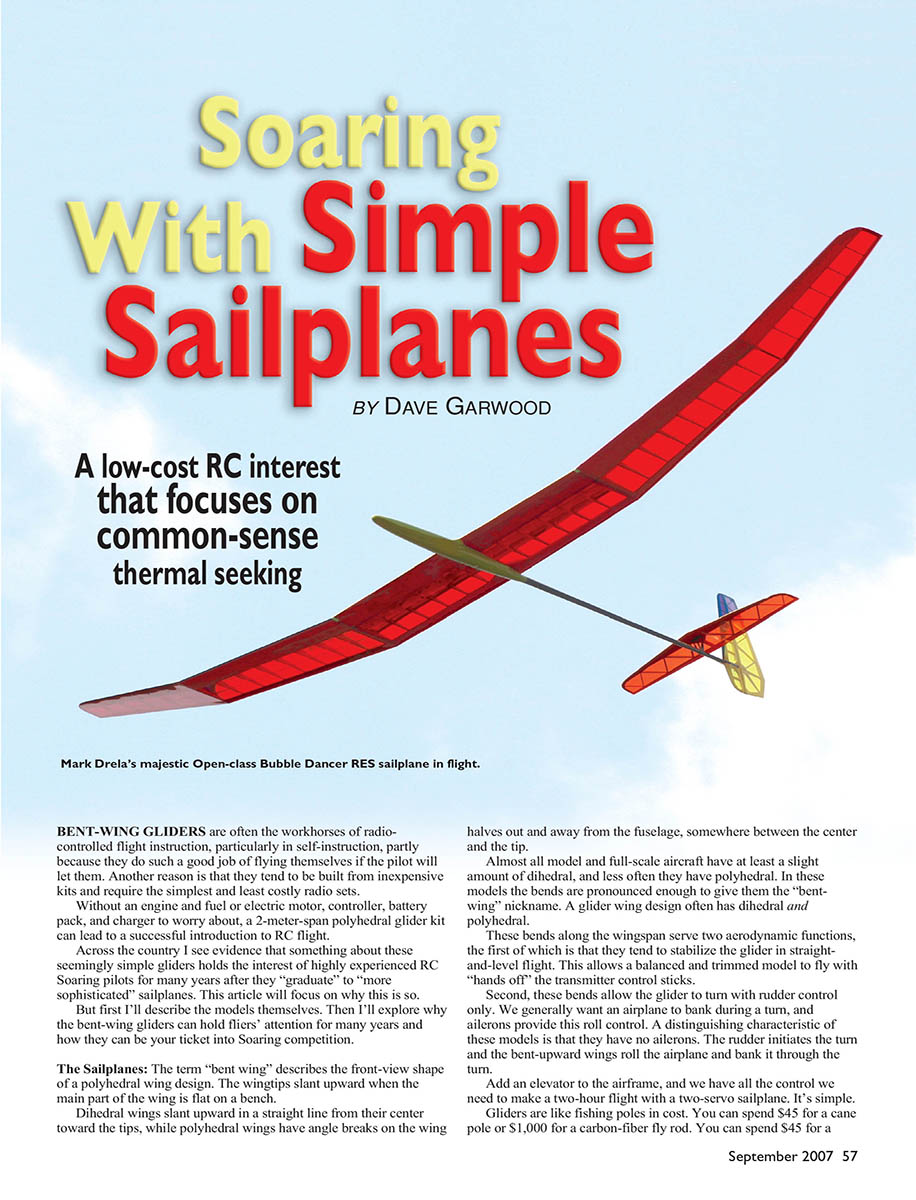
The term "bent wing" describes the front-view shape of a polyhedral wing design. The wingtips slant upward when the main part of the wing is flat on a bench.
Dihedral wings slant upward in a straight line from their center toward the tips, while polyhedral wings have angle breaks on the wing halves out and away from the fuselage, somewhere between the center and the tip.
Almost all model and full-scale aircraft have at least a slight amount of dihedral, and less often they have polyhedral. In these models the bends are pronounced enough to give them the "bent-wing" nickname. A glider wing design often has dihedral and polyhedral.
These bends along the wingspan serve two aerodynamic functions, the first of which is that they tend to stabilize the glider in straight-and-level flight. This allows a balanced and trimmed model to fly with "hands off" the transmitter control sticks.
Second, these bends allow the glider to turn with rudder control. We generally want an airplane to bank during a turn, and ailerons provide this roll control. A distinguishing characteristic of these models is that they have no ailerons. The rudder initiates the turn and the bent-up wing tips roll the airplane and bank it through the turn.
Add an elevator to the airframe, and we have all the control we need to make a two-hour flight with a two-servo sailplane. It's simple. Gliders are like fishing poles in cost. You can spend $45 for a cane pole or $1,000 for a carbon-fiber fly rod. You can spend $45 for a balsa kit or $1,000 for a molded wunderplane that is already built. Both poles catch fish and both sailplanes go up in thermals. How much you spend is a matter of personal preference.
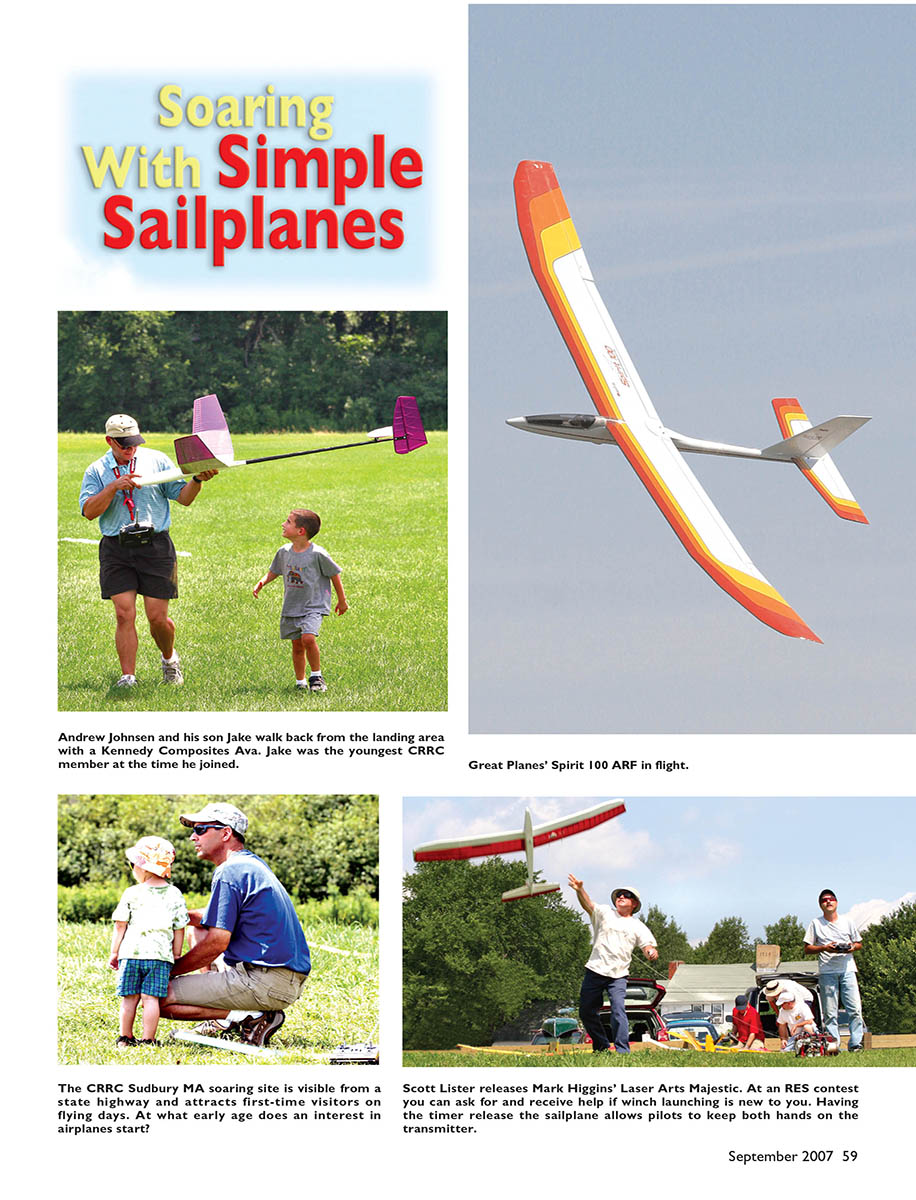
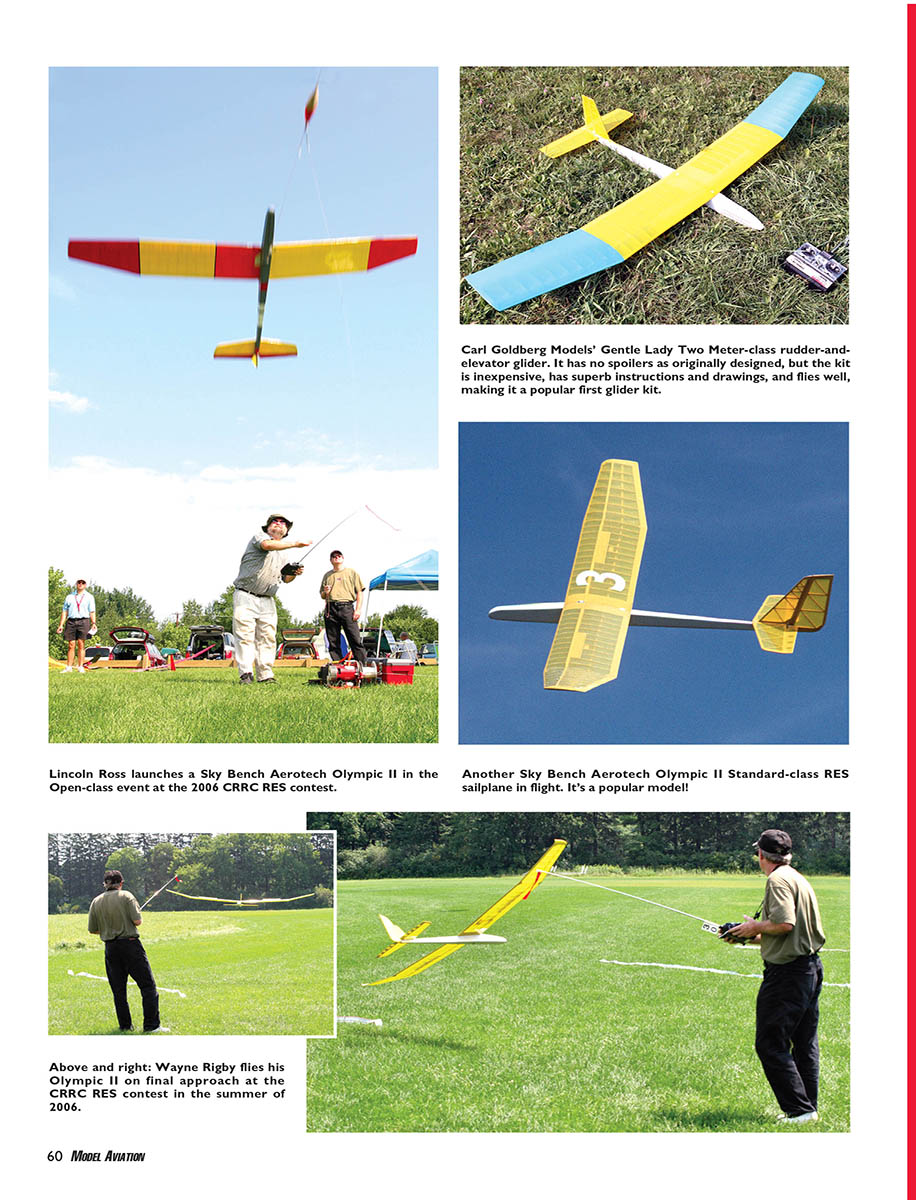
Plenty of people learn to fly with a $45 Carl Goldberg Products Gentle Lady 2-meter kit, yet the model is capable of two-hour flights. At the other end of the sophistication scale, builders might like the Mark Drela Bubble Dancer or a Kennedy Composites Ava for prebuilt-sailplane aficionados.
There is a smaller range of sailplanes, and they are generally classified by wingspan. They start at 1.5 meters/60 inches in span, often called hand-launch gliders, or HLGs, because no launching equipment is needed to fly them.
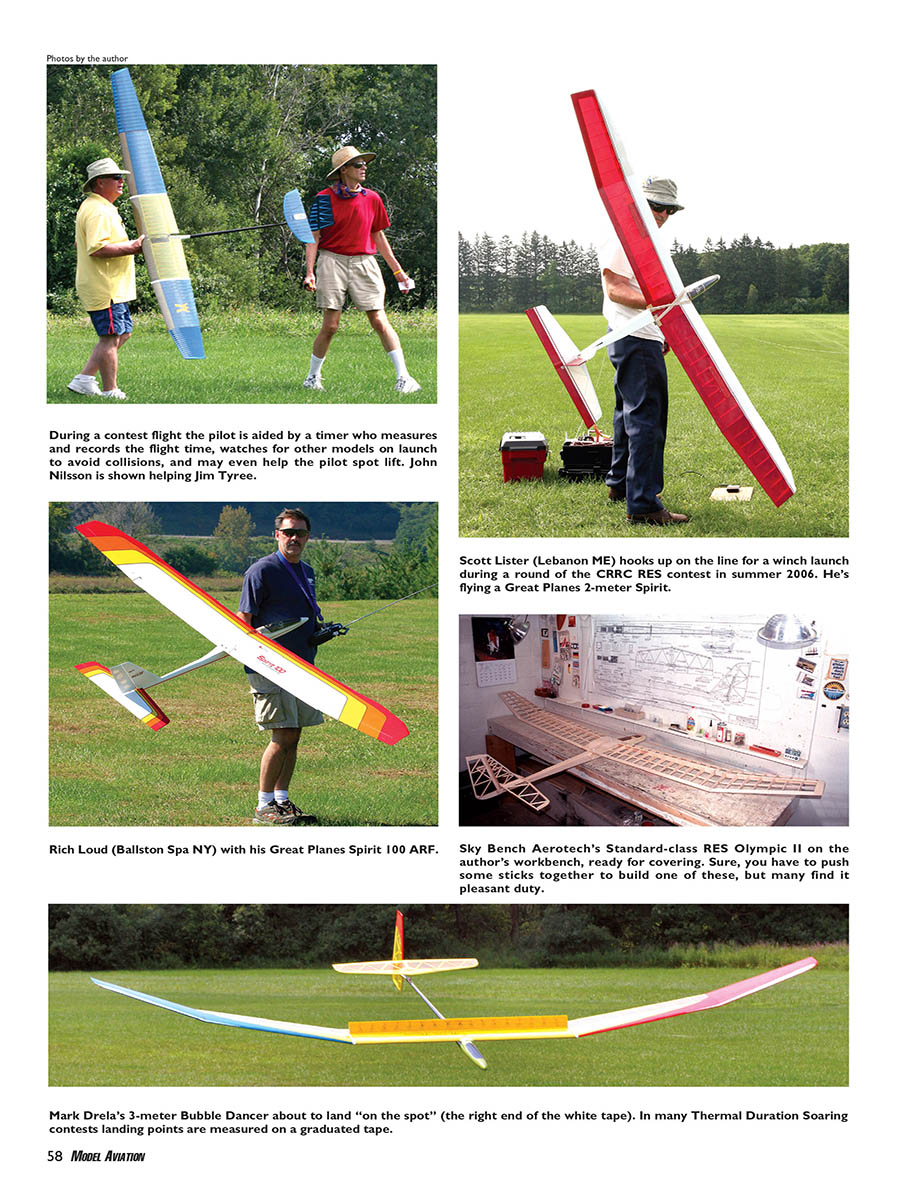
Next are the 2-meter/78-inch-span gliders, including the Gentle Lady and the Great Planes Spirit. Following that is the Standard Class, with spans limited to 100 inches. This includes the Sky Bench Aerotech Olympic II and the Great Planes Spirit 100.
The largest sailplanes belong to the Unlimited, or Open, Class, and they commonly span approximately 120 inches. The Bubble Dancer, the Bird of Time, and the Ava are Unlimited models. This class seems to have the largest number of aircraft, consisting of simple balsa kits and composite super sailplanes.
Gliders in all the preceding classes may or may not have ailerons, depending on the designer’s goals. For 2-meter and larger gliders we can see a useful aerodynamic device called a “spoiler.” With spoilers deployed, a pair of control surfaces rise (and sometimes lower as well) from the wing into the airstream and “spoil,” or reduce, the lift and add drag.
For our purposes opening the spoilers works like applying the brakes in a vehicle, which is useful for steepening the glide path when making a precise landing. Precision landings are helpful when flying from smaller fields and for scoring landing points in a contest.
A subset in each size class contains rudder, elevator, spoiler (RES) models, which do not have ailerons. Thus they save time during building and save the cost of a pair of in-wing microservos.
RES sailplanes typically fit three standard-size (inexpensive) servos—one each for rudder and elevator and one for the pair of spoilers. These gliders can be controlled with the simplest three- or four-channel radio sets.
Introduction to Competition:
The majority of AMA members report that they do not fly in competition. In case you are one of those who wonders what contest flying is like, the following is what you might find at one type of Soaring event: an RES Thermal Duration contest.
The number of RES contests held each year has increased in recent times. Large, established events such as the Central Valley R/C Soaring Club’s Fall Soaring Festival in Visalia, California (the largest RC Soaring event in the US), have added RES classes.
In 2006 63 pilots competed in the RES class at the Fall Soaring Festival. You can see the results at www.rcsoaring.com/scores/06cvcscores.htm.
On the other side of the country, and representing the other end of the size scale, the Charles River Radio Controllers (CRRC) club has hosted a summer RES contest for years. It attracts fliers from the New England area, and there may be 18-20 pilots each in the Two-Meter RES and Unlimited RES classes.
You can find large and small RES (and other Soaring) competitions across the country. Check the “Contest Calendar” listing in the back of each month’s MA to locate an event near you.
RES sailplanes are a good introduction to competition because competence in flying these models comes quicker than with aileron-equipped gliders. In addition, RES contests tend to be low-key and friendly. They are devoid of the high pressure sometimes found at other types of contests.
The flying task at a Thermal Duration contest is to launch, fly for a specified period of time, and land, ending the flight on time and near a ground target. The flight period is set before each round by the CD, who tries to provide a challenging but doable task. He or she might call for a seven-minute flight if lift conditions are good or only a five-minute task if it’s cloudy or windy and the available thermal lift is not expected to be good.
The flight score adds one point for each second aloft until the time limit for the round. Then it counts down, creating a penalty for flying too long.
A pilot scores landing points by accurately placing the sailplane’s nose when it comes to rest. The landing points are measured by a graduated tape that is staked to the ground at one end. The total score for the round is a sum of the flight points and the landing points. Five to seven rounds in each class per day are common at a contest.
People at a typical RES competition tend to be relaxed and helpful. You can ask for launch assistance or ask an experienced flier to time your round. Most pilots are happy to answer questions about the sailplanes they are using or have used. I’ve seen pilots rush to help repair damage to gliders belonging to fellow competitors. These fliers are mellow.
RES contests are generally low-key with plenty of time to prepare for each round, allowing refights for pop-offs or other launch mistakes. These events lack a cutthroat competitive atmosphere.
The CRRC’s annual RES contest has evolved into a two-day event. Lunch is served at the field, and the cost is covered in the registration fee. At midday we sit down and break bread together.
Fly ’em for a Lifetime:
An interesting thing about RES sailplanes—something known to many of us who have flown them for a long time—is that plenty of pilots never grow tired of them. Even though they are simple and inexpensive enough to serve as trainers, there’s plenty of room to grow within their flight envelope.
These models hold a Soaring pilot’s interest for years or even decades. For many fliers who have branched out to fly different and more expensive and fancier gliders, the relaxed performance the bent-wing sailplanes deliver can make for a happy flying day again and again.
Why do we fly RES? As I explained in the main article, it's a crackerjack introduction to precision RC glider flying and an easy on-ramp to Soaring competition. At the same time it holds the interest of highly skilled RC pilots, who continue to fly RES for years regardless of what other "more challenging" RC flying they do.
As exciting as FAI F3B international-level sailplane competition can be, it's tough to beat the "peaceful, easy feeling" that comes from guiding an RES floater around the sky. And as relaxing as this type of flying is, it remains challenging because every flight is different from the last, and no matter how well you fly there are subtle and elusive ways you can improve your game.
One thing you might notice after you have been to a few RES Soaring meets is that it's not only beginners who fly these "simple" gliders. Some RC Soaring "heavies" show up at club meets.
Those pilots have seen a lot, done a lot, and are still working to perfect their skills at flying simple gliders. You'll be lucky if one of them will time your round and, maybe during that seven-minute period, share a few hints, tips, and tricks that he or she has learned through the years.
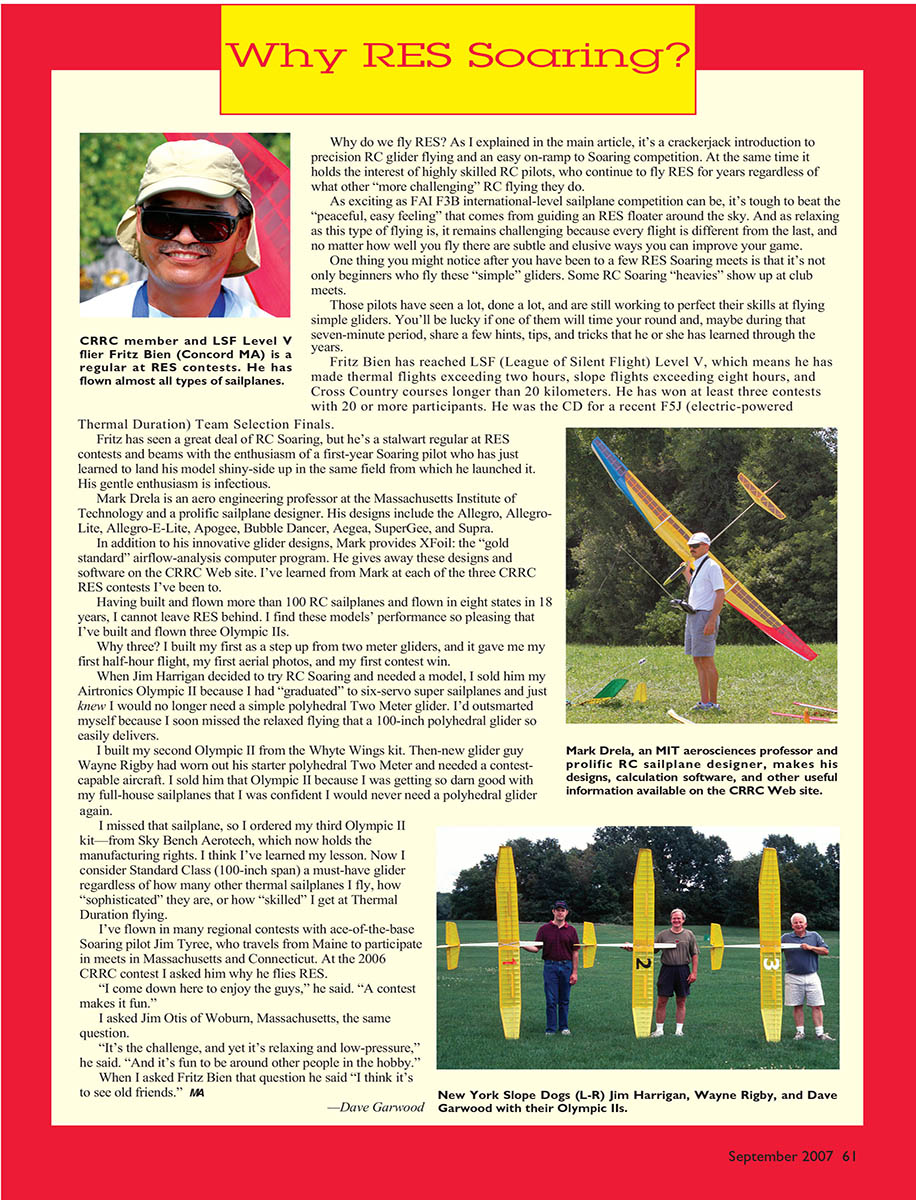
Fritz Bien has reached LSF (League of Silent Flight) Level V, which means he has made thermal flights exceeding two hours, slope flights exceeding eight hours, and Cross Country courses longer than 20 kilometers. He has won at least three contests with 20 or more participants. He was the CD for a recent F5J (electric-powered Thermal Duration) Team Selection Finals.
Fritz has seen a great deal of RC Soaring, but he's a stalwart regular at RES contests and beams with the enthusiasm of a first-year Soaring pilot who has just learned to land his model shiny-side up in the same field from which he launched it. His gentle enthusiasm is infectious.
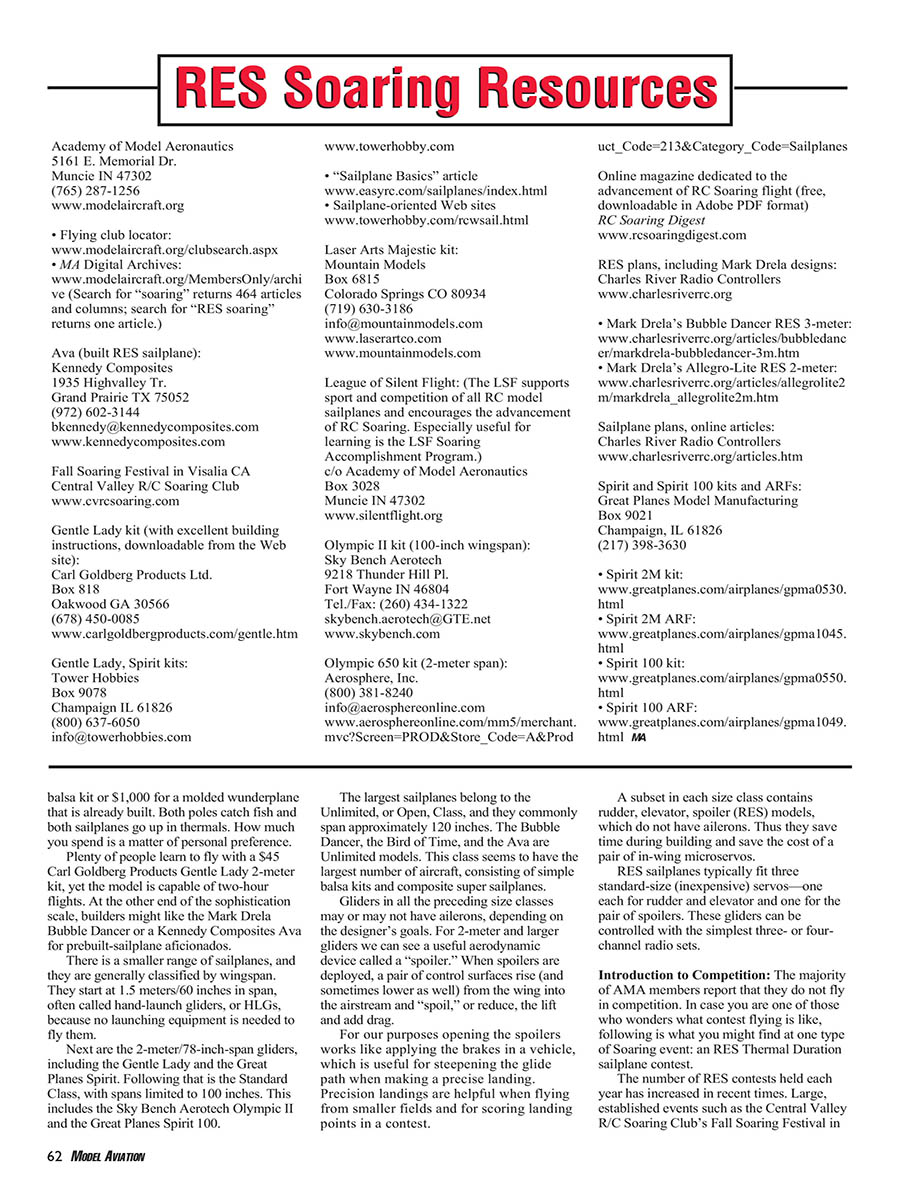
Mark Drela is an aero engineering professor at the Massachusetts Institute of Technology and a prolific sailplane designer. His designs include the Allegro, Allegro-Lite, Allegro-E-Lite, Apogee, Bubble Dancer, Aegea, SuperGec, and Supra.
In addition to his innovative glider designs, Mark provides Xfoil: the "gold standard" airflow-analysis computer program. He gives away these designs and software on the CRRC Web site. I've learned from Mark at each of the three CRRC RES contests I've been to.
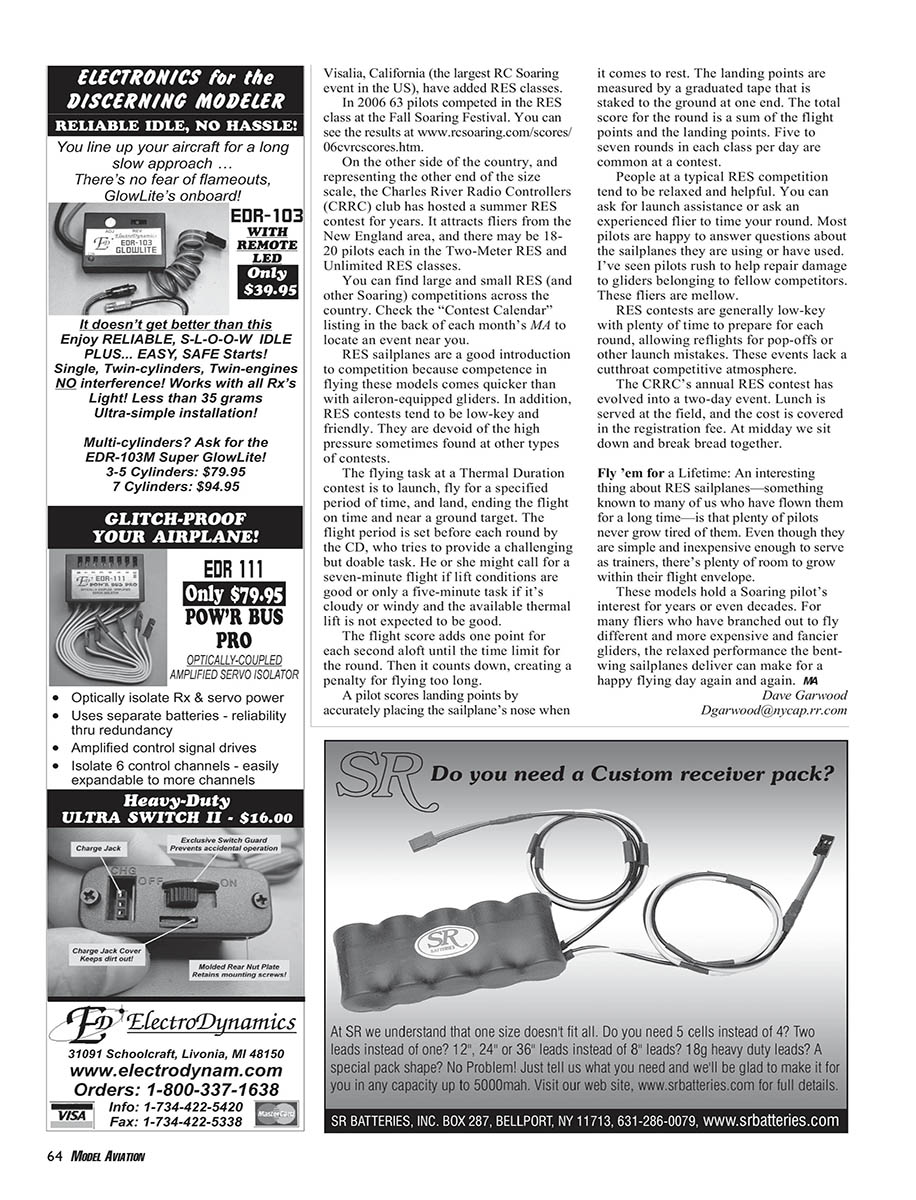
Having built and flown more than 100 RC sailplanes and flown in eight states in 18 years, I cannot leave RES behind. I find these models' performance so pleasing that I've built and flown three Olympic IIs.
Why three? I built my first as a step up from two meter gliders, and it gave me my first half-hour flight, my first aerial photos, and my first contest win.
When Jim Harrigan decided to try RC Soaring and needed a model, I sold him my Airtronics Olympic II because I had "graduated" to six-servo super sailplanes and just knew I would no longer need a simple polyhedral Two Meter glider. I'd outsmarted myself because I soon missed the relaxed flying that a 100-inch polyhedral glider so easily delivers.
I built my second Olympic II from the Whyte Wings kit. Then-new glider guy Wayne Rigby had worn out his starter polyhedral Two Meter and needed a contest-capable aircraft. I sold him that Olympic II because I was getting so darn good with my full-house sailplanes that I was confident I would never need a polyhedral glider again.
I missed that sailplane, so I ordered my third Olympic II kit—from Sky Bench Aerotech, which now holds the manufacturing rights. I think I've learned my lesson. Now I consider Standard Class (100-inch span) a must-have glider regardless of how many other thermal sailplanes I fly, how "sophisticated" they are, or how "skilled" I get at Thermal Duration flying.
I've flown in many regional contests with ace-of-the-base Soaring pilot Jim Tyree, who travels from Maine to participate in meets in Massachusetts and Connecticut. At the 2006 CRRC contest I asked him why he flies RES.
"I come down here to enjoy the guys," he said. "A contest makes it fun."
I asked Jim Otis of Woburn, Massachusetts, the same question.
"It's the challenge, and yet it's relaxing and low-pressure," he said. "And it's fun to be around other people in the hobby."
When I asked Fritz Bien that question he said "I think it's to see old friends."
—Dave Garwood [email protected]
Transcribed from original scans by AI. Minor OCR errors may remain.

