
Sopwith Dolphin
The final Sopwith of WW I is an FAC charmer
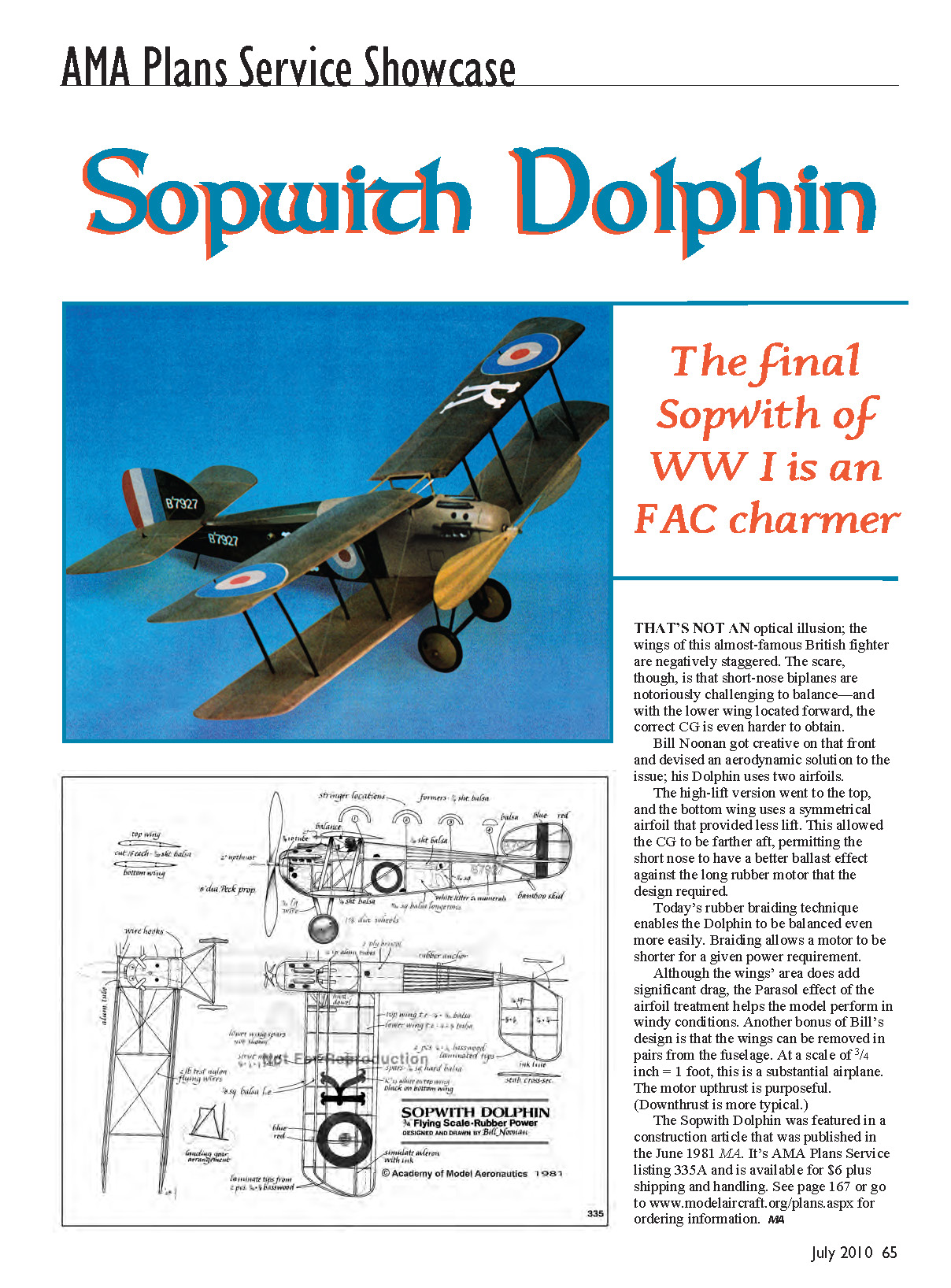
That's not an optical illusion; the wings of this almost-famous British fighter are negatively staggered. The problem, though, is that short-nose biplanes are notoriously challenging to balance—and with the lower wing located forward, the correct CG is even harder to obtain.
Bill Noonan got creative and devised an aerodynamic solution: his Dolphin uses two different airfoils. The high-lift airfoil is used on the top wing, while the bottom wing uses a symmetrical airfoil that provides less lift. This allowed the CG to be farther aft, permitting the short nose to serve as better ballast against the long rubber motor the design required.
Today's rubber-braiding techniques make the Dolphin even easier to balance. Braiding allows a motor to be shorter for a given power requirement.
Although the wings' area does add significant drag, the parasol effect of the airfoil treatment helps the model perform in windy conditions. Another bonus of Bill's design is that the wings can be removed in pairs from the fuselage. At a scale of 3/4 inch = 1 foot, this is a substantial airplane.
The motor upthrust is purposeful (downthrust is more typical).
Design highlights
- Negatively staggered wings
- Two-airfoil solution: high-lift top wing and symmetrical lower wing
- Allows CG to be farther aft for improved balance with a short nose
- Modern rubber braiding permits shorter motors for given power
- Removable wing pairs for transport/storage
- Performs well in wind due to parasol effect
- Motor uses upthrust by design
The Sopwith Dolphin was featured in a construction article published in the June 1981 MA. It's AMA Plans Service listing 335A and is available for $6 plus shipping and handling. See page 167 or go to www.modelaircraft.org/plans.aspx for ordering information.
Transcribed from original scans by AI. Minor OCR errors may remain.

