
Southeast Electric Flight Festival 2006
By Greg Gimlick
The 5th annual Southeast Electric Flight Festival (SEFF), held May 4–7, 2006, was bigger and better than each of the previous versions. I don't know how Jeff Meyers and the Fayette Flyers of Georgia do it, but those of us who attend each year are glad they find a way. This year they even managed to get help from the weatherman, and the rain held off until most attendees were packing to leave on Sunday.
The meet is held in Americus, Georgia, which is near many historical sites including the Andersonville battleground; Plains, Georgia (home of former president Jimmy Carter); and a small airfield where Charles Lindbergh soloed. The countryside is picturesque and the people welcome event participants with old-fashioned southern hospitality.
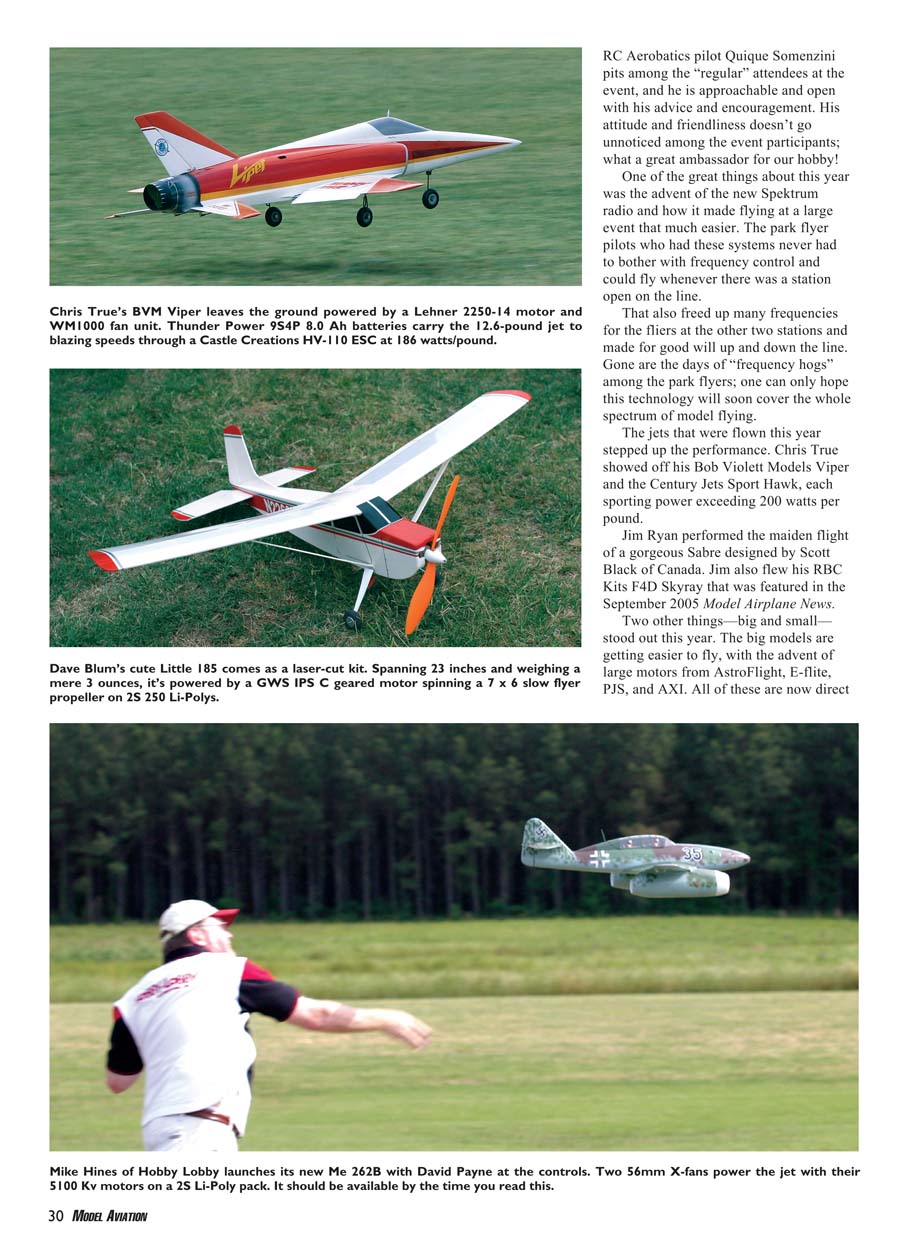
Among the most gracious hosts is Mac Hodges, who owns the flying field and one of the finest hobby shops you could hope to find. He goes all out to make sure everyone’s needs are taken care of, from providing plenty of RV parking to shelter and electricity. He even gave free airplane rides in his full-scale J-3 Cub.
The field is set up in three sections to accommodate park flyers, 3-D aircraft and helicopters, and sport fliers. With a 1,700-foot runway and the locations of the pilot stations, there were no conflicts other than the occasional overflight of a boundary that didn’t cause any problem.
Frequency control at a large event is usually a nightmare. However, with the paging system and staff at this gathering, it went smoothly and pins could always be found when kept out too long. This is the best system I’ve seen.
Sponsorship of any big event can be a double-edged sword, but Jeff and his crew kept it well balanced. Even with the large number of factory demonstration teams present to show off their models, there were enough frequencies and airspace for pilots to fly all they wanted.
More than 300 fliers registered and, as with most electric meets, each participant had several airplanes. Many of the vendors brought new models they wanted to show off, and many of us got a chance to fly them. What a great way to see and decide how you want to spend your money.
Competitions and demos
Thursday was set aside for a Limited Motor Run Sailplane competition and an F5B contest.
- Three flights were made in the "No Excuses" class. That is a two-minute motor-run window, then 13 more minutes of thermal flight, to land in a 20-foot-radius circle. Ernie Schlumberger won this contest.
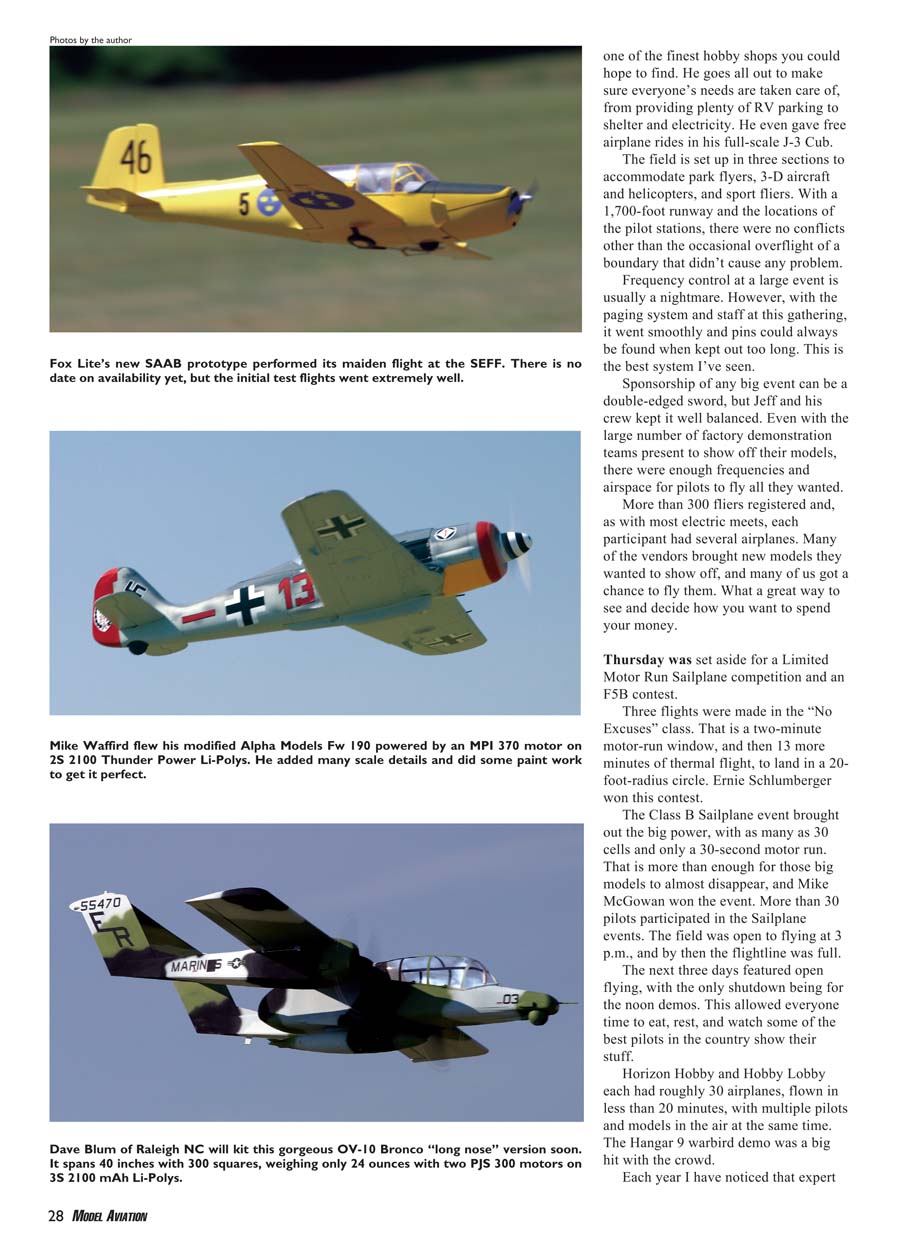
- The Class B Sailplane event brought out the big power, with as many as 30 cells and only a 30-second motor run. That is more than enough for those big models to almost disappear; Mike McGowan won the event.
- More than 30 pilots participated in the sailplane events.
The field was open to flying at 3 p.m., and by then the flightline was full.
The next three days featured open flying, with the only shutdowns being for the noon demos. This allowed everyone time to eat, rest, and watch some of the best pilots in the country show their stuff.
Horizon Hobby and Hobby Lobby each put on demos with roughly 30 airplanes flown in less than 20 minutes, with multiple pilots and models in the air at the same time. The Hangar 9 warbird demo was a big hit with the crowd.
Each year I have noticed that expert RC aerobatics pilot Quique Somenzini fits among the "regular" attendees at the event, and he is approachable and open with his advice and encouragement. His attitude and friendliness don't go unnoticed among the event participants; what a great ambassador for our hobby!
One of the great things about this year was the advent of the new Spektrum radio and how it made flying at a large event that much easier. The park-flyer pilots who had these systems never had to bother with frequency control and could fly whenever there was a station open on the line. That also freed up many frequencies for the fliers at the other two stations and made for good will up and down the line. Gone are the days of "frequency hogs" among the park flyers; one can only hope this technology will soon cover the whole spectrum of model flying.
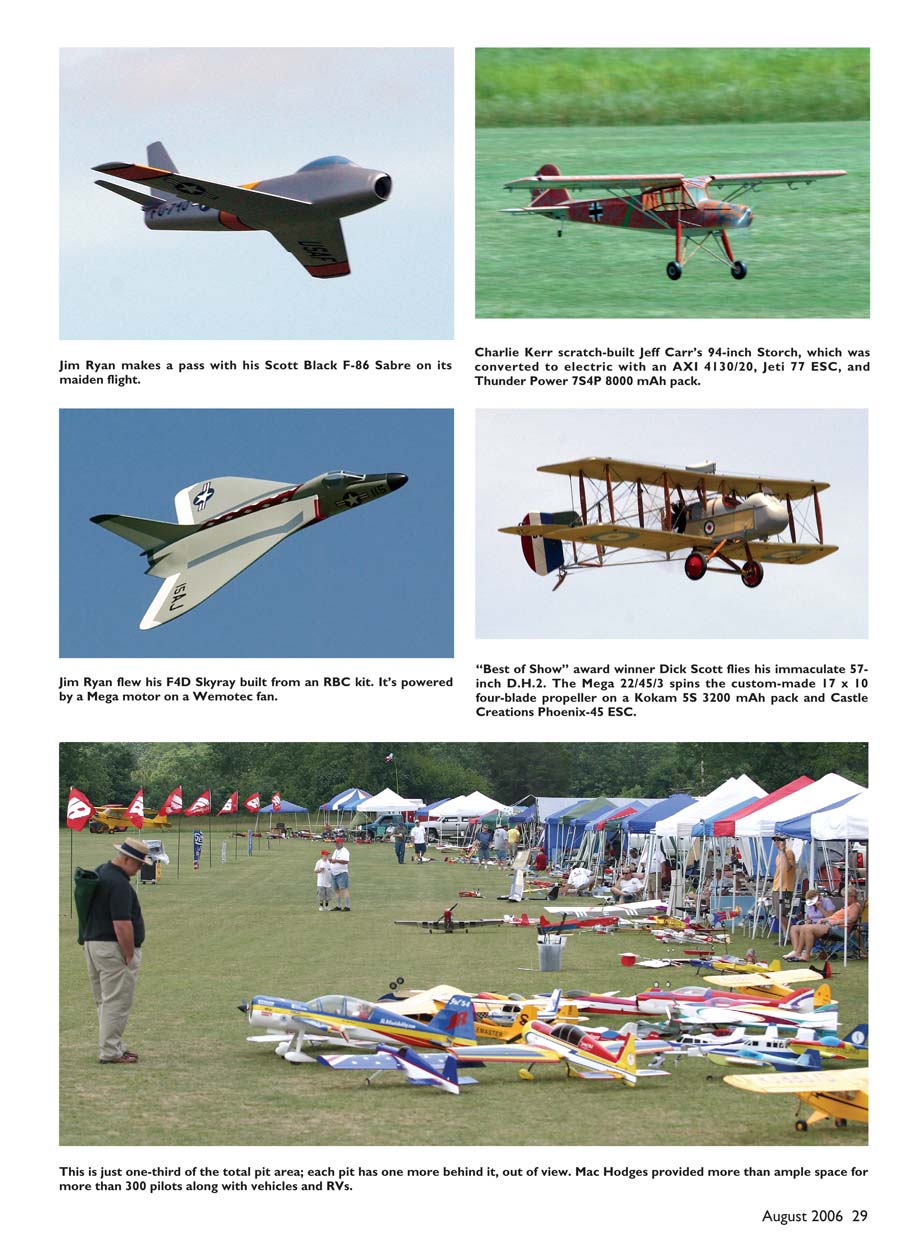
The jets that were flown this year stepped up the performance. Chris True showed off his Bob Violett Models Viper and the Century Jets Sport Hawk, each sporting power exceeding 200 watts per pound. Jim Ryan performed the maiden flight of a gorgeous Sabre designed by Scott Black of Canada. Jim also flew his RBC Kits F4D Skyray that was featured in the September 2005 Model Airplane News.
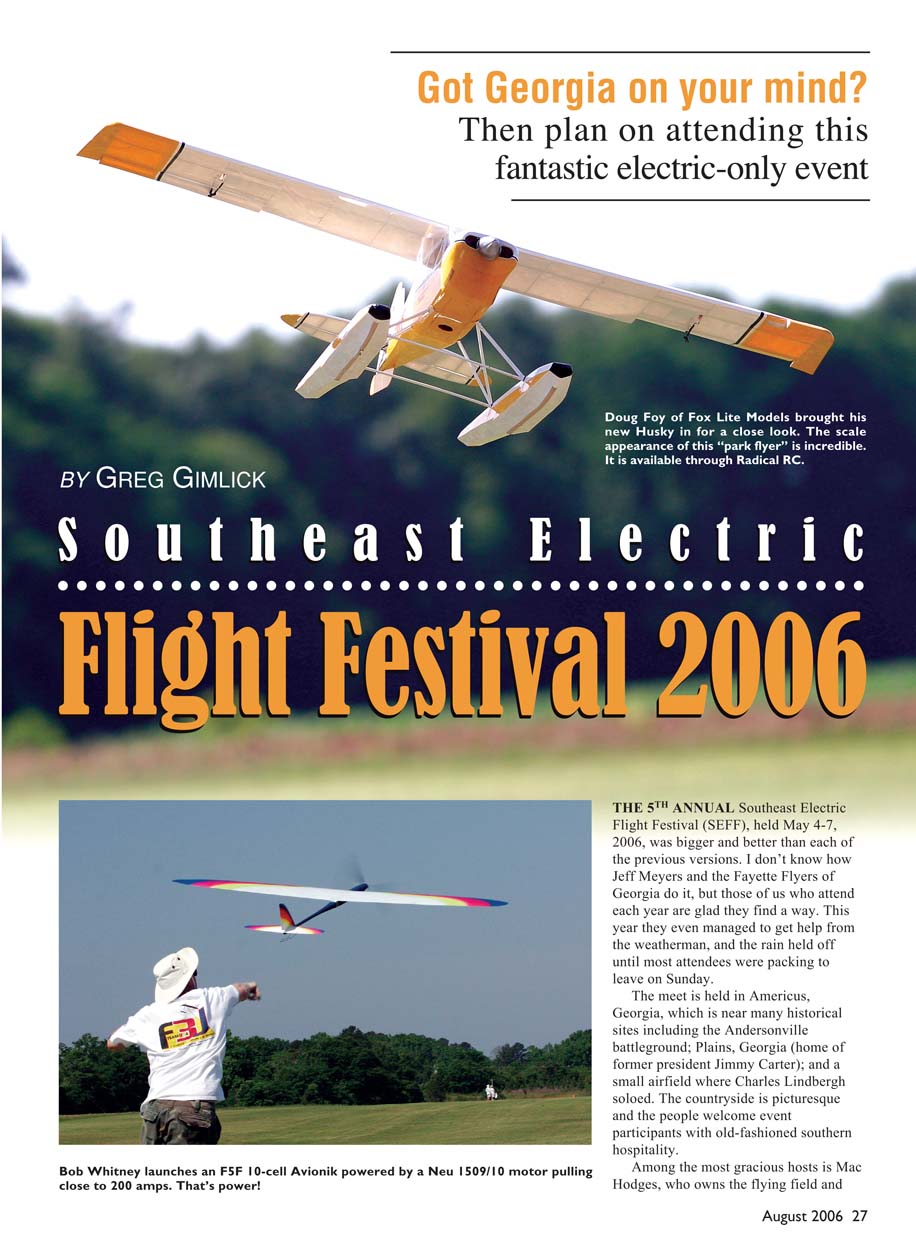
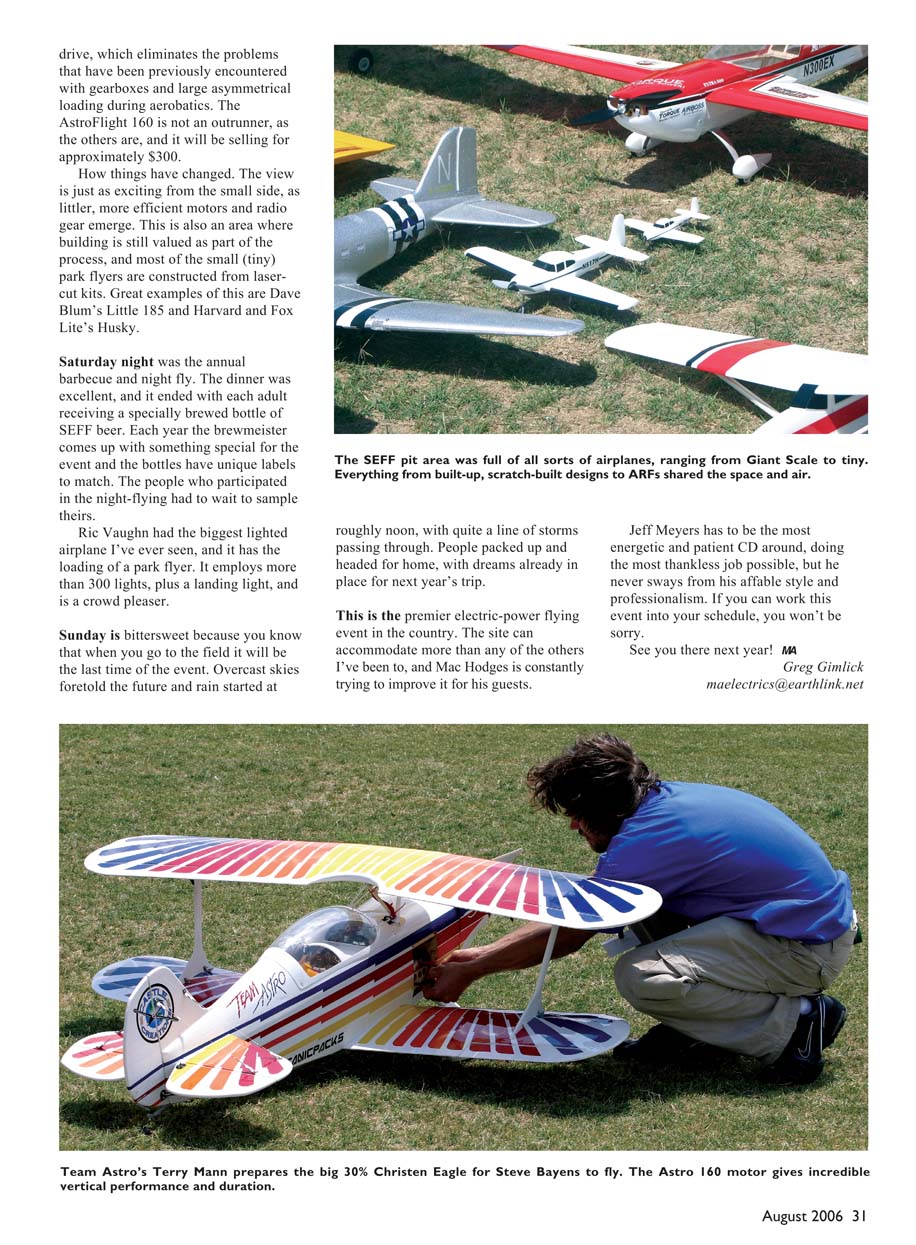
Two other trends—big and small—stood out this year. The big models are getting easier to fly with the advent of large motors from AstroFlight, E-flite, PJS, and AXI. All of these are now direct-drive. The view is just as exciting from the small side, as lighter, more efficient motors and radio gear emerge. This is also an area where building is still valued as part of the process, and most of the small (tiny) park flyers are constructed from laser-cut kits. Great examples of this are Dave Blum's Little 185 and Harvard and Fox Lite's Husky.
Saturday night and night fly
Saturday night was the annual barbecue and night fly. The dinner was excellent, and it ended with each adult receiving a specially brewed bottle of SEFF beer. Each year the brewmaster comes up with something special for the event and the bottles have unique labels to match. The people who participated in the night-flying had to wait to sample theirs.
Ric Vaughn had the biggest lighted airplane I’ve ever seen, and it has the wing loading of a park flyer. It employs more than 300 lights, plus a landing light, and is a crowd pleaser.
Sunday is bittersweet because you know that when you go to the field it will be the last time of the event. Overcast skies foretold the future and rain started at roughly noon, with quite a line of storms passing through. People packed up and headed for home, with dreams already in place for next year’s trip.
This is the premier electric-power flying event in the country. The site can accommodate more than any of the others I’ve been to, and Mac Hodges is constantly trying to improve it for his guests.
Jeff Meyers has to be the most energetic and patient contest director around, doing the most thankless job possible, but he never sways from his affable style and professionalism. If you can work this event into your schedule, you won’t be sorry.
See you there next year!
Greg Gimlick [email protected]
Transcribed from original scans by AI. Minor OCR errors may remain.

