
Southern California PSS Festival
FOR THE THIRD year running, the Inland Slope Rebels (ISR) club of Riverside, California has staged what seems to be the premiere Power Scale Soaring (PSS) event in the country—the Southern California PSS Festival, nicknamed "Cajon Summit" after its location.
The event was held May 27–28, 2000, and the ISR's energetic and visionary membership produced another outstanding event for PSS aficionados.
PSS is a specialized form of slope soaring, practiced by some of the better craftsmen and more-serious soaring pilots. Prototypes for PSS models have engines, but PSS models are designed, built, and flown in slope lift, without power.
Historically, PSS models have tended to be heavy and fast, with shorter spans and higher wing loadings than most sailplanes. Recently, EPP (expanded polypropylene) foam airplanes have allowed for PSS flying in lighter lift, so now there are warbirds and slope jets that will fly in light or strong lift.
The workmanship on fiberglass and foam airplanes tends to be high—at least for this event—showing pride in the design and production of these distinctive models.
The Site
Cajon Summit is approximately 80 miles northeast of Los Angeles. It's out in the high desert country of the San Bernardino National Forest, but this part of the preserve has few trees.
The flying site is on a several-mile-long ridge, which is 4,260 feet above sea level and approximately 1,000 feet above the valley floor. The location is remarkable for its steady south winds. They are created daily by the solar heating of the desert to the east, which draws air from the coast, through Cajon Pass and right up this slope.
There are two main flying sites: a slope for slower airplanes and a slope for faster airplanes.
Although access requires traveling through a few miles of rough dirt roads and parking is limited, the trip is worth the effort.
Landing unscathed at Cajon Summit requires precision flying, and misjudgments can put your airplane into a manzanita bush, which is not much more forgiving than a stone wall.
We had superb flying weather Saturday and Sunday—there was almost too much wind at times, and nearly any airplane anyone brought could be flown at one time or another.
The Event
The PSS Festival is mainly an informal event, with few rules and a relaxed schedule.
To add interest and to provide a focus, airplanes were static-judged by a panel of experienced builders and fliers, and trophies were awarded in six categories.
New this year was a Best Foam Plane category, to pay tribute to the highly original and sometimes-carefully-detailed designs of EPP foam—the bounceable wonder material that removes the fear of flying in crowded skies or over rough terrain.
The other categories were:
- Best WWII Plane
- Best Slope Jet
- Best Civilian Plane
- Best Prop Plane
- Best Foam Plane
- Pilots' Choice
Airplanes had to fly in order to receive an award—no show models here.
The wind was plentiful and the lift was strong Saturday and Sunday, with continuous flying all of both days. Event director Brian Laird had to call a halt to flying to announce the prize-winners and run the bountiful raffle.
Many thanks to the companies and individuals who contributed to the raffle; these gifts go far to pay the freight to run events such as this.
All judging was completed Saturday, so Sunday was a relaxed flying day. Participants flew airplanes they didn't have time to fly previously, tried maneuvers that weren't in the test program before judgment hour, and gave flying buddies a turn at the sticks. Some flew speed runs for Dave Wenzlick's radar gun.
The wind stayed with us, and a memorable late-afternoon event was a "Slope Scale Party"; for roughly a half-hour, repeated "half-pipe" back-to-back stall turns were performed with eight Brian Laird and Jeff Fukushima designs.
Flying this close in formation with these iron-horse airplanes is something that has to be seen to be believed. A few models tapped wings and exchanged minor paint scrapes, but collisions were rare and no airplanes were lost to midair accidents.
Memorable Sailplanes
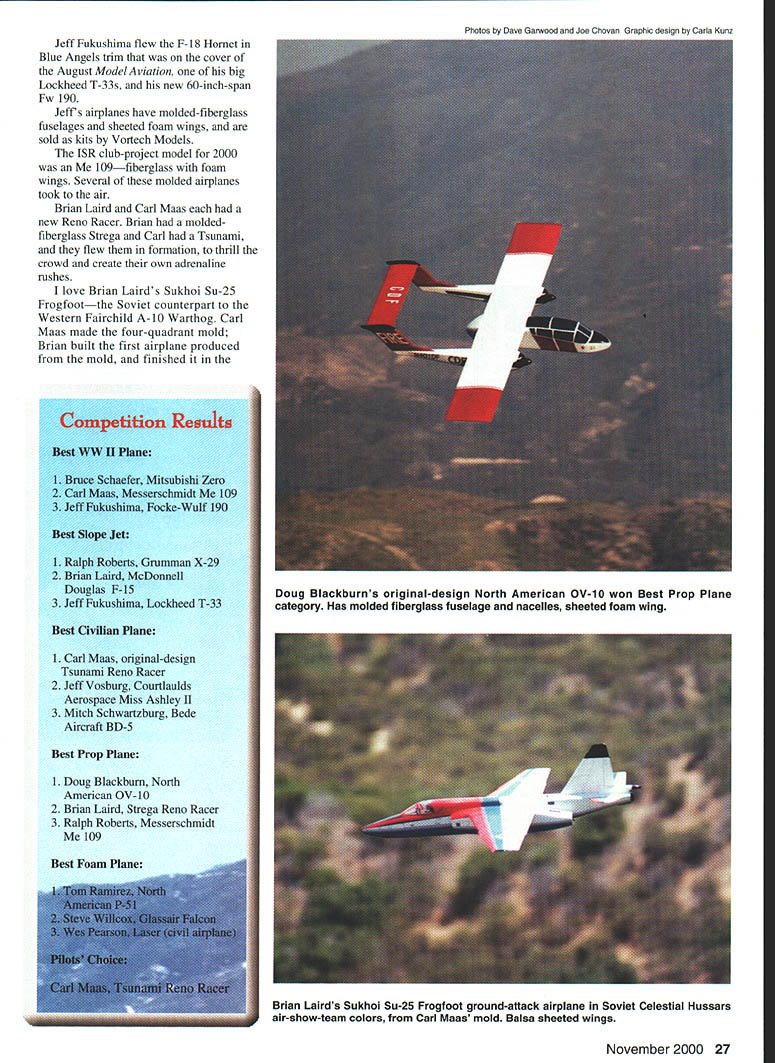
In my mind, the "technical achievement award" goes to Ralph Roberts for his Grumman X-29 experimental forward-swept-wing jet. The fuselage was molded via the lost-foam method, and wings are sheeted foam.
Ralph reported that his model demonstrates one of the design objectives of the prototype: no tip stall.
I asked Ralph if it was tough to find the center of gravity for the model, and he replied: "It sure was; I have built seven wings for this plane."
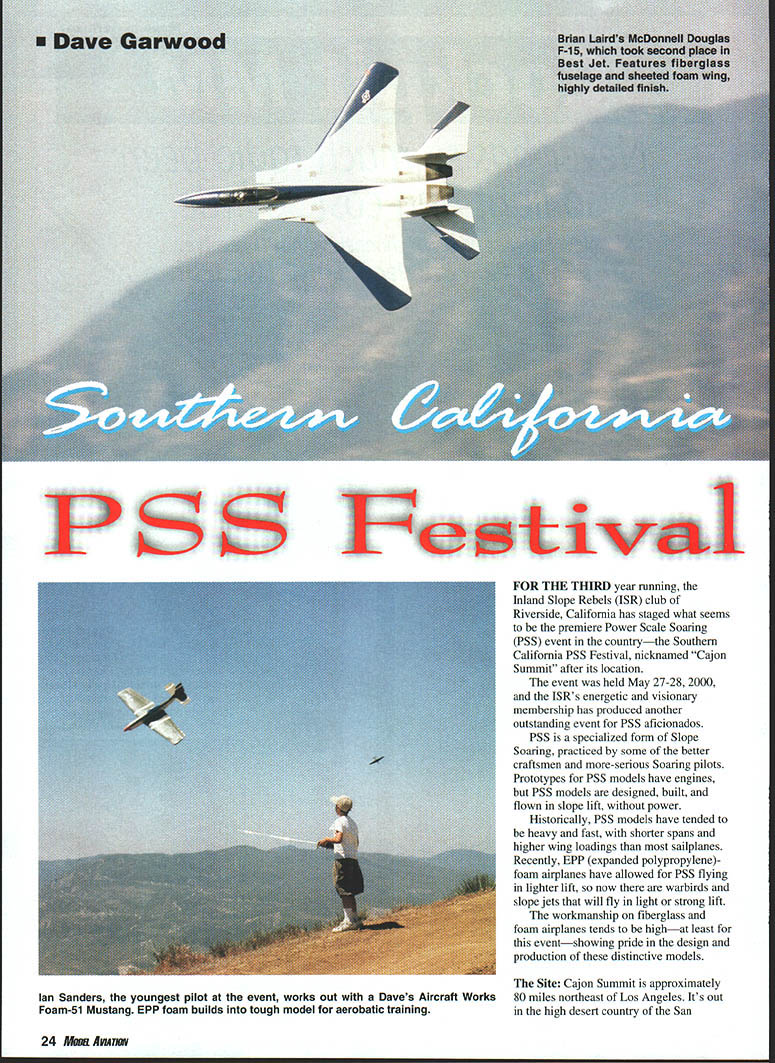
Brian Laird flew his big F-15 Eagle, converted from a Combat Models kit. The airplane was immaculately detailed, down to cross-lines in screw heads, and it flew well both days.
Brian is the successful designer of Slope Scale World War II warbirds and jets. We saw plenty of his designs in the air, including a pair of "pinball"-scheme P-63 Kingcobras, built and flown by Tim Neja and myself.
Jeff Fukushima flew the F-18 Hornet in Blue Angels trim that was on the cover of the August Model Aviation, one of his big Lockheed T-33s, and his new 60-inch-span Fw 190.
Jeff's airplanes have molded-fiberglass fuselages and sheeted foam wings, and are sold as kits by Vortech Models.
The ISR club-project model for 2000 was an Me 109—fiberglass with foam wings. Several of these molded airplanes took to the air.
Brian Laird and Carl Maas each had a new Reno Racer. Brian had a molded-fiberglass Strega and Carl had a Tsunami, and they flew them in formation, to thrill the crowd and create their own adrenaline rushes.
I love Brian Laird's Sukhoi Su-25 Frogfoot—the Soviet counterpart to the Western Fairchild A-10 Warthog. Carl Maas made the four-quadrant mold; Brian built the first airplane produced from the mold, and finished it in the colors of the Soviet air-show team—the Celestial Hussars. Brian really wrung it out this year.
Another model that demonstrated the high end of the modeler's art was Doug Blackburn's OV-10 Bronco, presented in firefighting colors. This airplane looked particularly realistic when it was in the air.
Pushing the envelope on the EPP-foam sculptor's art, Steve Patton flew his new large-scale Focke-Wulf Ta 152, a stretched-wing reconnaissance version of the FW 190. Steve took 12th place of 21 entries with the model at a Temple Hill F3C race. It was timed on Sunday at 107 mph. Who says foam can't go fast?
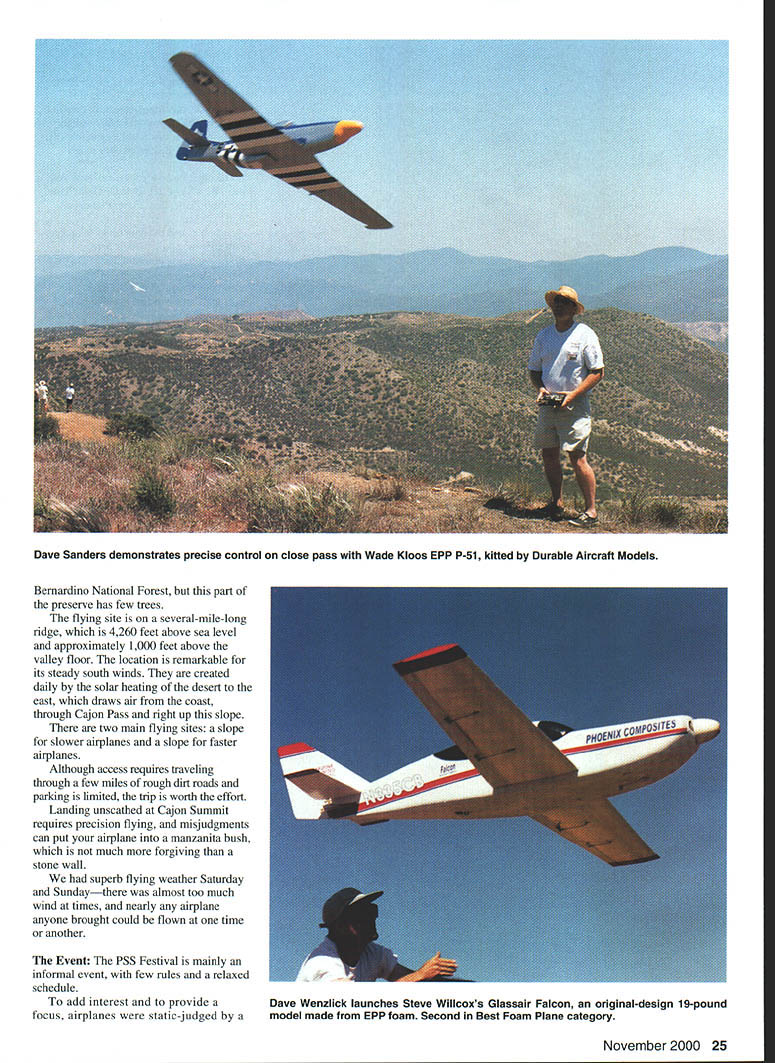
Dave Sanders, Tom Ramirez, and Wade Kloos flew large-scale P-51 Mustangs, built from Durable Aircraft Models kits. Each model was immaculately finished, demonstrating what can be done with UltraCote® covering, and looking like full-scale airplanes in the air.
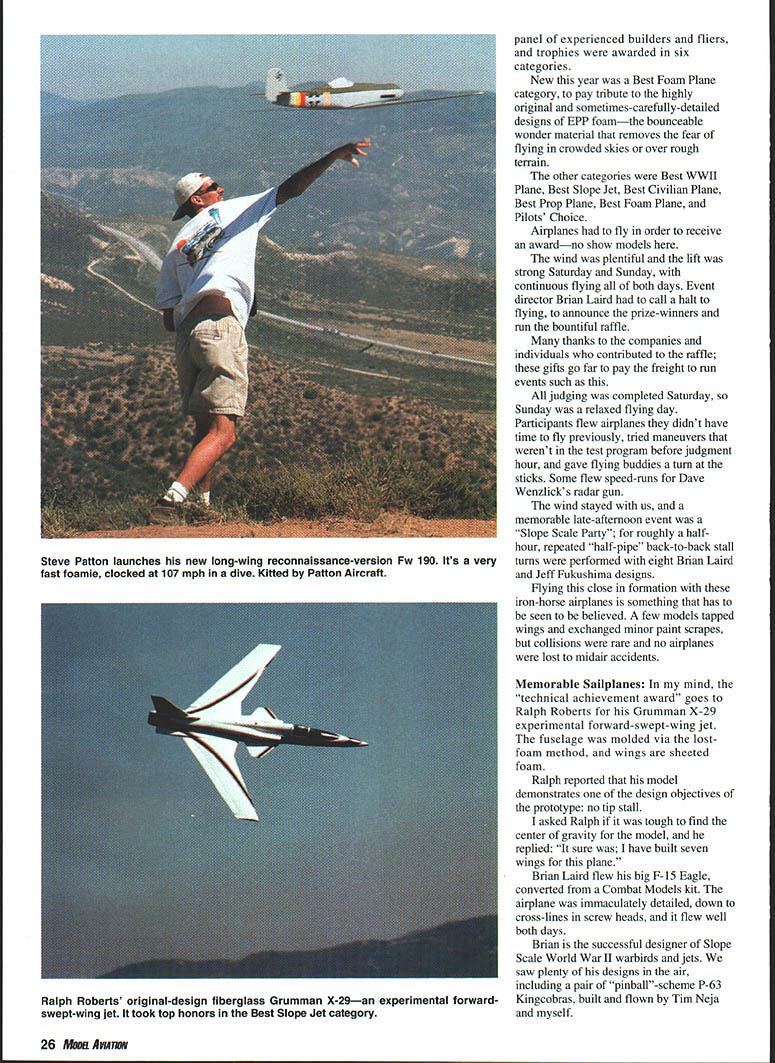
Almost everyone puts down to watch when Steve Willcox launches his giant Glassair Falcon. The original-design 19-pound EPP-foam model looked like a full-scale aircraft when it was on the wing.
On the opposite end of the scale were small EPP-foam airplanes, including Dave Sanders' 30-inch mini-foamie warbirds, Patton Aircraft's small, fast foamies, and Dave Wenzlick's very quick Bede BD-5 models.
It's not a crime to fly an airplane that looks like an airplane.
The Inland Slope Rebels and participants of the Southern California PSS Slope Festival put on a great show. For information on next year's event, see the ISR Internet site at http://ourworld.compuserve.com/homepages/ISR.
Competition Results
Best WWII Plane
- Bruce Schaefer, Mitsubishi Zero
- Carl Maas, Messerschmitt Me 109
- Jeff Fukushima, Focke-Wulf 190
Best Slope Jet
- Ralph Roberts, Grumman X-29
- Brian Laird, McDonnell Douglas F-15
- Jeff Fukushima, Lockheed T-33
Best Civilian Plane
- Carl Maas, original-design Tsunami Reno Racer
- Jeff Vosburg, Courtaulds Aerospace Miss Ashley II
- Mitch Schwartzburg, Bede Aircraft BD-5
Best Prop Plane
- Doug Blackburn, North American OV-10
- Brian Laird, Strega Reno Racer
- Ralph Roberts, Messerschmitt Me 109
Best Foam Plane
- Tom Ramirez, North American P-51
- Steve Wilcox, Glassair Falcon
- Wes Pearson, Laser (civil airplane)
Pilots' Choice
- Carl Maas, Tsunami Reno Racer
MA
Dave Garwood <REDACTED>
Transcribed from original scans by AI. Minor OCR errors may remain.

