
State of the Sport: Competition Fun Fly
by Chuck Andraka
IT'S A COMMON SCENARIO. A club puts together a small fun-fly, and you drag out the old beater to play some games and try to beat all your buddies' times. But it seems as though there is always that one guy who stays up late designing a new airplane to beat your Ugly Stick. For Pete's sake, he practices!
While everyone else is getting a kick out of playing airplane games, this guy takes it seriously. The next thing you know, he's kitting his whizbang model because it outperformed everybody's sport aircraft.
In 1988, R/C Report editor Gordon Banks put out a nationwide challenge to hotshots to come to Huntsville, Alabama, and "play" against the best in the country. Many came, many were humbled, and competition fun-fly has never been the same. There were entrants from all corners of the US and Canada. Several big names in the RC hobby attended, including RC Aerobatics and International Miniature Aerobatic Club (IMAC) competitor David Von Linsowe, Mac Hodges, and AMA Technical Director Steve Kaluf.
Spinoffs from such events have led to today's hot 3-D aircraft—profiles and all-up, lightweight ARFs. Competition fun-flys transformed from disconnected local gatherings to an official AMA rule-book event (number 705), which is now contested at the AMA Nats. An AMA SIG—the National Competition Fun Fly Association (NCFFA)—was formed to oversee and promote competitive fun-flying.
This article will chart the event and airplane development throughout the years, and hopefully it will stir interest in this aspect of the hobby.
Competition Fun Fly requires quick reflexes and develops an ability to "fly out of trouble" from many close-to-the-ground orientations. These are useful skills for many aspects of the hobby. Many Tournament of Champions and IMAC pilots have honed their skills by flying smaller profile airplanes.
In the early 1990s Competition Fun Fly earned a reputation as an airplane eater because many fast times were recorded with models that were damaged beyond recognition at the finish. However, in the mid 1990s, rules changes requiring the engine to be running and the airplane to be flyable to earn a score added a measure of finesse to the event.
It is common for a model to last several flying seasons now, although "dumb thumbs" can end things quickly! The hot competition airplanes look hard to fly because of their high degree of maneuverability, but their light weight and large wings actually make for tame models with the sticks in the middle. Some pilots have even used these aircraft as basic trainers at their clubs.
The Tasks
Some of the Competition Fun Fly tasks are traditional standards and some are new and unique twists. They can be divided into two categories: timed and mission. The timed portion typically starts and stops with the airplane on the ground, and a set of maneuvers must be completed while the stopwatch runs. These are usually some combination of loops, rolls, spins, and touch-and-gos. Timed limbo events are also included.
The mission events may or may not be timed to expedite the contest, but they typically require finesse rather than speed. This category is where you find those old club standbys such as bomb drops and spot landings.
The original R/C Report events concentrated on a small subset of timed tasks which have become traditional. By having similar tasks each year, the events quickly drove the development of airplanes and techniques to accomplish them.
One of the signature requirements is 10 Touch-and-Gos. During the early years, most pilots performed Figure Eights in a limited area, and the times were in the upper-20-second range. Then in 1990 a flier took the field and looped his airplane between each touch, substantially cutting the time to nearly 20 seconds.
In 1991 I attended my first national challenge. In the Huntsville hobby shop, one bystander asked if I was looping my Touch-and-Gos. I had not yet heard of this approach but figured I must try it. I damaged three airplanes in practice and returned to Figure Eights for the contest. Seeing the technique was key. I changed my airplane setup and learned the method, and now loop touches are fun and easy!
With airframe improvements, modern times are roughly 15 seconds. Jerry Smith holds the record at 12.53 seconds. The record for taking off, looping 10 times, and landing is 9.11 seconds without Touch-and-Gos.
To expand the possibilities for Touch-and-Gos, there are two tasks; one is the 360 Touch-and-Go, which allows a loop. The other is a minimum 180 Touch-and-Go, with no loops permitted. These maneuvers involve different skills in their completion.
Another signature task is a timed Inverted Limbo. A ribbon is set to 5 feet high, and you must pass your model under it five times and then land for time.
In the R/C Report days, the task was three passes long, and the best times were in the 30- to 40-second range. Most pilots were unsuccessful. Now, with five passes, the best times are roughly 25 seconds, and the majority of the field is successful. You must practice this skill to overcome that fear factor.
The remainder of the timed tasks include many combinations of loops, rolls, spins, and touches, all against the clock. A perennial favorite is the Roop: a roll followed immediately by a loop. Just be sure to get off of the aileron before you pump elevator!
In the old days, five Roops was the standard. However, when times for that event dropped to well below 10 seconds, we came to favor Split Roops, where sets of Roops are separated by Touch-and-Gos. The most common variant now is 3 x 3 Split Roops, where three sets of three Roops are performed with a Touch-and-Go between each set.
The timed tasks can be divided into a sequence. That's 27 maneuvers in 25 seconds!
As the airplanes have increased in capability, the key to winning any task is planning ahead for placement at the end. Since the tasks are only 10-30 seconds in duration, taking a few seconds getting back to the ground turns a good run into a bad flight.
Situating the model over the runway with a few feet to spare, pointed into the wind, will top off a great set of maneuvers. Since the airplane must be flyable and the engine must be running after the task to obtain a score, the "crash for time" approach is eliminated.
The mission tasks include those in which points are earned for accuracy, and they often require paraphernalia. More recently, these tasks are also timed to speed along the event's administration. He or she with the highest amount of earned points typically wins, but time can be used as a tiebreaker.
Common missions include the Bomb Drop, Spot Landings, and the "Carlisle Can Can," or Can Spot Landing. In this unique event, an empty soda can is tied to the airplane on a 50-foot string, and the pilot must touch the can in the circles for points without touching the model to the ground. Don't watch the can! Bomb Drop uses a dowel attached to the model and a washer or piece of tubing with a streamer attached as the bomb. This category also includes Climb and Glide events (glide upright or inverted for maximum time) and climb-and-spin events.
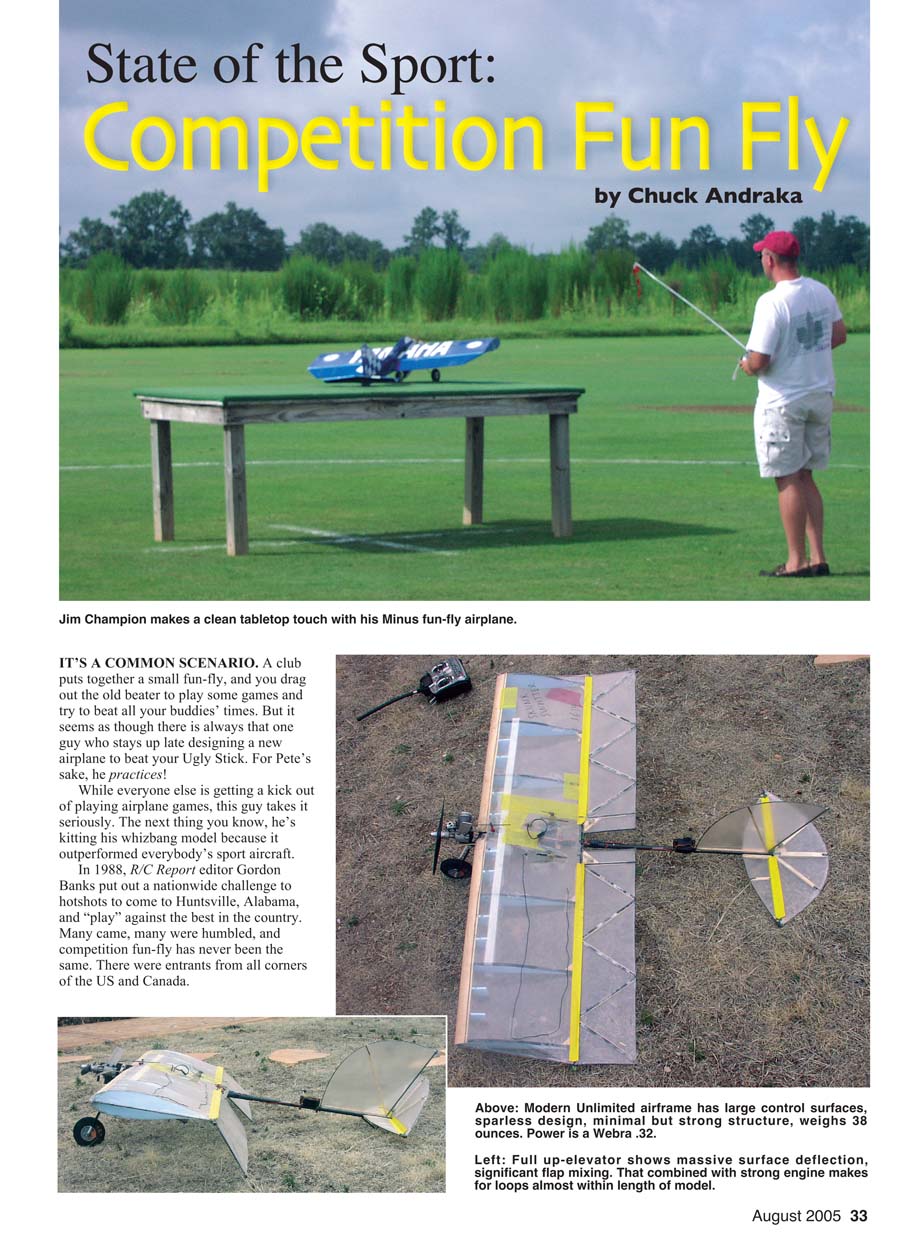
The most popular spectator event is the Table Landings, where the pilot attempts to make a number of Touch-and-Gos on a 4 x 8-foot table. As flier skill and airplane capability have continually improved, this Masters-level event has developed into a timed mission; take off from the ground, perform three table touches, and land on the ground.
At many events the tasks are divided into Masters and Sportsman skill levels. This encourages newcomers to participate without having to attempt the most trying tasks or compete against seasoned veterans.
The flying is also divided into Unlimited and Fun Fly categories of airplanes and tasks. Unlimited has no restrictions on the airplane and consists of timed tasks. Fun Fly traditionally emphasizes the mission tasks, although timed tasks are also included. The Fun Fly class also sets airframe limitations, such as minimum dimensions for profile models and the banning of "stick-boom" airplanes.
The Models
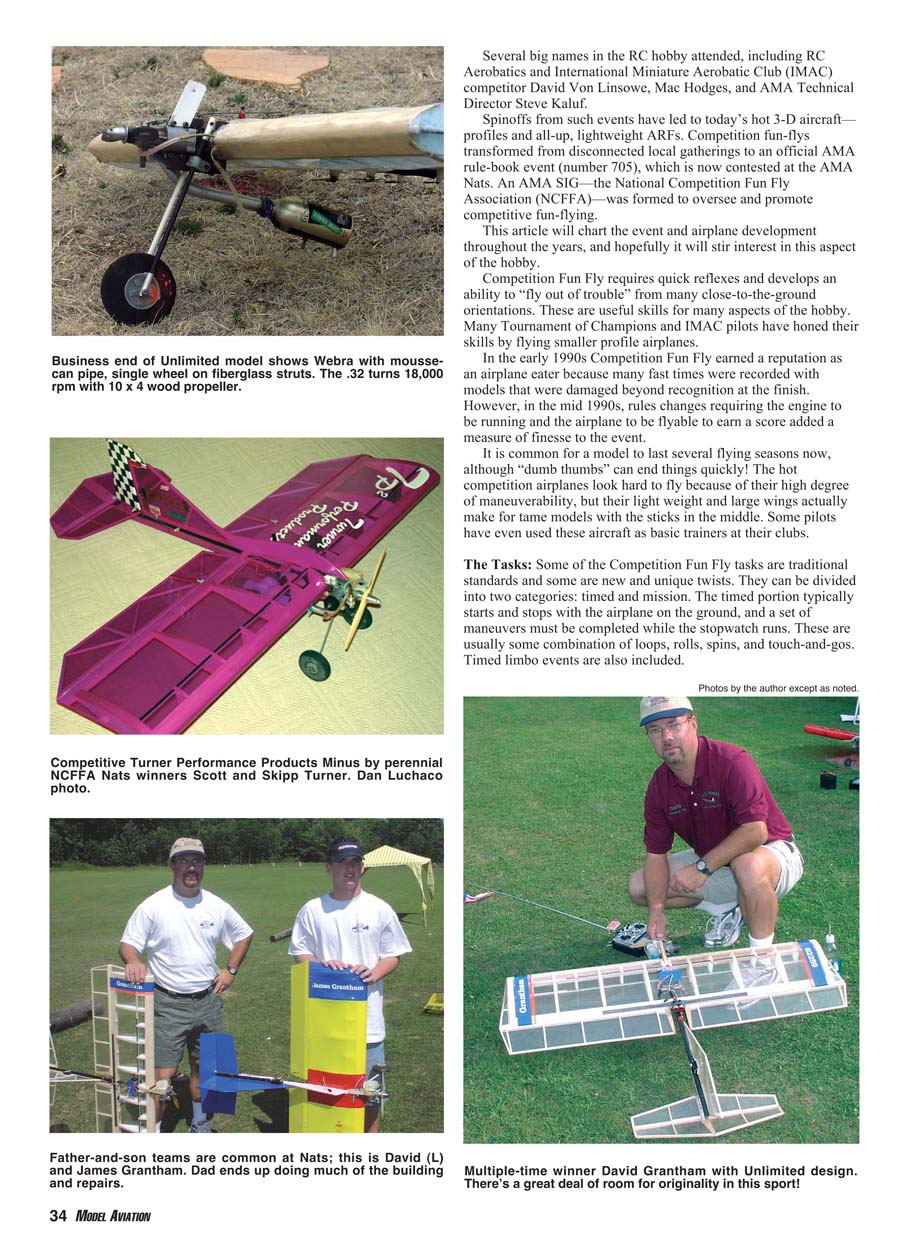
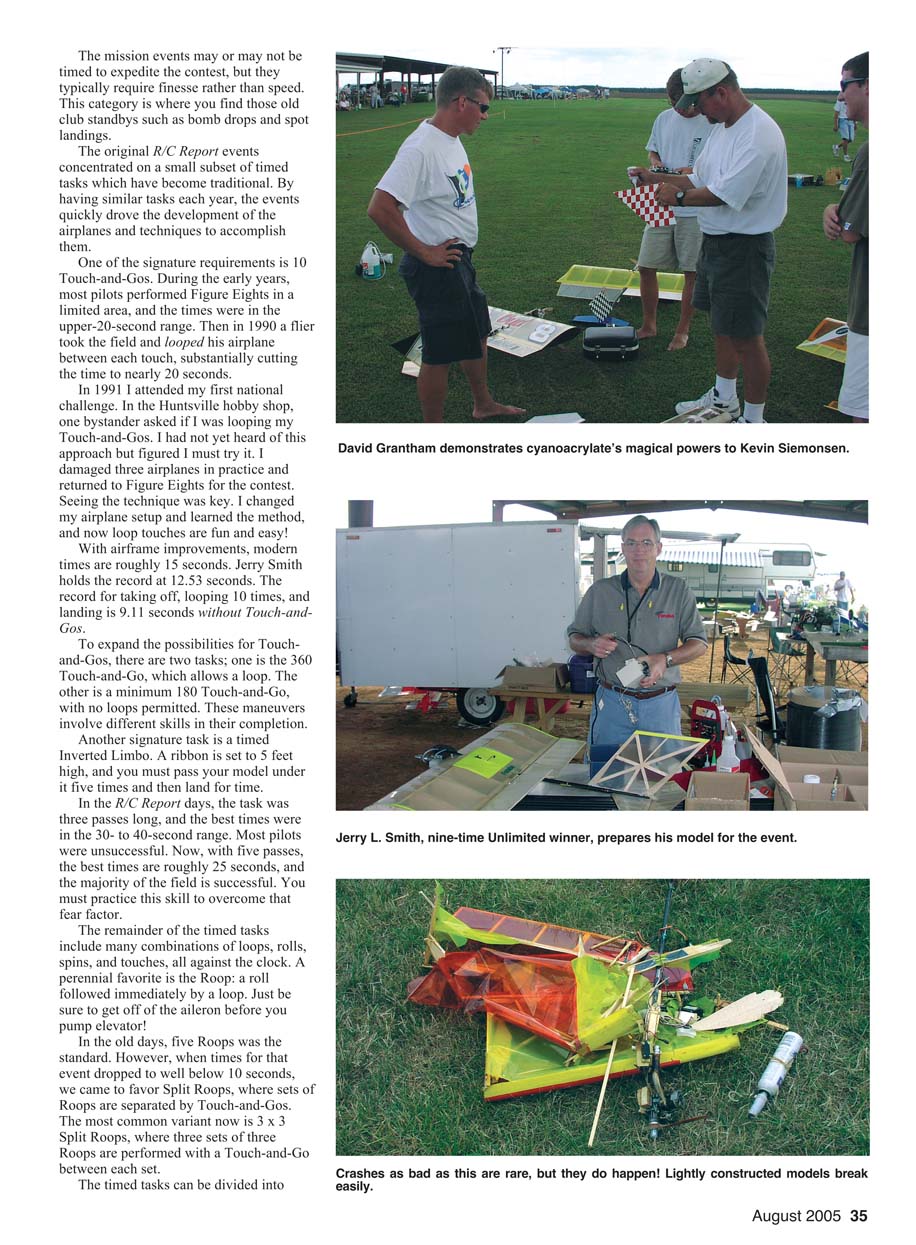
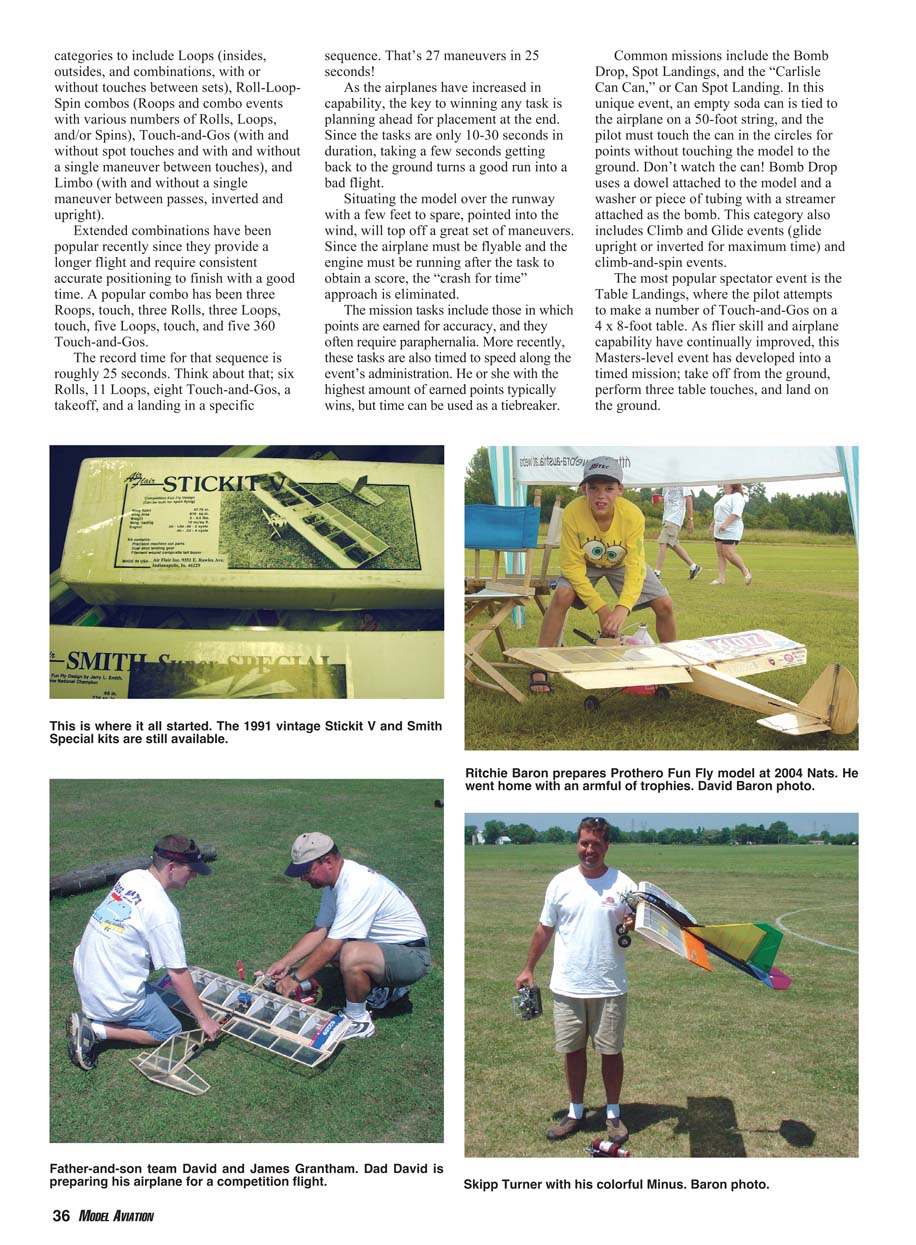
The Unlimited aircraft have evolved into looping, rolling machines. They typically have straight "Hershey-bar" wings with thick airfoils, carbon-tube fuselages, and large control surfaces. Their weight is minimal and control is enormous.
Dan Stevens is generally recognized as being the father of the stick-boom airplane, with his Stick-It series starting in the late 1980s. Soon thereafter, this new breed of model included such well-known designs as the Smith Special (a common plans-built and kitted design by Jerry L. Smith) and the Yard Dart. Pilots furiously began to develop these airplanes, and the sport evolved quickly. The kit names have almost become generic terms for this class of model.
The earliest such designs had 48-inch wingspans with 650-700 square inches of wing area. They were powered by lightweight .40 engines—the HP Gold Cup was the most popular—which were coupled with homemade, lightweight "mousse-can" pipes. All-up, the models weighed approximately 3 pounds.
In the late 1980s and early 1990s, the airplanes developed rapidly, shedding weight and improving performance. In 1992 Mac Hodges flew with a 34-ounce version, but that is at the low end of the scale! The wingspans rapidly dropped to 42-43 inches, and common weights steadied at 36-38 ounces. The .32 class of engine now dominates, and the Webra is the most common.
Airfoils are critical to these airplanes' high performance. In 1992 Jerry L. Smith showed up with a wind-tunnel-designed reflex airfoil that Robert Vess (who now works with NASCAR in wind-tunnel testing) developed at North Carolina State University. Jerry called his new airplane the Smith Super Special, and plans were immediately available from Radio Control Modeler magazine.
The airfoil had excellent high-angle-of-attack capabilities and slowed immediately when power was removed, facilitating accurate and quick landings. Typically at 90% original size and spanning 42 inches, this airfoil is still the most popular, although some have tried newer, thicker variations.
Jerry, Harold Parker, and Jeff Gilbert pioneered the development of mousse-can mufflers, which are essentially extremely lightweight, homebuilt tuned pipes. The three still make and market custom cans for many applications.
With advances in servo technology, the ailerons have grown from 3-inch chords in 1990 to chords that are usually longer than 5 inches today. The popular low-cost, high-power servos from Hitec have helped this progression, but every brand is represented.
As I mentioned, the trusty Webra .32 engine is popular, but the new Webra .36 has made some inroads. The propellers are usually 10 x 4 wood, for their quick spooling capability. Fuel ranges from 15% to 40% nitromethane, with only 1-2 ounces on board.
Airplane technology has fully embraced new composite technologies. Old models with fiberglass booms have been upgraded with wound carbon to save weight, even though the difference is only noticeable at the highest levels of competition. Substantial strengthening with carbon tow and strips is seen in many models.
A minimal amount of ribs is used—typically six for the whole wing—just to hold the covering out. There have even been some sparless designs, using the covering as a load-bearing member. The need is for minimal weight, a strong frame, and lots of power and control authority.
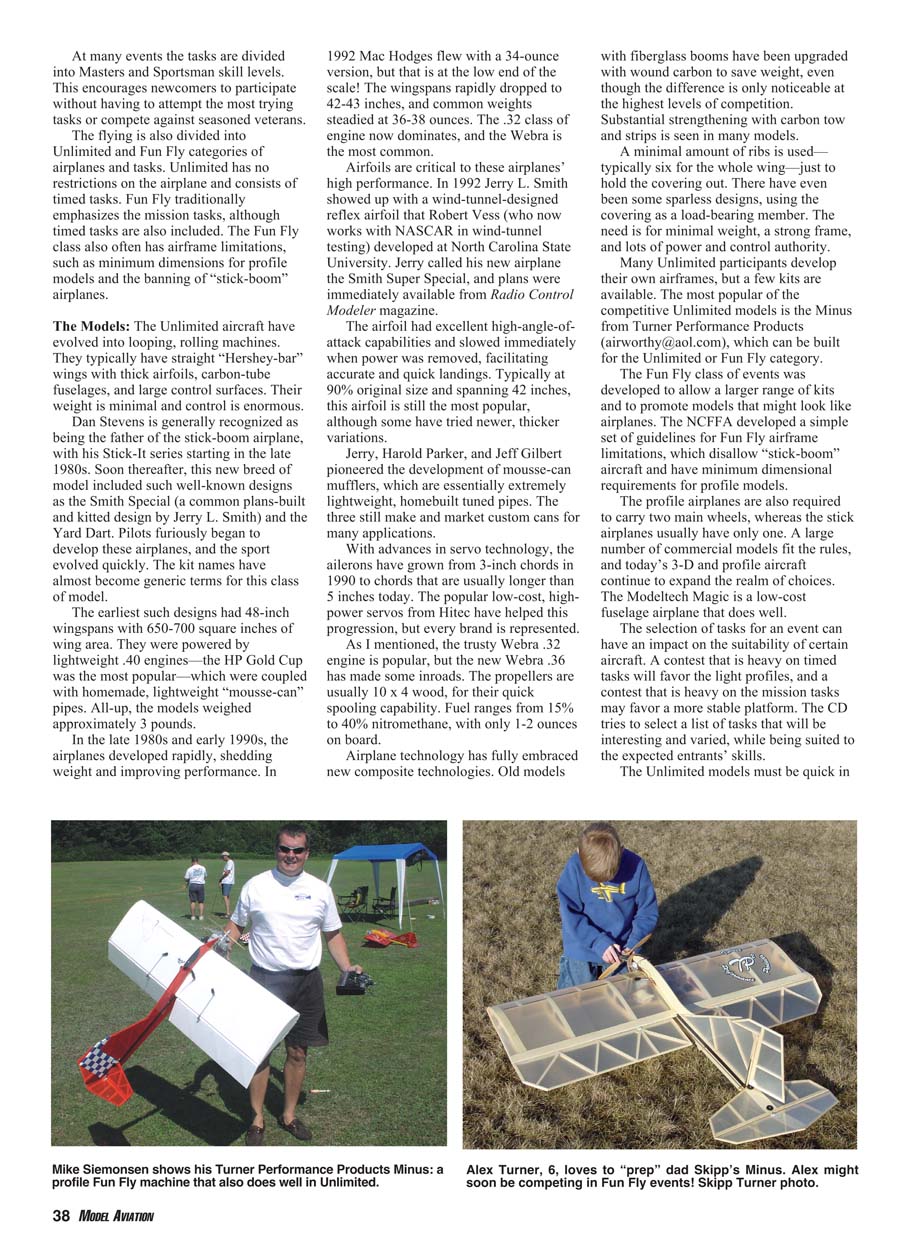
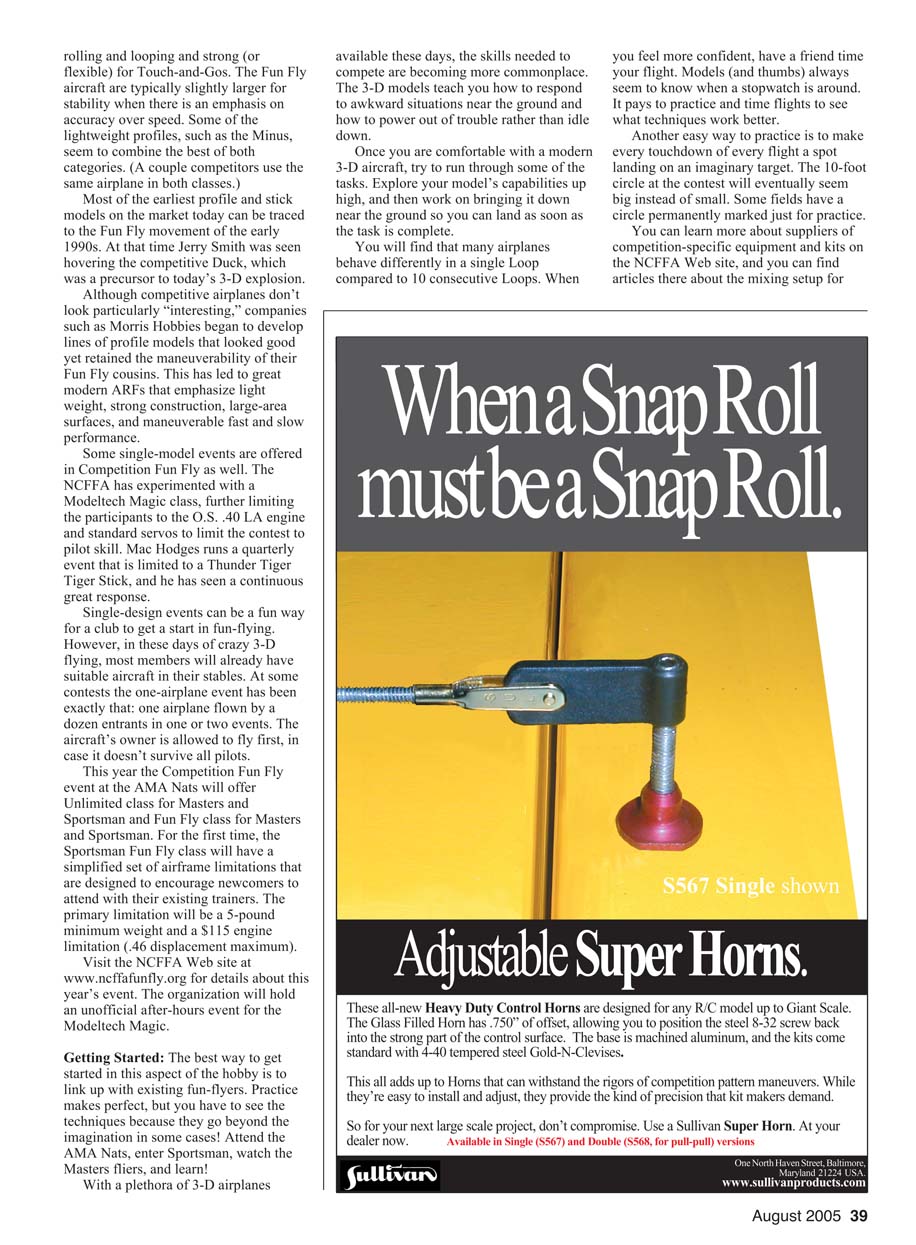
Many Unlimited participants develop their own airframes, but a few kits are available. The most popular of the competitive Unlimited models is the Minus from Turner Performance Products ([email protected]), which can be built for the Unlimited or Fun Fly category.
The Fun Fly class of events was developed to allow a larger range of kits and to promote models that might look like airplanes. The NCFFA developed a simple set of guidelines for Fun Fly airframe limitations, which disallow "stick-boom" aircraft and have minimum dimensional requirements for profile models.
The profile airplanes are also required to carry two main wheels, whereas the stick airplanes usually have only one. A large number of commercial models fit the rules, and today's 3-D and profile aircraft continue to expand the realm of choices. The Modeltech Magic is a low-cost fuselage airplane that does well.
The selection of tasks for an event can have an impact on the suitability of certain aircraft. A contest that is heavy on timed tasks will favor the light profiles, and a contest that is heavy on the mission tasks may favor a more stable platform. The CD tries to select a list of tasks that will be interesting and varied, while being suited to the expected entrants' skills.
The Unlimited models must be quick in rolling and looping and strong (or flexible) for Touch-and-Gos. The Fun Fly aircraft are typically slightly larger for stability when there is an emphasis on accuracy over speed. Some of the lightweight profiles, such as the Minus, seem to combine the best of both categories. (A couple competitors use the same airplane in both classes.)
Most of the earliest profile and stick models on the market today can be traced to the Fun Fly movement of the early 1990s. At that time Jerry Smith was seen hovering the competitive Duck, which was a precursor to today's 3-D explosion.
Although competitive airplanes don't look particularly "interesting," companies such as Morris Hobbies began to develop lines of profile models that looked good yet retained the maneuverability of their Fun Fly cousins. This has led to great modern ARFs that emphasize light weight, strong construction, large-area surfaces, and maneuverable fast and slow performance.
Some single-model events are offered in Competition Fun Fly as well. The NCFFA has experimented with a Modeltech Magic class, further limiting the participants to the O.S. .40 LA engine and standard servos to limit the contest to pilot skill. Mac Hodges runs a quarterly event that is limited to a Thunder Tiger Tiger Stick, and he has seen a continuous great response.
Single-design events can be a fun way for a club to get a start in fun-flying. However, in these days of crazy 3-D flying, most members will already have suitable aircraft in their stables. At some contests the one-airplane event has been exactly that: one airplane flown by a dozen entrants in one or two events. The aircraft's owner is allowed to fly first, in case it doesn't survive all pilots.
This year the Competition Fun Fly event at the AMA Nats will offer Unlimited class for Masters and Sportsman and Fun Fly class for Masters and Sportsman. For the first time, the Sportsman Fun Fly class will have a simplified set of airframe limitations that are designed to encourage newcomers to attend with their existing trainers. The primary limitation will be a 5-pound minimum weight and a $115 engine limitation (.46 displacement maximum).
Visit the NCFFA Web site at www.ncffafunfly.org for details about this year's event. The organization will hold an unofficial after-hours event for the Modeltech Magic.
Getting Started
The best way to get started in this aspect of the hobby is to link up with existing fun-flyers. Practice makes perfect, but you have to see the techniques because they go beyond the imagination in some cases! Attend the AMA Nats, enter Sportsman, watch the Masters fliers, and learn!
With a plethora of 3-D airplanes available these days, the skills needed to compete are becoming more commonplace. The 3-D models teach you how to respond to awkward situations near the ground and how to power out of trouble rather than idle down.
Once you are comfortable with a modern 3-D aircraft, try to run through some of the tasks. Explore your model's capabilities up high, and then work on bringing it down near the ground so you can land as soon as the task is complete.
You will find that many airplanes behave differently in a single Loop compared to 10 consecutive Loops. When you feel more confident, have a friend time your flight. Models (and thumbs) always seem to know when a stopwatch is around. It pays to practice and time flights to see what techniques work better.
Another easy way to practice is to make every touchdown of every flight a spot landing on an imaginary target. The 10-foot circle at the contest will eventually seem big instead of small. Some fields have a circle permanently marked just for practice.
You can learn more about suppliers of competition-specific equipment and kits on the NCFFA Web site, and you can find articles there about the mixing setup for competition aircraft. As with an RC Aerobatics airplane or a racer, the setup is key to comfortable flying.
If you place well at local contests, you can try the national level. Even if you struggle to place locally, there is nothing more fun than watching the best go at it, asking questions, and pushing your envelope of experience. The pilots at the Nats are friendly and ready to help. Fun and competition are not mutually exclusive!
The People
It is exciting to think that top RC fliers of their time have competed with us throughout the years, but Competition Fun Fly has been more about the local club fun-flyer excelling at the national level. Everyday pilots and airplane designers have had an impact on the overall RC scene, leading to the popular 3-D move.
Jerry L. Smith’s name is most synonymous with Competition Fun Fly. He has won the national Unlimited-class events nine times, dating back to the Huntsville days. He is always bringing a new approach to the table, and his model designs have been popular.
David Grantham typifies the southern laid-back approach. David is also a multiple winner of the Unlimited class. Despite the great fame this accomplishment brings, both are more than willing to help anyone.
Scott and Skipp Turner are like the Gillette Young Guns (NASCAR drivers); they have not been around as long, but they know the value of practice and equipment development. Scott and Skipp are top competitors in Unlimited and Fun Fly classes. They have redefined competition in the latter with their Minus design, and they often finish 1-2 in this category at the larger contests. The Turners kit the Minus, which is highly competitive in either class.
Harold Call represents a class of pilots that is most exciting to this hobby. He attended our 2001 Nats and competed in Sportsman. He listened, learned, and practiced. The next year he was in the middle of the pack in Masters, and he has finished in the top five since then. This shows that with dedication and persistence, a new pilot can become successful quickly. Many of the names I have mentioned helped Harold learn the hobby.
Competition Fun Fly has changed greatly, from the old weekend club events with “fly what you brung” to sophisticated airframes and precision tasks. However, the move to lightweight 3-D and profile aircraft in the marketplace has greatly expanded the variety of models and the people with the skill sets to compete. In addition, new power options in high-powered electrics are providing backyard practice sessions for people who can’t get out to the field.
The emphasis is on the fun in Fun Fly. It has developed into serious competition at the national level, but it is still a real kick in the pants. People who helped me when I showed up overmatched in 1991 are still attending every year, reliving the old days and cranking out new ideas and record times.
Any serious competition in this hobby is made more fun by the people. They will do whatever they can to get you set up and going. They also help with whatever you need (except thumbs) during the contest. It is common to see airplanes, motors/engines, and/or complete backup units loaned to competitors.
Contact NCFFA personnel via the Web site (www.ncffafunfly.org); this SIG has the people and resources to help you get started. Plan to attend the Nats this year in Muncie, Indiana, the weekend of July 30-31. Don’t just watch; enter Sportsman or Masters and learn through doing!
I would like to acknowledge the editorial help I received from Mark Smith (AMA District IX vice president) and Dan Luchaco (AMA District III associate vice president) in preparing this article. MA
Chuck Andraka 21 Juan Rd. NE Albuquerque NM 87123
Transcribed from original scans by AI. Minor OCR errors may remain.

