


State of the Sport: Electric-Powered Flight
by Bob Aberle
THE JULY 2001 Model Aviation contained an article by Dave Rees titled "The State of the Sport—Free Flight." MA has created this new format, which hopefully will develop into a series devoted to the many special-interest factions of our model-aviation hobby.
I was asked to do a similar piece on the state of the sport in electric-powered flight, better known as our "quiet eagles."
What is electric-powered flight?
Simply stated, electricity is employed to power a motor, as opposed to using a "wet" fuel to operate an engine. That sentence contains lesson number one: In electric-powered flight, we refer to the power plant as a motor. In fuel-powered flight, the power plant is called an engine.
Electric motors operate from batteries that store energy, much like a fuel tank supplies energy to run an engine. To fly an electric-powered model airplane, you must first charge the battery with enough electricity to be able to operate the motor for a convenient length of time. With a fueled model you fill the tank with a volatile liquid, then physically start the engine.
In flight, both power sources can achieve basically the same results. Years ago that wasn't the case, but improvements in electric-power technology (especially with motors and batteries) have helped make the different power sources more comparable today.
Why would a modeler want to fly "Electrics" (as we call them)? Several big advantages make electric power worth considering. Foremost is that electric power is quiet. You don't need a muffler when operating an electric motor. The combined motor and propeller noise is negligible when compared to a glow or gas-fueled engine.
Besides being a comfort to your ears, quiet electric power allows you to fly in urban environments (even in your own back yard!) without upsetting the general public. Many of us fly in the calm wind conditions of early morning hours without the fear of waking up neighbors.
Electric power is also clean. By that I mean that there is no fuel residue. There is never any mess to clean up after a flying session. There is no reason to worry about a protective fuel-proof paint for your models. And there is no chance of depositing residual fuel on the ground, which might eventually get into the groundwater.
These clean and quiet features of electric flight have made it much easier in recent years to obtain local flying sites. Upholding a "friendly" environment makes electric power very popular with local and regional government agencies.
From a pure hobbyist viewpoint, why would a model-airplane enthusiast want to employ electric power? Besides cleanliness and quietness, there are many more specific advantages associated with electric-powered flight.
These motors can be started with the flip of a switch. That alone will help save many a finger. They are also great on cold-weather days, since various temperatures have little effect on an electric motor. You can sit in a warm car while the battery is charging, then venture outside, into the cold, only when it is time to fly.
There are no idle problems. Motor speeds are available from idle up through full power. Because there is no carburetor, there are no adjustments to worry about. You will likely never have an engine abruptly stop running in flight.
Since the battery supplies its power through wires or a cable, it can be located literally anywhere within the model. This will allow the battery to be best positioned to help the aircraft's center of gravity (or balance point).
You can also run several electric motors from a single battery source. All motors will then start and stop at the same time. This makes for wonderful multi-motor flying scale applications. Basically, electric power allows you to concentrate more on flying and less on being an engine mechanic.
Vibration levels associated with fueled engines are not present with Electrics. As such, model structures can be designed lighter all around, and the model will last much longer in general because of less wear and tear.
Yes, there are a few disadvantages to electric-powered flight; there must be pros and cons to everything. With electric power, you must be careful about inadvertent motor start-ups. When you attach a battery to a motor, it will instantly start running. For safety sake, it is usually a good idea to remove the propeller when you have your model in the shop for repairs or adjustments.
Some may complain about short flight times. As you will soon learn, new battery technology and a little experience will easily handle that concern.
Others may be impatient waiting for the battery pack to recharge. It is possible to recharge in approximately 15 minutes. If that isn't fast enough, buy more battery packs. Then you can fly on one while the other(s) are recharging.
The last concern is that motor power is not exactly constant throughout a flight. With a fueled model, you can have 8,000 rpm at the start and finish of a flight. With Electrics, it may be 8,000 rpm at the start of a flight, but as the battery wears down it may be closer to 6,000 rpm toward landing time. New battery technology has also reduced this complaint to a minimum.
Electrics can and do provide a very practical and reliable source of power for the flight of model aircraft. Some modelers feel that you have to be an electrical engineer to master electric flight. That is clearly not the case, as I hope to convey in this article.
To best tell the entire story of electric powered flight I'll take you back to some of its beginnings.
Background:
Surprising to many modelers is the fact that electric power has been with us for a long time. The first reference I found was in the October 1909 Flight magazine, and it described an electric powered Free Flight model.
The claim was documented in the book Flying Toys by David Day, published by Angus Books, Ltd. of Great Britain in 1983. It's a startling revelation when you consider that the Wright brothers' first flight was only a few years before that time.
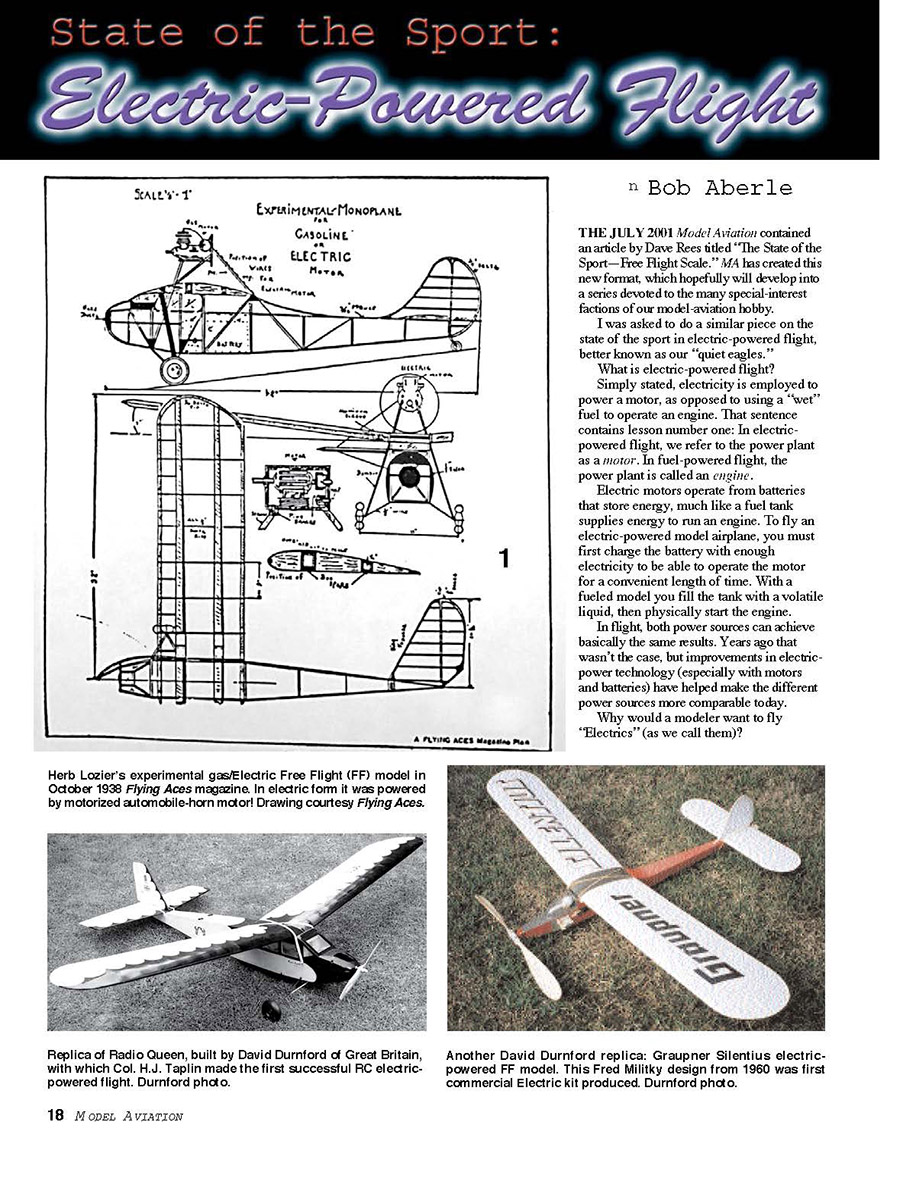
A more "current" reference was published in the October 1938 Flight magazine (page 47) in a piece titled "Lozier's Experimental Gas-Electric Model." In this article, Herb Lozier showed how he adapted a motorized automobile horn into an electric power plant.
The real details of this design are not known, but in just looking at the plan and reading the text, it does seem conceivable that it was successfully flown. In this case, 1938 was only a few years after the development of the Brown Junior model gas-fueled engine.
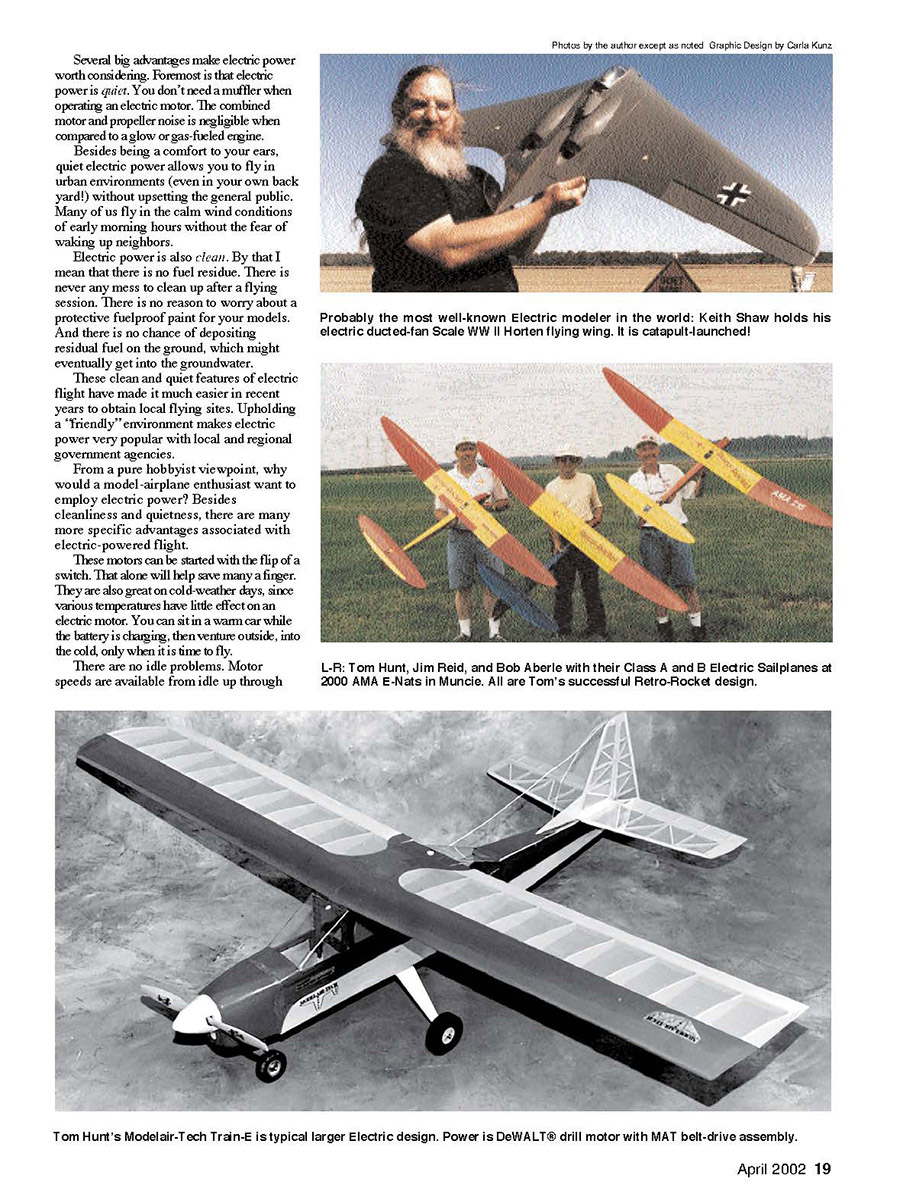
Modern-day electric power got a big boost when Colonel H.I. Taplin (Great Britain) made the first successful flight of a radio-controlled, electric-powered model in June 1957. The model, the Radio Queen, weighed close to eight pounds. The motor was a surplus 24-volt Emerson unit, which was powered by a bank of 25 silver-zinc type storage batteries.
Shortly after this successful first flight, we began seeing practical, lightweight, rechargeable nickel-cadmium (Ni-Cd) batteries for the first time. It was near this time that Radio Control (RC) system manufacturers started using these same batteries.
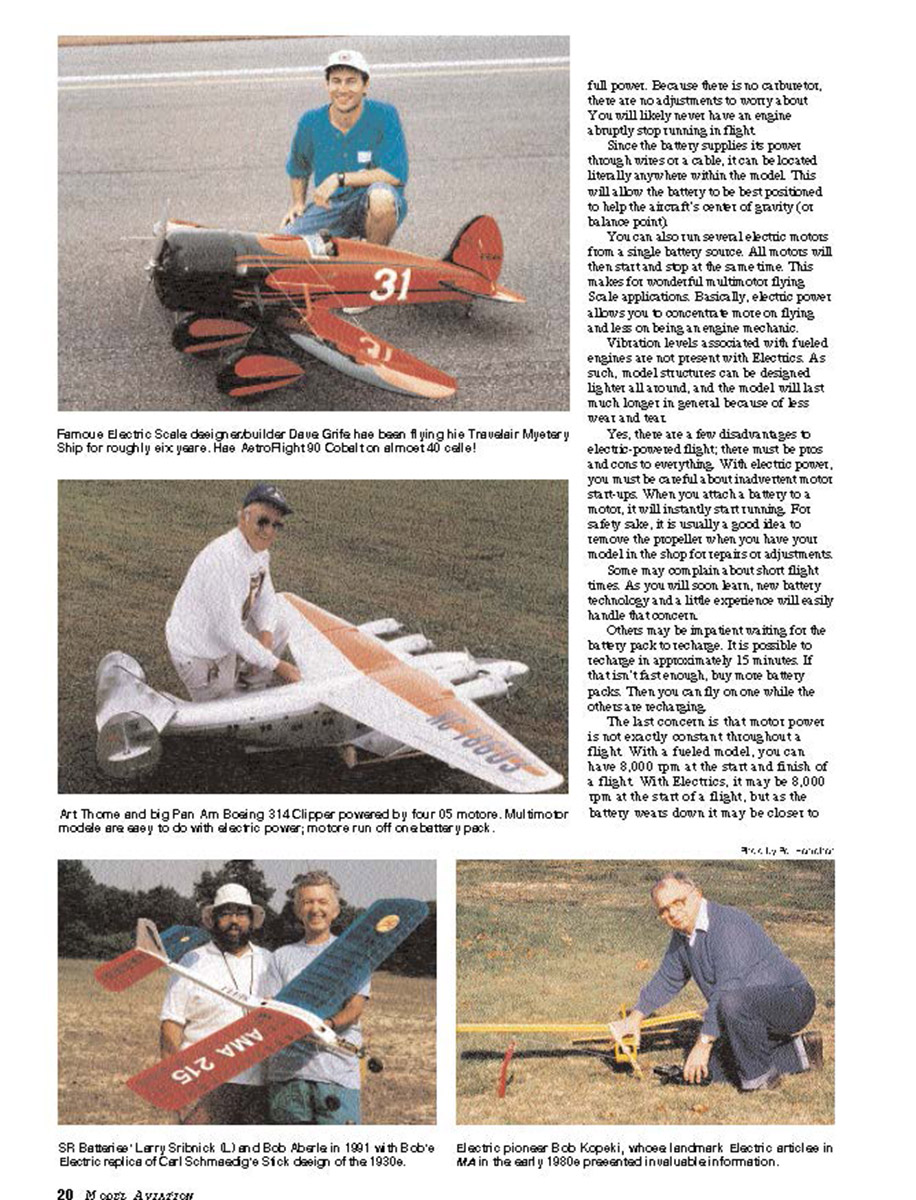
Early in 1960 Fred Millich of Germany designed an Electric Free Flight model called the Silentus. It weighed only five ounces with a 108-square-inch wing. The Graupner company made this as a kit (1960), which turned out to be the first commercial venture into electric power in the world.
During this same early-1960s time frame, the rechargeable (Ni-Cd) batteries really made the difference in the growth of electric-powered model aircraft.
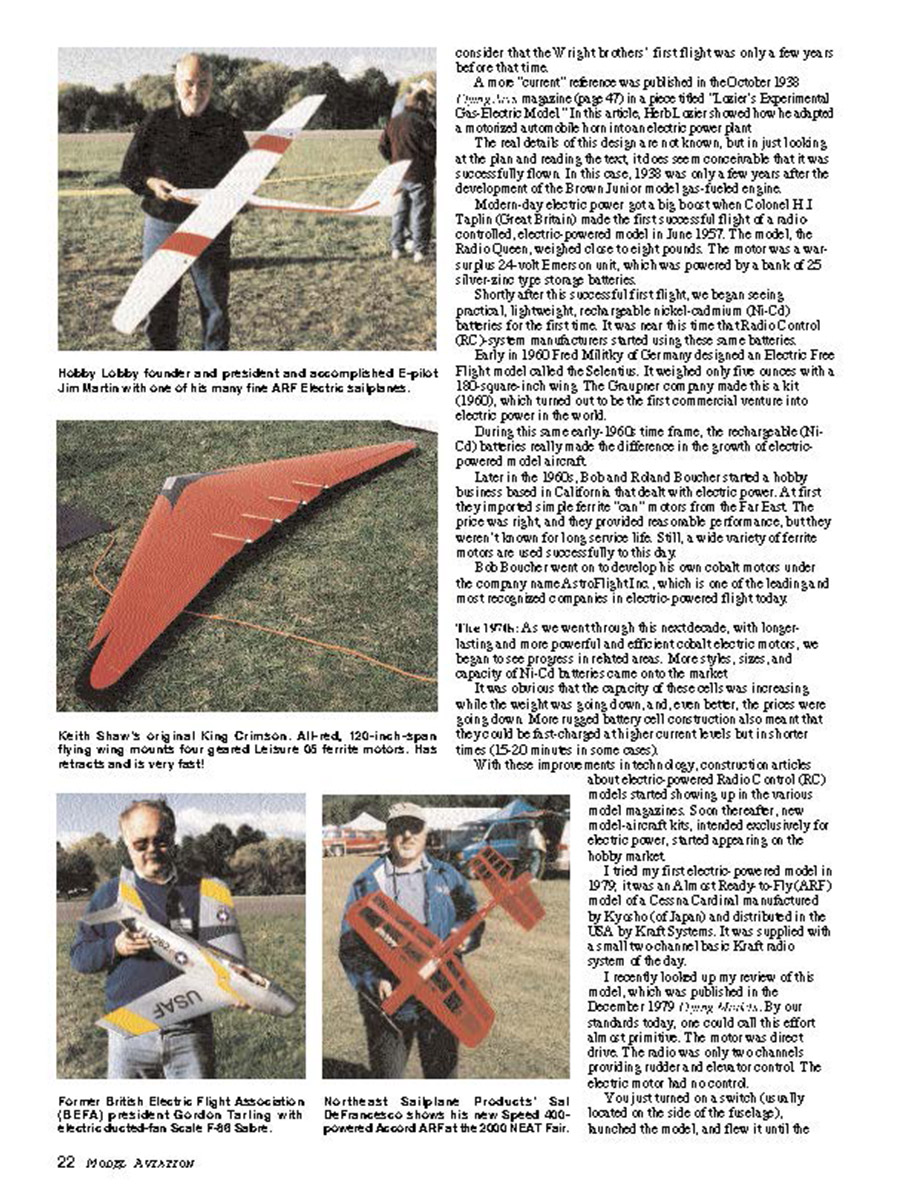
Later in the 1960s, Bob and Roland Boucher started a hobby business based in California that dealt with electric power. At first they imported simple ferrite "can" motors from the Far East. The price was right, and they provided reasonable performance, but they weren't known for long service life. Still, a wide variety of ferrite motors are used successfully to this day.
Bob Boucher went on to develop his own cobalt motors under the company name AstroFlight, Inc., which is one of the leading and most recognized companies in electric-powered flight today.
The 1970s: As we went through this next decade, with longer-lasting and more powerful and efficient cobalt electric motors, we began to see progress in related areas. More styles, sizes, and capacity of Ni-Cd batteries came onto the market.
It was obvious that the capacity of these cells was increasing while the weight was going down, and, even better, the prices were going down. More rugged battery cell construction also meant that they could be fast-charged at higher current levels but in shorter times (15–20 minutes in some cases).
With these improvements in technology, construction articles about electric-powered Radio Control (RC) models started showing up in the various model magazines. Soon thereafter, new model-aircraft kits, intended exclusively for electric power, started appearing on the hobby market.
I tried my first electric-powered model in 1979; it was an All-in-One Ready-to-Fly (ARF) model of a Cessna Cardinal manufactured by Kyosho (of Japan) and distributed in the USA by Kraft Systems. It was supplied with a small two-channel basic Kraft radio system of the day.
I recently looked up my review of this model, which was published in the December 1979 issue. By our standards today, one could call this effort almost primitive. The motor was direct drive. The radio was only two channels, providing rudder and elevator control. The electric motor had no control.
You just turned on a switch (usually located on the side of the fuselage), launched the model, and flew it until the battery was exhausted.
The 1980s:
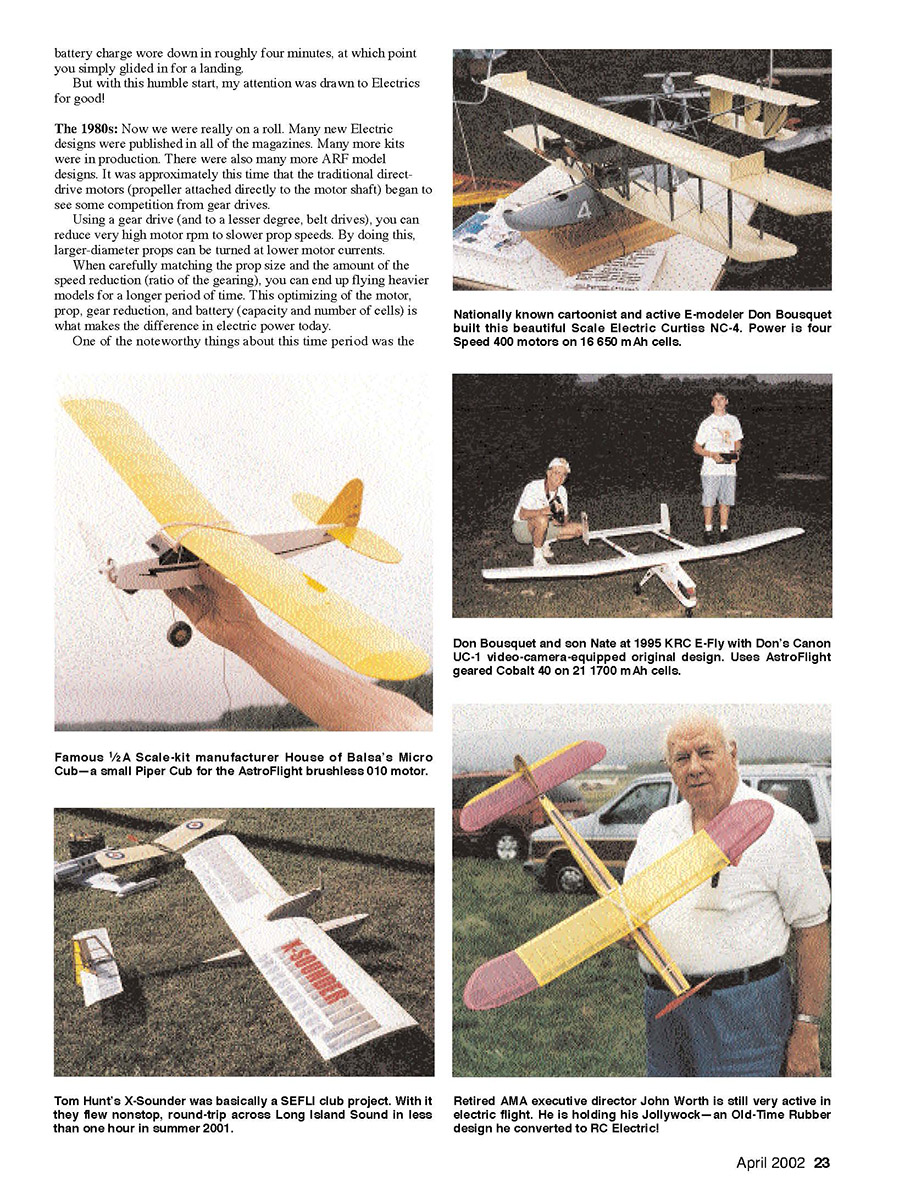
Now we were really on a roll. Many new Electric designs were published in all of the magazines. Many more kits were in production. There were also many more ARF model designs. It was approximately this time that the traditional direct-drive motors (propeller attached directly to the motor shaft) began to see some competition from gear drives.
Using a gear drive (and to a lesser degree, belt drives), you can reduce very high motor rpm to slower prop speeds. By doing this, larger-diameter props can be turned at lower motor currents.
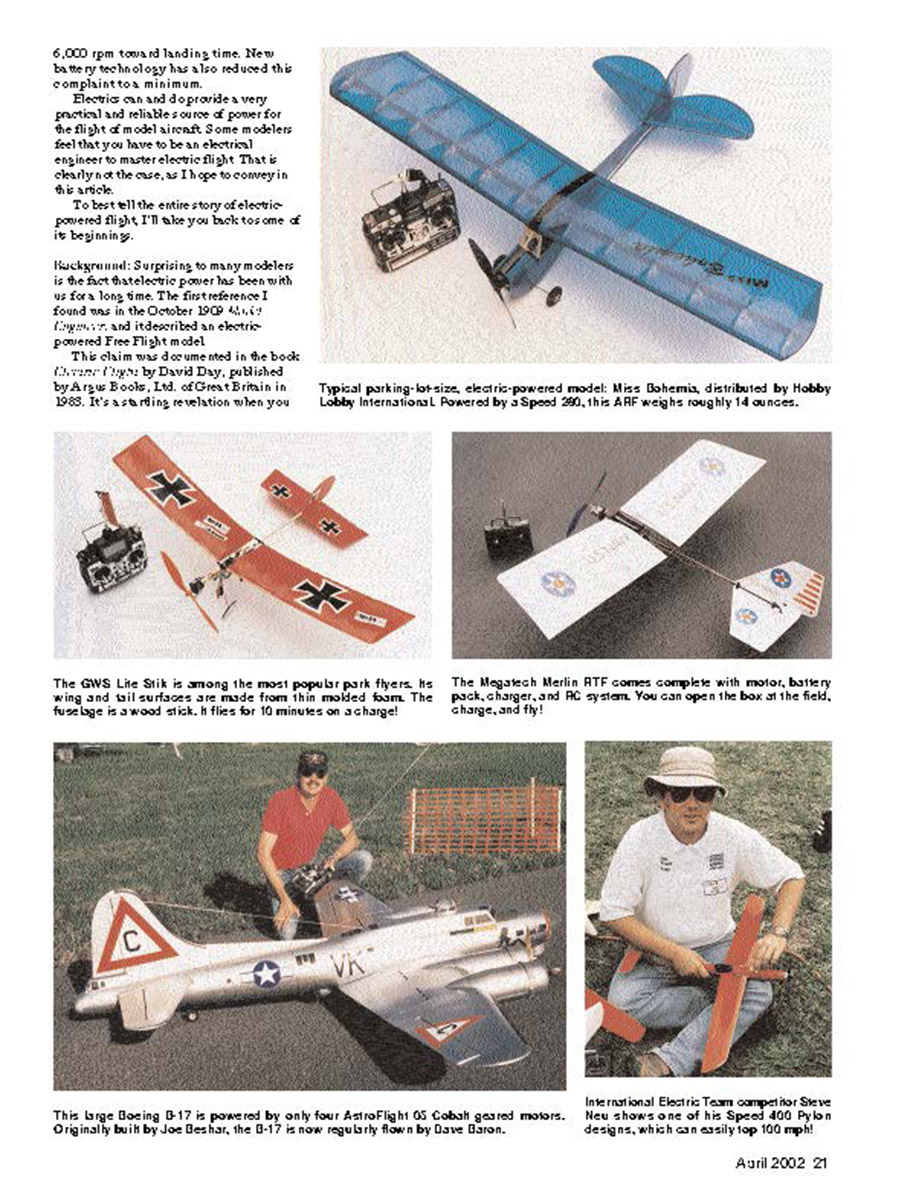
When carefully matching the prop size and the amount of the speed reduction (ratio of the gearing), you can end up flying heavier models for a longer period of time. This optimizing of the motor, prop, gear reduction, and battery (capacity and number of cells) is what makes the difference in electric power today.
One of the noteworthy things about this time period was the appearance of several "electric columnists": model-aircraft writers who were dedicated to explaining and promoting electric-powered flight. I'll mention more of the people later, but for now the story continues with the most famous electric writer: Model Aviation's Bob Kopski.
Bob began his electric column in MA in the early '80s. It started as a series that began with the motor, then the battery, then the charging, etc., until all aspects of electric flight were covered in a logical manner.
The material presented was so valuable that I waited every month for my MA issue so I could copy Bob's column and fill a large loose-leaf binder. I have that binder to this day as a testimonial to a man who essentially wrote the first book on electric power during a several-year period.
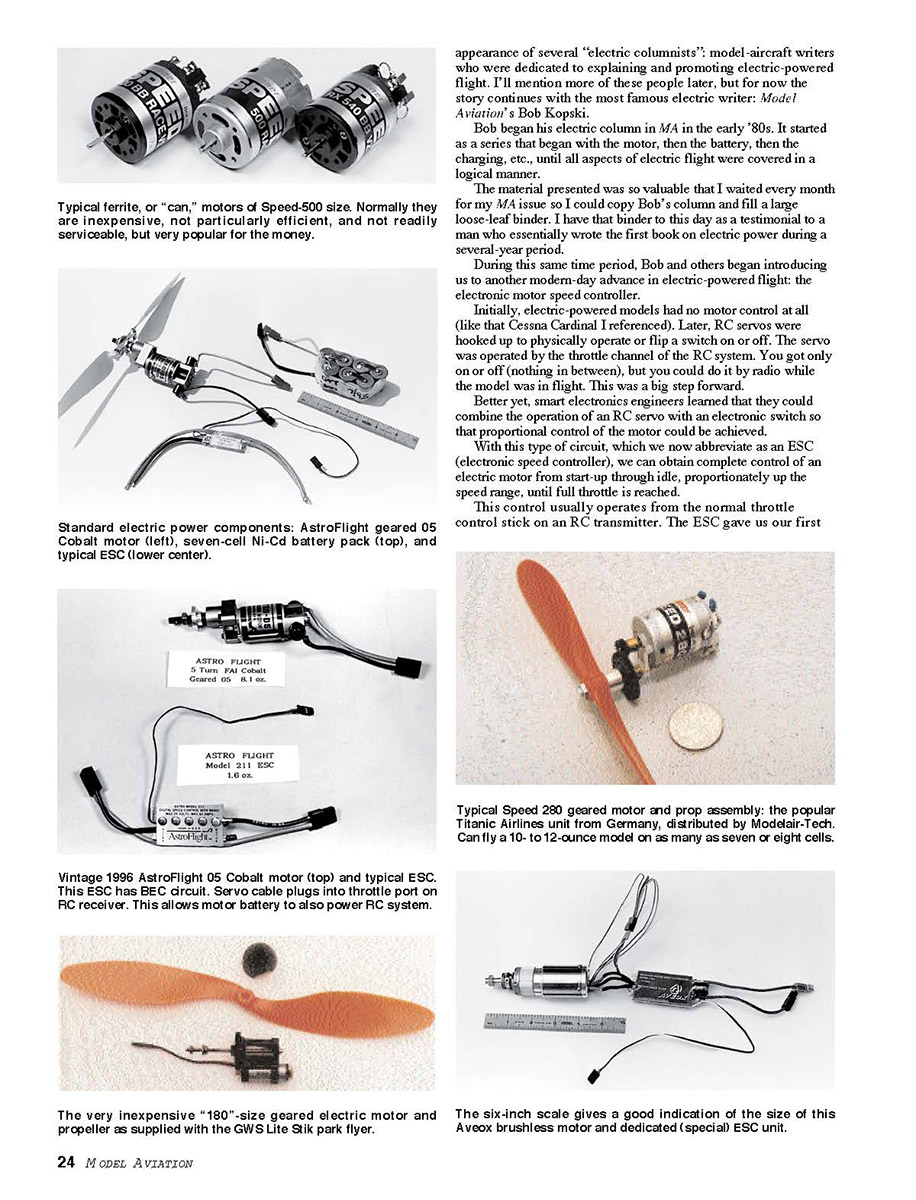
During this same time period, Bob and others began introducing us to another modern-day advance in electric-powered flight: the electronic motor speed controller.
Initially, electric-powered models had no motor control at all (like that Cessna Cardinal I referenced). Later, RC servos were hooked up to physically operate or flip a switch on or off. The servo was operated by the throttle channel of the RC system. You got only on or off (nothing in between), but you could do it by radio while the model was in flight. This was a big step forward.
Better yet, smart electronics engineers learned that they could combine the operation of an RC servo with an electronic switch so that proportional control of the motor could be achieved.
With this type of circuit, which we now abbreviate as an ESC (electronic speed controller), we can obtain complete control of an electric motor from start-up through idle, proportionately up the speed range, until full throttle is reached.
This control usually operates from the normal throttle control stick on an RC transmitter. The ESC gave us our first
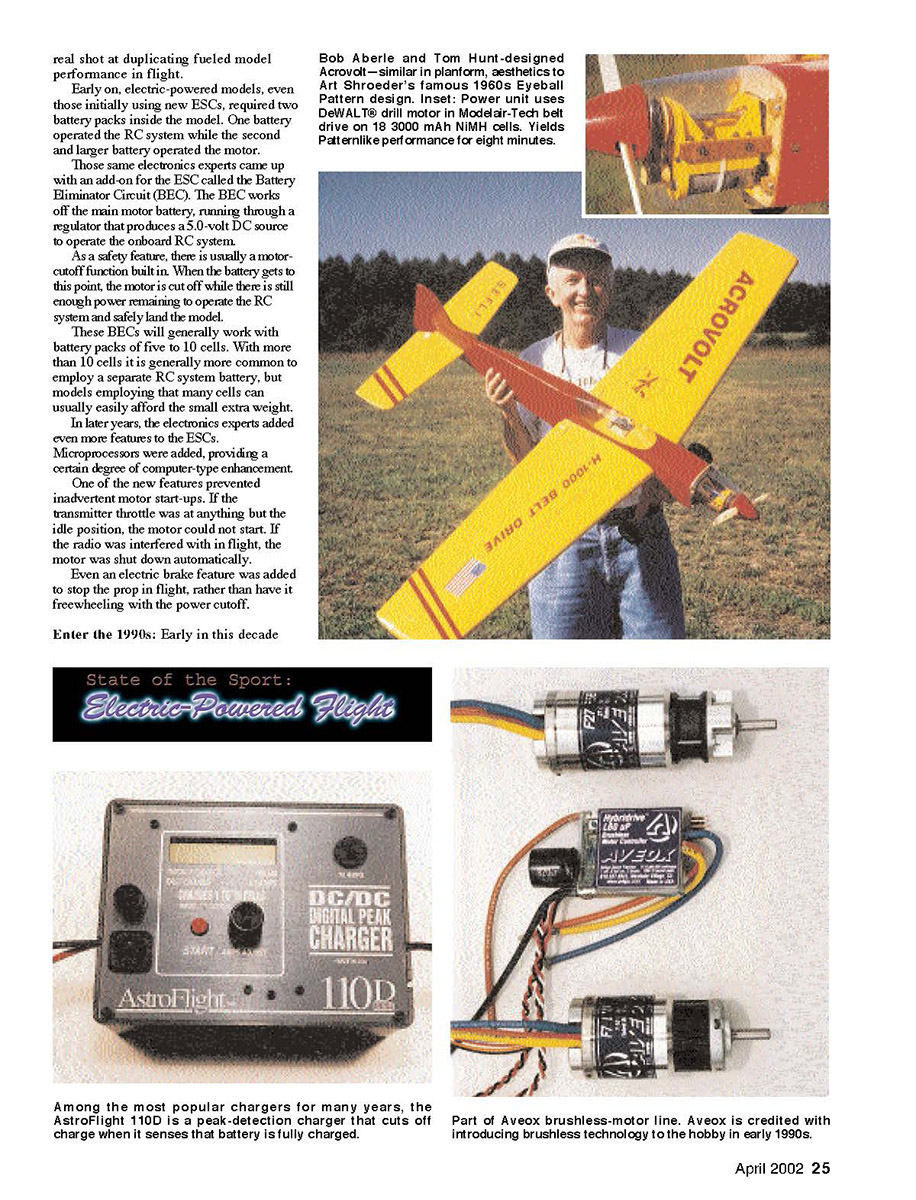
Enter the 1990s: Early in this decade we saw the first real improvement in electric-motor efficiency with the introduction of brushless-motor technology to electric-powered flight.
One of the companies that pioneered this development is Aveox, founded and headed by Dave Palombo of Westlake Village, California. Also involved with the development was Tom Cimato of MaxCim motors, located in the Buffalo, New York area.
The brushless motor, as the name implies, uses no brushes. The motor is essentially an AC motor, and, because of its special nature, can achieve efficiencies upward of 85% and more. This is clearly much more than ferrite-motor capability and even more than the popular cobalt motors.
The brushless motors were (and many still are) very expensive, and they required an equally expensive and specialized ESC.
However, besides their improved efficiency and smooth performance, brushless motors can provide literally years of service without the need for any maintenance. There are no brushes to replace, and, if operated under the proper current and voltage specifications, these motors should last almost indefinitely.
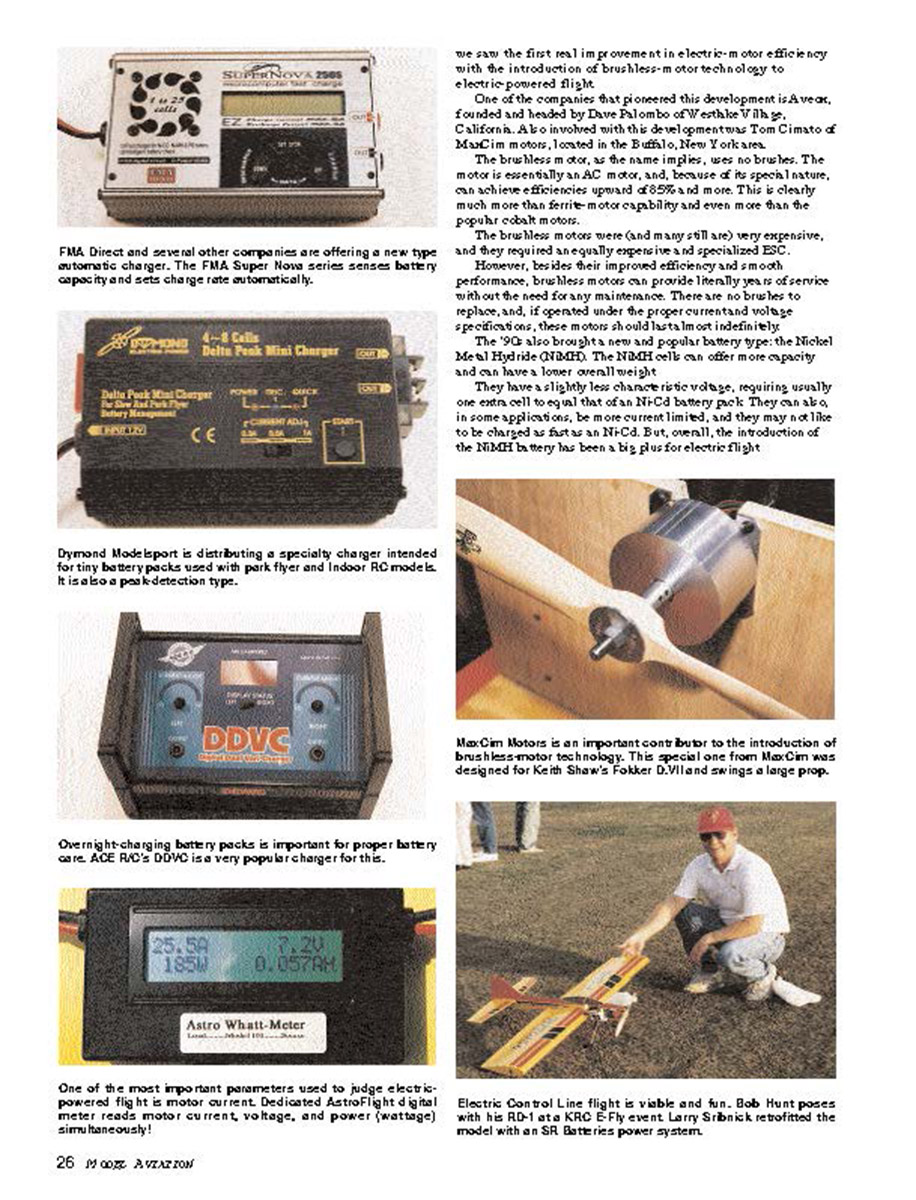
The ’90s also brought a new and popular battery type: the Nickel Metal Hydride (NiMH). The NiMH cells can offer more capacity and can have a lower overall weight.
They have a slightly less characteristic voltage, requiring usually one extra cell to equal that of an NiCd battery pack. They can also, in some applications, be more current limited, and they may not like to be charged as fast as an NiCd. But, overall, the introduction of the NiMH battery has been a big plus for electric flight.
The 21st Century: During the first two years of the millennium, we have seen many advances in electric-powered flight.
Most notable is several new manufacturers, besides Aveox and MaxCim, that provide high-efficiency brushless motors. Names that come to mind are AstroFlight, Hacker, the Jeti Models Phasor, and, in the foreseeable future, Castle Creations and MTM International.
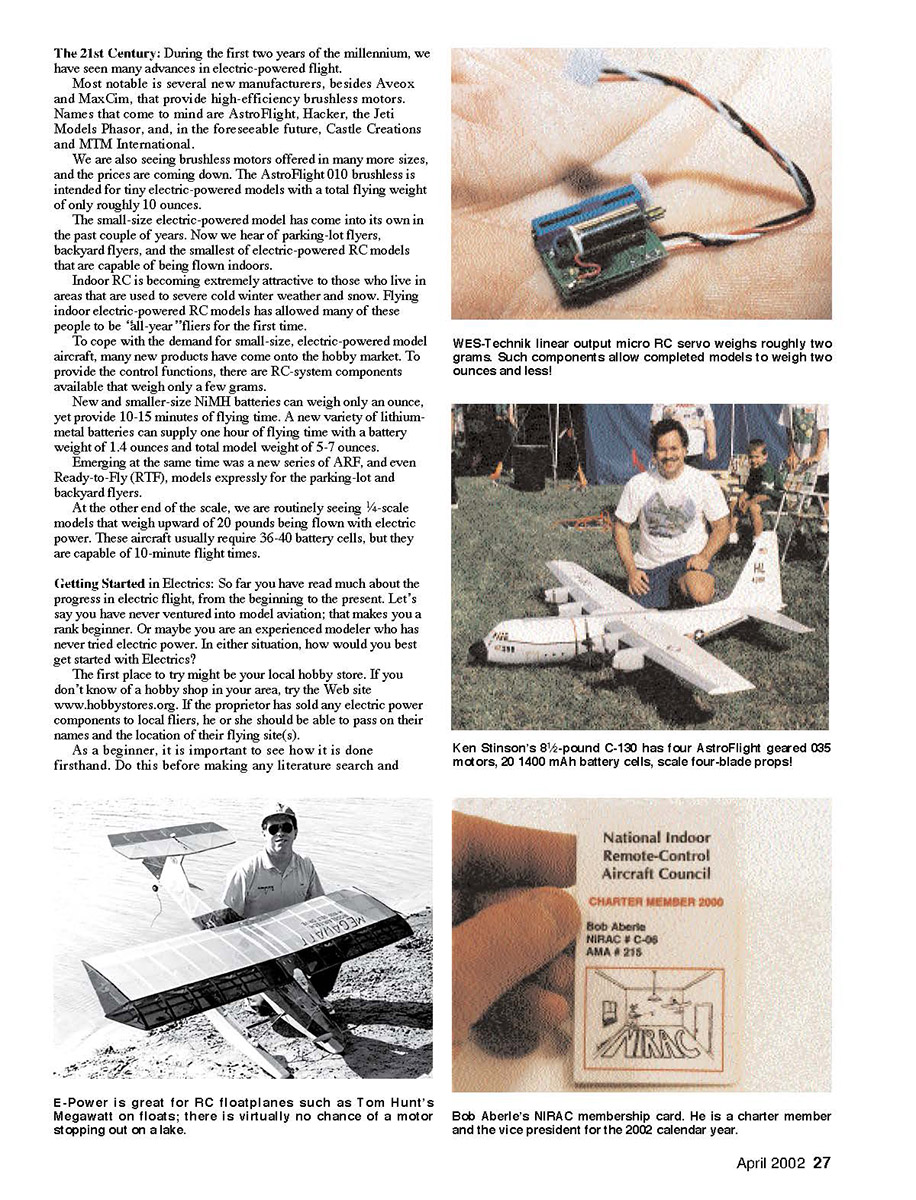
We are also seeing brushless motors offered in many more sizes, and the prices are coming down. The AstroFlight 010 brushless is intended for tiny electric-powered models with a total flying weight of only roughly 10 ounces.
The small-size electric-powered model has come into its own in the past couple of years. Now we hear of parking-lot flyers, backyard flyers, and the smallest of electric-powered RC models that are capable of being flown indoors.
Indoor RC is becoming extremely attractive to those who live in areas that are used to severe cold winter weather and snow. Flying indoor electric-powered RC models has allowed many of these people to be “all-year” fliers for the first time.
To cope with the demand for small-size, electric-powered model aircraft, many new products have come onto the hobby market. To provide the control functions, there are RC-system components available that weigh only a few grams.
New and smaller-size NiMH batteries can weigh only an ounce, yet provide 10–15 minutes of flying time. A new variety of lithium-metal batteries can supply one hour of flying time with a battery weight of 1.4 ounces and total model weight of 5–7 ounces.
Emerging at the same time was a new series of ARF, and even Ready-to-Fly (RTF), models expressly for the parking-lot and backyard flyers.
At the other end of the scale, we are routinely seeing 1/4-scale models that weigh upward of 20 pounds being flown with electric power. These aircraft usually require 36–40 battery cells, but they are capable of 10-minute flight times.
Getting Started in Electrics:
So far you have read much about the progress in electric flight, from the beginning to the present. Let’s say you have never ventured into model aviation; that makes you a rank beginner. Or maybe you are an experienced modeler who has never tried electric power. In either situation, how would you best get started with Electrics?
The first place to try might be your local hobby store. If you don’t know of a hobby shop in your area, try the Web site www.hobbystores.org. If the proprietor has sold any electric power components to local fliers, he or she should be able to pass on their names and the location of their flying site(s).
As a beginner, it is important to see how it is done firsthand. Do this before making any literature search and purchasing any equipment—certainly before spending any of your hard-earned money.
If you are not already an Academy of Model Aeronautics (AMA) member, join that organization. Visit the Website at www.modelaircraft.org or call 1-800-FLY-AMA (359-2623), extension 5. The AMA literature will help you with the safety aspects of our hobby in general.
You must remember that flying RC model aircraft carries with it certain responsibility. Two identical RC channels cannot be used at the same time; if they are, one will cause interference to the other, resulting in a possible crash scenario. This kind of concern is even more critical for the parking-lot or backyard flyer.
A new AMA Website expressly related to these special safety concerns can be accessed at www.parklflyer.org.
The AMA Membership Department provides a valuable supplemental insurance protection plan. As a member, you will also receive a monthly copy of Model Aviation, which is the official journal of AMA.
What Equipment Do You Need? In case electric-powered flight is a mystery to you, I’ll briefly discuss the system components you will need to purchase and learn about. Number one is the electric motor. It can operate a propeller directly or through a gear or belt reduction drive. The prop itself may be fixed, or in some cases it can fold up alongside the fuselage when the motor is shut down in flight.
Attached to the motor is an ESC. From it there is a large-gauge wire to the motor battery pack. The battery supplies power to the motor. It runs down during each flight and must be rapidly recharged, at the field, before commencing with the next flight.
Model control is accomplished through the use of an RC system consisting of a receiver and servos to operate the flying surfaces, such as the rudder, elevator, and ailerons. A cable from the ESC plugs into the throttle channel port or connector of the RC receiver. The RC system can be operated from its own separate battery pack or powered by the main motor battery on a shared arrangement using the BEC function built into the ESC. By doing this, you only have to carry one battery on the aircraft. And that is basically it!
There are many variations, but that is the basic equipment that goes into every model, from a two-ounce "micro" up to a 20-pound 1/4-scale model.
Publications: I have already started by mentioning Model Aviation and its popular "Radio Control Electrics" columnist Bob Kopski.
For years Bob has featured a portion of the column he refers to as the "Electric Connection Service." You write in and tell him you are interested in becoming involved in electric-powered flight, and he will publish your information so others in your area can contact you and welcome you into the hobby.
More recently, Model Aviation has added two new Electric columnists, each with a specialty. These columns alternate between Dave Robelen's "Micro-Flying" and Paul Bradley's "Small-Field Flying." Dave concentrates on the extremely small RC models intended for close-in flying or indoor flying. Paul is involved with the parking-lot flyers up through Speed-400-size power.
Flying Models magazine also has two fine alternating electric columnists: Don Belfort — a very active E-power competitor — and Dick Miller, who is one of the foremost electric-motor experts. Dick offers a free-access Web site (http://home.ptd.net/~rcm65/) that contains a tremendous amount of valuable motor data.
Seaplane & Electric Modeler is a relatively new magazine published bimonthly from the state of Washington. Publisher Wil Byers has created a publication that specializes in only seaplanes and electric-powered model aircraft; it carries roughly a 60/40 split between E-power and pure sailplane-type content.
S&EM also maintains a thorough listing of all major electric clubs throughout the USA and even in some foreign countries.
Air Age Publishing has three different magazines. The primary one is the time-honored Model Airplane News. Although it doesn't have an Electrics columnist as such, it is deeply involved in electric-powered flight. I am fortunate to be a member of the contributing-editor staff.
Air Age publishes a wonderful monthly newsletter called RC MicroFlight. It is available on a special-access Web site (www.rcmicroflight.com) and as a 16-page distributed hard copy. As the name implies, the subject matter concentrates on the small RC models with predominantly electric power.
Very recently, Air Age introduced a new quarterly publication: Backyard Flyer. This magazine covers models the next size up from the so-called "micro" class. Literally thousands of these aircraft have been sold in the past year or so. It is understandable that a special magazine would be dedicated to this class.
Radio Control Modeler magazine, based in California, has monthly Electrics columnist Jim Zare, who is generally involved with all aspects of electric-powered flight.
One of the primary reasons for reading all of these columns about electric power is that the authors will keep you posted on the latest products and technology improvements. All of the magazines are available through subscription, at newsstands, and at local hobby shops.
Not too many books have been dedicated to electric-powered flight. My book Clean & Quiet — The Guide to Electric Powered Flight (published by Douglas Charles Press in 1995) is essential and out of print. Progress being what it is with electric power, material gets dated quickly. Copies should still be available at hobby suppliers and at AMA's store in Muncie, IN.
I hate to sound commercial, but I have a new book out that is dedicated to all aspects of micro- and parking-lot flying: Getting Started in Backyard Flying was released by Air Age Publishing in January.
A good reference source for many years is Harry Higley's book Entering Electrics. It can be obtained from Tower Hobbies as a mail-order item.
You might also try Amazon.com for these books.
For many years, SR Batteries, Inc. has offered a technical-publication series known as Techniques. You can learn about these publications by calling up the SR Web site at www.srbatteries.com then selecting the "Techniques" section.
Each Techniques consists of four to eight pages, printed on 8½ x 11-inch paper and three-hole punched so you can make your own custom reference book.
R/C Techniques Index provides specific subject-matter information, allowing you to purchase only those volumes in which you might have interest. Topics cover the entire RC field, including flying, building techniques, materials, adhesives, radio systems, covering, and finishing, just to name a few.
A second edition of Techniques called Electric Flight Techniques provides a full series of technical info on all aspects of electric-powered flight (motors, batteries, speed controllers, props, etc.). This series also has a special detailed index by subject matter, which is the Electric Flight Techniques Index.
SR Batteries founder Larry Sribnick is the primary author of the Techniques volumes, along with many guest "expert" authors. Larry's efforts have resulted from years and years of answering customer questions at his business, at various trade shows, and at technical seminars that he has sponsored. This series can provide a great database for the electric-power enthusiast.
Electric-Power Computer Programs: One of the biggest problems in electric flight is being able to select a motor system for a particular model size, weight, and desired speed. Several computer programs are available that can greatly assist you in this electric-motor-selection process. They allow you to make adjustments to the various parameters to help optimize a particular E-power system.
One program is MotoCalc and another is ElectricCalc. Both are intended for PC (personal computer) operation. They contain an extensive variety of reference data.
With the aid of these programs, you can perform "what if?"-type calculations almost instantly. You can change the gear-reduction ratio or prop size and instantly see how the motor current and prop rpm will be affected. You can also add or subtract battery cells (raise or lower voltage) to see the effects on the entire system.
With some experience, either of the following programs can add considerably to the motor-selection process:
MotoCalc (Stefan Vorkoetter) Capable Computing Inc. RR3, Moorfield, Ontario Canada N0G 2K0 (519) 638-5470 Fax: (519) 638-2812 Web site: www.motocalc.com
ElectricCalc (Sid Kauffman) SLK Electronics 906 Charolais Dr. Greensboro NC 27406
Electric Power Nets: There are two major Web site nets that cater to the electric-powered-flight enthusiasts. One is the E-Flight Digest, and the other is the Small Flyers Net (or SFRC).
The E-Flight Digest is a private venture and has been around a long time. It covers E-power in general and has become popular with the fliers of the conventional-size and larger Electrics.
The SFRC is a more recent undertaking by Air Age Publishing. As the name implies, the SFRC is intended more for the micro-flyers (parking lot, backyard, and indoors). Both of these nets are offered as a regular free service.
Usually one series is put up on the Web site each day. You can ask questions and obtain answers to your electric-power problems. You can even post your own findings on new products and offer suggestions for improvements.
To sign up for E-Flight Digest, visit the Web site at www.ezonenag.com and follow the instructions. For the SFRC, send an E-mail to [email protected]. In the text of the message, type "subscribe sfrc digest." In your actual message, don't use brackets or quotes as I did here. That's all there is to it. Each day you will receive output from each of the two nets.
I suspect that more nets will be formed as time goes along.
Electric Power Organizations: Two national organizations represent a good portion of those flying with electric power. They are known as Special Interest Groups (SIGs), and both advise and work with AMA.
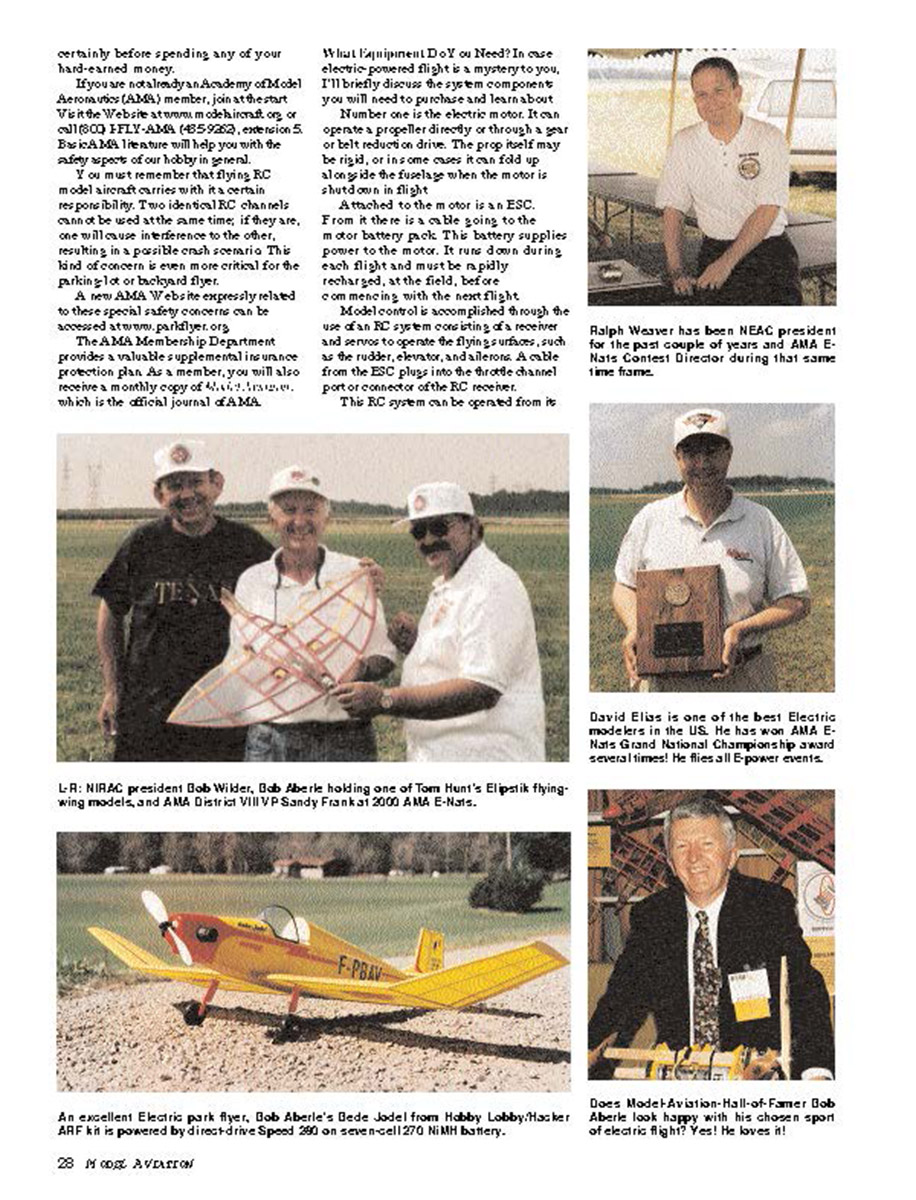
The overall Electric organization is the National Electric Aircraft Council (NEAC), which Larry Sribnick of SR Batteries, Inc. founded in 1995. Ralph Weaver of Fishers IN is the current NEAC president.
Basically, NEAC is involved with electric-flight competitions and is the host organization at the annual AMA Electric National Championships held at AMA Headquarters in Muncie IN every year (usually the first week in August). You can learn more about NEAC on the Web site at www.electricalrcart.org.
The smaller E-power models intended for indoor and park-flying are in the domain of the new National Indoor Remote-Controlled Aircraft Council (NIRAC), which was founded by National Electric Endurance record-holder Bob Wilder of Colleyville TX.
NIRAC was originally chartered as the SIG for the indoor R/C flier. However, because of the size of models used for indoor flight, it quickly grew to encompass parking-lot and backyard flyers as well.
NIRAC is organized as a new informational-type association and is open to anyone. If you're interested, contact Bob Wilder at the new NIRAC address by contacting Bob Wilder at [email protected] or writing to him at 1005 Hidden Oaks Ct., Colleyville TX 76034.
E-Power Competitions: AMA has an official rule book, a copy of which can be easily obtained upon request. In that book are a series of model competitions dedicated to electric-powered flight that have been established during the past few years. There is an entire procedure for establishing and updating these rules.
Presently the AMA Electric Nationals includes four official AMA events (A and B Electric Sailplane and A and B Electric Old Timer). The details of these categories are in the AMA rule book. They are basically what we call Limited Motor Run (LMR) events; your model is allowed a brief electric motor run to gain altitude, after which it becomes a glider or sailplane for the remainder of the flight.
Additional events created by the NEAC, such as 1/4A Electric Sailplane, 1/4A Electric Texaco, Electric Sport Scale, and Electric Pylon Racing, add to the fun of the Electric Nationals, or “E-Nats” as we refer to it.
Future plans include running additional events for such things as Aerobatics (Pattern), Electric helicopters, and larger Scale Electric competitions.
Anyone can enter a regular glow-type competition substituting electric power system. Popular West Coast modeler Bob Benjamin has successfully competed using electric power alone with slow and scale glider pilots at national Scale championships and the Large Scale Top Gun event held in Florida each spring.
NIRAC is in the process of establishing a new Indoor RC Nationals, to be held in the Muncie Indoor during the annual AMA Nationals. A tentative date has been set for Tuesday, July 9, 2002. Initially four events will be held, but it is hoped that this will eventually grow into a several-day competition, encompassing more than a half dozen different contest activities.
Hopefully other large indoor flying facilities will be offered for regional Indoor RC Events across the country. There is even the possibility that AMA will, in the not-too-distant future, build an indoor flying/radio control airplane exhibit at the wonderful AMA National Model Aviation Museum at the Muncie Headquarters.
Still other Electric competitions involve the “postal” concept, where rules are published, the model flights are flown and logged across the country, and the results are sent by mail to a contest coordinator for tabulating purposes. This is especially interesting for electric events in the winter months when outdoor flying is not practical.
Electric power is a truly international effort. Electric models are flown all over the world. NEAC and several local electric clubs — in particular, the Silent Electric Flyers of San Diego, CA (http://seffc.org) — have coordinated International Electric Competition Eliminations and have even hosted an International Championship fleet combination trade show and indoor RC fly, all within one large convention center.
Starting in the early 1960s, a very special RC Electric fly was created by a group of Pennsylvania modelers who were members of the Keystone R/C Club. (In the group was Ed Eisenberg, Bob Koski.) They founded what became known as the KRC Electric Fly, which was held for an 18-year period, first in Quakertown and later in Allentown, PA.
The KRC had its last show in 1996, after which the club members voted to fill this void. The very large and active Silent Electric Flyers of Long Island (SEFI) club established a new E-Fly which has been named the Northeast Electric Aircraft Technology (NEAT) Fair. The concept was created and organized by popular East Coast modeler Tom Hunt.
The first NEAT Fair was held in September 2000 in upstate New York at the Peaceful Valley Campgrounds in Downsville.
The NEAT Fair has quickly become the largest electric-fly gathering in the world. It is worth your review if you are even remotely serious about electric-powered flight. During the three-day affair, some 1,000+ people attend. Vendors from across the country and from some foreign countries attend with the express purpose of selling all their new products. It is the best.
There are also lots of other major Electric fly-ins held across the country each year. Their names and locations are usually announced in the E-Flight Digest and the SEFRC Website, and these are listed in most of the hobby magazines.
Electric Flight’s Future: This is where it really gets fun! Electric-powered flight is still in its beginning stages of development. New technologies are constantly contributing to our needs.
In the past 10 years, cell phones have reached a point where there is one in almost every family. There is a continuous trend towards phones physically smaller, lighter in weight, more powerful, and with the ability to operate for long periods of time on batteries. A spin-off from this has helped create specialized microchips to allow for micro RC receivers and other components also with lithium ion and lithium polymer (or plastic) batteries.
New battery technology is increasingly important to our electric-flying efforts. We are continually looking for new battery developments that will provide a lot of power from a small and lightweight package and have the ability of very rapid recharging.
The same company will soon be releasing a new rechargeable lithium battery for the consumer market that would be an entirely new product, and not simply a cell phone product that was passed on to us. The future may be a single cell type product small enough, light enough, and hopefully at a reasonable price.
Along with new batteries, we look forward to new brushless motors optimized for battery/charger that should cope with the various new battery technologies. We also look forward to changes that can be operated by the ordinary modeler without any real electrical or electronics experience.
We look toward our Department of Defense and other government agencies that are presently experimenting with a variety of unmanned aerial vehicles (UAV) using electric power. One variety of these UAVs is being tried for battlefield reconnaissance situations where the convenience and stealth of electric power is so important. Another variety expects to fly UAVs at extreme altitudes, where air-breathing engine operation would not be possible.
All of this experimental work can only lead to new and improved motors and batteries and associated electronics that can help our world of modeling in the future.
If you haven't tried E-power, I hope you will at least consider it for the future. You don't have to be an expert in electricity or electronics to become an active participant. You may have to do some simple soldering, but even that is quickly being replaced by ready-made connectors. The help is out there for you when you need it.
Look at the progress in glow-fuel engines in the last 25 years, then look at the progress of electric-powered flight in the same time period. Where will we be in another 25 years?
Electric Manufacturers/Suppliers: The following list covers manufacturers, distributors, suppliers, and, in some cases, importers of electric-powered model-aircraft equipment. Although the intent was to identify all in the business, several may have been missed. For that I apologize in advance.
MA Bob Aberle 33 Falcon Dr. Hauppauge NY 11788 [email protected]
Academy of Model Aeronautics (AMA) (Model Aviation, AMA Convention, AMA services) 5161 East Memorial Dr. Muncie IN 47302 (765) 287-1256 Fax: (765) 289-4248 www.modelaircraft.org
ACE Hobby Distributors, Inc. (RTF models, chargers, radio systems) 2682 Walnut Ave. Tustin CA 92780 (800) 322-7121 www.acehobby.com
Air Age Publishing Inc. (Model Airplane News, RC MicroFlight newsletter, Backyard Flyer) 100 East Ridge Rd. Ridgefield CT 06877-4606
Anything R/C (ARF, R/C props, model kits) Chris Hansen 1822 E. 40th Ave Spokane WA 99203 (509) 747-2526 Fax: (509) 456-6430 [email protected] www.anythingrc.com
AstroFlight Inc. (Cobalt and brushless motors, speed controllers, chargers) 13311 Beach Ave. Marina Del Rey CA 90292 (310) 821-6242 Fax: (310) 822-6637 www.astroflight.com
Aveox Electric Flight Systems (Brushless motors, controllers) 31324 Via Colinas #103 Westlake Village CA 91362 (818) 597-8915 [email protected] www.aveox.com
Balsa Products Inc. (Microreceivers, batteries, GWS motors) 122 Jansen Ave. Iselin NJ 08830 (732) 634-6131 www.balsapr.com
Batteries America (E.H. Yost & Co.) (Batteries, connectors, wire) 2211-D Parview Rd Middleton WI 53562 (800) 308-4805 [email protected] www.batteriesamerica.com
Bill Griggs Models (Electric kits) 3137 Whitelaw Rd. Canastota NY 13032 (315) 697-8152 www.griggsmodels.com
BMJR Model Products (Kits, motors, batteries, accessories) Box 1210 Sharpes FL 32959-1210 (321) 537-1159 www.bmjrmodels.com
B&T Racing Products (Batteries, heat-shrink tubing, copper connecting bars) 508 Lake Winds Tr. Rougemont NC 27572 Tel./Fax: (919) 471-2060 www.rc-aero.com/biz/bandt
Castle Creations (Speed controllers, brushless motors) 18773 W.
Transcribed from original scans by AI. Minor OCR errors may remain.

