
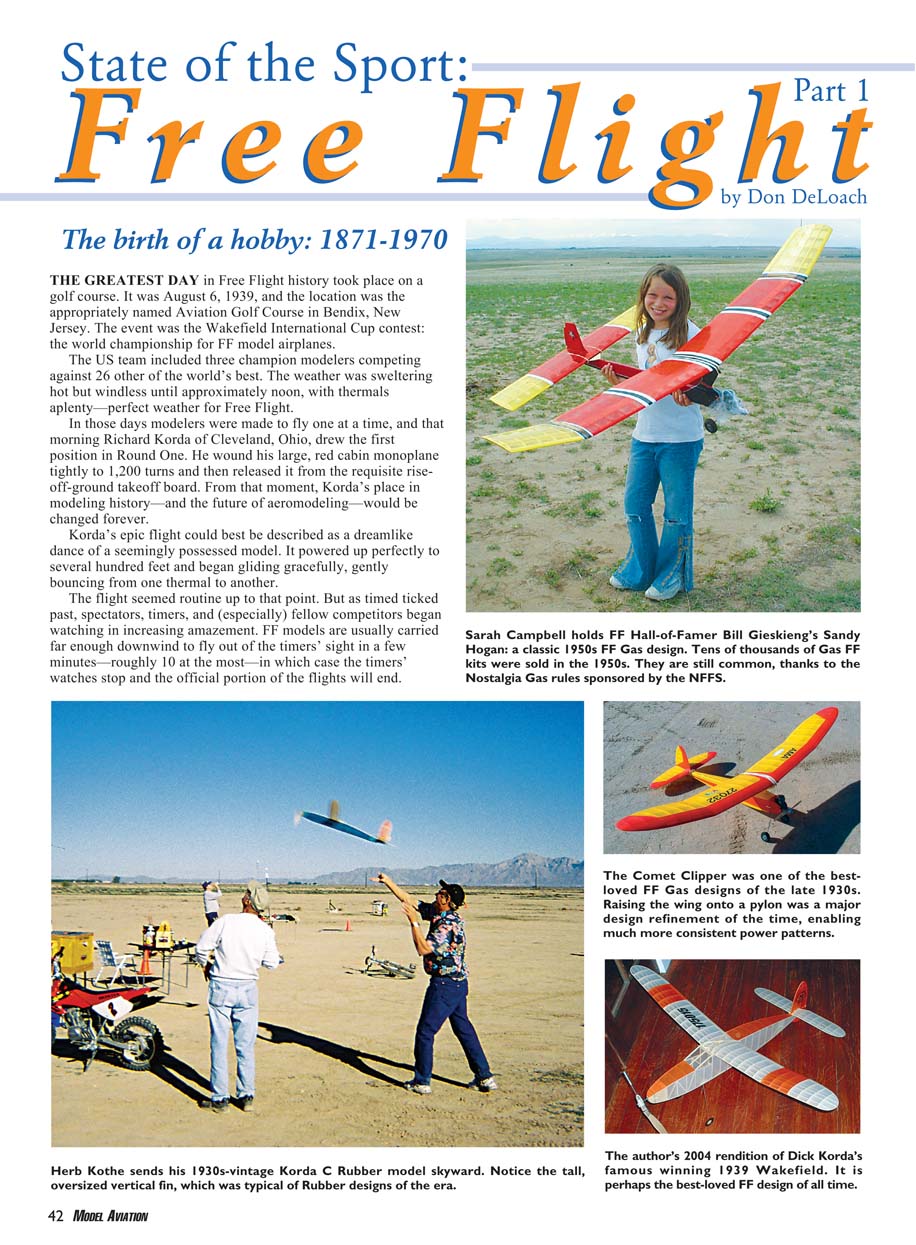
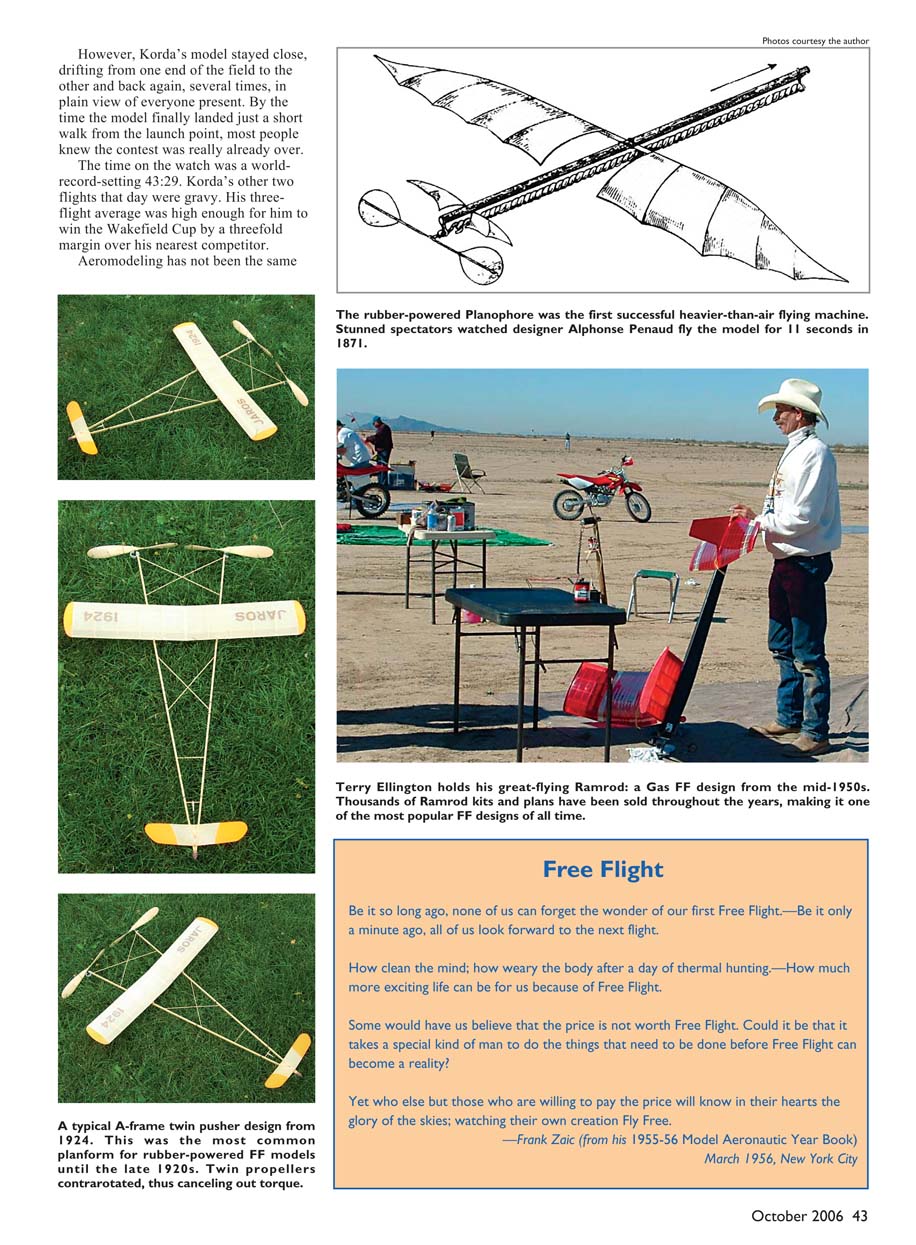
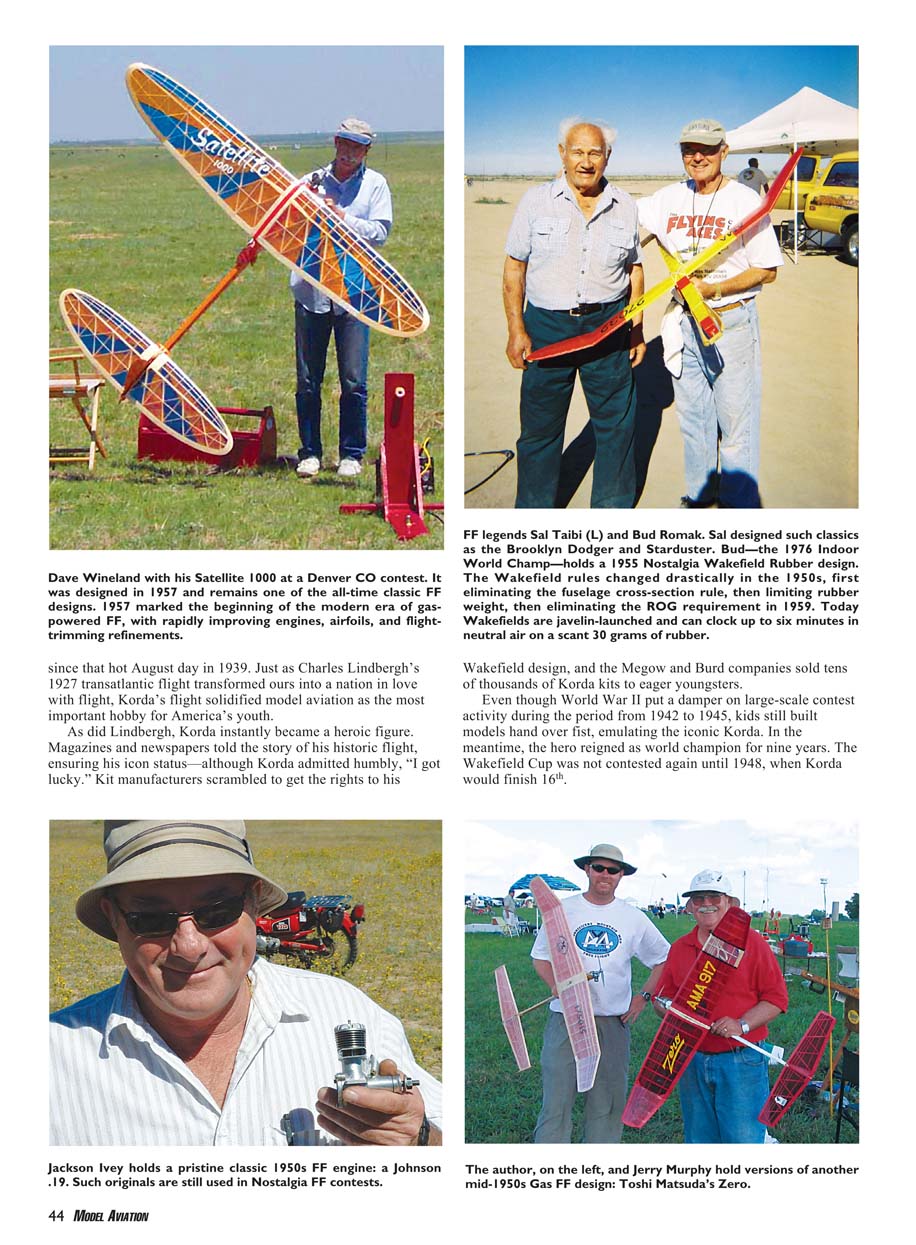
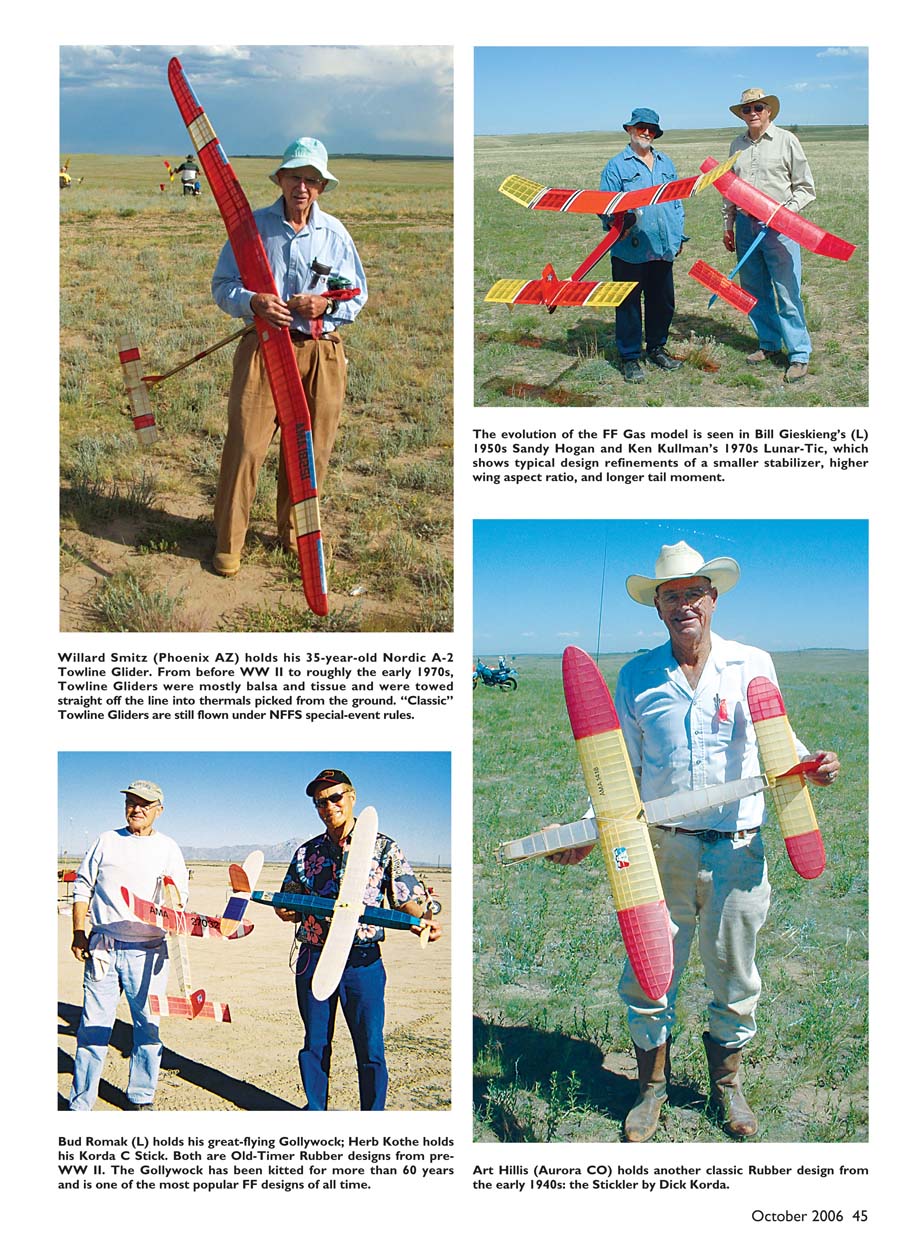
State of the Sport: Free Flight — Part 1
by Don DeLoach
The birth of a hobby: 1871–1970
The greatest day in Free Flight history took place on a golf course. It was August 6, 1939, at the appropriately named Aviation Golf Course in Bendix, New Jersey. The event was the Wakefield International Cup contest: the world championship for Free Flight (FF) model airplanes.
The U.S. team included three champion modelers competing against 26 of the world's best. The weather was sweltering hot but windless until approximately noon, with thermals aplenty—perfect weather for Free Flight.
In those days modelers were made to fly one at a time, and that morning Richard (Dick) Korda of Cleveland, Ohio, drew the first position in Round One. He wound his large, red cabin monoplane tightly to 1,200 turns and then released it from the requisite rise-off-ground takeoff board. From that moment, Korda's place in modeling history—and the future of aeromodeling—was changed forever.
Korda's epic flight could best be described as a dreamlike dance of a seemingly possessed model. It powered up perfectly to several hundred feet and began gliding gracefully, gently bouncing from one thermal to another. The flight seemed routine up to that point. But as time ticked past, spectators, timers, and (especially) fellow competitors began watching in increasing amazement. FF models are usually carried far enough downwind to fly out of the timers' sight in a few minutes—roughly 10 minutes at the most—in which case the timers' watches stop and the official portion of the flights ends.
However, Korda's model stayed close, drifting from one end of the field to the other and back again, several times, in plain view of everyone present. By the time the model finally landed just a short walk from the launch point, most people knew the contest was really already over. The time on the watch was a world-record-setting 43:29.
Korda's other two flights that day were gravy. His three-flight average was high enough for him to win the Wakefield Cup by a threefold margin over his nearest competitor.
Aeromodeling has not been the same since that hot August day in 1939. Just as Charles Lindbergh's 1927 transatlantic flight transformed a nation into one in love with flight, Korda's flight solidified model aviation as the most important hobby for America's youth.
As did Lindbergh, Korda instantly became a heroic figure. Magazines and newspapers told the story of his historic flight, ensuring his icon status—although Korda admitted humbly, "I got lucky." Kit manufacturers scrambled to get the rights to his Wakefield design, and the Megow and Bud companies sold tens of thousands of Korda kits to eager youngsters.
Even though World War II put a damper on large-scale contest activity from 1942 to 1945, kids still built models hand over fist, emulating the iconic Korda. In the meantime, the hero reigned as world champion for nine years. The Wakefield Cup was not contested again until 1948, when Korda finished 16th.
"In the years since Korda’s win, it is hard to find a modeler—and virtually impossible to find an FF modeler—who doesn’t emphatically answer 'of course!' when asked if they’ve heard of Dick Korda. But in truth, FF modeling has a longer history before 1939 than since."
Free Flight "Be it so long ago, none of us can forget the wonder of our first Free Flight.—Be it only a minute ago, all of us look forward to the next flight. How clean the mind; how weary the body after a day of thermal hunting.—How much more exciting life can be for us because of Free Flight. Some would have us believe that the price is not worth Free Flight. Could it be that it takes a special kind of man to do the things that need to be done before Free Flight can become a reality? Yet who else but those who are willing to pay the price will know in their hearts the glory of the skies; watching their own creation Fly Free." — Frank Zaic (from his 1955–56 Model Aeronautic Year Book), March 1956, New York City
Penaud
Alphonse Penaud was an inquisitive young Frenchman who was only 21 when he designed, built, and publicly flew the first successful heavier-than-air flying machine. The historic flight took place August 18, 1871.
The rubber-powered model was the remarkably modern-looking pusher monoplane Penaud named the Planophore. Members of the French Academy of Sciences at the Tuileries Gardens in Paris were stunned when Penaud flew the model 131 feet in 11 seconds.
The Planophore was conventional in size and appearance (about 20 inches long and weighing approximately 15 grams). Its wingspan was roughly equal to its length, and it displayed remarkable flight stability—the result of Penaud’s methodical flight-testing. For the 11-second flight Penaud used only 240 turns on the rubber motor. In hindsight, surely many more turns—thus a more impressive flight—would have been possible.
Penaud also experimented successfully with small rubber-powered ornithopters and helicopters. He successfully marketed the latter to the general public as toys. In 1874 a bishop from Dayton, Ohio, bought one of the Penaud flying toys and took it home to his 8- and 12-year-old sons for them to play with. The boys’ names were Wilbur and Orville Wright.
Birth of a Hobby
Thanks to the flying toys of Penaud and a few others, the world was in love with flight long before the Wright brothers’ aviation achievements at Kitty Hawk, North Carolina. The concept of Free Flight model airplanes as an enjoyable pastime—not just a scientific means to an end—was already well established before man-carrying aviation even existed.
Shortly after the Wrights’ success in 1903, model-aircraft books and magazines began to appear, capitalizing on the aviation fervor that was sweeping the world. Model clubs began springing up in the world’s largest cities, and before long contests were being held and records were being kept.
The models of the day were built mostly from hardwoods or bamboo, wire, and paper, and flights were measured in straight-line distance rather than duration. Despite these handicaps, by 1916 the world-record distance for a rubber-powered model had surpassed one mile.
Rapid Progress
The "A"-frame twin pusher dominated Free Flight until roughly 1925.
By the late 1920s tractor monoplanes became Free Flight’s standard planform, and balsa had replaced other woods as the primary construction material. By the 1930s towline gliders, hand-launched gliders, indoor microfilm models, and outdoor gas-engine-powered models had come into being, further diversifying Free Flight.
Around 1936 the first folding propeller for rubber-powered models was introduced, and it was a revolution. Models could be made to power up to great altitudes and glide gracefully without the drag of big blades. This development gave rise to the need for another invention: the dethermalizer (DT).
In the 1930s it was common for Free Flight models to fly out of sight in thermals; it was rare for modelers to even give it a second thought. According to Model Aviation Hall of Famer Chet Lanzo, "We just became fast builders." Lanzo once wrote that a typical contest weekend meant arriving with twice as many models as he left with.
The time for DTs had come. The first DTs were pop-out rudder tabs which spun models out of thermals. They sometimes worked too well, resulting in a crunched nose upon landing. The pop-up stabilizer DT soon followed and has continued to be the most common DT arrangement to this day. The stabilizer is held down on the front and rear by rubber bands in tension.
The Max
Dick Korda’s 43:29 world-record Wakefield flight soon prompted major rules changes for how flights were scored in competitions. Instead of hoping for one lucky flight and an eagle-eyed timer, FFers would shoot for a target maximum time on each flight—similar to a par in golf.
The "max," as it became known, along with the widespread use of the DT, changed Free Flight drastically for the better, roughly at the end of World War II. The best modelers became those who could consistently put their models in lift, score the max, DT the models, and return to the line for the next flight.
With that, models were no longer disposable. Because of that, flight testing and design refinements rapidly improved the airplanes' performance level.
The Peak of Popularity
In the 1940s model aviation's popularity was nearing its zenith. Model engines were being perfected and advancements were taking place every month.
Giant contests were held in city parks across America. These meets had huge exposure through newspaper coverage and corporate sponsors such as Plymouth automobiles. I recall one meet I entered in San Antonio, Texas, around 1949, when I was 11 years old.
"There were probably a hundred kids entered," my father said. "You had to stand in line to wait your turn to fly."
By the 1950s, many Free Flight modelers saw control-line (CL) as an improvement over their interest and moved to that discipline. Radio control (RC) was also starting to develop as yet another alternative to Free Flight.
But Free Flight still ruled in the meantime. The contest scene across the country was still at least 50% Free Flight. Even CL and RC modelers built and flew FF in those days because it was the cheapest and easiest way to start. Everyone built his or her own models back then, which is a huge departure from today.
The 1960s
By this time Free Flight was still quite popular, but RC had taken the modeling world by storm. With the advent of proportional radios and better battery and engine technology, RC was just too evolved for most modelers to resist. Yet Free Flight continued to thrive behind the scenes on a lesser scale.
In an age when the three modeling disciplines were fiercely proud and independent, the time was right for FF modelers to band together. Therefore, in 1967 the National Free Flight Society (NFFS) was born.
The NFFS exists to this day as an organization dedicated to "preserving, promoting, and enhancing the art, sport, and science of Free Flight Model Aviation in all its forms." Starting with three founding members, the NFFS has grown to more than 1,600 members in every U.S. state and in several dozen foreign countries.
The organization’s award-winning Free Flight magazine is lovingly published 10 times a year—as it has been since 1967—by FF volunteer writers and editors, and it contains 100% FF content. NFFS volunteers have also produced and published a Symposium book every year since 1968. It features the latest in FF technology and theory and includes an honors list of the best FF model designs.
A Modeling Rebirth
The mid-1960s saw the emergence of two other important national Free Flight movements: the Flying Aces Club (FAC) and the Society of Antique Modelers (SAM). SAM was founded by old-time modelers interested in nonscale designs and engines of the 1930s and 1940s. They resurrected classic designs such as Kordas, Gollywocks, Comet sailplanes, and Playboys.
The SAM movement started in Denver, Colorado, in the early 1960s. John Pond simultaneously spurred the movement along further west in California, and it struck a chord. Denver’s Model Museum Flying Club eventually became SAM Chapter 1: the first of hundreds of chapters that have sprung up since.
As does the FAC, SAM holds a national-championship meet every year, and it is hugely popular. SAM Speaks is one of the best newsletters in the FF world, and it is published six times per year.
The Flying Aces Club (FAC) was founded by Dave Stott and Bob Thompson—two modeling friends from Connecticut who viewed the modeling world as generally too serious. They opined that it had evolved past the grade-school innocence of the 1930s and 1940s, as illustrated in the pages of the whimsical Flying Aces magazine of that era.
The FAC picked up where the magazine left off, resurrecting an off-the-cuff, childlike aura. Bob Thompson occasionally donned a leather flying helmet, silk scarf, and goggles on contest days, calling himself "Captain Downthrust."
The FAC steadily gained strength through the years to the point where a national contest was established and approximately 60 FAC squadrons rose up in major cities across the country and even overseas.
The FAC is showing no signs of slowing down. Most of its events are for rubber-powered flying scale models, and FAC participants are undoubtedly the world's best at FF Scale.
Hundreds of FAC-only meets are held throughout the year from coast to coast, including a major meet at the AMA field in Muncie, Indiana, and the annual FAC Nats (which takes place in even-numbered years) and "Non-Nats" (which takes place in odd-numbered years) at the Geneseo airport in western New York.
The FAC has an official rule book but no elected leaders—an anachronism, one would think. Yet this organization is a truly great success story. It has a younger membership base than most FF groups, and its popularity continues to grow steadily. All AMA clubs could benefit from studying the FAC’s success.
— Don DeLoach [email protected]
Transcribed from original scans by AI. Minor OCR errors may remain.

