
State of the Sport: Free Flight Part 2
by Don DeLoach
1970-2006
Last month I explored the storied early history of free flight (FF), from the 1870s through the 1960s. This month FF enters the modern era: 1970 to 2006.
The decade of the 1970s was one of change in the FF world. Flying fields were disappearing, old-time FFers were dying off, and more aeromodelers were taking up RC flying instead of FF. Yet the FF contest scene remained strong, led by the establishment in 1971 of the United States FF Championships (USFFC).
The USFFC was a success from the beginning, held at the great Taft, California, flying site. Three hundred or more competitors would converge on the venue every Memorial Day weekend, making the event equal to—or even more competitive than—the AMA FF Nats. The USFFC had everything from night flying to Jumbo Rubber Scale, and the “Sweepstakes” winner was awarded a trophy more than 6 feet tall. The USFFC continues to this day; although it's not quite as big as it was in the glory days of the 1970s, it is still among the largest half-dozen FF meets in the US.
Also of note in the 1970s, chase bikes came into normal use at FF fields. This trend began slowly at several Nats in the 1960s when it became clear that chasing FF models on foot across 1,300-foot runways was unhealthy. Today chase bikes are the standard for serious FF participants who often have to pursue their models many miles during the course of a contest day. The typical FF chase bike is a dirt bike in the 70cc–200cc size range, costing $500–$1,500. It is rare to find a serious FF competitor without one. Only FF Scale fliers, with their smaller fields and typically shorter flights, seldom use these vehicles.
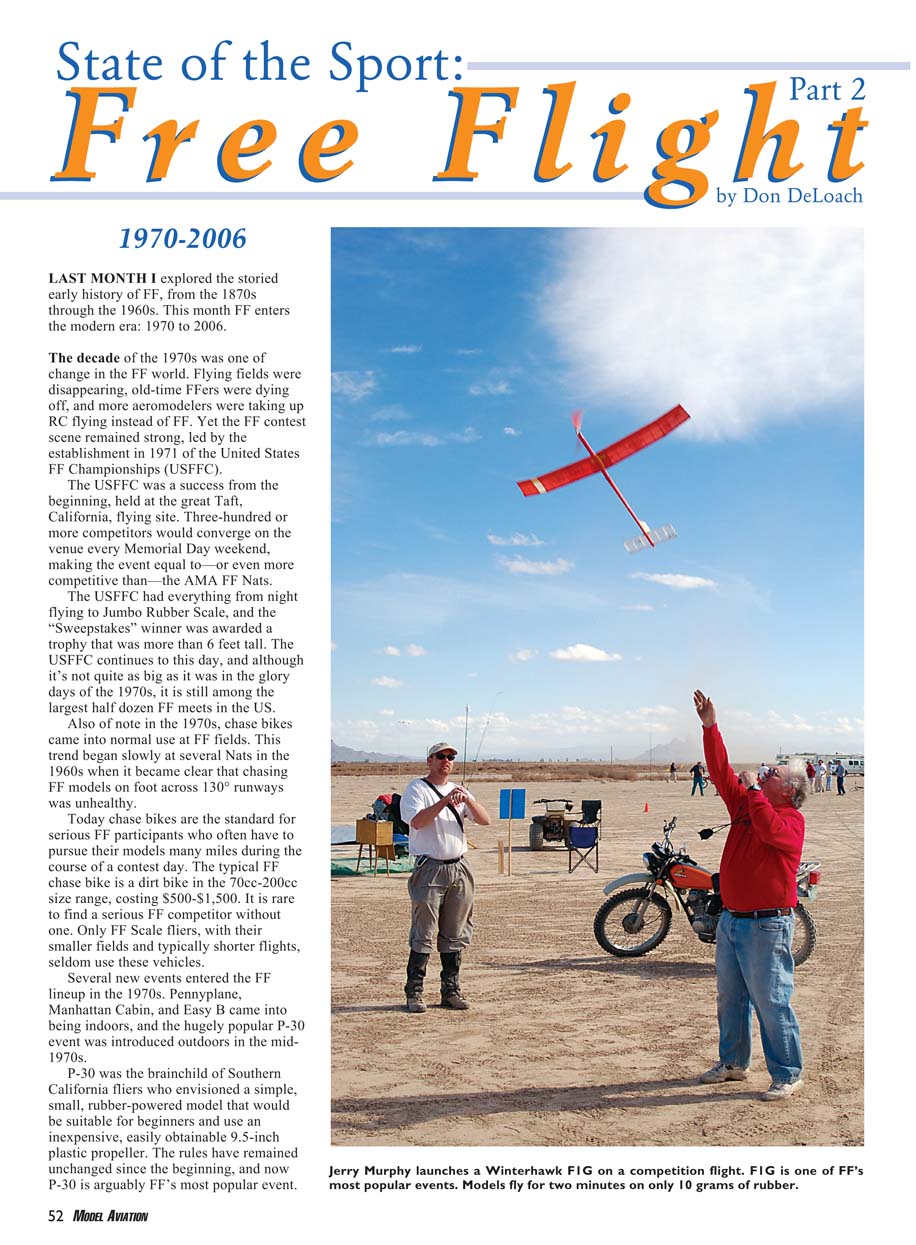
Several new events entered the FF lineup in the 1970s. Pennyplane, Manhattan Cabin, and Easy B came into being indoors, and the hugely popular P-30 event was introduced outdoors in the mid-1970s. P-30 was the brainchild of Southern California fliers who envisioned a simple, small, rubber-powered model that would be suitable for beginners and use an inexpensive, easily obtainable 9.5-inch plastic propeller. The rules have remained unchanged since the beginning, and now P-30 is arguably FF's most popular event. Most P-30s—even those built by beginners—will easily fly for 60–90 seconds, making them perfect for most small fields.
Technological improvements in engine design revolutionized FF power events in the 1970s. Schnürle-ported, ball-bearing racing engines by Rossi, K&B, Webra, and others hit the scene, relegating the older loop-scavenged, plain-bearing engines to obsolescence. The legendary Rossi .15 dominated FAI FF Power during the entire decade. AMA Power events also became horsepower races while designs improved in handling greater launch speeds. The Stardusters and Ramrods of the 1960s were replaced by the Pearl and Satellite design families of the 1970s. Pearls and Satellites are still popular and competitive in AMA Gas, some 30 years after their original popularity.
Bob White: No retrospective on international FF would be complete without mention of Robert P. White of Monrovia, California. He came to international prominence in the 1970s. Bob had returned to FF in the mid-1960s after a long layoff and quickly became one of the world’s premier Outdoor Rubber fliers. For many years he concentrated on one event: international-class F1B Wakefield.
Bob’s signature twin-fin F1B design went through annual refinements, continually improving its performance. From 1971 through 1989 Bob was on seven of the ten US F1B teams that competed at the FF World Championships. Five of the seven times he scored a top-five finish, finally winning the Wakefield Cup in 1987. Bob was inducted into the National Free Flight Society Hall of Fame in 1988 and continued to fly FF enthusiastically until his death in November 2005. Bob’s impeccably crafted World Champion F1B “#22” is hanging in AMA’s National Model Aviation Museum in Muncie, Indiana, for all to appreciate.
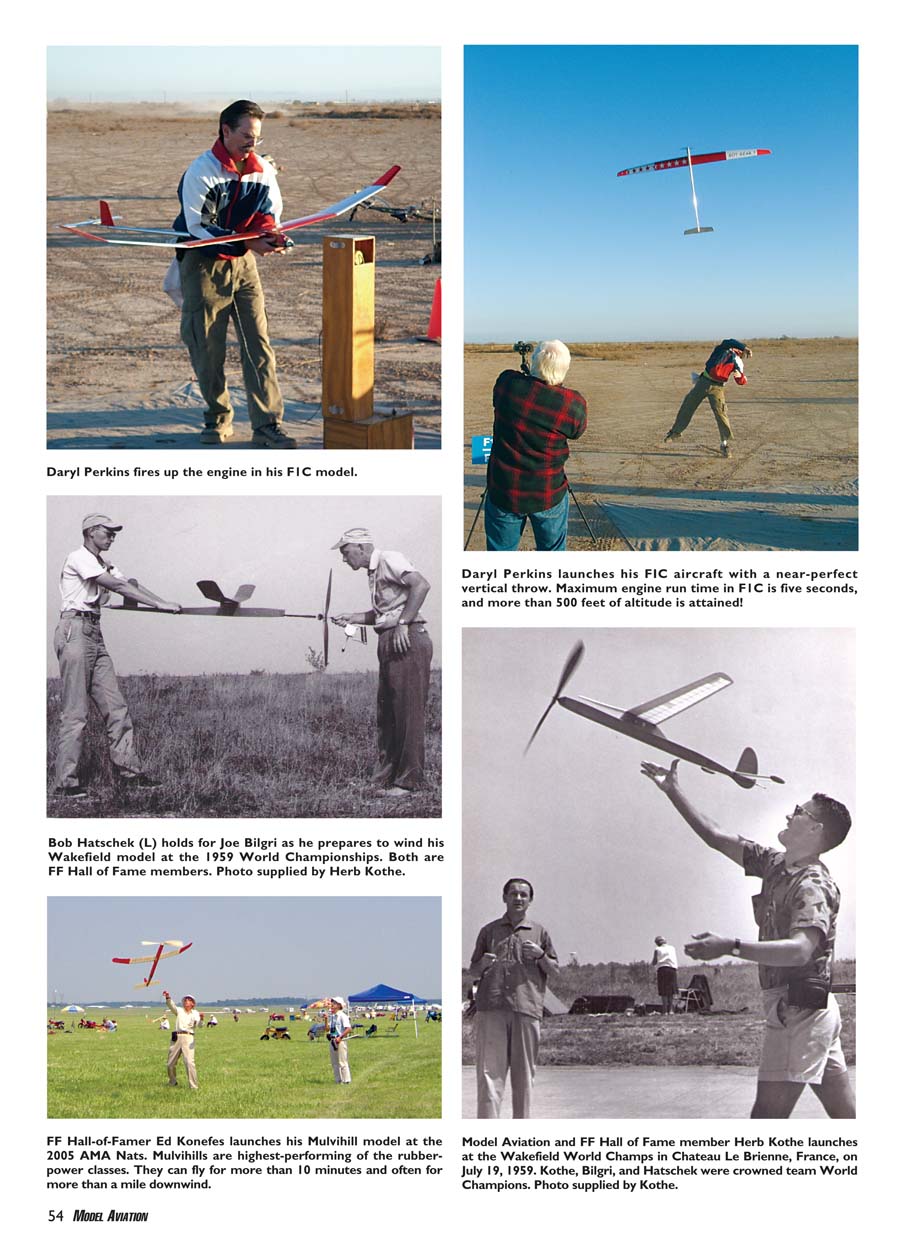
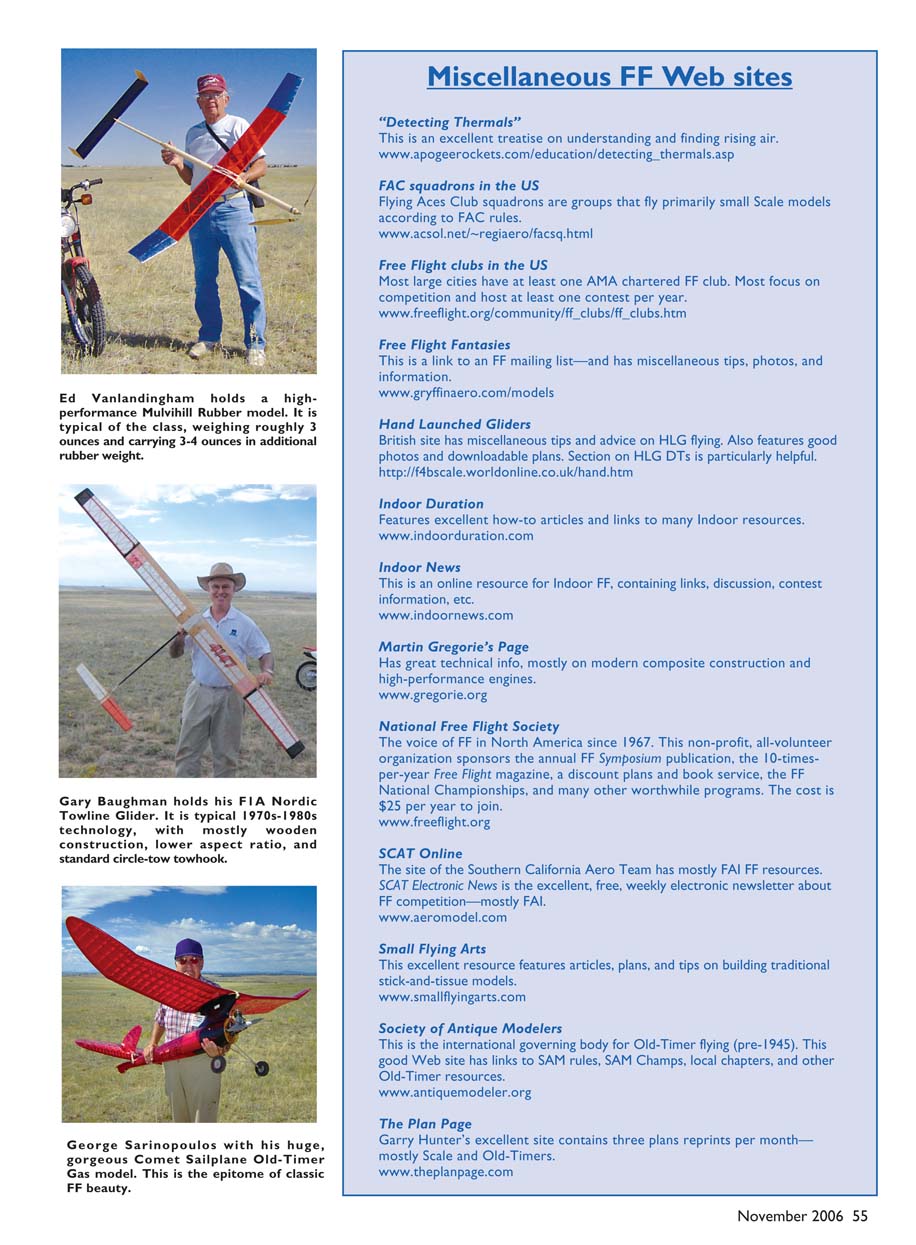
Miscellaneous FF Web sites
- "Detecting Thermals" — An excellent treatise on understanding and finding rising air.
www.apogeerockets.com/education/detecting_thermals.asp
- FAC squadrons in the US — Flying Aces Club squadrons are groups that fly primarily small Scale models according to FAC rules.
www.acsol.net/~regiaero/facsq.html
- Free Flight clubs in the US — Most large cities have at least one AMA-chartered FF club. Most focus on competition and host at least one contest per year.
www.freeflight.org/community/ff_clubs/ff_clubs.htm
- Free Flight Fantasies — A link to an FF mailing list with miscellaneous tips, photos, and information.
- Hand Launched Gliders — British site with tips and advice on HLG flying. Features good photos and downloadable plans. Section on HLG DTs is particularly helpful.
http://f4bscale.worldonline.co.uk/hand.htm
- Indoor Duration — Features excellent how-to articles and links to many indoor resources.
- Indoor News — An online resource for Indoor FF, containing links, discussion, contest information, etc.
- Martin Gregorie's Page — Great technical info, mostly on modern composite construction and high-performance engines.
- National Free Flight Society — The voice of FF in North America since 1967. This non-profit, all-volunteer organization sponsors the annual FF Symposium publication, the 10-times-per-year Free Flight magazine, a discount plans and book service, the FF National Championships, and many other programs. Cost is $25 per year to join.
- SCAT Online — The site of the Southern California Aero Team; mostly FAI FF resources. SCAT Electronic News is a free, weekly electronic newsletter about FF competition—mostly FAI.
- Small Flying Arts — Excellent resource featuring articles, plans, and tips on building traditional stick-and-tissue models.
- Society of Antique Modelers — International governing body for Old-Timer flying (pre-1945). Site has links to SAM rules, SAM Champs, local chapters, and other Old-Timer resources.
- The Plan Page — Garry Hunter's excellent site contains three plan reprints per month—mostly Scale and Old-Timers.
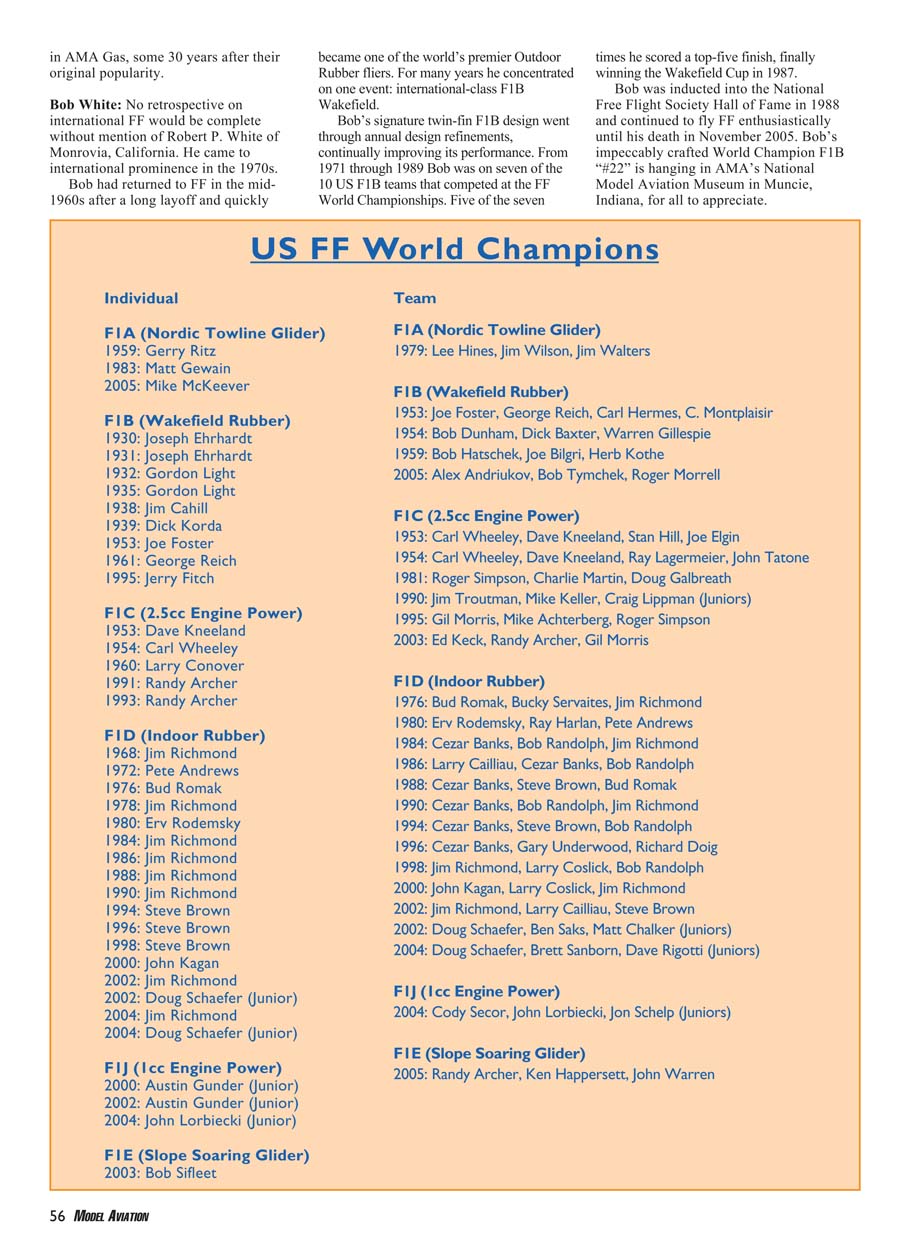
US FF World Champions
Individual
- F1A (Nordic Towline Glider)
- 1959: Gerry Ritz
- 1983: Matt Gewain
- 2005: Mike McKeever
- F1B (Wakefield Rubber)
- 1930: Joseph Ehrhardt
- 1931: Joseph Ehrhardt
- 1932: Gordon Light
- 1935: Gordon Light
- 1938: Jim Cahill
- 1939: Dick Korda
- 1953: Joe Foster
- 1961: George Reich
- 1995: Jerry Fitch
- F1C (2.5cc Engine Power)
- 1953: Dave Kneeland
- 1954: Carl Wheeley
- 1960: Larry Conover
- 1991: Randy Archer
- 1993: Randy Archer
- F1D (Indoor Rubber)
- 1968: Jim Richmond
- 1972: Pete Andrews
- 1976: Bud Romak
- 1978: Jim Richmond
- 1980: Erv Rodemsky
- 1984: Jim Richmond
- 1986: Jim Richmond
- 1988: Jim Richmond
- 1990: Jim Richmond
- 1994: Steve Brown
- 1996: Steve Brown
- 1998: Steve Brown
- 2000: John Kagan
- 2002: Jim Richmond
- 2002: Doug Schaefer (Junior)
- 2004: Jim Richmond
- 2004: Doug Schaefer (Junior)
- F1J (1cc Engine Power)
- 2000: Austin Gunder (Junior)
- 2002: Austin Gunder (Junior)
- 2004: John Lorbiecki (Junior)
- F1E (Slope Soaring Glider)
- 2003: Bob Sifelet
Team
- F1A (Nordic Towline Glider)
- 1979: Lee Hines, Jim Wilson, Jim Walters
- F1B (Wakefield Rubber)
- 1953: Joe Foster, George Reich, Carl Hermes, C. Montplaisir
- 1954: Bob Dunham, Dick Baxter, Warren Gillespie
- 1959: Bob Hatschek, Joe Bilgri, Herb Kothe
- 2005: Alex Andriukov, Bob Tymchek, Roger Morrell
- F1C (2.5cc Engine Power)
- 1953: Carl Wheeley, Dave Kneeland, Stan Hill, Joe Elgin
- 1954: Carl Wheeley, Dave Kneeland, Ray Lagermeier, John Tatone
- 1981: Roger Simpson, Charlie Martin, Doug Galbreath
- 1990: Jim Troutman, Mike Keller, Craig Lippman (Juniors)
- 1995: Gil Morris, Mike Achterberg, Roger Simpson
- 2003: Ed Keck, Randy Archer, Gil Morris
- F1D (Indoor Rubber)
- 1976: Bud Romak, Bucky Servaites, Jim Richmond
- 1980: Erv Rodemsky, Ray Harlan, Pete Andrews
- 1984: Cezar Banks, Bob Randolph, Jim Richmond
- 1986: Larry Cailliau, Cezar Banks, Bob Randolph
- 1988: Cezar Banks, Steve Brown, Bud Romak
- 1990: Cezar Banks, Bob Randolph, Jim Richmond
- 1994: Cezar Banks, Steve Brown, Bob Randolph
- 1996: Cezar Banks, Gary Underwood, Richard Doig
- 1998: Jim Richmond, Larry Coslick, Bob Randolph
- 2000: John Kagan, Larry Coslick, Jim Richmond
- 2002: Jim Richmond, Larry Cailliau, Steve Brown
- 2002: Doug Schaefer, Ben Saks, Matt Chalker (Juniors)
- 2004: Doug Schaefer, Brett Sanborn, Dave Rigotti (Juniors)
- F1J (1cc Engine Power)
- 2004: Cody Secor, John Lorbiecki, Jon Schelp (Juniors)
- F1E (Slope Soaring Glider)
- 2005: Randy Archer, Ken Happersett, John Warren
Indoor Dominance
While Bob White was dominating Wakefield competitions outdoors, the US became the leader in international indoor FF beginning in the early 1970s. From 1968 to 2004 Jim Richmond won eight F1D World Championships. This incredible record makes him by far the most decorated individual in FF World Champs history and probably in all of aeromodeling history.
During the same period, five other US indoor fliers won individual titles and the US won 11 of 18 team titles. From 1976 to 2004 only two F1D World Championships—in 1982 and 1992—were not won by a US individual or US team.
No country can claim as many World Champion FF fliers as the US. Thirty-eight individual World Championships have been won by 24 US competitors. Of those 24, seven earned more than one individual world title. See the sidebar for a complete list of America's FF elite.
The 1980s
The early 1980s saw the first applications of what we now consider high-tech construction methods in the FAI events. Carbon, Kevlar, and foam composites began to revolutionize construction and design of FF models. Wings became longer and skinnier, airfoils thinner and more efficient, and gadgets more numerous.
The typical 1980s Wakefield (F1B) model had variable-incidence tailplane (VIT) and auto-rudder (AR) to maximize the climb. As early as 1981, Soviet Wakefield fliers were testing delayed propeller release (DPR) front ends. DPR—which would become standard on Wakefields from the early 1990s on—released the propeller a half second after a vertical javelin launch, gaining the model roughly 20 extra feet of altitude.
F1A “Nordic” towline gliders also used quite a bit of composites, enabling a more aggressive “zoom” launch off of a circle tow hook. Circle-towing came to the US from Eastern Europe in the 1970s and was ubiquitous by the 1980s. It enabled the flier to circle the model overhead on the towline for many minutes until the right air was found.
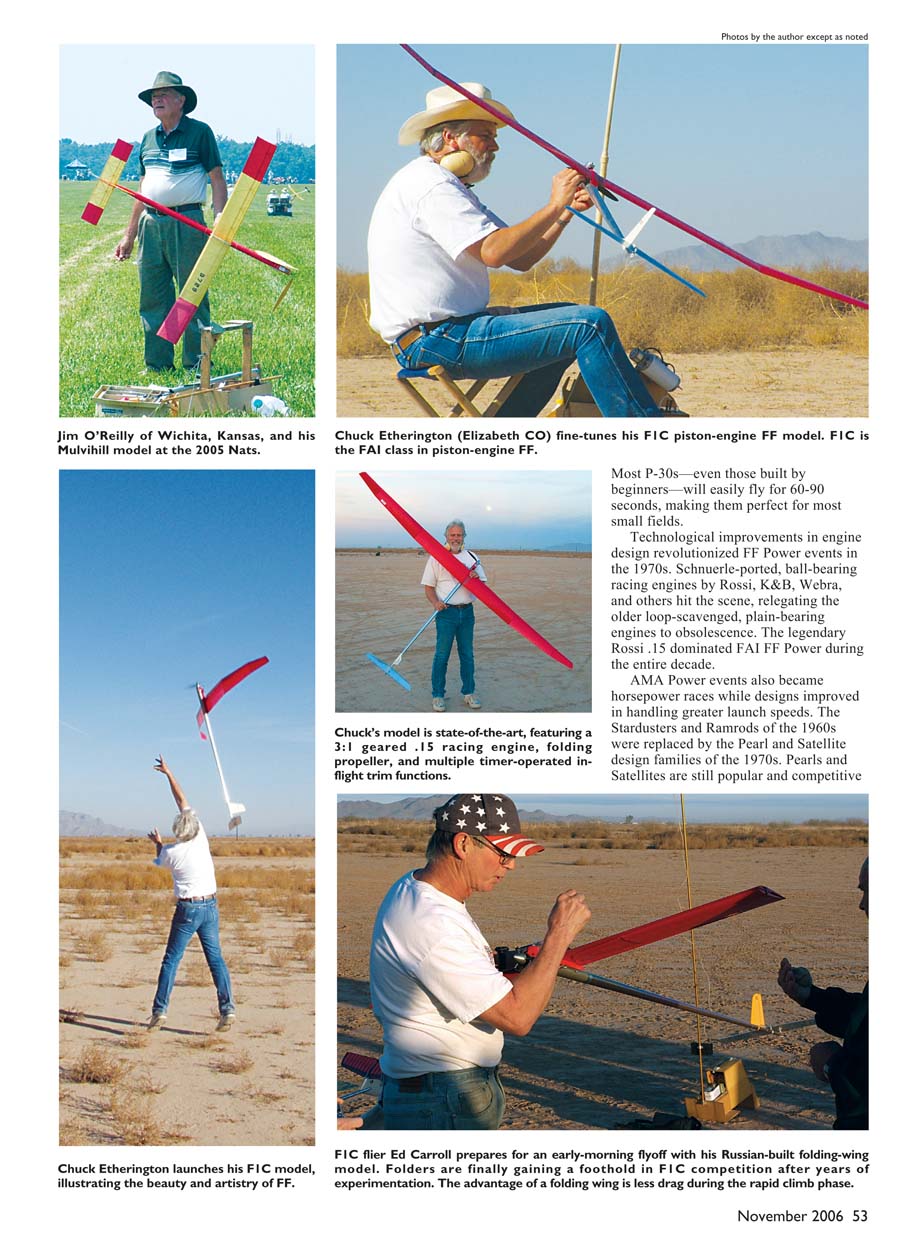
FAI Power (F1C) took the greatest leap in the 1980s with the introduction of the Nelson .15 racing engine and the “bunt” transition. Bunt was first tried in the 1960s but wasn't perfected and put into widespread use until the 1980s. It is a timer-actuated one-quarter outside loop just after engine shutoff at the top of a screaming, vertical power pattern. The advent of bunt—when used in conjunction with VIT and AR—meant that FAI Power models could get far higher than Wakefields or Nordics, and their still airtimes reflected this difference. Because of this it wasn't long before the FAI shortened the seven-second engine run to five seconds.
1990s to Present
The modern era of FF is in many ways the most exciting time in our history. Although most of the early FF heroes are gone, quite a few legends are still flying with us. Men such as Jim Richmond, Gil Morris, Bob Hatschek, Herb Kothe, Bud Romak, Sal Taibi, Bob Bienenstein, Joe and Ed Konefes, Phil Klintworth, and Earl Stahl are still extremely active. Pair that with the current resurgence in youth participation, and we have an interesting mix of old and new. The young people involved in FF today are largely the outgrowth of organized mentoring programs.
In FAI circles the Builder-of-the-Model Rule (BOM) was abolished in the late 1980s for the outdoor FF classes. This fact, paired with the fall of the Soviet Union and other Eastern Bloc nations, opened the door for former state-sponsored modelers to market RTF FF models in the US. As a result, kids and novices are now able to buy full-function FAI FF models and learn to fly them in competition.
Many of these people aren't interested in FF as a hobby; they view it more as a sport and the models as their sporting equipment. There are those who decry the loss of building skills and patience they instill as the downfall of FF; they have valid points. FF used to be a craftsman's game, and in some events it still is. An alternate opinion is that anything that brings more people out to the FF field is good—and I happen to agree. Nothing in the FAI rules stipulates that you can't still build your own models, and many of the experts still do.
FF duration contests are less about building skills and more about flying strategy and tactics than ever before. As the saying goes, "the thermal doesn't care who built the model."
The Elusive Thermal: Since the first FF contest was held, fliers have been keenly aware of the presence of thermals. For many years thermal detection was more art than science. Back then fliers watched the grass blow in front of them or felt for air-temperature changes on exposed skin. By the 1980s and 1990s the majority of serious FFers used thermal-detection equipment. Today most fliers rely on multiple devices to aid in picking air, the most common of which is the thin Mylar streamer mounted atop a 15- to 30-foot pole. Such streamers will show every subtle up-and-down air movement.
The next most popular device is the thermistor, or electronic thermometer. These are very sensitive, with 1/10-degree resolution. Modelers will often use a streamer and thermistor in concert when making the decision to launch. Common practice is not to launch until both indicators rise simultaneously.
Other common thermal-detection aids are soap bubbles and cattail fluffies, both of which are most useful in light wind conditions. They are best for smaller, lighter models such as P-30s and hand-launched gliders. At FF World Championships, various upwind-sensing equipment has been used successfully to pinpoint thermal activity.
Better Technology and Techniques: In the last 15 years there have been massive developments in products and technology for FF. Carbon, Kevlar, and boron are now widely employed, thanks to several low-cost suppliers. The use of composites even in mostly balsa models makes them stronger and longer-lasting than ever before.
Rubber strip used for FF has been steadily improving since World War II. Through the years there have been many brands of rubber: Dunlop, Filati, T-56, FAI Black, Champion, Pirelli, and Chinese. Today Tan II and Tan Super Sport reign supreme. Tan II came onto the scene in 1993. Produced until 2002, it was the finest model-airplane rubber ever made, with an energy return that was 20% better than any rubber before and approximately 50% better than the rubber of the 1950s. The result for FF modelers has been that most national records have been broken since 1993. Tan II is no longer available, but Tan Super Sport is within 5% as good, with energy figures still well exceeding any rubber that was produced before 1993. There are two brands of sport rubber: Tan Sport and Tru-Torque.
Glow engines for FF have steadily improved since the early days of spark ignition in the 1930s and 1940s. FF engines differ from sport-flying RC engines in many ways. Since the engine is only allowed to run for as few as four seconds, FFers desire the highest rpm and power-to-weight ratios. Racing specialty engines such as Nelson, Rossi, Cyclon, and Jett are the most sought after for FF use. But there are also FF classes for the slower engines of the Old-Timer (pre-1943) and Nostalgia (pre-1957) classes.
Laser cutting has also significantly enhanced FF. There are many more high-quality kits available today than ever before. Even though the FF kits aren't produced by the thousands as they were in the 1940s–1960s, today's kits are more apt to produce good-flying models. (Ask any veteran FF modeler about the brick-heavy balsa in 1960s Berkeley, Guillows, and Sterling kits.)
Some modern suppliers of top-quality FF kits are Campbell's Custom Kits, Dare Engineering, Dumas, Diels, Peck-Polymers, Micro-X, Indoor Model Supply, StarLink-FliteTech, and Golden Age Models.
Perhaps the greatest technological leap in recent years has been the advent of radio telemetry gear to locate and recover FF models. Prior to roughly 20 years ago, the options were few when one's FF model flew out of sight or into a tall cornfield. It was common in those days to lose several airplanes each season because of DT failures, timers losing sight of the model, or other circumstances.
That all changed in the mid-1980s, when FFer Jim Walston started marketing radio receivers and transmitters to the FF community. The system costs several hundred dollars, but it was quick to catch on. The tiny 3- to 4-gram transmitters fit onto all but the smallest FF models and make retrieval much more reliable. Modelers can track their models in the air or on the ground, from several miles away.
This advance has really changed the way we fly FF. There is no longer a fear of losing models to the thermal gods. Even if a model goes out of sight or into a forest, a steady beep is still heard on the receiver and will lead the flier directly to the model's location.
Today, 20 years after the advent of radio tracking, hundreds of incredible retrieval stories abound. One modeler had a DT failure on his F1A glider and quickly hopped into his full-scale aircraft with receiver in tow. He was able to fly several miles downwind with his model and even watched it land. Another flier tracked an out-of-sight airplane several miles downwind until the signal dropped suddenly. The sun set and the guy gave up for the day. The next morning he flipped on his receiver and heard a steady beep that led him right to the model, sitting on a lakeshore. He hypothesized that the airplane had been found floating and was returned to the shore by a boater. Despite being waterlogged, the transmitter still delivered a signal once it was dry and above the waterline.
Next Month: Part 3 of this series will cover getting started in the various AMA and FAI FF classes: Gas, Rubber, and Glider.
Don DeLoach [email protected]
Transcribed from original scans by AI. Minor OCR errors may remain.

