
State of the Sport: Free Flight — Part 3
by Don DeLoach
Getting started in Free Flight
There has never been a better time to get started in free flight (FF) modeling. Kits are much better today, and for those who don't enjoy building, expert builders sell excellent RTF models. Great videos, books, and other resources are available, and excellent clubs and fields still exist.
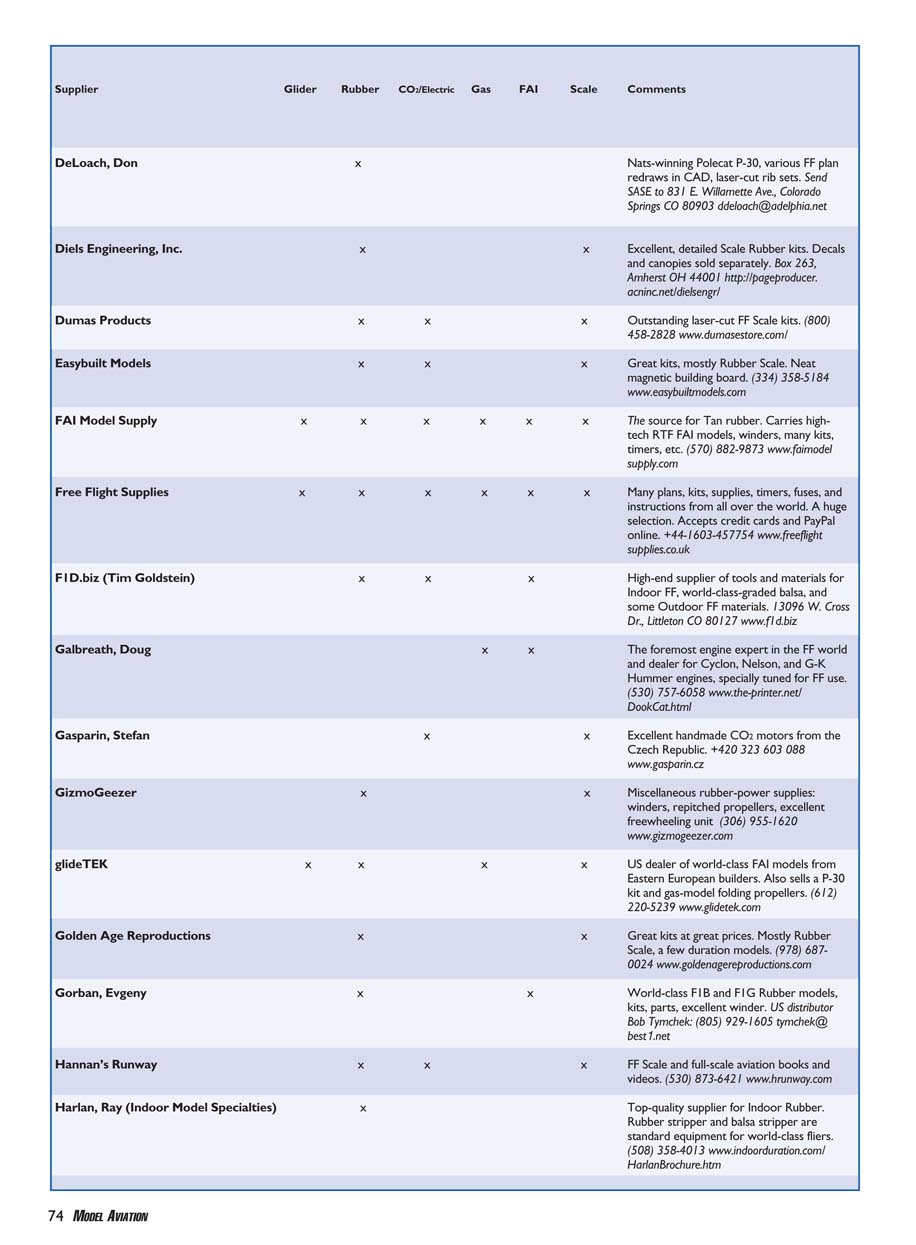
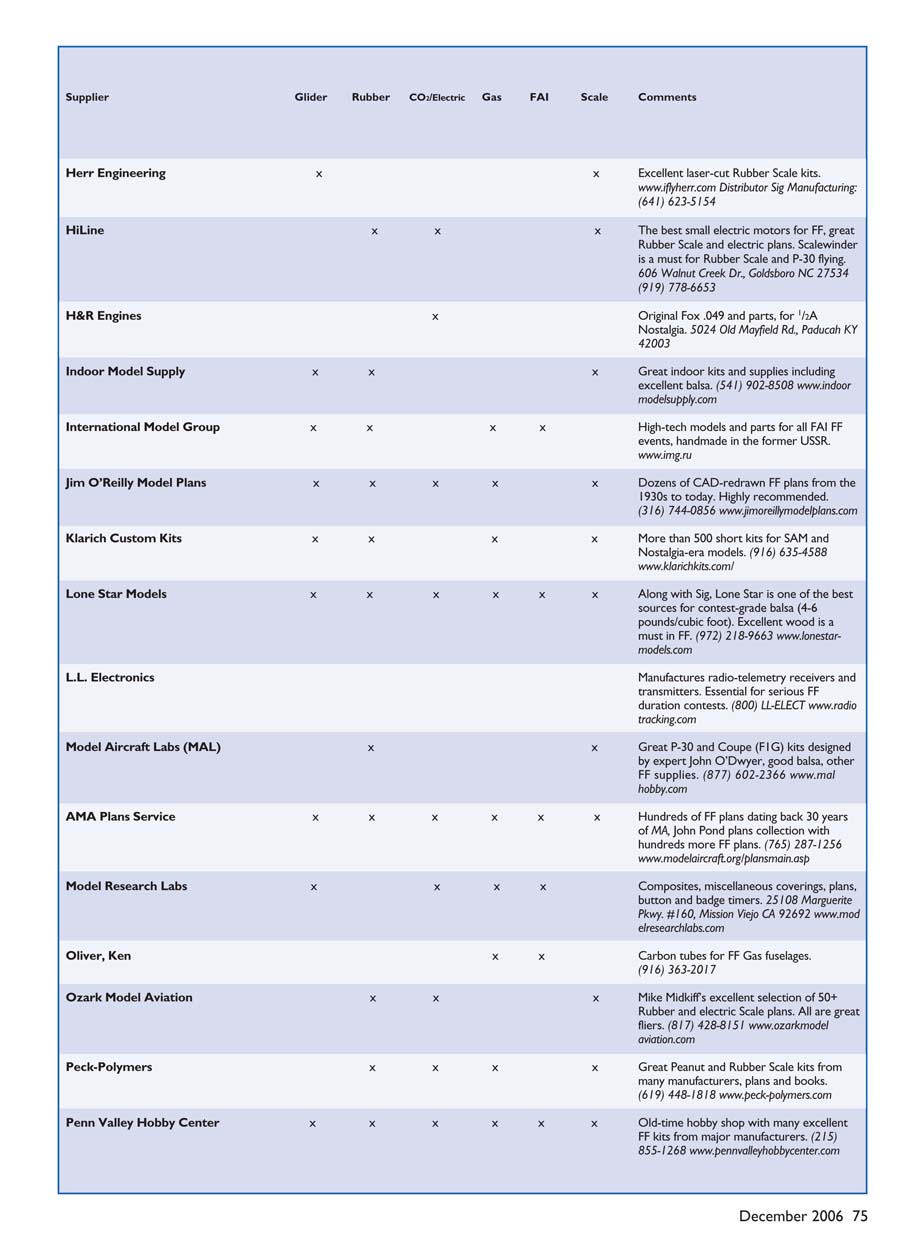
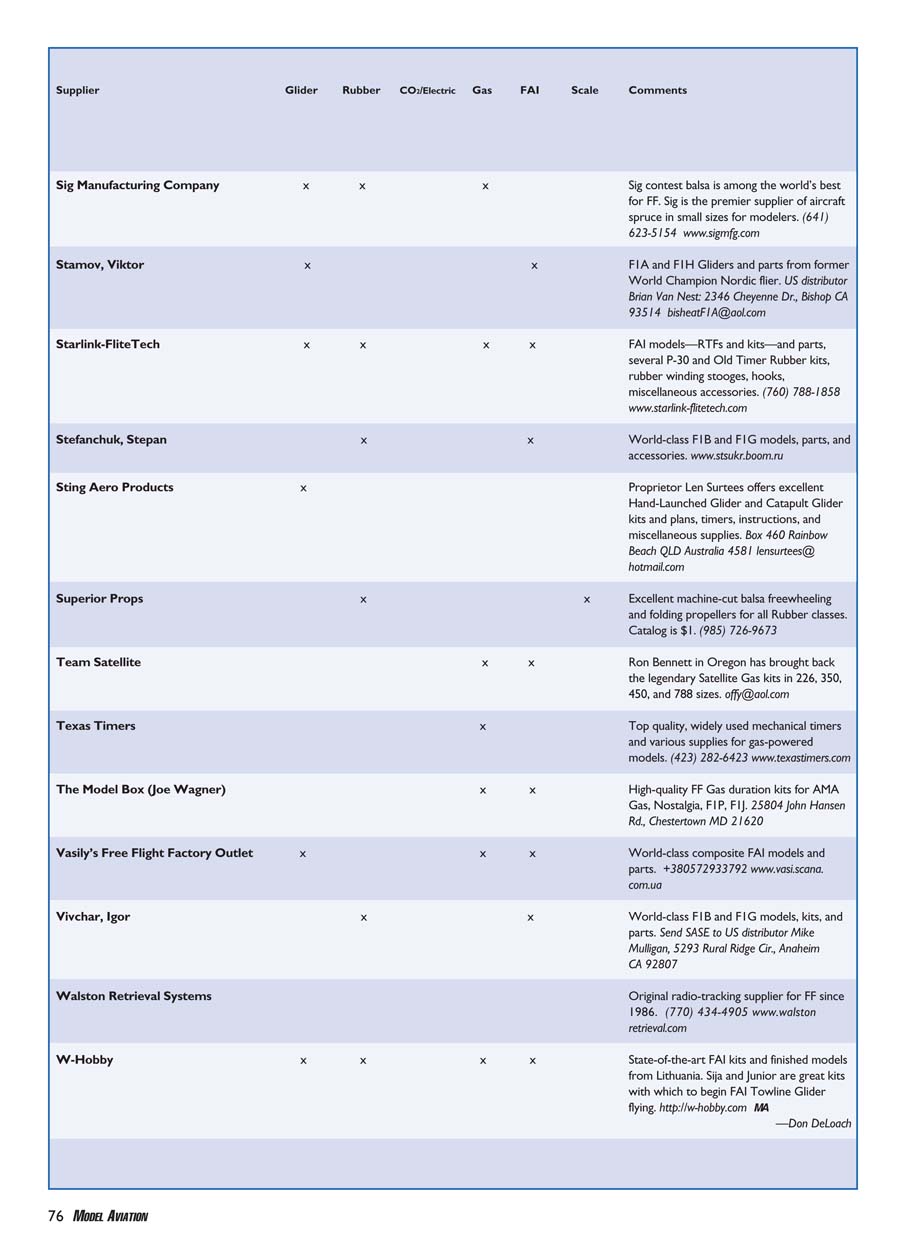
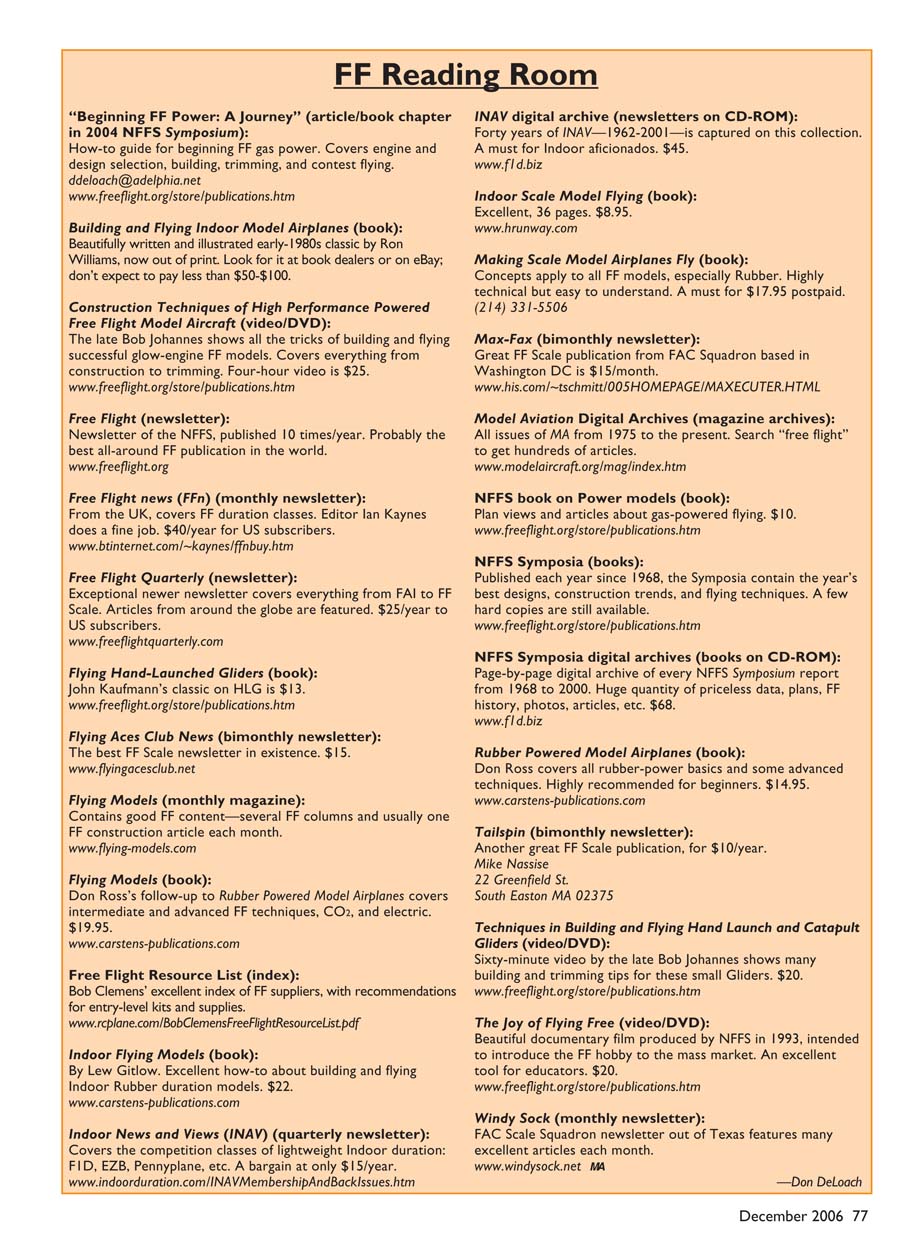
(The following makes several references to various FF suppliers and sources. See the sidebars "FF Suppliers" and "FF Reading Room" for detailed information.)
Starting with Gliders
Since the early days of model aviation, simple FF gliders have been the natural starting point for most beginners. They remain a great place to start. Many glider kits are available in the $10–$20 range, producing nice-flying models and teaching much about flight trimming in the process.
#### Hand-launched and catapult gliders
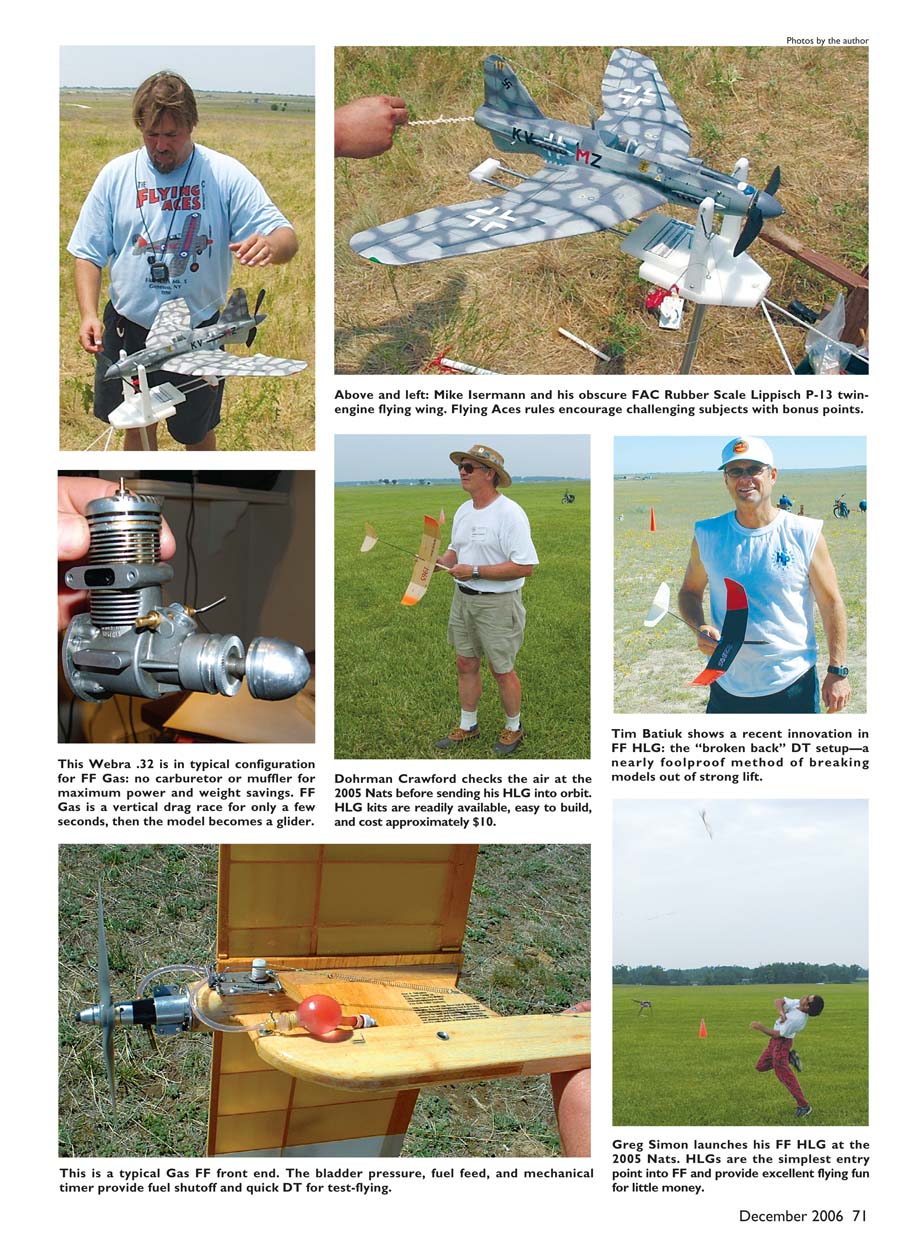
Hand-launched gliders are great for kids and beginners—anyone with at least average arm strength. If you'd rather rest your arm, rubber-band catapult glider kits are equally rewarding.
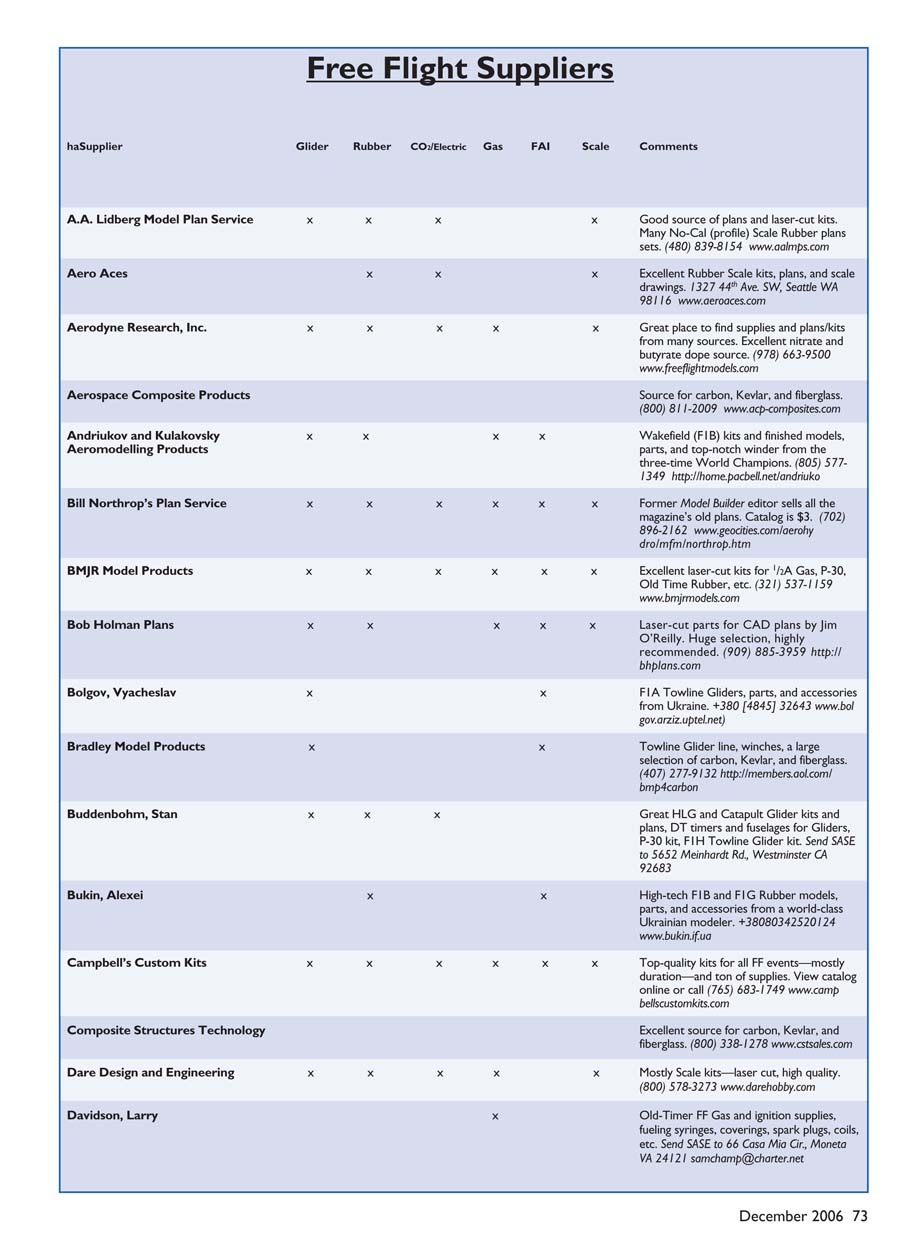
Three of the best small glider-kit suppliers are Stan Buddenbohm, Sting Aero Products, and Campbell's Custom Kits. Each offers kits, plans, and supplies in all size and complexity ranges, with excellent wood and good instructions. Check John Kaufmann's Building and Flying Hand-Launched Gliders or Bob Johannes' how-to glider video, both available from www.freeflight.org.
#### Towline (Nordic) gliders
"Nordic" towline gliders have been around since the 1920s. Some devotees consider Nordic gliders to be the purest form of model airplane: no engine, no ground control, majestic circling, and silent flight. A good Nordic glider is an object of immense beauty and simplicity.
Towlines for all competition classes are limited to 50 meters in length (164 feet). The established glider classes fall into three basic categories of complexity: classic/straight tow, intermediate/circle tow, and modern bunt.
- Classic-style gliders are the simple, mostly balsa "A-1"-sized models which are straight-towed and "kited" off the line within a few seconds. Good small glider kits for roughly $30 are the Lil' Dip and Jetstream from BMJR Model Products.
- A small step up from A-1 is the F1H kit from Campbell's Custom Kits called the Jesse James. It is also a straight-tow model but has a better glide and more advanced design.
- Another classic glider—larger and more expensive—is the Thermal Probe from glideTEK. It is easy to fly and one of the best-performing classic towline designs available.
The intermediate style of Nordic glider uses circle-tow technology: the flier circles the model overhead while it's still attached to the towline. When rising air is sensed, the flier sprints forward and the glider is "zoomed" off the line, at which point the timekeeper begins timing the flight.
Good circle-tow designs are the Sija F1A from W-Hobby and the Mini Master F1H by Stan Buddenbohm. Both are available in kit form and offer high performance for relatively little money. Intermediate-tech Nordics in experienced hands are still competitive with the best high-tech Nordics.
High-tech Nordics use mostly carbon and Kevlar, complex auto-gadgetry, and are significantly more expensive. High-tech gliders also use circle-tow hooks, with the added complexity of a "bunt" transition.
"Bunt" is a timer-actuated one-quarter outside loop at the top of the fast zoom launch. The bunt transition gains the model an extra 20–30 feet of altitude, which is precious at high levels of competition.
Check out many RTF F1A and F1H gliders from European builders such as Beschasny, Stamov, Bolgov, Makarov & Kochkarov, glideTEK, and W-Hobby. Expect to pay substantially for these finely engineered machines, but their performance and longevity are exceptional.
Getting started in Rubber flying
As I wrote in Part 1 of this series, rubber-powered model airplanes are the original form of heavier-than-air aviation, dating back to 1871. Rubber power is the FF class best known to the wider American audience. Slide-together, rubber-powered toys are still widely available at discount stores and toy shops—just as they were 100 years ago.
Rubber-powered FF is still popular, with great kits, plans, and excellent rubber strip readily available. Hobby shops rarely carry everything you need, but some still stock kits and supplies. See the "Free Flight Suppliers" sidebar for quality sources.
A good starter kit for an inexperienced modeler is the Peck R.O.G. from Peck-Polymers. It is a simple design with a stick fuselage that goes together in a couple of hours. For more ambitious beginners and those with some modeling experience, consider one of the many P-30 class kits.
P-30 was conceived as an entry-level event and still offers excellent performance. Most P-30s will easily fly one to two minutes without thermal help, even in beginners' hands. This makes them perfect for most average-sized fields.
Try the Majestyk or Super P-30 from Campbell's Custom Kits, the Kiwi or Tailfister from BMJR Model Products, or the Model Aircraft Labs (MAL) Sparrowhawk. Almost any P-30 kit will build easily and fly well. With a good-flying P-30 you will soon find the need for larger fields and the use of DT (dethermalizer). P-30 is an excellent event to enter at your first FF contest.
As the next step up from P-30, try a Society of Antique Modelers (SAM) Old-Timer (OT) rubber design. Many great kits, short kits, and plans are available. Designs including the Sparky, Gollywock, and Casano Stick are still popular 60–70 years after they first appeared.
The Gollywock is a favorite of beginners and experts since it is easy to build and climbs like a rocket. Campbell's Custom Kits, Bob Holman Plans, Jim O'Reilly Model Plans, and Starlink are great sources of OT rubber kits and plans.
If you prefer the size and power of larger OT rubber models, try the Korda 1939 Wakefield, Korda Stickler, Red Buzzard, or Smith 1941 Mulvihill from Bob Holman Plans. All have performance equal to or better than their smaller cousins; they just require larger motors.
The largest and best-performing rubber models belong to the AMA "Mulvihill" class (Unlimited Rubber). This category has no wingspan, length, propeller, weight, or rubber restrictions—the only rule is that the model must have less than 300 square inches of wing area.
Typical Mulvihill models are light (4 ounces or less), large (4–5 feet long), and carry a huge amount of rubber—approximately equal to their empty weight. After a two-minute propeller run, a typical Mulvihill will often fly 10 minutes or more and require several miles of downwind recovery area unless the wind is calm.
Flying Mulvihill is uniquely fun because the models climb so high and for so long. Their performance is amazing to watch, especially if your mental picture of rubber power is of a child playing with a toy in the front yard.
Good sources of Mulvihill plans and articles include the NFFS Plans Service (www.freeflight.org/store/plans/plans.htm) and the NFFS Symposium digital archive (www.freeflight.org/store/symposiums.htm). You can also search "Mulvihill" in the AMA Plans Service (www.modelaircraft.org/plansmain.asp) to find several designs published in Model Aviation over the years.
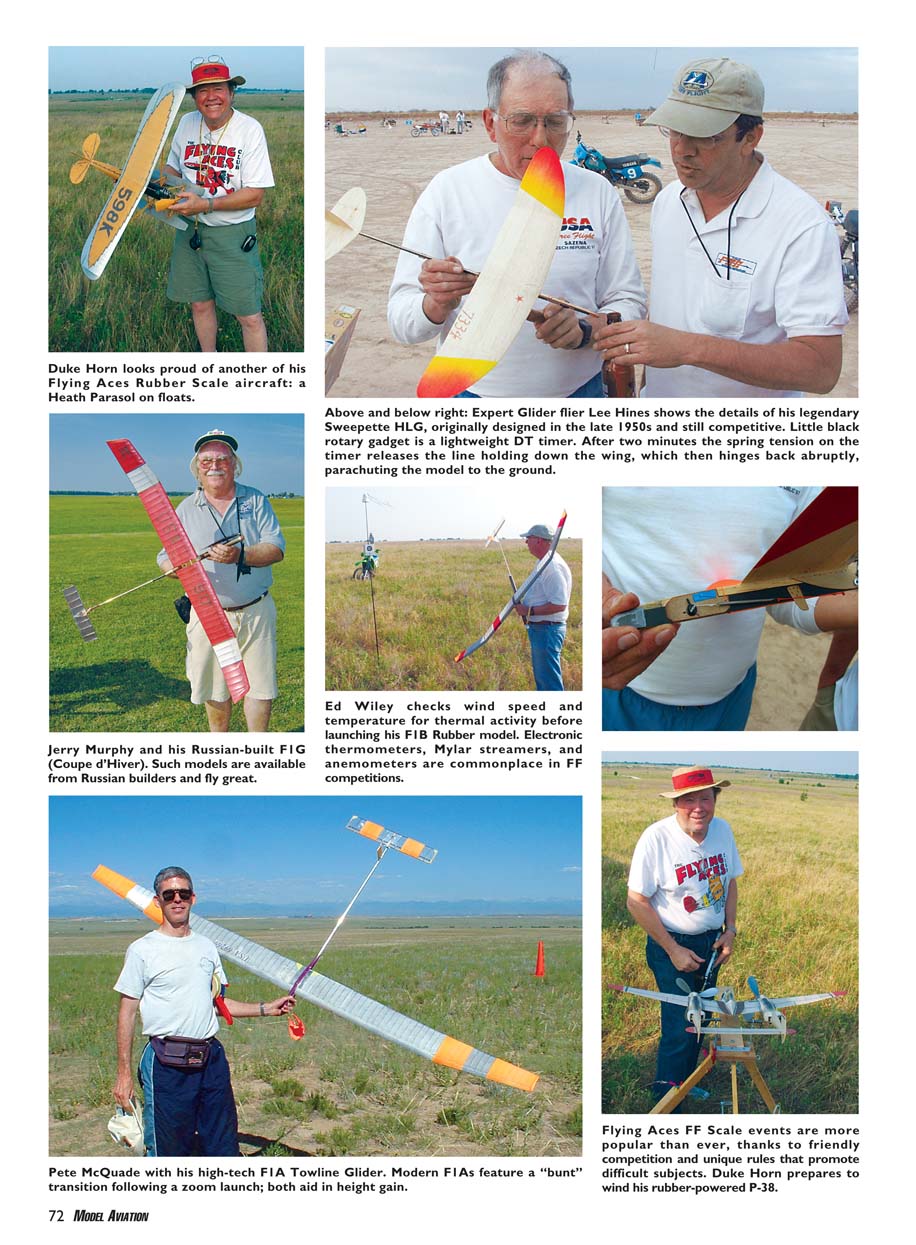
The Coupe d'Hiver (FAI class F1G) event originated in France after World War II. It specifies a fairly heavy airframe (70 grams empty) with a relatively small rubber motor (10 grams maximum). The result is a two-minute model that is more challenging than P-30 or OT rubber but flies beautifully.
Coupe motors are short and stout because they swing large-diameter propellers on few turns (about 400–500). Following a quick 30-second ascent to approximately 150 feet, the Coupe model begins its graceful glide. Modern Coupes—though underpowered compared to some classes—excel in the glide phase. With sink rates around 1.5 feet per second, they can sometimes be hard to DT reliably.
If you prefer the challenge of building, check out the Kiwi Coupe from BMJR Model Products or the Souper Coupe from Campbell's Custom Kits. The best balsa-kit Coupe is MAL's Winterhawk.
Since Coupe is an FAI event, the Builder-of-the-Model rule is nonexistent; therefore, F1G provides a nice entry point for FF competition. There are many RTF and ARF Coupes and Coupe parts available from the European market.
Among the world's best F1Gs are those by Burdov (Starlink), Alexei Bukin, and Evgeny Gorban. Simpler ARF Coupe kits from Starlink are also available—notably the Beau Coupe and Burdov's Candy G.
F1B Wakefield represents the pinnacle of technical performance in rubber power. These models are limited by airframe weight (200 grams minimum) and rubber weight (30 grams maximum).
Despite those limitations, modern F1B airplanes are capable of breathtaking performance. Motors are wound to the verge of breaking and models are javelin-launched to vertical climbs before the propellers fold at approximately 250 feet. Then the outstanding glide of the modern F1B takes over, often clocking five to seven minutes in calm air.
European F1Bs and parts for building your own are readily available. For starters, try one of the simpler entry-level varieties by Vivchar (Prima) or Burdov (STARTer). Both will provide excellent performance and give you a good taste of F1B. Some entry-level F1Bs can be had for less than $250. When you are ready for the big time, world-class F1Bs by champions such as Burdov, Bukin, Vivchar, Andriukov, and Gorban will run in the neighborhood of $800–$1,500.
FF Reading Room
- “Beginning FF Power: A Journey” (article/book chapter in 2004 NFFS Symposium): How-to guide for beginning FF gas power. Covers engine and design selection, building, trimming, and contest flying. [email protected] www.freeflight.org/store/publications.htm
- Building and Flying Indoor Model Airplanes (book): Beautifully written and illustrated early-1980s classic by Ron Williams, now out of print. Look for it at book dealers or on eBay; don't expect to pay less than $50–$100.
- Construction Techniques of High Performance Powered Free Flight Model Aircraft (video/DVD): The late Bob Johannes shows all the tricks of building and flying successful glow-engine FF models. Covers everything from construction to trimming. Four-hour video is $25. www.freeflight.org/store/publications.htm
- Free Flight (newsletter): Newsletter of the NFFS, published 10 times/year. Probably the best all-around FF publication in the world. www.freeflight.org
- Free Flight news (FFn) (monthly newsletter): From the UK, covers FF duration classes. Editor Ian Kaynes does a fine job. $40/year for US subscribers. www.btinternet.com/~kaynes/ffnbuy.htm
- Free Flight Quarterly (newsletter): Exceptional newer newsletter covers everything from FAI to FF Scale. Articles from around the globe are featured. $25/year to US subscribers. www.freeflightquarterly.com
- Flying Hand-Launched Gliders (book): John Kaufmann's classic on HLG is $13. www.freeflight.org/store/publications.htm
- Flying Aces Club News (bimonthly newsletter): The best FF Scale newsletter in existence. $15. www.flyingacesclub.net
- Flying Models (monthly magazine): Contains good FF content—several FF columns and usually one FF construction article each month. www.flying-models.com
- Flying Models (book): Don Ross's follow-up to Rubber Powered Model Airplanes covers intermediate and advanced FF techniques, CO2, and electric. $19.95. www.carstens-publications.com
- Free Flight Resource List (index): Bob Clemens' excellent index of FF suppliers, with recommendations for entry-level kits and supplies. www.rcplane.com/BobClemensFreeFlightResourceList.pdf
- Indoor Flying Models (book): By Lew Gitlow. Excellent how-to about building and flying Indoor Rubber duration models. $22. www.carstens-publications.com
- Indoor News and Views (INAV) (quarterly newsletter): Covers the competition classes of lightweight Indoor duration: F1D, EZB, Pennyplane, etc. A bargain at only $15/year. www.indoorduration.com/INAVMembershipAndBackIssues.htm
- INAV digital archive (newsletters on CD-ROM): Forty years of INAV—1962–2001—is captured on this collection. A must for Indoor aficionados. $45. www.f1d.biz
- Indoor Scale Model Flying (book): Excellent, 36 pages. $8.95. www.hrunway.com
- Making Scale Model Airplanes Fly (book): Concepts apply to all FF models, especially rubber. Highly technical but easy to understand. A must for $17.95 postpaid. (214) 331-5506
- Max-Fax (bimonthly newsletter): Great FF Scale publication from FAC Squadron based in Washington DC. $15. www.his.com/~tschmitt/005HOMEPAGE/MAXECUTER.HTML
- Model Aviation Digital Archives (magazine archives): All issues of Model Aviation from 1975 to the present. Search "free flight" to get hundreds of articles. www.modelaircraft.org/mag/index.htm
- NFFS book on Power models (book): Plan views and articles about gas-powered flying. $10. www.freeflight.org/store/publications.htm
- NFFS Symposia (books): Published each year since 1968, the Symposia contain the year's best designs, construction trends, and flying techniques. A few hard copies are still available. www.freeflight.org/store/publications.htm
- NFFS Symposia digital archives (books on CD-ROM): Page-by-page digital archive of every NFFS Symposium report from 1968 to 2000. Priceless data, plans, history, and photos. $68. www.f1d.biz
- Rubber Powered Model Airplanes (book): Don Ross covers all rubber-power basics and some advanced techniques. Highly recommended for beginners. $14.95. www.carstens-publications.com
- Tailspin (bimonthly newsletter): Another great FF Scale publication, for $10/year. Mike Nassise, 22 Greenfield St., South Easton MA 02375
- Techniques in Building and Flying Hand Launch and Catapult Gliders (video/DVD): Sixty-minute video by the late Bob Johannes shows many building and trimming tips for these small gliders. $20. www.freeflight.org/store/publications.htm
- The Joy of Flying Free (video/DVD): Beautiful documentary film produced by NFFS in 1993, intended to introduce the FF hobby to the mass market. An excellent tool for educators. $20. www.freeflight.org/store/publications.htm
- Windy Sock (monthly newsletter): FAC Scale Squadron newsletter out of Texas features many excellent articles each month. www.windysock.net
Glow-engine FF
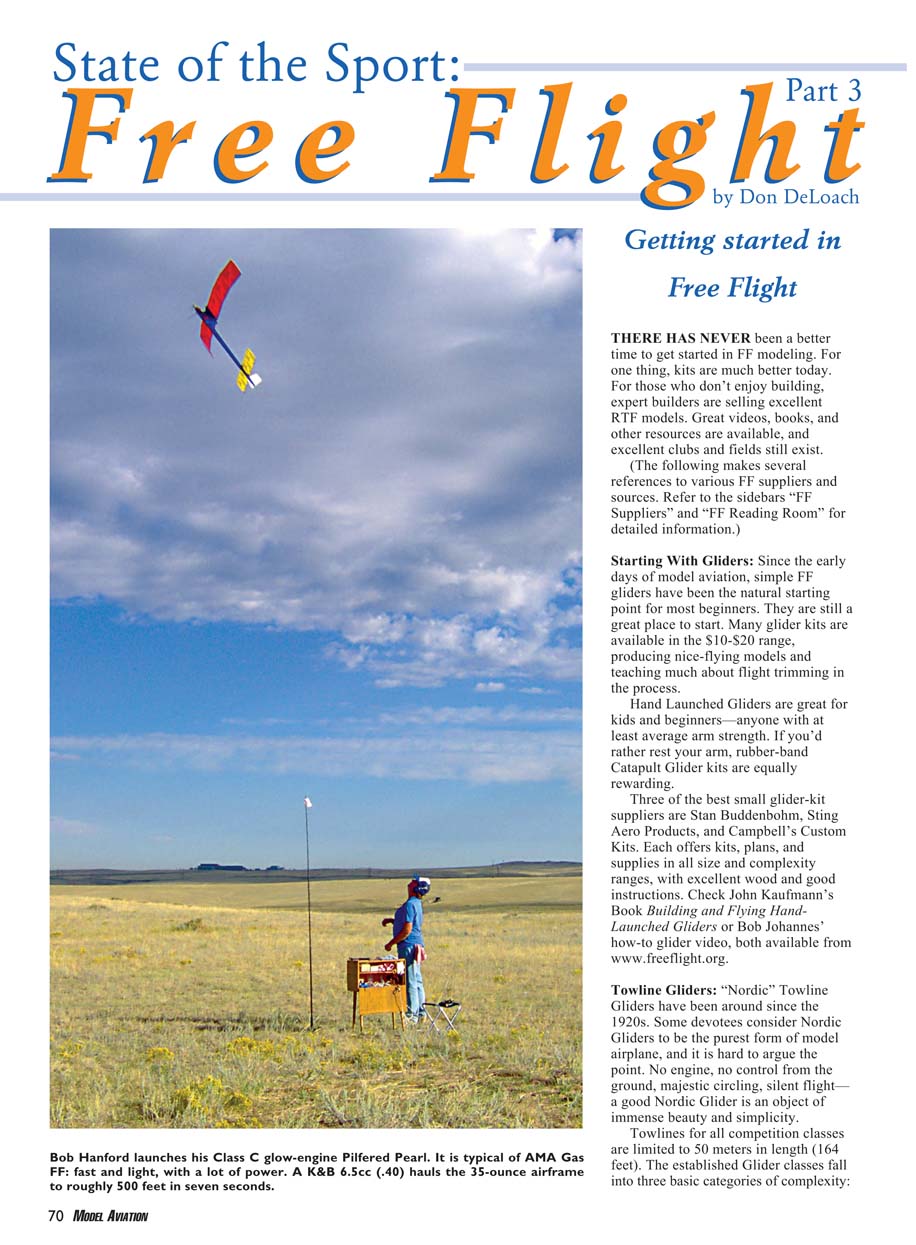
FF Gas remains popular thanks to many kits and equipment suppliers. Campbell’s Custom Kits is one of the best, offering more than a dozen kits in various sizes and many plans. BMJR Model Products, Team Satellite, and The Model Box are other excellent suppliers of gas kits.
Gas FF is basically a vertical drag race. The object is to get your model as high as possible in the allotted engine-run time (which varies from four to 12 seconds), then transition to a longer glide phase. Four to 12 seconds isn’t very long, so designs trend toward small, fast, and amply powered aircraft.
For example, a hot .049 setup has a 250–300 square-inch wing and a 6–7 ounce total weight. This type of model will attain roughly 400 feet of altitude on a seven-second engine run, aiming for a two-minute maximum ("max").
Typical larger models are:
- Engine Class A/B: .15–.21 cu. in. displacement engine, 450–600 square-inch wing area, 18–25 ounces.
- Engine Class C/D: .35–.65 cu. in. displacement engine, 700–1,200 square-inch wing, 35–60 ounces.
Gas models are among the best-performing FF airplanes. One look at the AMA national records list will confirm this. The current record in Class A Category I is 105 minutes, or 43 consecutive max flights!
The ultimate in gas FF performance is found in FAI classes F1J and F1C. Both are typically high-aspect-ratio models with composite construction and top-of-the-line engines.
- F1J is for 1 cc (.061) power with no weight minimum.
- F1C is the World Championships class, with 2.5 cc (.15 cu. in.) power and a minimum weight of 750 grams.
F1C is extremely demanding (high minimum wing loading) but offers amazing performance. The best F1Cs today have wingspans in excess of 100 inches and climb to incredible altitudes on scant five-second engine runs. F1C maxes are three minutes, but a good F1C model will glide for five to 10 minutes in calm air. Because of this, flyoffs (overtime) are often held at sunrise or sunset when thermal activity is nil.
Current state of the art in ultra-high-performance F1C is the folding-wing model. Long wings glide better but have more drag in the climb; folding the wings for the climb and unfolding them at the top yields a higher climb and a better glide. Folding-wing F1Cs have been developing since the 1960s; in 2003 an F1C folder finally won the World Championships. Since then, many top competitors have adopted at least one folder.
Beginning FF gas flying
Getting started in gas FF is fairly easy if you’ve had any experience with glow engines. The main challenges are making your engines run consistently and learning the fine art of gas-FF trimming.
There are roughly three kinds of gas FF models: those with no auto surfaces (also called "lockdown" or Classic Gas); those with variable-incidence tail and auto rudder (VIT and AR) only; and bunters (VIT, AR, and a one-quarter outside loop after engine shutoff).
Typical starter models for Classic Gas are the Mini Pearl 1/2A from Campbell’s Custom Kits or Jim O’Reilly Model Plans, the Satellite series from Team Satellite, or any of the Nostalgia series from BMJR. Kits from The Model Box are also excellent.
If you want to jump into FAI gas flying without building, you can purchase an RTF F1J model for as little as $500. Check out glideTEK, Vasily Beschasny, W-Hobby, or International Model Group for F1J models. The best .061 engine currently available is the Cyclon from Doug Galbreath. Most modern F1Js are designed around it.
For a longer discussion, see my article in the 2004 NFFS Symposium “Beginning FF Power: A Journey” or get the NFFS video by Bob Johannes. Most important, understand that flying FF gas requires a healthy respect for fast-moving engines and models.
These airplanes are spectacular when things go right but can be quite dangerous when things go wrong. Minimize danger by having an experienced flier close by when you are starting out. Hearing protection is a must since FF engines have no mufflers and run at full throttle. Always test-fly and practice on secluded fields with no spectators; the models are much safer later, when they have been trimmed.
FF Scale
FF Scale today is dominated by the Flying Aces Club (FAC). FAC has its own rule book and many AMA-sanctioned contests across the U.S. and worldwide. Most scale meets in the U.S. today are run to FAC Scale and flight rules rather than AMA rules.
FAC's core mission is to preserve the traditional stick-and-tissue building philosophy embodied in 1930s model aviation. There are huge yearly FAC contests at Geneseo, New York (Historical Air Group field), and the AMA field in Muncie. The highlight of attending an FAC meet is seeing a master fly a multiengine scale subject detailed to the last rivet.
Most FAC Scale models have wingspans ranging from 1 to 3 feet and are rubber powered, but larger models and electric and CO2 engines are also used. For a rule book and a year’s worth of great newsletter, send $15 to FAC-GHQ, 3301 Cindy Ln., Erie PA 16506.
There are more FF categories and events than listed here: Payload, Cargo, Rubber Speed, rocket power, Slope Soaring Glider, CO2, electric, and even compressed air. Most of those aren’t flown very often, but their existence underscores the diversity of the FF experience.
Large or small, low-tech or high-tech—if chasing models soaring free in lazy circles gets your blood pumping, you’ll likely become one of us: a rare breed called the free flighter. Join us!
Don DeLoach [email protected]
Transcribed from original scans by AI. Minor OCR errors may remain.

